

Overwhelmed by strike, San Francisco schools found the money for top union demands

by Danielle Smith
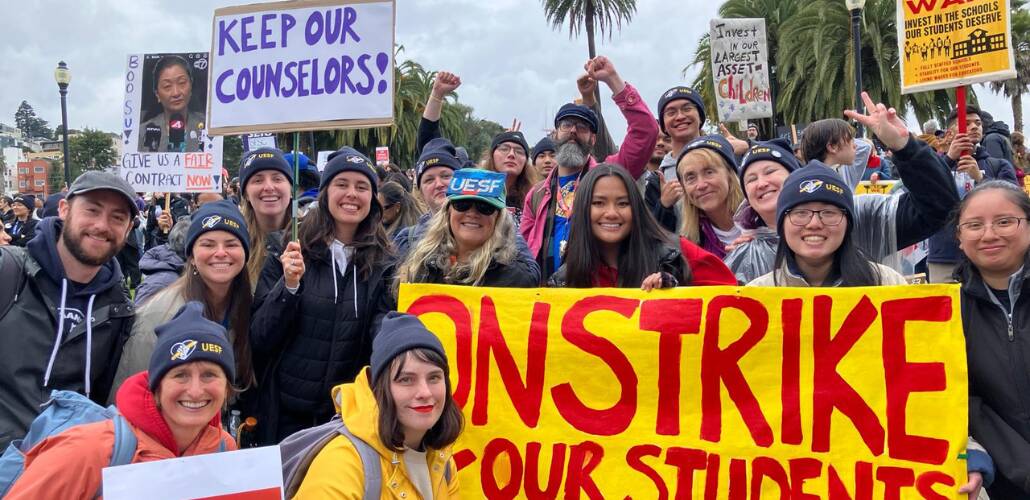
Six thousand San Francisco educators won fully funded health care, sanctuary schools and an up to 8.5% raise over two years by walking out for the first time in nearly 50 years.
After just four days on strike, Feb. 9 to 12, they won their top demands — some of which the district had previously refused even to bargain over.
“It was hard and it was joyful and we f-ing beat them,” said Ilan Desai-Geller, a high school teacher who served on the bargaining committee and as a regional strike captain. “They found the money all of a sudden.
“They found the money for the things they said they couldn’t. They agreed to the language they said they couldn’t.”
Workers in classified roles, such as paraeducators, will get a raise of 8.5% over the two years of the contract; workers in certificated roles, such as teachers, will get 5%.
Next up will be Los Angeles, where 35,000 educators are poised to strike on April 14 alongside 30,000 members of SEIU Local 99, such as cafeteria workers, custodians, bus drivers and special ed assistants.
In San Francisco, other union workers including principals, custodians and lunchroom staff joined educators on the picket line in a sympathy strike.
United Teachers Los Angeles and United Educators of San Francisco are part of We Can’t Wait, a statewide campaign by more than 30 California Teachers Association locals, with a shared platform calling for smaller class sizes, more resources for schools instead of layoffs, and competitive wages and benefits to address the thousands of vacancies in California’s public schools.
The locals also agreed to escalate along a common timeline. Across the bay from San Francisco, Richmond Teachers United also struck this year, for the first time ever, and won 8% raises over two years. Two locals in the Sacramento area also struck; one of them, Twin Rivers Educators United, stayed out for 12 days and won 7% raises over two years.
Years in the making
The San Francisco strike success was five years in the making, as the union worked to develop an elected committee at each school. The committee focused on problems within the school, but also kept in touch with the larger union.
There were meetings bringing together all the elementary school committees, for instance, and all the middle and high school committees, and a citywide general assembly. Activists from different schools got to know each other and saw what issues they had in common.
“Once we start getting more sites with union building committees, then there’s more conversations happening at each site, there’s more information getting shared to each member,” said Alanna Merchant, who teaches sixth- and seventh-grade science.“I feel like that was how all of this started.”
From these building committees came many of the strike captains and 120 members of the bargaining committee, Merchant among them.
Paraeducator Faith Avalos said that building to a strike took a lot of conversations with her co-workers, asking questions like, “How do you feel about the district right now?”
“It was issues-based, but a lot of it was just, do you feel supported at your job by the district? Do you feel they could be doing a better job?” said Avalos, who would become a strike captain.
Schools held their own strike votes and practice pickets. The union asked rank and filers who were organizing in their own schools to go help out other worksites too, Merchant said, and this developed into a network of regional strike captains like her, who helped support the strike captains.
Outside the bargaining room
The strikers picketed at schools in the mornings, then gathered for larger community actions in the afternoons.
Strike captains were responsible for turning out members to picket and keeping track of participation. Each picket also had an attendance person, a communications person and chant leaders — everyone had a role.
At Avalos’s middle school in northern San Francisco, art teachers made custom banners and painted the sidewalks. Two workers made custom signs with a picture of Superintendent Maria Su crying that said: “Boo Su.”
When middle school students came out to show support, the strikers taught them how to lead chants and walk the picket line and explained why they were taking action.
“Middle school students don’t do anything unless you tell them they have to do it, but we had a bunch of students show up [on their own initiative],” Avalos said. “They were the most energetic. They drew hopscotch, but you were jumping on Donald Trump and Elon Musk’s faces. They made signs that were like ‘Teachers can’t survive on only apples.’”
Avalos’ middle school was one of the sites where the district chose to send scabs from human resources, so small groups of strikers covered the back entrances. However, the strikers at her school mainly focused on getting support from the community. Out of a staff of about 500, only one person, who was non-union, crossed the picket line, she said.
The afternoon rallies and marches drew up to 15,000-20,000 participants, according to the union. One day they marched from a rally in Mission Dolores Park to City Hall. Another day, thousands gathered on the beach to spell out “Strike” and “For Our Students,” an impressive turnout given the “schlep to the beach,” said bargaining committee member and regional strike captain Michelle Cody.
Though the bargaining committee couldn’t always attend them, those actions gave them the morale boost they needed to keep going and the leverage to win their demands, said special education paraprofessional Diana Mueller, another regional strike captain and bargaining committee member.
“We filled the streets; it was incredible,” Mueller said. “And it really is true when you hear folks talk about how what happens outside the bargaining room really has an impact on what happens inside the bargaining room.”
Love letter to the city
Even though San Francisco has fewer children and parents than many other cities, the community support for the strike was strong. Local businesses provided free food, coffee and restrooms. Desai-Geller said he heard from a lot of people that it felt like a version of San Francisco they hadn’t seen for a long time.
He said gentrification and an influx of transplants in A.I.-related jobs are pushing the working class out of the city to the East Bay. Meanwhile educators were being told there was no money for public schools.
The school district had initially refused to negotiate over union demands that it claimed weren’t legally mandatory subjects of bargaining: sanctuary schools to protect immigrant students and families and extending an in-school shelter program for students who need housing, according to Desai-Geller. But ultimately, the district agreed to these demands during the strike.
Cody, who was born and raised in the city, said the strike felt like “a love letter back to San Francisco.” She got to lead chants at two of the actions and said that “one day longer, one day stronger” became like the soundtrack of the strike. She loved seeing people say “The rain be damned!” and fill the streets together, singing.
“In that moment, it was like everyone believed in what we were doing,” she said, “because it wasn’t just about us, it was about what this could mean for our city, our government. Everyone could connect with something that we were asking for. Everyone at some point had a teacher, an educator, a social worker, a para, a counselor that has impacted their lives.”

Danielle Smith is a staff writer and organizer at Labor Notes, where this story first appeared.
The post Overwhelmed by strike, San Francisco schools found the money for top union demands appeared first on San Francisco Bay View.
Source: https://sfbayview.com/2026/04/overwhelmed-by-strike-san-francisco-schools-found-the-money-for-top-union-demands/
Anyone can join.
Anyone can contribute.
Anyone can become informed about their world.
"United We Stand" Click Here To Create Your Personal Citizen Journalist Account Today, Be Sure To Invite Your Friends.
Before It’s News® is a community of individuals who report on what’s going on around them, from all around the world. Anyone can join. Anyone can contribute. Anyone can become informed about their world. "United We Stand" Click Here To Create Your Personal Citizen Journalist Account Today, Be Sure To Invite Your Friends.
LION'S MANE PRODUCT
Try Our Lion’s Mane WHOLE MIND Nootropic Blend 60 Capsules
Mushrooms are having a moment. One fabulous fungus in particular, lion’s mane, may help improve memory, depression and anxiety symptoms. They are also an excellent source of nutrients that show promise as a therapy for dementia, and other neurodegenerative diseases. If you’re living with anxiety or depression, you may be curious about all the therapy options out there — including the natural ones.Our Lion’s Mane WHOLE MIND Nootropic Blend has been formulated to utilize the potency of Lion’s mane but also include the benefits of four other Highly Beneficial Mushrooms. Synergistically, they work together to Build your health through improving cognitive function and immunity regardless of your age. Our Nootropic not only improves your Cognitive Function and Activates your Immune System, but it benefits growth of Essential Gut Flora, further enhancing your Vitality.

Our Formula includes: Lion’s Mane Mushrooms which Increase Brain Power through nerve growth, lessen anxiety, reduce depression, and improve concentration. Its an excellent adaptogen, promotes sleep and improves immunity. Shiitake Mushrooms which Fight cancer cells and infectious disease, boost the immune system, promotes brain function, and serves as a source of B vitamins. Maitake Mushrooms which regulate blood sugar levels of diabetics, reduce hypertension and boosts the immune system. Reishi Mushrooms which Fight inflammation, liver disease, fatigue, tumor growth and cancer. They Improve skin disorders and soothes digestive problems, stomach ulcers and leaky gut syndrome. Chaga Mushrooms which have anti-aging effects, boost immune function, improve stamina and athletic performance, even act as a natural aphrodisiac, fighting diabetes and improving liver function. Try Our Lion’s Mane WHOLE MIND Nootropic Blend 60 Capsules Today. Be 100% Satisfied or Receive a Full Money Back Guarantee. Order Yours Today by Following This Link.


| Visits: | 1,805,230,276 |
| Stories: | 8,640,559 |
Whistler Blowers, Insiders

