

‘Finance Can Put Trade at Risk, Leaving the Global Economy “On the Brink” – with Developing Countries Hardest Hit’

.
The report shows that shifts in financial markets move global trade almost as strongly as real economic activity, influencing development prospects worldwide.
- Globalization is being rewired by geopolitics and policy shifts. The financial system will have to adapt to better serve the real-economy needs.
- Policy volatility is now a persistent challenge for trade, investment and development.
- Financial shocks spill over rapidly into the real economy, revealing gaps in the global economic architecture.
- Developing economies drive global growth but face the highest financing and climate risks.
- Coordinated reforms linking trade, finance, debt and climate action can restore stability and recentre development.
UN Trade and Development (UNCTAD) Secretary-General Rebeca Grynspan said the findings show how financial conditions increasingly determine the direction of global trade.
“Trade is not just a chain of suppliers. It is also a chain of credit lines, payment systems, currency markets and capital flows.”
Global trade rose by about 4 per cent early in 2025, driven in part by firms accelerating imports ahead of tariff changes, but also by structural shifts: services are expanding faster, supported by growth in the digital economy and AI, and South–South trade is growing above average.
Beneath these factors, underlying trade growth is estimated at between 2.5 and 3 per cent and is expected to ease further as financial conditions influence production and investment decisions more strongly.
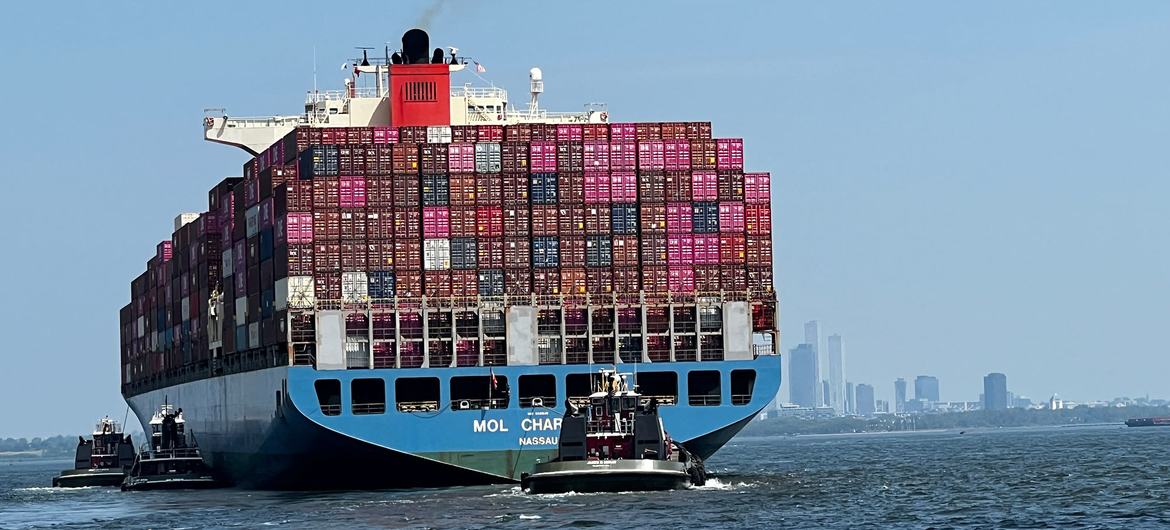
More than 90 per cent of global trade depends on bank finance. Dollar liquidity and cross-border payment systems are also crucial for international trading activities.
This deep reliance on financial channels makes trade closely linked to global financial and monetary conditions. A shift in interest rates or investor sentiment in a major financial centre can affect trade volumes worldwide.
For developing countries, where access to affordable credit is limited, these financial pressures can undermine otherwise viable trade transactions.
The report also highlights the increasing role of financial factors of commodity markets, particularly in essential food systems. For several major food trading companies, more than 75 per cent of income now stems from financial operations rather than the physical movement of goods.

Developing economies face mounting pressures
Developing economies are forecast to grow by 4.3 per cent, significantly faster than advanced economies.
But they face higher financing costs, greater exposure to sudden shifts in capital flows and rising climate-related financial risks. These factors limit the fiscal and investment space needed to sustain growth.
The global South accounts for more than 40 per cent of world output, nearly half of global merchandise trade and more than half of global investment inflows.
Yet its role in global financial markets remains limited. Excluding China, developing countries represent only about 12 per cent of global equity market value and around 6 per cent of global bond issuance.
Because their domestic financial markets are small, many developing economies rely on external borrowing at significantly higher cost. Borrowing rates of 7 to 11 per cent are common, compared with 1 to 4 per cent in major advanced economies.
These elevated costs often reflect structural issues in the international financial architecture rather than economic fundamentals, reducing long-term investment and slowing growth.
Climate vulnerability adds to financial pressures. Countries repeatedly exposed to extreme weather now pay an estimated 20 billion dollars more each year in interest because lenders perceive them as riskier.
Since 2006, these additional premiums have cost climate-vulnerable economies about 212 billion dollars – resources that could have supported social investment or climate adaptation.
Dollar dominance continues to anchor global finance
Despite gradual diversification of international reserves, the dollar remains central to global finance. Its share of international payments through SWIFT has risen from 39 per cent to about 50 per cent in five years.
The United States also accounts for half of global equity market value and about 40 per cent of global bond issuance. While this provides stability in uncertain periods, it also links developing economies to financial cycles over which they have limited influence.
Targeted reforms to restore stability and support development
UNCTAD outlines a set of practical reforms aimed at reducing financial vulnerability, improving predictability and supporting stronger alignment between trade, finance and development. The report calls for:
- Fix the multilateral trade dispute system so rules are enforced and uncertainty is reduced.
- Update trade rules for today’s economy; including services, digital trade, climate action and new industrial strategies.
- Close data gaps on trade and investment statistics to better inform and coordinate policies;
- Reform the international monetary system to limit harmful swings in currencies and capital flows.
- Strengthen regional and domestic capital markets so developing countries can raise affordable long-term finance.
- Use macroprudential tools (rules that reduce negative financial spillovers) to better protect trade and investment.
- Improve transparency in commodity trading and expand access to affordable trade finance, especially for small businesses.
Rebeca Grynspan said reconnecting trade and finance is essential for lasting stability.
“What does genuine resilience require? Integrated policy frameworks that recognize links between trade, finance and sustainability.” She added that coordinated reforms can strengthen long-term development prospects.
“Fundamentally, we cannot understand trade isolated from finance”
|
|
About UN Trade and Development (UNCTAD)
UNCTAD is the UN’s leading body on trade and development. Founded in 1964, it supports 195 member states with expert analysis, technical assistance, and serves as a platform for intergovernmental dialogue.
UNCTAD helps developing countries make trade, finance, investment, and the digital economy work for inclusive and sustainable development.
RELATED:


*SOURCE: UN Trade and Development (UNCTAD). Go to ORIGINAL: https://unctad.org/press-material/unctad-finance-can-put-trade-risk-leaving-global-economy-brink-developing-countries 2025 Human Wrongs Watch
Source: https://human-wrongs-watch.net/2025/12/03/finance-can-put-trade-at-risk-leaving-the-global-economy-on-the-brink-with-developing-countries-hardest-hit/
Anyone can join.
Anyone can contribute.
Anyone can become informed about their world.
"United We Stand" Click Here To Create Your Personal Citizen Journalist Account Today, Be Sure To Invite Your Friends.
Before It’s News® is a community of individuals who report on what’s going on around them, from all around the world. Anyone can join. Anyone can contribute. Anyone can become informed about their world. "United We Stand" Click Here To Create Your Personal Citizen Journalist Account Today, Be Sure To Invite Your Friends.
LION'S MANE PRODUCT
Try Our Lion’s Mane WHOLE MIND Nootropic Blend 60 Capsules
Mushrooms are having a moment. One fabulous fungus in particular, lion’s mane, may help improve memory, depression and anxiety symptoms. They are also an excellent source of nutrients that show promise as a therapy for dementia, and other neurodegenerative diseases. If you’re living with anxiety or depression, you may be curious about all the therapy options out there — including the natural ones.Our Lion’s Mane WHOLE MIND Nootropic Blend has been formulated to utilize the potency of Lion’s mane but also include the benefits of four other Highly Beneficial Mushrooms. Synergistically, they work together to Build your health through improving cognitive function and immunity regardless of your age. Our Nootropic not only improves your Cognitive Function and Activates your Immune System, but it benefits growth of Essential Gut Flora, further enhancing your Vitality.

Our Formula includes: Lion’s Mane Mushrooms which Increase Brain Power through nerve growth, lessen anxiety, reduce depression, and improve concentration. Its an excellent adaptogen, promotes sleep and improves immunity. Shiitake Mushrooms which Fight cancer cells and infectious disease, boost the immune system, promotes brain function, and serves as a source of B vitamins. Maitake Mushrooms which regulate blood sugar levels of diabetics, reduce hypertension and boosts the immune system. Reishi Mushrooms which Fight inflammation, liver disease, fatigue, tumor growth and cancer. They Improve skin disorders and soothes digestive problems, stomach ulcers and leaky gut syndrome. Chaga Mushrooms which have anti-aging effects, boost immune function, improve stamina and athletic performance, even act as a natural aphrodisiac, fighting diabetes and improving liver function. Try Our Lion’s Mane WHOLE MIND Nootropic Blend 60 Capsules Today. Be 100% Satisfied or Receive a Full Money Back Guarantee. Order Yours Today by Following This Link.


| Visits: | 1,760,099,859 |
| Stories: | 8,552,323 |
Whistler Blowers, Insiders

 God's Word - 2 Corinthians Chapter 9 (Jeff Osburn) |