

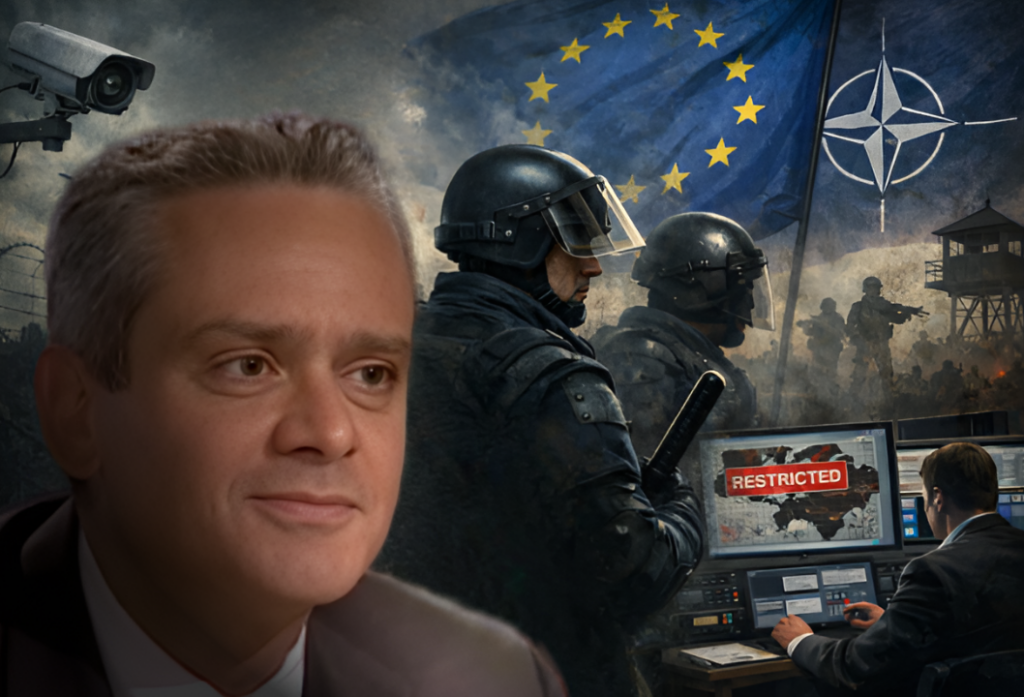
NATO’s Red Pen on Ukraine: Jacques Baud and the Silencing of Dissent

Freddie Ponton
21st Century Wire
On 15 December, the European Union took a step that few could have imagined: it sanctioned twelve individuals, including Swiss analyst and former intelligence officer Jacques Baud and French national Xavier Moreau, not for breaking the law, but for expressing views deemed politically inconvenient. Asset freezes, travel bans, and economic restrictions were imposed without any judicial process. While presented as an EU initiative, the fingerprints of NATO’s strategic communications and information-control apparatus are unmistakable, shaping both the targets and the justification. Europe is no longer simply countering disinformation; it is policing interpretation itself, turning independent analysis into a potential liability. The question now is not whether dissent will be punished, but how far these measures will go, and who will decide the boundaries of acceptable thought.
Baud, a Swiss national, is not a political activist, influencer, or anonymous online provocateur. He is a former Swiss intelligence officer and army colonel, trained in counter-terrorism, counter-guerrilla warfare, and chemical and nuclear weapons. Over the course of his career, he helped design the Geneva International Centre for Humanitarian Demining (GICHD) and its Mine Action Information Management System (IMSMA), served with the United Nations as Chief of Doctrine for Peacekeeping Operations in New York, worked extensively in Africa, and later held senior responsibilities at NATO, where he led efforts against the proliferation of small arms. He is also the author of multiple books on intelligence, asymmetric warfare, and terrorism, texts widely read well before the Ukraine war.
Yet this résumé, once considered exemplary, has now been recast as suspicious. On 15 December, the EU placed Baud under sanctions, freezing assets and restricting travel, accusing him of acting as a “spokesperson of Russian propaganda” and of participating in “information manipulation and influence.” No criminal charges have been filed. No judicial process has taken place. No evidence has been publicly tested in court. The punishment is administrative, political, and immediate.
DOCUMENT: COUNCIL DECISION (CFSP) 2025/2572 of 15 December 2025 amending Decision (CFSP) 2024/2643 concerning restrictive measures in view of Russia’s destabilising activities (Source: EUR-Lex)
European Council decision concerning restrictive measures in view of alleged Russia’s destabilising activities
This is not an isolated case. Baud joins a growing list of European journalists, analysts, and commentators sanctioned or publicly stigmatised for expressing views that diverge from official EU and NATO positions. Germans living in Russia, independent journalists, and alternative media figures have already faced similar measures. What unites these cases is not proof of coordination with Moscow, but a shared refusal to reproduce the sanctioned narrative framework through which the war must be interpreted.
From Foreign Policy to Narrative Enforcement
Officially, these sanctions are justified as defensive measures against “foreign information manipulation and interference”, a phrase now deeply embedded in EU and NATO communications. The stated objective is to protect European democracies from destabilisation. In practice, however, the definition of “manipulation” has expanded so broadly that any analysis which echoes, overlaps with, or even partially aligns with Russian positions can be deemed suspect, regardless of sourcing, intent, or transparency.
The problem is not that governments counter disinformation. Every state does. The problem is how disinformation is defined, who defines it, and what instruments are used to combat it.
In Baud’s case, the EU does not allege clandestine activity, secret funding, or covert coordination with Russian authorities. Instead, he is held responsible for contributing to a narrative environment that, in Brussels’ view, undermines Ukraine and EU security. This is a crucial shift: The target is no longer falsehood, but interpretation.
Once interpretation itself becomes sanctionable, the boundary between security policy and censorship collapses.
France’s Role, and NATO’s Shadow
Several reports indicate that the initiative to sanction Baud and eleven others originated with France. French Foreign Minister Jean-Noël Barrot publicly announced that Europe would impose sanctions on what he described as “pro-Russian agents,” including individuals accused of repeatedly influencing French and European public debate. Among those named was Xavier Moreau, a French analyst long critical of NATO policy.
Barrot’s declaration on X was unambiguous:
“At France’s initiative, Europe is today imposing sanctions against Kremlin propaganda outlets and those responsible for foreign digital interference. Zero impunity for the architects of chaos.”
The language is revealing. “Architects of chaos” is not a legal category; it is a political one. It frames speech as an act of aggression and analysts as hostile operators.
Behind this framing lies a figure little known to the public but central to the architecture of Europe’s contemporary information policy: Marie-Doha Besancenot, Senior Advisor for Strategic Communications in the French Foreign Ministry. Prior to assuming this role, Besancenot served from 2020 to 2023 as NATO Assistant Secretary General for Public Diplomacy.
In an interview published in English by the French Ministry of the Armed Forces and Veteran Affairs, in March 2025, Besancenot openly described founding a task force in late 2023 dedicated to detecting and analysing what she termed “hostile narratives,” with the capacity to alert authorities “in real time” and propose political responses. The task force’s mission, she explained, was to detect, track, and report information threats against NATO in the information domain. In this interview, Besancenot articulate how “France understood what was happening in the information domain was a matter of national security”, and speaks of Viginum, a French agency created in response to these perceived threats, and that is responsible for monitoring and protecting the state against foreign digital interference that, according to them, affects the digital public debate in France.
The continuity is striking. The doctrine developed inside NATO’s strategic communications apparatus appears to have migrated almost seamlessly into national and EU-level policy, without democratic debate, parliamentary oversight, or public consent.
Strategic Communications as Political Power
NATO insists that it does not police speech and that it respects freedom of expression. Formally, this is true. NATO does not arrest journalists or pass laws. Instead, it develops conceptual frameworks, “hybrid threats,” “information laundering,” and “foreign information manipulation”, which are then adopted by member states and EU institutions.
This is how power operates indirectly
Once a narrative framework is institutionalised, it becomes self-enforcing. Media outlets internalise red lines. Publishers hesitate. Platforms over-moderate. Governments justify extraordinary measures as technical necessities or national security. The perfect storm in which sanctions replace debate.
One of the most insidious concepts to emerge from this ecosystem is that of “information laundering”, the idea that domestic journalists or analysts can unwittingly “clean” foreign propaganda simply by engaging with it critically. Under this logic, intent becomes irrelevant. What matters is effect, as defined by strategic communicators.
This doctrine eliminates the possibility of good-faith analysis. To examine Russian claims, even to refute them selectively or partially, is to risk being accused of amplifying them. The only safe position is total dismissal, which appears to be NATO and the EU’s endgame.
The Democratic Cost
The danger of this approach extends far beyond Jacques Baud.
Sanctions are no longer being used to punish illegal acts, but to discipline discourse. They operate without due process and create chilling effects far wider than their immediate targets. An analyst does not need to be sanctioned to be silenced; seeing a peer sanctioned is often enough.
Moreover, these measures are imposed by non-elected bodies, EU councils, commissions, and advisory structures, drawing heavily on NATO doctrine, an alliance that itself is not subject to democratic accountability. National parliaments are largely absent from the process. Courts intervene only after the damage is done.
The precedent is dangerous. If today the target is analysts accused of being “pro-Russian,” tomorrow it could be critics of EU defence spending, sceptics of military escalation, or scholars questioning intelligence claims. Once the machinery exists, its scope inevitably expands.
History offers ample warning. Democracies do not usually collapse through sudden repression, but through the gradual normalisation of exceptional measures, each justified by urgency, each framed as temporary, each defended as necessary.
Security Without Freedom Is Not Security
The EU and NATO argue that they are facing unprecedented hybrid threats and that extraordinary responses are required. That claim deserves serious consideration. But security achieved by narrowing the space of permissible thought is a brittle security, one that ultimately undermines the democratic resilience it claims to protect.
A society confident in its values does not need to freeze bank accounts to win arguments. It does not need to conflate analysis with subversion. It does not need to outsource intellectual authority to strategic communications units.
Jacques Baud may be wrong in some of his assessments. He may be right in others. That is beside the point. What matters is that his arguments exist in the open, supported by sources, available for rebuttal. The appropriate response to analysis is counter-analysis, and certainly not sanctions. By choosing punishment over debate, Europe is not defending democracy. It is redefining it, quietly, administratively, and without asking its citizens whether this is the kind of polity they wish to inhabit.
The sanctions against Baud are therefore not merely about Ukraine, Russia, or NATO. They are about who gets to speak, who decides what is permissible to think, and whether Europe still trusts its citizens to judge arguments for themselves.
That question, once raised, cannot be easily swept away.
Today, we are featuring a hard-hitting article authored by Florian Rötzer and published by Overton Magazin, which examines how an established Western expert, with a long career in NATO, the UN, and intelligence analysis, has been transformed into a political liability for refusing to conform to the approved narrative on Ukraine. Rötzer situates Baud’s case within a wider campaign to police Europe’s information space, arguing that the EU is no longer debating uncomfortable analyses but blacklisting them, with far-reaching consequences for freedom of expression and democratic accountability…
Florian Rötzer reports for Overton Magazin…
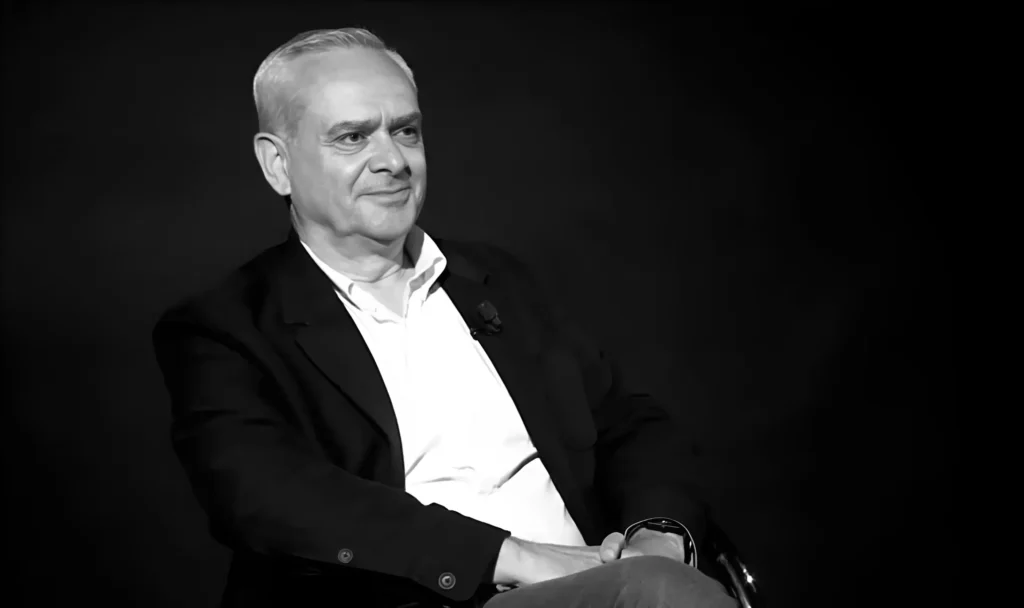
EU sanctions Jacques Baud: “Spokesperson of Russian propaganda”
The EU is growing increasingly nervous because its pro-Ukraine and anti-Russian policies threaten to become a disaster. The institutions and states are apparently so unstable that the European population now needs protection not only through banning numerous Russian media outlets and journalists, but also through sanctioning Western European journalists and authors who provide information critical of the EU and NATO. In May, Germans living in Russia, Thomas Roeper and Alina Lipp, were placed on the sanctions list . The new sanctions list, dated December 15, now also includes the Swiss national Jacques Baud, a bestselling author, former army officer, and analyst for the Swiss intelligence service, as well as an employee of the United Nations and NATO in Ukraine. He is accused of being a “mouthpiece for pro-Russian propaganda” and spreading conspiracy theories.
Apparently, there is growing fear within the EU that the propagated narrative regarding Russia and Ukraine is eroding, especially now that Washington, under Trump, wants to end the war and the military situation is deteriorating for Ukraine. The initial slogan was that Ukraine had to win the war, which quickly revealed itself to be a proxy war between Russia and NATO. This was followed by the assertion that it could not lose, a point still implied in the phrase “just peace.” While the initial goal was to weaken Russia so that it would withdraw its troops from Ukraine, including Crimea, the current strategy is simply to resist Russia’s demand for the withdrawal of Ukrainian troops from the Donetsk region and to insist on a stalemate on the front line. NATO membership has now been forgotten, although the demonstrative and uncompromising promise of it was a key justification for the war from the Russian perspective.
Since at least 2014, an information war has been waged between NATO and Russia. Since Trump’s second presidency, Washington has focused on controlling and purging the American information space against government critics and media outlets. The threat of Russian influence operations, a key focus of Democratic policy, is no longer a major concern in light of the rapprochement. However, it remains a concern within the EU, which, along with NATO, attempts to combat the information space through strategic communication—that is, influencing the population—and through the purported fight against disinformation.
The EU’s East StratCom Task Force (ESCTF) is intended to influence the population in Eastern Europe in favor of the EU. EUvsDisinfo is meant to counter disinformation—not disinformation from NATO or Western governments/media, of course, but only that labeled as pro-Russian or pro-Kremlin, i.e., Foreign Information Manipulation and Interference (FIMI). Anything not categorically aligned with the EU and NATO’s interests against Russia, or not automatically dismissing everything said in Russia as disinformation, is considered pro-Kremlin or pro-Russian, and thus ultimately seen as manipulation in the service of the Russian state.
The firewall is being built
One gets the impression that the EU is now lashing out wildly to protect its narrative and strategy by increasingly narrowing the political discourse. Jacques Baud may make some false or debatable statements, as is also the case in pro-Ukrainian circles, but he certainly doesn’t operate in secret. Instead, he argues in his books with numerous pieces of evidence and arrives at conclusions that can actually be more Kremlin-friendly than is typical in the Western mainstream. He deliberately avoids using Russian sources. Therefore, one can engage with his statements in a completely rational and argumentative manner.
But this is apparently already seen as dangerous in the EU, which is why the sanctions—let’s call it censorship—are suggested by the claim that expressing any understanding of Russian politics must mean being a “mouthpiece” for the Russian government. This is a common tactic: anyone labeled pro-Russian, even if their relationship to Russia, the EU, and NATO differs from the official narrative, is immediately considered to be paid by Russia, an agent, a proxy, or a member of the fifth column.
He is accused, in particular, of blaming Ukraine for “staging its own invasion in order to join NATO.” There is no evidence for this claim. It likely refers to a 2019 interview Baud mentioned with military expert Arestovich , who subsequently became a popular presidential advisor and was ultimately dismissed by Zelenskyy in early 2023 due to disagreements over the war .
Arestovich declared at the time, still very much in line with the European narrative, that Putin wanted to restore the Soviet Union: “The probability that our price for joining NATO is a major war with Russia is 99.9%. And if we don’t join NATO, we will be annexed by Russia within 10-12 years. Now we have to decide.” He added that “a major war with Russia and the transition to NATO as a consequence of victory over Russia” would be better. This can be interpreted as implying that Ukraine wanted to provoke war. However, Baud doesn’t say this.
Continue reading this article here…
READ MORE EU NEWS AT: 21st CENTURY WIRE EU NEWS FILES
SUPPORT OUR INDEPENDENT MEDIA PLATFORM – BECOME A MEMBER @21WIRE.TV
VISIT OUR TELEGRAM CHANNEL
21st Century Wire is an alternative news agency designed to enlighten, inform and educate readers about world events which are not always covered in the mainstream media.
Source: https://21stcenturywire.com/2025/12/17/natos-red-pen-on-ukraine-jacques-baud-and-the-silencing-of-dissent/
Anyone can join.
Anyone can contribute.
Anyone can become informed about their world.
"United We Stand" Click Here To Create Your Personal Citizen Journalist Account Today, Be Sure To Invite Your Friends.
Before It’s News® is a community of individuals who report on what’s going on around them, from all around the world. Anyone can join. Anyone can contribute. Anyone can become informed about their world. "United We Stand" Click Here To Create Your Personal Citizen Journalist Account Today, Be Sure To Invite Your Friends.
LION'S MANE PRODUCT
Try Our Lion’s Mane WHOLE MIND Nootropic Blend 60 Capsules
Mushrooms are having a moment. One fabulous fungus in particular, lion’s mane, may help improve memory, depression and anxiety symptoms. They are also an excellent source of nutrients that show promise as a therapy for dementia, and other neurodegenerative diseases. If you’re living with anxiety or depression, you may be curious about all the therapy options out there — including the natural ones.Our Lion’s Mane WHOLE MIND Nootropic Blend has been formulated to utilize the potency of Lion’s mane but also include the benefits of four other Highly Beneficial Mushrooms. Synergistically, they work together to Build your health through improving cognitive function and immunity regardless of your age. Our Nootropic not only improves your Cognitive Function and Activates your Immune System, but it benefits growth of Essential Gut Flora, further enhancing your Vitality.

Our Formula includes: Lion’s Mane Mushrooms which Increase Brain Power through nerve growth, lessen anxiety, reduce depression, and improve concentration. Its an excellent adaptogen, promotes sleep and improves immunity. Shiitake Mushrooms which Fight cancer cells and infectious disease, boost the immune system, promotes brain function, and serves as a source of B vitamins. Maitake Mushrooms which regulate blood sugar levels of diabetics, reduce hypertension and boosts the immune system. Reishi Mushrooms which Fight inflammation, liver disease, fatigue, tumor growth and cancer. They Improve skin disorders and soothes digestive problems, stomach ulcers and leaky gut syndrome. Chaga Mushrooms which have anti-aging effects, boost immune function, improve stamina and athletic performance, even act as a natural aphrodisiac, fighting diabetes and improving liver function. Try Our Lion’s Mane WHOLE MIND Nootropic Blend 60 Capsules Today. Be 100% Satisfied or Receive a Full Money Back Guarantee. Order Yours Today by Following This Link.


| Visits: | 1,765,312,881 |
| Stories: | 8,560,148 |
Whistler Blowers, Insiders

