

Pardons, Threats, and Carbon Markets: The Foreign Hands Shaping Honduras’ Vote

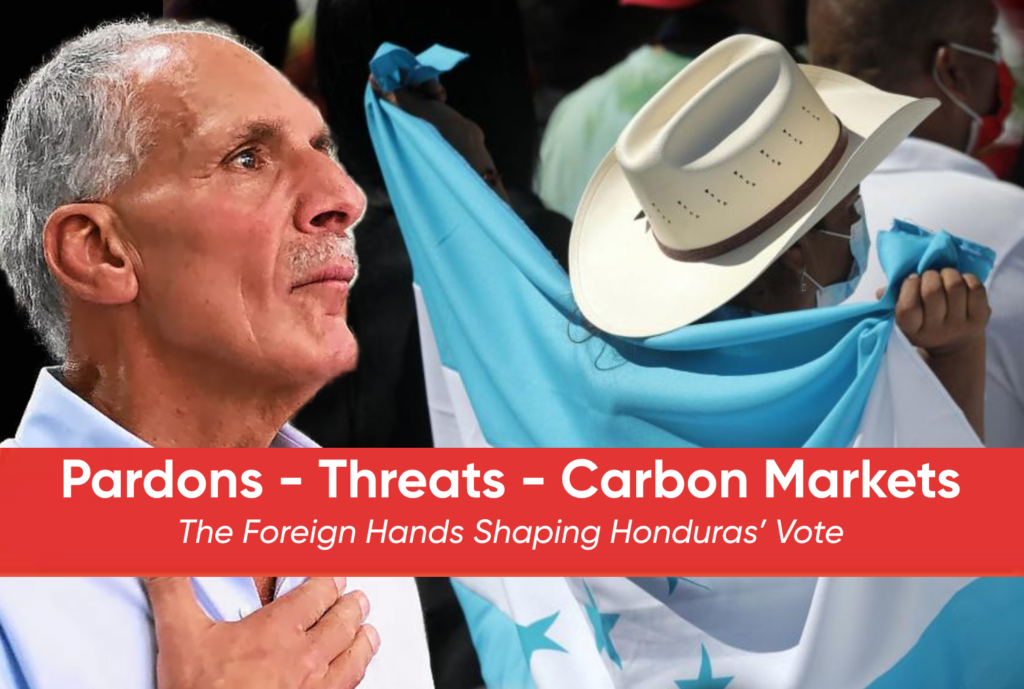
Honduras entered its election season bracing for the familiar turbulence of a close race, but few expected the campaign to be jolted by a foreign intervention as blunt as the one delivered from a stage in the United States. With partial results showing Nasry “Tito” Asfura edging ahead of Salvador Nasralla by only a fraction of the vote, and Rixi Moncada trailing behind, the country found itself caught between its own democratic contest and the gravitational pull of American power. Early returns, with only a portion of polling stations counted, placed Asfura at roughly 40–41 percent, Nasralla at about 39 percent, and Moncada near 19–20 percent, a razor-thin spread in which even a whisper from abroad could shift the atmosphere, let alone the full-throated intervention that followed.
The intervention came in the form of a threat wrapped in a promise. Donald Trump, speaking with the authority of a sitting U.S. President sprinting to the midterm elections, announced that he would pardon former Honduran president Juan Orlando Hernández, currently imprisoned in the United States for drug trafficking, if Hondurans delivered victory to Asfura. Ironically, Trump’s pledges to help “Tito” fight his opposition, which he characterises as “narcocommunists”, while warning that U.S. financial aid to Honduras could be cut if voters dare to choose otherwise. It was the kind of political pressure and hypocrisy usually applied behind closed doors, now broadcast with theatrical confidence. The message to Hondurans was unmistakable: vote for the candidate Washington prefers, and the United States will reward you; defy it, and you may lose critical funding.
Civil society groups reacted with a mix of alarm and weary recognition. Honduras has long experienced political and economic pressure from abroad, but the brazenness of this episode revived painful memories of earlier eras of intervention. International NGOs, from European election monitors like Global Exchange and Transparency International, issued statements warning that the campaign environment had been contaminated by outside actors whose power dwarfed that of Honduras’ democratic institutions. Observers emphasized that such pressure does not need to be covert to be destabilising; when a foreign leader publicly conditions aid on an election outcome, the democratic process becomes distorted before a single vote is counted.
Running parallel to this diplomatic turbulence were deeper concerns about the interests positioned to influence Honduras’ future economic direction. Among them was a set of allegations, highlighted in an investigative report by Unlimited Hangout, pointing to an international organization called CC35. The reporting described CC35 as an NGO promoting an Inter-American carbon market and a sweeping “smart grid” initiative for the western hemisphere, ventures that could generate enormous streams of carbon-credit revenue and energy-infrastructure contracts. The article noted Asfura’s role as a director within the organization, suggesting that the outcome of this election could determine whether Honduras becomes a key node in a network of climate-finance and technology projects backed by powerful private and philanthropic actors. The potential implications are vast, touching on land management, energy sovereignty, and the monetization of natural resources, and nature itself.
The Trump and Milei-backed candidate in today’s presidential elections in Honduras, Nasry Asfura, is a director of a globalist NGO called CC35 that is aiming to impose an Inter-American carbon market and “smart grid.” It is basically the Latin American equivalent of Michael… pic.twitter.com/kLHKPx41Pr
— Whitney Webb (@_whitneywebb) November 30, 2025
What the Trump administration and mainstream media will avoid mentioning is the story of Nasry Asfura, and how he became embroiled in a political scandal in Honduras after being named in the Pandora Papers, which highlighted his supposed connections to dubious offshore financial dealings. Asfura also faced charges of money laundering and embezzlement, but these allegations were dismissed by Asfura’s successor, Jorge Aldana, who, back in 2022, served as the president of CC35.

.
What cannot be dismissed so easily is the unmistakable pattern now visible to Hondurans, including foreign political power pressing down from one direction, transnational business interests hovering from another, and a fragile electoral process caught in between. Trump’s threat to withdraw U.S. financial aid unless his preferred candidate wins amplifies the pressure already felt by a nation grappling with poverty, migration, and governance challenges. The suggestion that its economic survival may depend on aligning with an external power strikes at the heart of national sovereignty.
In the final stretch before the vote, Washington’s posture toward Honduras took on a tone that felt eerily familiar to many Hondurans. A flurry of anti-“communist” warnings, from fiery U.S. congressional hearings to op-eds and official-adjacent social-media posts, revived the same ideological script used to justify the 2009 coup. In a hearing led by Rep. Maria Elvira Salazar, the election was framed not as a democratic choice but as a bulwark against creeping “Castro-Chavismo,” with the chairwoman invoking Cuba and Venezuela as cautionary specters and suggesting the Honduran military had once “saved” the country, and might be expected to do so again. The Wall Street Journal joined the chorus with an op-ed warning that “Venezuela aims to gobble up Honduras,” a phrase that reduced the nation’s electoral process to a geopolitical chess move. As even messaging from inside the U.S. foreign-policy apparatus echoed this tenor, casting the election as a struggle to prevent Honduras from drifting toward authoritarianism, as if any government outside Washington’s preferred orbit were inherently suspect.
For Hondurans who lived through 2009, the synchronization was unmistakable: the same domestic elites, the same foreign voices, the same alarmist vocabulary, all resurrected in time to influence another pivotal vote. The choreography of this rhetoric, amplified across hearings, editorials and official channels, revealed not a principled concern for democracy but an enduring strategy of red-scare politics designed to tip the scales of Honduran sovereignty before ballots were even counted.
For voters, the stakes feel both immediate and structural. The next government will oversee decisions about energy policy, resource management, foreign investment, and international financing, decisions that will shape the country long after campaign banners are taken down.
The clarity that lies ahead depends on several factors: the integrity of the final vote count, the resolve of Honduran institutions to enforce electoral norms, and the willingness of international observers to speak candidly about what they witnessed. It also depends on continued investigative scrutiny into organisations like CC35, whose roles and backers must be understood.
VIDEO: The president of the CC35, Nasry Asfura, gives his speech at the COP26 in Glasgow on behalf of all the subnational governments of the planet before the United Nations Framework Convention on Climate Change (UNFCCC) as part of The Local Governments and Municipal Authorities Constituency (LGMA). (Source: CC35)
.
Yet one reality has already surfaced: this election is not merely a competition among Honduran candidates. It has become a confrontation between a nation striving to make its own choices and the powerful actors, political and corporate, that believe they have a right to shape those choices.

Mark Goodwin and Whitney Webb report for Unlimited Hangout…
Debt From Above: The Carbon Credit Coup
Latin America is quietly being forced into a carbon market scheme through regional contractual obligations – enforced by the satellites of a US intelligence-linked firm – which seeks to create an inter-continental “smart grid,” erode national and local sovereignty, and link carbon-based life to the debt-based monetary system via a Bitcoin sidechain.
Sweeping across the shores of Latin America comes a scheme from some of the most predatory figures in the venture capital ecosystem of the United States. It is a brazen attempt to assert foreign influence across Latin America and threatens to reshape the very fabric of the region and the day-to-day lives of its people. At its core is a serpentine set of contractual obligations, held at the municipal level, cast throughout Central and South America, upheld by an intelligence-linked satellite company, and controlled by a private sector consortium of green-washed financiers aiming to turn the region’s forests into equity and carbon credits. At the same time, it obliges local governments to spend “conservation” funds on projects that further financialize nature and aid the construction of an inter-continental “smart” grid. One of its key ambitions appears to be further entrenching the debt load of the region through the multi-lateral development banks and the dollarization of the continent from the subnational level up through carbon markets upheld by a digital ledger. What seems like a technological marvel aimed at progress and connectivity harbors a darker agenda — one that intertwines planetary surveillance, financial predation, geopolitical maneuvering, and the domination of a resource-rich continent buried in debt.
This grand design, known by the acronym GREEN+ and conceived by stalwarts of the digital dollar and debt schemes of the private sector, has quietly taken root through a web of political entanglements at the local level. Even a key figure in the Drexel Burnham Lambert junk bond scandal plays a role. Astonishingly, every capital city of Latin America has eagerly signed on, apparently unaware of the strings attached to these seemingly benign partnerships, while a majority of municipalities in the region have also made commitments with these same groups that will push them to join GREEN+, potentially in a matter of weeks. The (hopefully) well-meaning regional governments have unwittingly paved the way for a sweeping surveillance apparatus tied to American intelligence that threatens to erode privacy and civil liberties under the guise of progress and combating the climate crisis.
Upon further observation, GREEN+’s connections reveal a disturbing narrative of financial interests melding with geopolitical ambitions. The backers of the satellite company share ties with former members of the highest offices of US financial policy and regulation alongside the key architects and profiteers of private capital creation, aiming to consolidate control over monetary flows in Latin America within the redistribution of distressed government debt from the public to the private sector. As this two-part series will show, this concerted effort is not merely about surveillance – it’s a calculated move towards further dollarization, tightening the grip of corporate and technological monopolies over the economic landscape of the Americas.
The scheme’s proponents also speak of how it will significantly advance the “economic” and “regional” integration of the Americas, invoking visions of unity while obscuring the true nature of their agenda for economic domination and stronger regional governance. Their model, eerily reminiscent of the EU’s transition from a free trade union to a bureaucratic behemoth yoked to the US through the Eurodollar, sets the stage for unelected entities to enforce policies through programmable money, enabled by smart contracts on blockchains and designed to benefit the few at the expense of the many. What materializes before us is not just a technological evolution but a quiet banker coup — one that lays the groundwork for land grabs and invasive surveillance under the guise of progress and conservation. It’s a narrative that echoes throughout history, where intelligence-linked figures and predatory financial interests converge to prey upon the Global South, leaving a trail of economic exploitation and geopolitical manipulation in their wake. What masquerades as progress for individuals and the environment at large may very well be the harbinger of a new era of subjugation and control.
THE GREEN+ PROGRAM
In 2022, several groups came together to launch the GREEN+ (Government Reduction of Emissions for Environmental Net + Gain) Jurisdictional Programme, the “first program that will monitor by satellite all subnational protected areas of the planet” and – through contracts with numerous local and state governments – propel and deepen the economic integration of the Americas through the quiet imposition of a continent-wide, blockchain-based carbon market.
GREEN+ has been piloted in a handful of Latin American cities since its founding and is due to launch globally in just a few weeks time. Most of the GREEN+ agreements with “subnational” governments have remained focused on Latin America. Per the program, the subnational agreements have established the “rules and requirements to enable accounting and crediting with GREEN+ policies and measures and/or nested projects, implemented as GHG mitigation activities,” with GREEN+ being described as “the planet’s new subnational government advisory mechanism.”
Key to the program are the services provided by GREEN+ founding member Satellogic, an Argentina-founded company closely aligned with Peter Thiel’s Palantir and Elon Musk’s SpaceX that specializes in sub-meter resolution satellite surveillance. Satellogic, a contractor to the US government and whose founders were also previously contactors for the US’ DHS, NSA and DARPA, will provide surveillance data of the entire world’s “protected areas” to GREEN+’s governing coalition, composed of the NGOs CC35, the Global Footprint Network, The Energy Coalition and other “respected stakeholders.”
According to the press release that details Satellogic’s alliance with GREEN+, the satellite surveillance data “will enable individuals, organizations, and global markets to accurately monitor the compliance of signatory jurisdictions to avoid deforestation.” However, other information in the press release reveals that forests will actually be monitored for the purpose of generating “credible” carbon credits to be traded on exchanges by GREEN+ on behalf of subnational governments. The press release also states that the GREEN+ alliance with Satellogic will “advance the future measurement of energy emissions in the most populated areas of the planet,” i.e. the surveillance of carbon emissions from space. Satellogic launched some GREEN+-affiliated satellites in 2022 as part of its pilot and is due to launch the remainder this April during Miami Climate Week. Satellogic’s past and upcoming launches of GREEN+ satellites were/will be conducted in collaboration with Elon Musk’s SpaceX, also a contractor to the US military and US intelligence agencies.

IMAGE: Satellogic Announces Exclusive Agreement with GREEN+ Jurisdictional Programme to Monitor all Subnational Protected Areas on the Planet (Source: Business Wire)
Though framed as a way to develop economic incentives to mitigate climate change, the program is based on California’s controversial and grift-prone cap and trade program and has been created (and is being implemented by) individuals and companies that are seeking to covertly dollarize Latin America and/or have deep ties to US intelligence. Its ultimate ambitions go far beyond carbon markets and seek to use satellite surveillance to enforce carbon emission levels in both urban and rural areas. It also seeks to impose a new financial system centered around energy, commodity, and natural resource “credits” that are underpinned by extensive and invasive surveillance, underscored by the motto: “Earth observation is preservation.”
The alliance that created GREEN+ includes the NGOs CC35, the Global Footprint Network (GFN), Arnold Schwarzenegger’s Catalytic Finance Foundation (CFF, formerly R20) and The Energy Coalition (TEC); the Gibraltar-based law firm Isolas; the global insurance giant Lockton; the satellite company Satellogic; the “green” blockchain company EcoRegistry; the dominant carbon credit certifier in Latin America, Cercarbono; and Rootstock (RSK), the bitcoin side-chain protocol responsible for “smart BTC.” Several members of the alliance, though how many is unclear, now operate as part of a consortium linked to a company called Global Carbon Parks, which is discussed in greater detail later in this article and now manages major aspects of GREEN+. The NGOs (i.e. CC35, GFN, CFF and TEC) involved in founding GREEN+ are those who actually govern the GREEN+ program from California.
As previously mentioned, the program takes carbon in “effectively conserved protected areas of a sub-national jurisdiction”, i.e. a city, county, province, or state/region, and converts them into carbon credits. Per the program, “these credits are traded on the [carbon] offset market, and income is deposited in a trust fund” that is controlled by GREEN+ and is known as the GREEN+ Trust. That trust is run by unspecified individuals who work for Lockton, Isolas and Rootstock. Alejandro Guerrero, head of Lockton’s Argentina & Uruguay branch, is the only publicly acknowledged member of the trust.
Another website tied to the GREEN+ initiative describes the initial process as follows:
- Public and private agreements between [a subnational] government and custodians are signed with zero upfront cost.
- Custodians trade the carbon units that are produced by the subnational governments (the public sector) signing contracts with the private sector in voluntary carbon markets.
- Those contracts signed by the subnational governments become smart contracts and carbon credits are then tokenized for traceability.
- The GREEN+ Trust holds government funds in escrow.
Subsequently, “a partial release of trust funds is made periodically during the crediting period of the jurisdictional initiative.” From this “partial release,” “a percentage operational fee” is deducted (the percentage is undisclosed in the program’s documents) and paid to the GREEN+ program while a separate (and also undisclosed) fee is also deducted “for the operation of the GREEN+ Trust.” Disbursements of what remains are made annually over a ten year period and, per graphs produced by GREEN+, those payments remain the same, fixed value even if the value of the carbon credits of the protected areas grows.
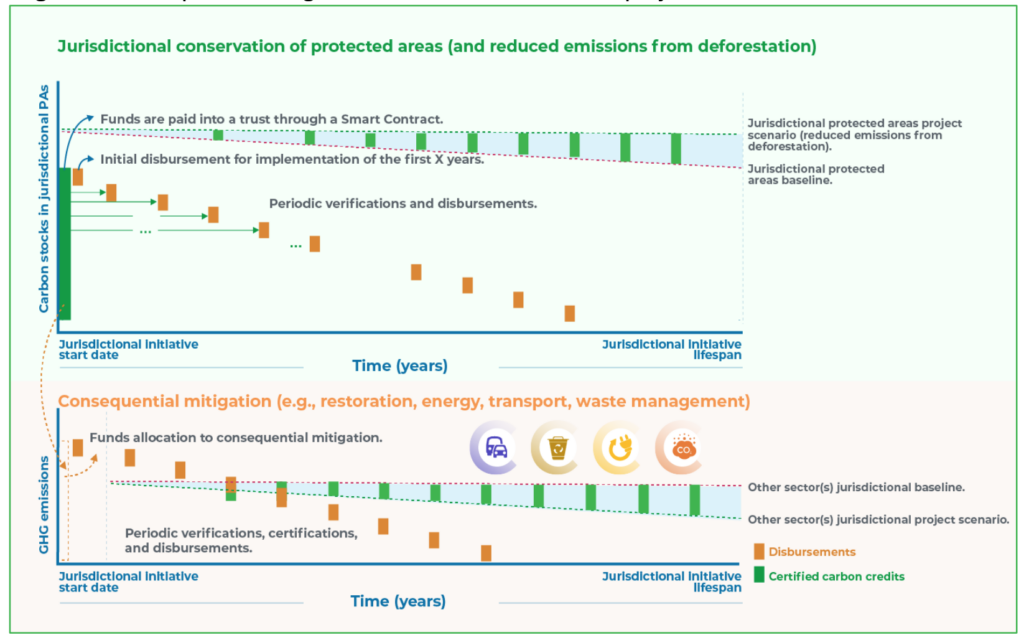
IMAGE: Figure 5. Consequential mitigation of Jurisdictional GREEN+ projects (Source: Green+)
Between 40% and 60% of the funds actually received by subnational governments can be used to “design and execute projects” aimed at conservation, while the rest “is allocated for new jurisdictional decarbonisation initiatives” that can produce additional or “consequential” carbon credits. These “consequential” credits are then “offered as a preferred option to the investors who initially purchased the conservation credits at a 50% discounted price calculated at the current market price.” However, later in the same document, the program says that “the amount required for the initial implementation” of conservation projects “may not exceed 20% of the funds allocated [from the GREEN+ Trust] to the jurisdictional initiative.” Clearly, the amount of funds actually being generated for conservation-related projects is minimal and, even in the best case scenario, is less than half of the capital generated by the carbon credits themselves. However, as we shall see, these “conservation” projects must be done in conjunction with approved partners of Global Carbon Parks, which – like the organization itself – are tied to predatory financial interests and oligarchs with questionable motives.
Continue reading this investigative report here…
See more investigative reports from Unlimited Hangout
READ MORE ELECTIONS NEWS AT: 21st CENTURY WIRE SOUTH ELECTIONS FILES
SUPPORT OUR INDEPENDENT MEDIA PLATFORM – BECOME A MEMBER @21WIRE.TV
VISIT OUR TELEGRAM CHANNEL
21st Century Wire is an alternative news agency designed to enlighten, inform and educate readers about world events which are not always covered in the mainstream media.
Source: https://21stcenturywire.com/2025/12/01/pardons-threats-and-carbon-markets-the-foreign-hands-shaping-honduras-vote/
Anyone can join.
Anyone can contribute.
Anyone can become informed about their world.
"United We Stand" Click Here To Create Your Personal Citizen Journalist Account Today, Be Sure To Invite Your Friends.
Before It’s News® is a community of individuals who report on what’s going on around them, from all around the world. Anyone can join. Anyone can contribute. Anyone can become informed about their world. "United We Stand" Click Here To Create Your Personal Citizen Journalist Account Today, Be Sure To Invite Your Friends.
LION'S MANE PRODUCT
Try Our Lion’s Mane WHOLE MIND Nootropic Blend 60 Capsules
Mushrooms are having a moment. One fabulous fungus in particular, lion’s mane, may help improve memory, depression and anxiety symptoms. They are also an excellent source of nutrients that show promise as a therapy for dementia, and other neurodegenerative diseases. If you’re living with anxiety or depression, you may be curious about all the therapy options out there — including the natural ones.Our Lion’s Mane WHOLE MIND Nootropic Blend has been formulated to utilize the potency of Lion’s mane but also include the benefits of four other Highly Beneficial Mushrooms. Synergistically, they work together to Build your health through improving cognitive function and immunity regardless of your age. Our Nootropic not only improves your Cognitive Function and Activates your Immune System, but it benefits growth of Essential Gut Flora, further enhancing your Vitality.

Our Formula includes: Lion’s Mane Mushrooms which Increase Brain Power through nerve growth, lessen anxiety, reduce depression, and improve concentration. Its an excellent adaptogen, promotes sleep and improves immunity. Shiitake Mushrooms which Fight cancer cells and infectious disease, boost the immune system, promotes brain function, and serves as a source of B vitamins. Maitake Mushrooms which regulate blood sugar levels of diabetics, reduce hypertension and boosts the immune system. Reishi Mushrooms which Fight inflammation, liver disease, fatigue, tumor growth and cancer. They Improve skin disorders and soothes digestive problems, stomach ulcers and leaky gut syndrome. Chaga Mushrooms which have anti-aging effects, boost immune function, improve stamina and athletic performance, even act as a natural aphrodisiac, fighting diabetes and improving liver function. Try Our Lion’s Mane WHOLE MIND Nootropic Blend 60 Capsules Today. Be 100% Satisfied or Receive a Full Money Back Guarantee. Order Yours Today by Following This Link.


| Visits: | 1,760,178,215 |
| Stories: | 8,552,417 |
Whistler Blowers, Insiders

