

Yair Netanyahu and the Haredi Rise in Israel’s Zionist Institutions

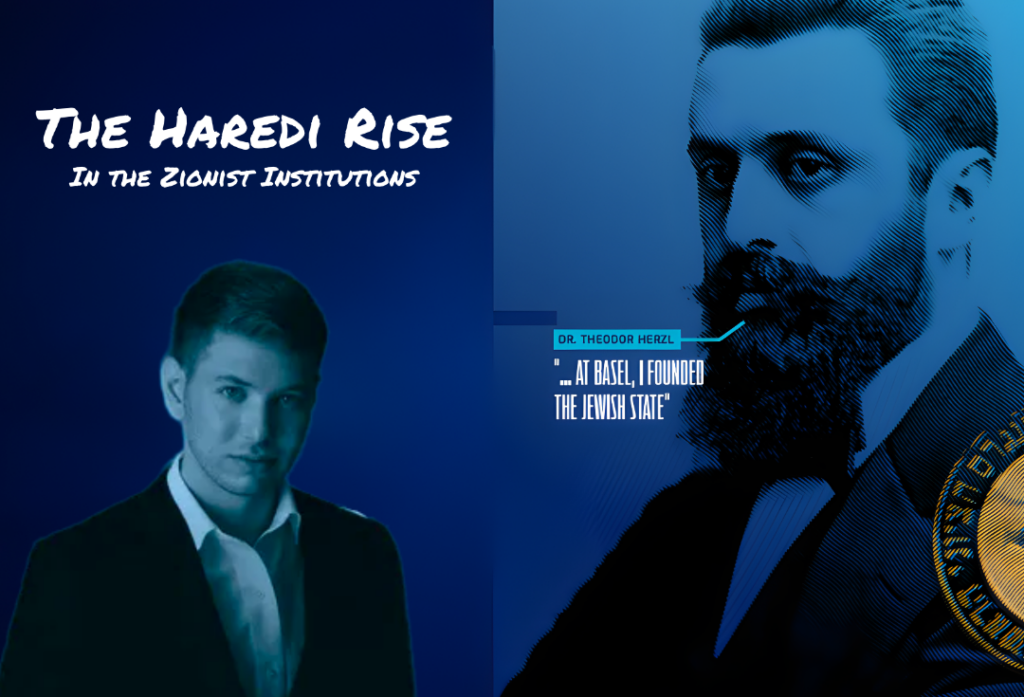
What began as a brief political scandal around the possible appointment of Yair Netanyahu, Israel’s prime minister’s son, quickly opened a window onto a much larger and largely hidden arena: Israel’s national Zionist institutions. The proposed role at the World Zionist Organisation was no ceremonial post; it came with a minister-level salary, generous benefits, and real influence over budgets and appointments. News of the potential appointment sparked a public and political backlash, with accusations of nepotism and cronyism forcing the move to be shelved. Yet the controversy exposed something deeper: a patronage system that operates far from public scrutiny, where powerful positions and tens of millions of dollars are quietly divided through coalition agreements rather than public debate.
Within this shadowed system, one development stands out. Over the past decade, and especially since 2020, ultra-Orthodox parties and figures have steadily expanded their presence in institutions whose very foundation is Zionism. Today, fundamentalist Haredi factions hold roughly 17% of the World Zionist Congress, occupy senior roles in the Jewish National Fund (JNF) and the World Zionist Organisation, and oversee growing budgets that flow to affiliated associations in Israel and likely abroad. This advance has taken place quietly, often via diaspora-based frameworks and family or party networks, even as much of Haredi society continues to publicly reject Zionist ideology and distance itself from state obligations such as military service.
The following report follows that contradiction to its source. It traces the money, the appointments, and the internal struggles—between pragmatism and belief, permission and prohibition, inside both the Haredi world and the national institutions themselves. Are the ultra-Orthodox becoming genuine partners in the Zionist project, as some of their representatives insist, or is this a calculated entry into institutions rich in land, budgets, and influence? As one senior figure inside the World Zionist Organisation puts it more bluntly: it’s not that the Haredim suddenly became Zionists, it’s that the money and the jobs were already there.

IMAGE: A Photo of Theodor Herzl, founder of the Zionist Organization, displayed during a gala event on the occasion of the 125th anniversary of the First Zionist Congress at the original venue, the Stadtcasino Basel, in Basel, Switzerland, August 29, 2022. (Source: REUTERS/Arnd Wiegmann)
Shuki Sadeh reports for Shomrim…
Have the Haredim Embraced Zionism? “They Haven’t Suddenly Become Zionists – They’re Here for the Money and the Jobs”
The controversy over the proposed appointment of Yair Netanyahu to a senior role in the World Zionist Organization has sparked a rare wave of public interest in the internal politics of Israel’s national institutions. One long-term trend that has largely escaped attention is the increasing presence of ultra-Orthodox parties in national institutions, where they now constitute 17 percent of the delegates to the Zionist Congress. Are the ultra-Orthodox becoming Zionists? Are they forging new connections with non-Haredi streams of Judaism? And what about the clause promoting IDF service? A Shomrim report
A little over a month ago, a political storm erupted over the prospect that Yair Netanyahu could be appointed to a senior position in the World Zionist Organization, accompanied by a salary equivalent to that of a government minister and other perks. The proposal focused attention on Israel’s national institutions, which tend to conduct their affairs far from the prying eye of the public or the media. In the end, the prime minister’s son was not given the position. Apart from the questionable identity of the candidate, there was nothing new in such conduct – whereby parties from all parts of the Israeli political spectrum (apart from the Arab parties) divvy up between them plum jobs with generous salaries and other perks. In late November, a new agreement was signed, with 35 senior positions up for grabs – of which 10 come with a salary equivalent to that of a minister. In this respect, the status quo has been restored, and all parties – with the exception of Yesh Atid, whose leader, Yair Lapid, opted to withdraw from national institutions – are participating. “Efforts to arrange a job for Yair Netanyahu, for members of the Deri family and for a huge group of political activists are just the tip of the iceberg of what’s going on there,” Lapid said, referring to the agreement and the allocation of positions in national institutions among political parties.
It is no coincidence that Lapid mentioned the Deri family. If there is one relatively new trend within these national institutions, which is not being subjected to much public scrutiny, it is the increased involvement of ultra-Orthodox parties in the institutions in recent years. Shas was the first of these parties to take the plunge and began taking active part in them back in 2015. Since then, it has increased its involvement. One of Aryeh Deri’s sons, Yanki, is the head of a department in the World Zionist Organization. Shlomo Deri, the brother of the Shas chairman, served until 2021 as deputy chairman of the Jewish National Fund and then served for another year as associate chairman. While neither of these positions pays a salary, they both wield massive influence in terms of real estate, the profession in which Shlomo Deri was active. Currently, he is believed to be on the verge of being reappointed to the associate chairman position he held until three years ago.
In addition to Shas, since 2020, the national institutions have seen an influx of representatives from a more separatist Haredi party – MK Moshe Gafni’s Degel Hatorah party. This is despite the sharp criticism from within the ultra-Orthodox world over the move and of any connection with organizations which have Zionism as the cornerstone of their beliefs – about which more below. This growing participation is facilitated through ties with Eretz Hakodesh, a Haredi party founded in the United States in 2020, where its founder, Rabbi Pesach Lerner, and its voter base are located. Currently, the only Haredi party that does not have a foothold in the national institutions is Agudat Yisrael (which, along with Degel Hatorah, makes up the United Torah Judaism faction in the Knesset).
“The fact that the Haredi public is joining the national institutions is a move of historic importance,” said then-JNF chairman Avraham Duvdevani at a meeting of the organization’s board of governors in November 2020, after the arrival of Eretz Hakodesh. “With the Haredi joining and with representation for every stream [of Judaism], this is the time to reopen the Religious Department, to forge a connection with synagogues from every stream and with the rabbinical public, to raise funds and so on.”
However, this is where matters become more complicated. In mainstream politics, ultra-Orthodox parties do not define themselves as Zionist and, as a result, do not view their voters as obligated to serve in the IDF. When it comes to the national and Zionist institutions, however, Zionism is very much part of the definition and essence. How do they overcome this apparent dichotomy? That depends on who you ask.
Politicians from Degel Hatorah who were involved in one way or another with Eretz Hakodesh, are now distancing themselves from any identification with Zionist institutions. This is despite the fact that, in the same year that Eretz Hakodesh was established, the now-deceased leader of the Litvak Haredi community, Rabbi Chaim Kanievsky, had given permission for his followers to take part in elections for national institutions.
“The simple answer is that people outside of Israel don’t live this conflict and don’t experience the tension that there is in Israel, like over the issue of military service,” says Yisrael Schwebel, a member of the Litvak Hasidic community who was recently elected to the board of the JNF, having served for five years as head of the Department for Periphery Advancement and Diaspora Involvement at the World Zionist Organization. “In the end, we’re all Zionists. The Haredim in Israel and those overseas. So are the settlers and the protestors on Kaplan Street. The concept of Zionist is very charged here in Israel compared to overseas. But people love the Land of Israel and want to be involved in what is happening here. The World Zionist Organization is a platform where they can feel that they are expressing their solidarity and their participation, and it’s a fantastic way. Really.”
Another source – a member of the World Zionist Organization board – does not buy Schwebel’s insistence that “we’re all Zionists.” Asked about the newly arrived ultra-Orthodox representatives, he says that, “It’s not that they have suddenly become Zionists. They’re here for the money and the jobs.
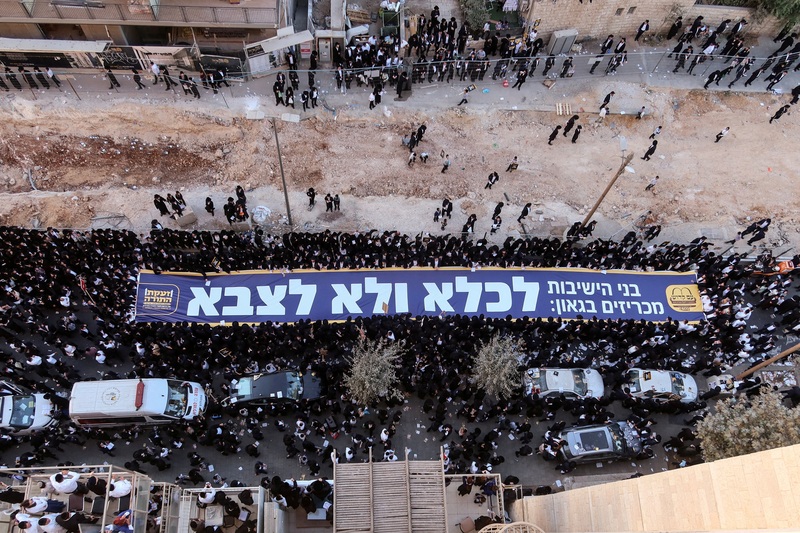
IMAGE: To prison, not to the army.” Haredi demonstration in Jerusalem against IDF conscription, October 2025. (Source: Reuters)
“People outside of Israel don’t live this conflict and don’t experience the tension that there is in Israel, like over the issue of military service,” says Yisrael Schwebel. “In the end, we’re all Zionists.”
17 percent of the Zionist Congress are Haredim
A little background before we continue. There are four bodies that are considered Israel’s national institutions: Keren Hayesod, the Jewish Agency, the Jewish National Fund (KKL-JNF) and the World Zionist Organization. All four fall under the umbrella of the World Zionist Congress, which meets every five years to elect delegates. The most recent, 39th meeting, was held in Jerusalem in October.
These delegates are divided into three categories: the first are representatives of apolitical Zionist organizations, such as Hadassah, WIZO, Na’amat, Maccabi, and so on. The second group is made up of representatives of Israeli parties, based on their relative strength in the Knesset; for each MK, they get two delegates. The third group is made up of delegates elected overseas, who are politically affiliated. For example, representatives from Likud or Meretz who are elected by Jewish communities overseas join their Israeli counterparts and make up a faction in the World Zionist Congress. In total, there are 543 delegates, and Haredi parties currently have 96 of them. This is around 17 percent of the total number of delegates, which is more or less the proportion of ultra-Orthodox in the Israeli population and slightly more than the estimates, which put the proportion of Haredim at around 14 percent, of the total global Jewish population.
The two bodies where more of the political appointments are made are the JNF and the World Zionist Organization. Calcalist recently revealed that there is a total of 146 political appointments in these two bodies alone, of which 35 are senior positions that come with terms similar to those of ministers or Knesset members; the JNF, which owns 13 percent of all the land in Israel and leases it out on long-term contracts, is the main bankroller. This year, the JNF is expected to transfer around $60 million to the World Zionist Organization, thanks to the new coalition agreement – compared to $40 million a year until now.
Another important concept to understand when it comes to the national institutions is, “streams.” As already mentioned, the Haredi stream was established in 2020 and began receiving $1.5 million from the JNF and World Zionist Organization. Now, that figure is expected to rise to $2 million for each stream, including: the Haredi stream, the Orthodox (National Religious stream), the Reform Movement, the Conservative Movement, and the new secular-Jewish stream that was recently established by the joint Yesh Atid-Meretz faction.
Whether these delegates and these streams are based in Israel or overseas, the money allocated to them eventually reaches the associations affiliated with them in Israel. In the case of Eretz Hakodesh – the American-based Haredi faction – the money goes to an association called The Haredi Movement for Torah and Tradition, which was registered in Israel in December 2020, just after Eretz Hakodesh joined the national institutions. Schwebel and his deputy, Avi Grinwald, are listed as functionaries of the association, while one of the functionaries of its sister association, Eretz Hakodesh: Torah and Tradition, is none other than Aryeh Deri’s son, Yanki.
Money started flowing to the first of these associations almost immediately. In 2021, it received 2.3 million shekels ($700,000), the following year it received 9.2 million shekels, and in 2023 it received 5.1 million shekels ($1,600,000). In its financial reports, the association does not specify the source of its income, merely mentioning “miscellaneous allocations.” At least part of its funding, however, comes from the national institutions – as Schwebel confirms. He says that the association received an annual payment of $475,000 from the World Zionist Organization and 975,000 shekels ($304,000) from the JNF. Another source inside the World Zionist Organization also confirmed to Shomrim the information about the money this association received from both institutions.
In 2021 and 2022, the Haredi Movement for Torah and Tradition had three salaried employees. One of them was Sarah Pindrus, the wife of Yitzhak Pindrus, who was a Degel Hatorah Knesset member until July of this year, when he and the other members of ultra-Orthodox factions resigned in political protest. Since 2023, the association has not had any salaried employees; the CEO, Avi Grinwald, is paid directly by the World Zionist Organization, where he is Schwebel’s deputy. Another association which received funding from both of these national institutions – WZO and JNF – is the Shas-affiliated Association for the Advancement of Haredi Jewish Values in Israel. In 2021, that association received 385,000 shekels ($120,000) from the two institutions; in 2022, it got 702,000 shekels ($200,000) and in 2023 the figure jumped to 5 million shekels ($1.5 million).
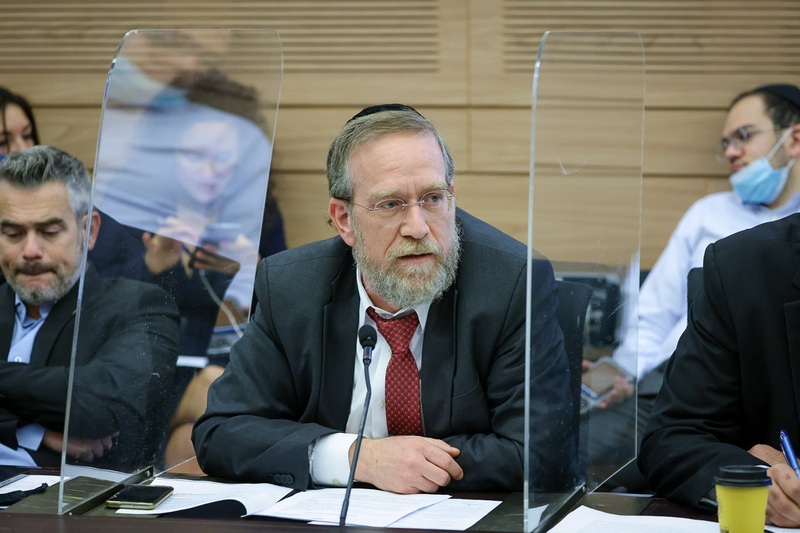
IMAGE: Former MK Yitzhak Pindrus. (Source: Noam Moskowitz, Knesset Spokesperson’s Office)
What do these Haredi associations do with the money? For the most part, that information is not available. In 2022, the Haredi Movement for Torah and Tradition spent around 6.5 million shekels ($2 million) on aid to Ukrainian Jews – around a third of that was transferred to other associations. The association invested 600,000 shekels ($187,000) in Jewish studies and another 1.2 million shekels ($375,000) in a clause listed simply as “community relations overseas.” A year later, in 2023, the association provided 1.7 million shekels ($530,000) to fund activities linked to the Gaza war, primarily assisting Israelis forced from their homes. Some 1.5 million shekels ($470,000) were spent on relations with communities overseas and around 500,000 shekels ($156,000) on distributing content.
The association affiliated with Shas also refrains from detailing what they spend their money on. According to its public records, in 2022 and 2023, it spent almost all of its allocated budget, around 2.6 million shekels and 2.4 million shekels, respectively, on “events.” In 2023, according to its reports, the association had a budgetary surplus of 2 million shekels, even though nonprofit organizations are not supposed to end the year with money in their accounts.
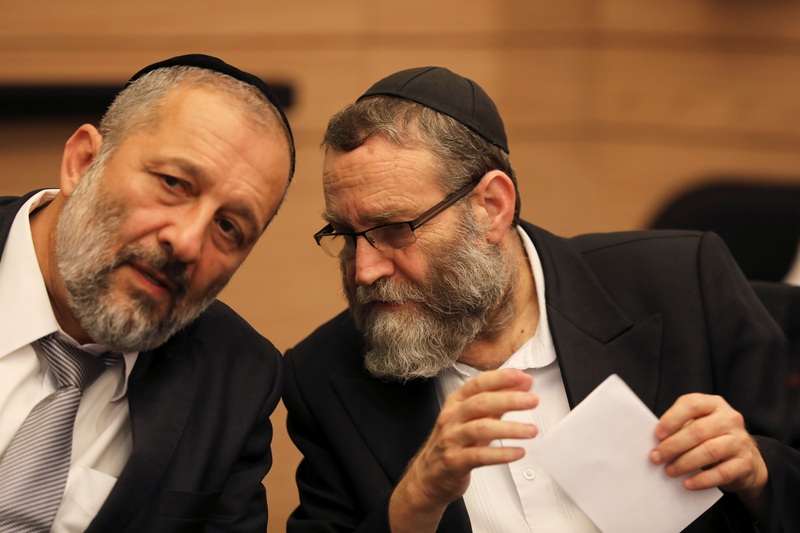
IMAGE: Degel Hatorah Chairman Moshe Gafni and Shas Chairman Aryeh Deri. (Source: Reuters)
The clause encouraging IDF recruitment
While Shas has been openly active within the national institutions for around a decade, things are a lot more complicated when it comes to Degel Hatorah. In 2023, for example, the general assembly of the JNF passed a resolution whereby any new official would have to sign the Jerusalem Program, the World Zionist Organization’s official platform, which includes clauses encouraging “recruitment and service in the Israel Defense Forces” and nurturing the “multi-faceted” character of the Jewish people. One of the two Eretz Hakodesh representatives – Shmuel Litov, who serves in a voluntary capacity as deputy chair of the JNF and head of its Education Committee – has yet to sign.
At the most recent Zionist Congress, a coalition of liberal delegates and Zionist organizations initiated and passed an amendment to the WZO constitution, whereby every member of the board of that organization or the JNF must sign the Jerusalem Program. Now that signing this document is a prerequisite for assuming a position, many within the corridors of the national institutions are asking whether Litov, who is not expected to step down from his position as deputy chair of the JNF, will also sign. Nechemya Malinowitz, the other Eretz Hakodesh representative, who is expected to succeed Schwebel as head of the Department for Periphery Advancement and Diaspora Involvement, has signed the program – perhaps because he is more closely associated with American Jewry.
In a conversation with Shomrim, Schwebel rejects accusations that the Haredim have only become active in the national institutions because of funding and jobs. “There is Haredi money in the national institutions,” he says, “but that has been built into them for decades. Haredim have become involved, so it’s just been rectified. It hasn’t harmed the other streams in the national institutions, or that everyone is getting less. There’s simply more money and now every stream gets the same.”
At the same time, Schwebel agrees that there is something absurd about the fact that money from Israeli citizens purchasing an apartment goes toward funding the national institutions. “The State of Israel has to find a solution to this issue. There’s no reason that the World Zionist Organization has a Diaspora Department as long as Israel has a Ministry of Diaspora, and that the WZO department is funded by JNF land sales. It doesn’t make sense. True, I’m not a purist; this is a game and we are playing it. But we came to get things done and to do so professionally. The two representatives of Eretz Hakodesh – Litov and I – we are professionals, and we don’t play political games. This isn’t about lucrative jobs and appointments.”
Schwebel is an accountant by training who previously worked as treasurer for the Haredi Education Department at Jerusalem Municipality, where the head of the department at the time was outgoing MK Yitzhak Pindrus. Before being appointed to his current position with the World Zionist Organization, Schwebel was vice CEO of the Olami movement, which got most of its funding from Haredi businessman Aaron Wolfson. Even today, Schwebel is listed as “additional accountant” for the Morasha Olami association, the organization’s branch in Israel.
Litov, for his part, was once an advisor to MK Moshe Gafni – the head of the Degel Hatorah party and the seemingly perpetual chairman of the Knesset’s Finance Committee – and is considered close to him to this day. Ahead of the last municipal election in Beit Shemesh, there were reports in the ultra-Orthodox press that Litov could be selected as the party’s candidate for mayor. This, of course, did not happen. Similarly, he serves on the board of the Meuhedet HMO and, until mid-2024, was director-general of Bnei Brak Municipality. Gafni’s son, Eliyahu, who, according to some reports, is active in party affairs, is employed by the JNF and, in a political appointment, serves as Litov’s assistant – just one of the so-called “positions of trust” in the national institutions.

IMAGE: KKL-JNF’s historic donation box. (Source: Shutterstock)
“In June 2022, a Haredi newspaper slammed representatives of Eretz Hakodesh for obtaining funding from the JNF for Haredi youths: “Exposed to the Zionist poison and coercion that the JNF disseminates.”
Between permission and sacrilege
Let’s return to the Haredi parties’ “Zionist conflict.” When Eretz Hakodesh was established in 2020, Kanievsky gave permission for the organization to participate in Israel’s national institutions. Since then, however, there have been voices in the Ashkenazi Haredi community that have been sharply critical of that decision and it appears that the criticism is intensifying. For example, in June 2022, a Haredi newspaper called The Voice of Education slammed representatives of Eretz Hakodesh for obtaining funding from the JNF for Haredi youths, citing concerns that “hundreds of thousands of Haredi youths across the country will be exposed to the Zionist poison and coercion that the JNF disseminates.” The late Rabbi Deutsch, one of the leaders of the Jerusalem Faction, wrote an article in 2022 in which he came out against Haredi participation in the national institutions.
This dichotomy came to a head in advance of the recent elections for the national institutions, when, in February of this year, Rabbi Dov Lando, the leader of the Litvak community and the most vocal opponent of ultra-Orthodox service in the IDF, published an article in Degel Hatorah’s newspaper – Yated Ne’eman – in which he called on the Haredi to withdraw from the national institutions, citing Chilul Hashem – desecrating the name of God. “Zionism is a movement whose purpose is to establish the Jewish people on an explicitly secular foundation, rooted in heresy and rebellion against divine sovereignty. All the national institutions are built upon this ideology” Rabbi Dov Landau wrote “There can be no allowance for participating with them, serving in any role within their institutions, or voting in their elections in any form whatsoever.”

IMAGE: Haredim protest against the State of Israel and Zionism in Washington, November 2023. One month after the massacre. (Source: Reuters)
These tensions, it seems, are responsible for the vehement denials issued by Degel Hatorah politicians when asked whether they are involved in Eretz Hakodesh or the national institutions. Indeed, in conversations with Shomrim for this article, they vehemently denied past or present involvement. In response, Schwebel insists that “there would not have been an Eretz Hakodesh if there had not been [involvement].” He adds that, after Kanievsky gave permission, there was direct Israeli involvement in the establishment of the Eretz Hakodesh party. “Without rabbis from the community, nothing moves,” he adds. “It’s obvious that it began with rabbinical support in Israel and overseas.”
Continue reading this analysis here…
READ MORE ISRAEL NEWS AT: 21st CENTURY WIRE ISRAEL FILES
SUPPORT OUR INDEPENDENT MEDIA PLATFORM – BECOME A MEMBER @21WIRE.TV
VISIT OUR TELEGRAM CHANNEL
21st Century Wire is an alternative news agency designed to enlighten, inform and educate readers about world events which are not always covered in the mainstream media.
Source: https://21stcenturywire.com/2025/12/19/yair-netanyahu-and-the-haredi-rise-in-israels-zionist-institutions/
Anyone can join.
Anyone can contribute.
Anyone can become informed about their world.
"United We Stand" Click Here To Create Your Personal Citizen Journalist Account Today, Be Sure To Invite Your Friends.
Before It’s News® is a community of individuals who report on what’s going on around them, from all around the world. Anyone can join. Anyone can contribute. Anyone can become informed about their world. "United We Stand" Click Here To Create Your Personal Citizen Journalist Account Today, Be Sure To Invite Your Friends.
LION'S MANE PRODUCT
Try Our Lion’s Mane WHOLE MIND Nootropic Blend 60 Capsules
Mushrooms are having a moment. One fabulous fungus in particular, lion’s mane, may help improve memory, depression and anxiety symptoms. They are also an excellent source of nutrients that show promise as a therapy for dementia, and other neurodegenerative diseases. If you’re living with anxiety or depression, you may be curious about all the therapy options out there — including the natural ones.Our Lion’s Mane WHOLE MIND Nootropic Blend has been formulated to utilize the potency of Lion’s mane but also include the benefits of four other Highly Beneficial Mushrooms. Synergistically, they work together to Build your health through improving cognitive function and immunity regardless of your age. Our Nootropic not only improves your Cognitive Function and Activates your Immune System, but it benefits growth of Essential Gut Flora, further enhancing your Vitality.

Our Formula includes: Lion’s Mane Mushrooms which Increase Brain Power through nerve growth, lessen anxiety, reduce depression, and improve concentration. Its an excellent adaptogen, promotes sleep and improves immunity. Shiitake Mushrooms which Fight cancer cells and infectious disease, boost the immune system, promotes brain function, and serves as a source of B vitamins. Maitake Mushrooms which regulate blood sugar levels of diabetics, reduce hypertension and boosts the immune system. Reishi Mushrooms which Fight inflammation, liver disease, fatigue, tumor growth and cancer. They Improve skin disorders and soothes digestive problems, stomach ulcers and leaky gut syndrome. Chaga Mushrooms which have anti-aging effects, boost immune function, improve stamina and athletic performance, even act as a natural aphrodisiac, fighting diabetes and improving liver function. Try Our Lion’s Mane WHOLE MIND Nootropic Blend 60 Capsules Today. Be 100% Satisfied or Receive a Full Money Back Guarantee. Order Yours Today by Following This Link.



| Visits: | 1,759,615,725 |
| Stories: | 8,551,632 |
Whistler Blowers, Insiders


THESE ARE YOUR TRUE GLOBAL TERRORISTS!!!!….. JEEEEWWWSSS!!!
JD – US Marine: Some Idiots Try And Give The “JEEEWWWSS” A Free Pass By Claiming They Are Not The Same As Zionists,…. YES THEY ARE, THEY ARE ALL LIARS, CHEATS, PERVERTS, EXTORTIONISTS, AND EXECUTE OR SUPPORT MASS MURDERS!!!
.