
From Sanctions to Abduction: Venezuela, the Rule of Law, and America’s Imperial Reflex

Freddie Ponton
21st Century Wire
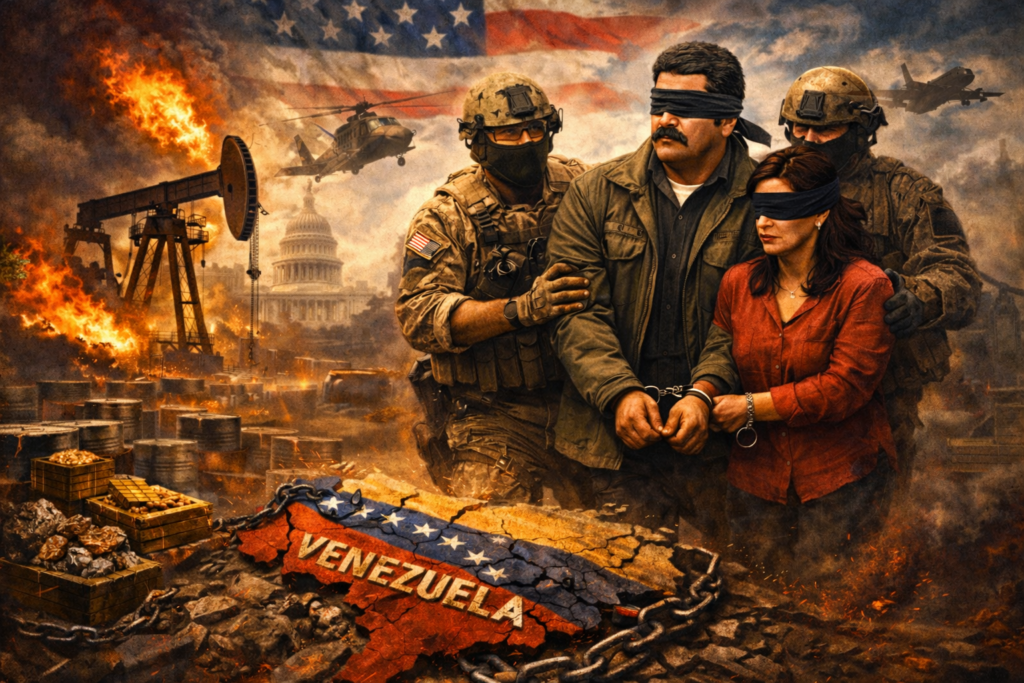
By design or desperation, the United States has crossed a historic line in Venezuela. What follows may reshape Latin America for a generation. In the early hours of January 3, 2026, as much of the world slept, the Western Hemisphere jolted awake. Reports emerged that U.S. forces had carried out a rapid military operation deep inside Venezuela, striking military installations and civilian areas alike, and, most astonishingly, removing President Nicolás Maduro and his wife, Cilia Flores, from Venezuelan soil and transferring them to U.S. custody in New York. Equally striking was the apparent inaction of the Venezuelan air force and the lack of response from the nation’s air defense system, which allowed U.S. aircraft to penetrate and operate in Venezuelan airspace with almost no interference, raising urgent questions about whether internal compromise, paralysis, or extraordinary tactical surprise made the operation possible.
Washington described the operation as a law-enforcement action against a “narco-state.” Caracas called it a kidnapping, an act of war, and a catastrophic violation of international law. Across Latin America, the reaction was visceral: governments that have long lived in the shadow of U.S. power were reminded—brutally—that sovereignty in the Western Hemisphere remains conditional.
This was not merely an operation against a man or a government. It was a message: the U.S. will act unilaterally to protect its interests, regardless of legality or consequence.
To understand why Venezuela, why now, and why in this manner, one must look beyond personalities and headlines to the deeper architecture of American power: the Monroe Doctrine, the Roosevelt Corollary, Cold War realpolitik, and the modern struggle over energy, currency, and supply chains. What unfolded in Venezuela is best understood not as an anomaly but as the logical culmination of long-standing imperial doctrine colliding with a rapidly changing world.
Hegemony, Oil, and the Dollar
For more than two centuries, U.S. policy toward Latin America has been guided by a simple principle: no rival power shall dominate the Western Hemisphere. First articulated in the Monroe Doctrine of 1823, expanded through Theodore Roosevelt’s corollary at the dawn of the 20th century, and enforced through coups, invasions, and covert operations during the Cold War, this principle has never been abandoned, only modernised.
What has changed is the terrain.
The Petrodollar and the Logic of Force
Since the 1970s, American global power has rested not only on military supremacy but on the petrodollar system, the arrangement by which global oil trade is conducted primarily in U.S. dollars, with surplus revenues recycled into U.S. Treasury bonds. This architecture allowed Washington to finance deficits, export inflation, and weaponise finance with unparalleled reach.
Preserving that system has often required violence. From the Middle East to Latin America, states that attempted to price oil outside the dollar system or assert sovereign control over energy policy frequently faced sanctions, destabilisation, or regime change.
Venezuela is uniquely dangerous to this order. It holds the largest proven oil reserves on Earth, yet over the past decade, it has increasingly sought to operate outside U.S. financial control, deepening energy and trade ties with China, Russia, Iran, and other members of the expanding BRICS+ bloc. In an era of dedollarization, alternative payment systems, and commodity-backed trade, Venezuela represents not just a resource prize but a systemic threat.
China, BRICS+, and the Hemispheric Panic
For Washington, this is no longer theoretical. Chinese capital now finances ports, railways, power grids, and telecommunications across South America. Beijing has become the largest trading partner for several Latin American economies. BRICS expansion threatens to normalise oil and mineral trade beyond Western financial infrastructure.
The U.S. response has been blunt: reassert hemispheric dominance before it erodes further.
This strategy is explicit in the U.S. national security Strategy of the United States of America 2025 document, which openly discusses “near-shoring” manufacturing to Latin America, not to revive American industry, but to replace China while preserving low labour costs. The goal is not domestic reindustrialisation, but the construction of a U.S.-dominated supply chain stretching from Greenland to the Strait of Magellan, insulated from Chinese influence and secured for future conflict scenarios.
The US goals for the Western Hemisphere can be summarised as “Enlist and Expand.”
In this context, Venezuela is not an outlier. It is the keystone. The stakes include not only oil, but strategic minerals, rare earths, and the broader economic infrastructure that shapes global supply chains.
The Kidnapping of President Maduro and His Wife
The operation, a planned US mission dubbed “Operation Absolute Resolve”, was unprecedented in scale and audacity. According to US officials, more than 150 aircraft, including bombers, fighter jets and reconnaissance planes, were ultimately deployed through the course of the night. According to various Venezuelan sources and regional observers, Maduro and Dr Cilia Flores were seized from a fortified military installation in central Caracas. The operation unfolded in under three hours. Reportedly, air defences were neutralised, communications disrupted, and a U.S. helicopter was reportedly damaged but not downed. On the Venezuelan side, dozens were killed, including members of the president’s security detail and civilians. However, rumours of an inside complicity or strategic paralysis are growing.
The most puzzling element is not that the operation succeeded, but how little visible resistance it encountered, particularly from Venezuela’s air force and air defense systems. This has fueled speculation about internal betrayal and negotiated extraction.
In a recent article, The Telegraph’s claim of “secret meetings” in Doha, Qatar, implicating Delcy Rodríguez and her brother in Maduro’s removal should be treated with scepticism or at least caution. The Venezuelan military and Delcy Rodríguez have publicly reaffirmed loyalty to Maduro, casting doubt on such allegations. The piece reads less like investigative reporting and more like a strategic narrative aimed at creating chaos, pressuring Rodríguez, and undermining Venezuela’s unity, ultimately serving the Trump administration’s agenda of destabilisation without direct occupation.
Delcy Rodríguez is widely regarded as a central figure of Chavismo; her politics shaped by both ideology and personal loss. Her father, Jorge Antonio Rodríguez, a left-wing activist, died in 1976 while in the custody of Venezuela’s DISIP intelligence service, an agency then operating with close U.S. backing; human rights groups have long argued his death resulted from torture. That trauma became a defining marker of the Rodríguez family and helps explain her enduring mistrust of U.S. intervention and steadfast alignment with the Chávez-Maduro project. Reports of discreet contacts with U.S. figures such as Senator Marco Rubio are better understood as crisis diplomacy, efforts to slow escalation and protect civilians after a major U.S. military operation, rather than collusion. The idea that Delcy Rodríguez or her brother Jorge Jesús Rodríguez Gómez, the President of the National Assembly of Venezuela since 2021, would have facilitated Nicolás Maduro and his wife’s kidnapping sits uneasily with their political lineage and history, and resembles narrative warfare more than a credible reading of Venezuela’s internal power dynamics.
VENEZUELA’S VP: WE WILL NEVER BE SLAVES AGAIN
Venezuela’s Vice President Delcy Rodriguez gave a powerful address on January 3, where she demanded the release of President Nicolas Maduro, condemning his kidnapping and confirming that Venezuela would not surrender to US imperial… pic.twitter.com/3dyNnlba3o
— Sovereign Media (@sov_media) January 4, 2026
Venezuelan authorities deny any deal. They insist Maduro remains the legitimate president under the Venezuelan constitution and demand his immediate return. Vice President Delcy Rodríguez was sworn in as interim head of state under constitutional procedures, with the armed forces publicly reaffirming loyalty to the Bolivarian government.
Supporters of Nicolas Maduro took to the streets of Caracas, demanding the release of the Venezuelan president following his capture by the United States https://t.co/kNH5oWxggC pic.twitter.com/ufJP1YKKqd
— Reuters (@Reuters) January 5, 2026
Yet the optics are destabilising. When a president can be removed from a hardened military facility without a nationwide military response, doubt spreads. Doubt fractures unity. And a fracture is often the prelude to regime collapse, which is exactly what the US would like to see. Chaos would provide the necessary excuse for a US invasion in the name of democracy and stability. After all, Maduro’s removal doesn’t remove Chavism, and the US has clearly demonstrated that it is prepared to act outside of international law to get its hands on Venezuela’s natural resources.
Legally, the operation rests on exceptionally thin ground. There was no UN Security Council authorisation nor any approval (and pre-knowledge) from the US Congress. No claim of imminent self-defense. No recognised legal doctrine allows one state to seize the sitting head of another sovereign state on foreign soil. If Washington’s argument, that criminal charges nullify sovereignty, were accepted, no leader anywhere would be safe. The implications extend far beyond Venezuela.
Undoubtedly, this is a precedent that shatters sovereignty, and the comparison to Panama in 1989 is unavoidable. In December of that year, U.S. forces invaded Panama, captured General Manuel Noriega, and flew him to Miami to stand trial on drug trafficking, money laundering, and racketeering charges, deliberately bypassing Panamanian courts and international legal norms. The parallel with Venezuela is striking: in both cases, Washington reframed a military invasion as a law-enforcement action, invoking narcotics allegations to legitimise the extraterritorial seizure of a sitting head of state, a precedent never codified in law, only enforced through power.
The difference is one of context. In 1989, the United States acted at the apex of unchallenged post-Cold War dominance. In 2026, it does so in a fragmented, multipolar world where such actions accelerate the erosion of international norms rather than reinforce them.
Economic Siege and the Myth of “Stolen Oil”
Trump and his allies claim U.S. firms were dispossessed illegally in Venezuela. The historical record tells a different story. The nationalisation of oil in 1976, and later restructuring under Chávez, included compensation for foreign investors. Claims of theft are politically convenient, but definitely not factual.
The real devastation came from sanctions and economic warfare. Financial isolation, blocked oil exports, and denied access to global banking crippled the Venezuelan economy. Economists estimate tens of thousands of deaths were indirectly caused by sanctions, as imports of food, medicine, and industrial inputs collapsed.
VIDEO: Economist Jeffrey Sachs on U.S. Sanctions and how they have devastated Venezuela & killed over 40,000 since 2017 (Source: Democracy Now)
.
With Maduro removed, Wall Street is now poised to reap what sanctions and invasions wrought. Hedge funds, banks, and energy firms are exploring access to Venezuela’s energy and infrastructure sectors valued in the hundreds of billions of dollars. The military operation is already being monetised.
Who Benefits: Power, Profit, and the Donor State
The Investment Roadshow
Within days of Maduro’s arrival in U.S. custody, Wall Street began openly positioning itself for Venezuela’s post-sovereignty future. Charles Myers, a former Evercore executive, is organising a March 2026 delegation of 20 hedge fund, energy, and infrastructure leaders to explore $500–750 billion in deals over five years.
The timing is striking. This push follows directly on the heels of the military operation and Trump’s pledge to exercise temporary oversight of Venezuela, ensuring billions for U.S. oil companies while asserting control over the world’s largest proven petroleum reserves.
Supporters view it as the end of economic collapse; critics call it imperial extraction. Even opposition figures like María Corina Machado acknowledge the oddity: the interim president, Delcy Rodríguez, remains a longtime Bolivarian official, highlighting the contradictions in U.S. narratives of regime change.
Paul Singer, Adelson, and the Political-Commercial Nexus
At the centre of this economic capture is Paul Singer, founder of Elliott Investment Management. Elliott’s acquisition of CITGO, Venezuela’s key U.S.-based asset, positions Singer to profit enormously. The military operation eliminated legal and operational risks, allowing U.S.-backed management to stabilise assets, clear bondholder disputes, and restore production.
Singer is also a major donor to hardline pro-Israel and interventionist Republican networks, working closely with Miriam Adelson, whose influence shaped Trump’s foreign policy. Trump himself benefited from seven-figure contributions from Singer- and Adelson-linked entities. Venezuela thus becomes a case study in how geopolitical force serves financial and ideological agendas in tandem.
A Hemisphere Recolonised?
On Monday, the United Nations Security Council (UNSC) convened in an emergency session in New York to discuss the US’s rendition of Venezuela’s President Nicolás Maduro from Caracas, a decision that has caused significant upheaval throughout the region and beyond. UN Secretary-General António Guterres informed ambassadors that national sovereignty, “political independence, and territorial integrity” must be upheld, following his warning on Saturday that the US has established a “dangerous precedent” for global order. This UN Security Council extraordinary meeting was broadcast live today under the agenda item “Threats to International Peace and Security”, following the United States attack on Venezuela.
Video: UNSC holds a briefing on recent United States action in Venezuela under its agenda item on threats to international peace and security (Source: United Nations)
.
At the UNSC, Latin American countries sharply disagreed over the US attack on Venezuela. Venezuela, Cuba, Mexico, Brazil, and Chile condemned it as illegal, imperialist, and a threat to sovereignty and international law, calling for de-escalation and democratic solutions. As expected, Argentina welcomed the US action in Caracas as a step toward ending repression, addressing drug trafficking, and restoring stability, while urging international support and the release of detained citizens.
What is clear: the United States has chosen coercion over coexistence, dominance over diplomacy, empire over adaptation. In doing so, it has reaffirmed its hegemony, but also exposed its fear. Fear of China. Fear of dedollarization. Fear of the BRICS and of a world no longer centred on Washington. The kidnapping of a president may succeed tactically. Strategically, it risks accelerating the very forces it seeks to suppress. History suggests empires do not fall when weak, but when they are too strong to recognise their own overreach.
READ MORE VENEZUELA NEWS AT: 21st Century Wire VENEZUELA Files
SUPPORT OUR INDEPENDENT MEDIA PLATFORM – BECOME A MEMBER @21WIRE.TV
VISIT OUR TELEGRAM CHANNEL
21st Century Wire is an alternative news agency designed to enlighten, inform and educate readers about world events which are not always covered in the mainstream media.
Source: https://21stcenturywire.com/2026/01/05/from-sanctions-to-abduction-venezuela-the-rule-of-law-and-americas-imperial-reflex/
Anyone can join.
Anyone can contribute.
Anyone can become informed about their world.
"United We Stand" Click Here To Create Your Personal Citizen Journalist Account Today, Be Sure To Invite Your Friends.
Before It’s News® is a community of individuals who report on what’s going on around them, from all around the world. Anyone can join. Anyone can contribute. Anyone can become informed about their world. "United We Stand" Click Here To Create Your Personal Citizen Journalist Account Today, Be Sure To Invite Your Friends.
LION'S MANE PRODUCT
Try Our Lion’s Mane WHOLE MIND Nootropic Blend 60 Capsules
Mushrooms are having a moment. One fabulous fungus in particular, lion’s mane, may help improve memory, depression and anxiety symptoms. They are also an excellent source of nutrients that show promise as a therapy for dementia, and other neurodegenerative diseases. If you’re living with anxiety or depression, you may be curious about all the therapy options out there — including the natural ones.Our Lion’s Mane WHOLE MIND Nootropic Blend has been formulated to utilize the potency of Lion’s mane but also include the benefits of four other Highly Beneficial Mushrooms. Synergistically, they work together to Build your health through improving cognitive function and immunity regardless of your age. Our Nootropic not only improves your Cognitive Function and Activates your Immune System, but it benefits growth of Essential Gut Flora, further enhancing your Vitality.

Our Formula includes: Lion’s Mane Mushrooms which Increase Brain Power through nerve growth, lessen anxiety, reduce depression, and improve concentration. Its an excellent adaptogen, promotes sleep and improves immunity. Shiitake Mushrooms which Fight cancer cells and infectious disease, boost the immune system, promotes brain function, and serves as a source of B vitamins. Maitake Mushrooms which regulate blood sugar levels of diabetics, reduce hypertension and boosts the immune system. Reishi Mushrooms which Fight inflammation, liver disease, fatigue, tumor growth and cancer. They Improve skin disorders and soothes digestive problems, stomach ulcers and leaky gut syndrome. Chaga Mushrooms which have anti-aging effects, boost immune function, improve stamina and athletic performance, even act as a natural aphrodisiac, fighting diabetes and improving liver function. Try Our Lion’s Mane WHOLE MIND Nootropic Blend 60 Capsules Today. Be 100% Satisfied or Receive a Full Money Back Guarantee. Order Yours Today by Following This Link.


| Visits: | 1,773,290,016 |
| Stories: | 8,576,651 |
Whistler Blowers, Insiders

