

Maduro’s Defense Could Expose CIA Drug Operations

Freddie Ponton
21st Century Wire
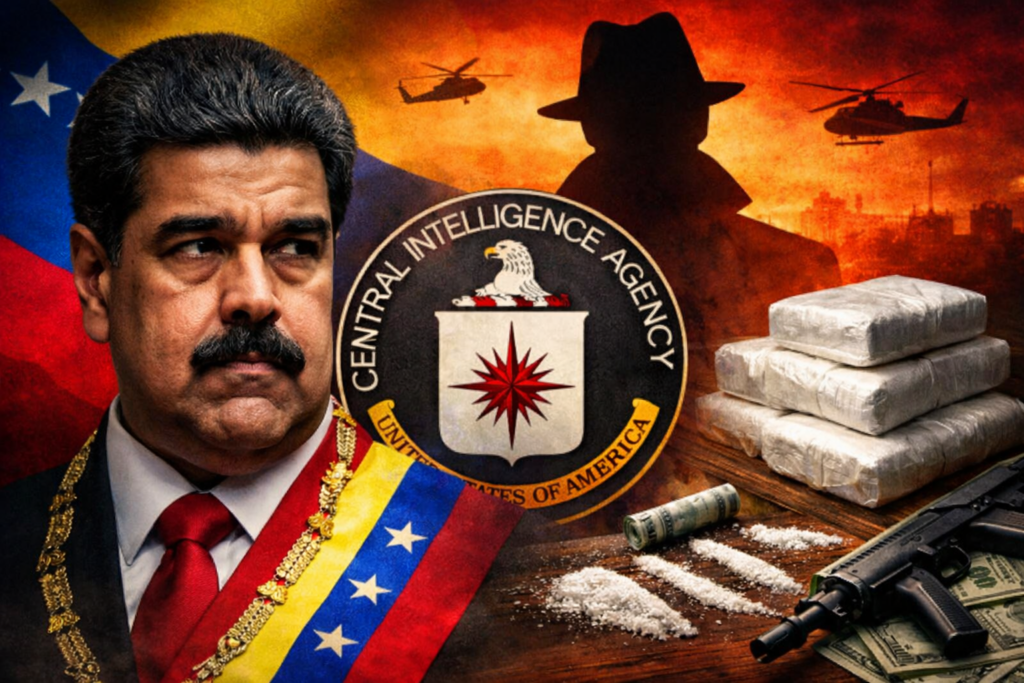
The sealed superseding indictment issued by the U.S. District Court for the Southern District of New York against Nicolás Maduro, his wife Dr Cilia Flores, and their alleged co-conspirators, accuses them of orchestrating cocaine shipments into the United States from 1999 up to 2025, working with Colombian guerrillas and criminal networks. Yet beyond these charges lies a far more explosive issue: the Maduro defense could expose decades of covert CIA and DEA involvement in drug trafficking across Latin America, revealing uncomfortable truths that intersect directly with the very operations the U.S. prosecution now cites, while highlighting stark double standards in selective enforcement, exemplified by Trump’s pardon of former Honduran president Juan Orlando Hernández, implicated in a network responsible for over 400 tonnes of cocaine entering the U.S.
What makes the case against Nicolás Maduro and Cilia Flores so combustible is not merely the severity of the allegations, but the quiet danger that a full-throated defense could illuminate decades of shadowy U.S. intelligence and law-enforcement operations across Latin America. That risk crystallised in 2020, when Washington unveiled sealed SDNY indictments, unprecedented “narco-terrorism” charges against Maduro and 14 current and former Venezuelan Officials, including a cash bounty against the sitting head of state. Maduro’s wife, Dr Cilia Flores, was not cited in the 2020 indictment.
These legal moves unfolded alongside a tightening web of sanctions, diplomatic isolation, and covert pressure. Venezuelan officials and international observers have since characterised the presidential couple’s seizure in Caracas as an unlawful abduction/kidnapping, carried out beyond U.S. jurisdiction and outside any recognised extradition process, fueling accusations that the prosecution is deeply entangled with regime-change ambitions and clandestine intelligence activity rather than a purely judicial quest for accountability.
SEE MORE: From Sanctions to Abduction: Venezuela, the Rule of Law, and America’s Imperial Reflex
A Historical Lens on Intelligence and Narcotics
Allegations of U.S. intelligence complicity, or at least toleration in narcotics trafficking, are neither new nor fringe. Over the last five decades, investigative journalists, congressional committees, and whistleblowers have documented instances where the strategic objectives of the CIA and DEA appeared to override conventional law enforcement.
In Southeast Asia, during the 1960s and 1970s, opium production thrived under the protection of U.S.-aligned militias. During the Iran-Contra era, congressional inquiries confirmed that cocaine flows tied to Contra supply networks were known but largely ignored by intelligence agencies prioritising anti-communist objectives. In post-Cold War Latin America, allegations emerged of “controlled deliveries,” protected informants, and selective enforcement of drug laws.
The CounterPunch article we are featuring today is titled “Meet the CIA: Guns, Drugs, and Money.” It synthesises decades of reporting and declassified documents to illustrate a pattern: narcotics operations, when aligned with strategic or political imperatives, were at times overlooked or tacitly facilitated by U.S. agencies. Even official U.S. documents, such as the CIA Inspector General’s 1998 report, acknowledged that the agency had knowledge of trafficking by U.S.-aligned actors and failed to intervene decisively, not out of incompetence alone, but because operational priorities and sometimes pure corruption outweighed enforcement.
Furthermore, a declassified CIA document references a Senate Foreign Relations Committee investigation in the mid‑1980s into allegations that Nicaraguan Contras and their American supporters helped smuggle cocaine into the United States and that both the CIA and DEA were implicated in different ways. The document recounts statements from sources claiming the Contra effort involved narcotics financing and that participants claimed CIA involvement.
Venezuela: A Case Study in Complexity
The SDNY indictment portrays Venezuela as a uniquely criminalised state, covering alleged activity from 1999 through 2020. Yet this period coincides with intense and often opaque U.S. involvement in the region. For years, American intelligence and counter‑narcotics operations were deeply engaged in neighbouring Colombia and Central America, and covert and visible efforts were directed at influencing Venezuelan politics. During this era, the DEA, CIA, and other agencies developed extensive informant networks and undertook surveillance operations in Latin America that intersected with the very trafficking patterns the current prosecution now highlights.
Within this intricate web, it becomes difficult to view Venezuela in isolation. Its alleged involvement in drug trafficking occurred against the backdrop of broader regional dynamics in which U.S. policymakers, military planners, and law enforcement maintained intimate knowledge of, and at times operational relationships with, trafficking networks for strategic or geopolitical ends. The defense could thus frame Venezuela not as an outlier, but as part of a system in which selective enforcement and strategic toleration were routine. By exposing these connections, the defense might complicate the prosecution’s narrative of unilateral criminality and underscore the complex interplay between local actors and U.S. intelligence priorities.
Compounding this complexity is what official monitoring and international data reveal about Venezuela’s actual role in transnational cocaine flows. According to the Washington Office on Latin America (WOLA) report “Beyond the Narcostate Narrative: What U.S. Drug Trade Monitoring Data Says About Venezuela,” U.S. government data from the interagency Consolidated Counterdrug Database indicates that Venezuela is not a primary transit country for cocaine bound for the United States—despite recurring political rhetoric suggesting otherwise. In 2018, roughly 210 metric tons of cocaine were reported to have moved through Venezuela, compared to over six times that amount transiting countries such as Guatemala, and roughly *90 percent of U.S.-bound cocaine trafficked via Western Caribbean and Eastern Pacific routes, not Venezuelan territory.
Similarly, the 2025 UNODC World Drug Report, published by the United Nations Office on Drugs and Crime, shows that Venezuela is mentioned only marginally in global trafficking statistics, with international drug travel dominated by Pacific and Caribbean corridors through other transit states. One recent media summary reported that only about 5 % of cocaine from Colombia moves through Venezuela’s territory, while the overwhelming majority follows other routes to the U.S.
Such assessments undercut the U.S. government’s narrative that Venezuela constitutes a central hub in the hemispheric cocaine trade. They highlight a more nuanced reality: while organised crime and corruption indeed affect Venezuelan institutions, the weight of official data places most of the transhipment burden on other routes and countries, raising substantive questions about the prosecutorial storyline.
Recent reporting underscores just how entangled U.S. intelligence and geopolitical considerations are in the Maduro case. According to El País, CIA operatives were reportedly embedded within the Venezuelan government, providing critical intelligence that enabled U.S. military forces to locate Nicolás Maduro. In tandem, Maduro and Cilia Flores appeared in a New York court, proclaiming their innocence and asserting sovereign immunity, while UN Secretary-General Antonio Guterres and legal scholars raised alarms over the legality of the U.S. operation. These developments highlight that beyond drug trafficking allegations, the case is already enmeshed in broader questions of international law, covert operations, and geopolitical legitimacy, precisely the sort of evidence the defense could leverage to challenge the prosecution’s narrative and underscore the selective application of justice.
Strategic Vulnerabilities for the Prosecution and The Paradox of Exposure
The indictment relies heavily on cooperating witnesses, confidential informants, intelligence-derived evidence, and extraterritorial jurisdiction. These elements are precisely the points most vulnerable to disruption. If the Maduro defense were to produce evidence showing that key traffickers were DEA or CIA informants, or documentation of controlled shipments or intelligence operations involving the same actors cited in the indictment, the prosecution would confront a profound dilemma. Admitting such evidence risks exposing sensitive intelligence operations, undermining witness credibility, and raising questions about the consistency and impartiality of U.S. drug policy. Conversely, excluding it invites charges that the trial is politically motivated rather than legally grounded.
In a recent interview on the YouTube channel Redacted, Judge Andrew Napolitano warned: the U.S. prosecution of the Maduros could hit a wall if their defense starts revealing secrets about the CIA’s alleged role in drug trafficking across Venezuela and South America… and that’s just the tip of the iceberg. Watch:
In a recent interview on the YouTube channel Redacted, Judge Andrew Napolitano warned: the U.S. prosecution of the Maduros could hit a wall if their defense starts revealing secrets about the CIA’s alleged role in drug trafficking in Venezuela and across South America… and… pic.twitter.com/0bJTzuChE5
— Freddie Ponton (@freddie_ponton) January 6, 2026
Historically, cases that threaten to reveal sensitive intelligence operations rarely reach full adjudication. Legal mechanisms such as the State Secrets Privilege, the Classified Information Procedures Act (CIPA), and political considerations frequently prevent potentially embarrassing material from entering the public record. Yet the threat of disclosure is often as potent as the disclosure itself. A defense that credibly asserts: “You accuse us of crimes you have long tolerated, facilitated, or exploited”, forces a confrontation with historical U.S. actions in the global narcotics trade, potentially undermining the moral and prosecutorial authority the SDNY case seeks to assert.
Hypocrisy, Exposure, and Pandora’s Box
The Maduro indictment is more than a legal document; it is a symbolic instrument of U.S. policy, designed to isolate and criminalise a sitting head of state. Yet the very weight of the prosecution’s claims could compel the defense to introduce historical, political, and operational context that paints a more nuanced picture: one in which U.S. intelligence and law enforcement are not merely impartial arbiters, but actors with complex, sometimes compromised, histories in Latin American drug trafficking networks.
The hypocrisy is starkly illustrated by Juan Orlando Hernández, former president of Honduras, who was pardoned by Donald Trump despite being implicated as a key figure in a drug trafficking network responsible for over 400 tonnes of cocaine entering the United States. The contrast between Hernández’s immunity and the aggressive prosecution of Maduro, Dr Cilia Flores, and other Venezuelan officials exposes a double standard that calls into question the credibility and impartiality of the case.
In prosecuting Venezuela, the United States risks opening a Pandora’s box: the deeper the case proceeds, the greater the potential to reveal politically inconvenient truths, operationally sensitive histories, and systemic contradictions in U.S. drug enforcement. The SDNY indictment is not only a legal instrument, it is also a potential flashpoint where prosecutorial certainty collides with decades of contested history in the shadowy intersection of intelligence, narcotics, and geopolitics.
Jeffrey St. Clair and Alexander Cockburn write for CounterPunch…
Meet the CIA: Guns, Drugs and Money
On November 22, 1996, the US Justice Department indicted General Ramón Guillén Davila of Venezuela on charges of importing cocaine into the United States.
The federal prosecutors alleged that while heading Venezuela’s anti-drug unit, General Guillén smuggled more than 22 tons of cocaine into the US and Europe for the Calí and Bogotá cartels. Guillén responded to the indictment from the sanctuary of Caracas, whence his government refused to extradict him to Miami, while honoring him with a pardon for any possible crimes committed in the line of duty. He maintained that the cocaine shipments to the US had been approved by the CIA, and went on to say that “some drugs were lost and neither the CIA nor the DEA want to accept any responsibility for it.”
The CIA had hired Guillén in 1988 to help it find out something about the Colombian drug cartels. The Agency and Guillén set up a drug-smuggling operation using agents of Guillén’s in the Venezuelan National Guard to buy cocaine from the Calí cartel and ship it to Venezuela, where it was stored in warehouses maintained by the Narcotics Intelligence Center, Caracas, which was run by Guillén and entirely funded by the CIA.
To avoid the Calí cartel asking inconvenient questions about the growing inventory of cocaine in the Narcotics Intelligence Center’s warehouses and, as one CIA agent put it, “to keep our credibility with the traffickers,” the CIA decided it was politic to let some of the cocaine proceed on to the cartel’s network of dealers in the US. As another CIA agent put it, they wanted “to let the dope walk” – in other words, to allow it to be sold on the streets of Miami, New York and Los Angeles.
When it comes to what are called “controlled shipments” of drugs into the US, federal law requires that such imports have DEA approval, which the CIA duly sought. This was, however, denied by the DEA attaché in Caracas. The CIA then went to DEA headquarters in Washington, only to be met with a similar refusal, whereupon the CIA went ahead with the shipment anyway. One of the CIA men working with Guillén was Mark McFarlin. In 1989 McFarlin, so he later testified in federal court in Miami, told his CIA station chief in Caracas that the Guillén operation, already under way, had just seen 3,000 pounds of cocaine shipped to the US. When the station chief asked McFarlin if the DEA was aware of this, McFarlin answered no. “Let’s keep it that way,” the station chief instructed him.
Over the next three years, more than 22 tons of cocaine made its way through this pipeline into the US, with the shipments coming into Miami either in hollowed-out shipping pallets or in boxes of blue jeans. In 1990 DEA agents in Caracas learned what was going on, but security was lax since one female DEA agent in Venezuela was sleeping with a CIA man there, and another, reportedly with General Guillén himself. The CIA and Guillén duly changed their modes of operation, and the cocaine shipments from Caracas to Miami continued for another two years. Eventually, the US Customs Service brought down the curtain on the operation, and in 1992 seized an 800-pound shipment of cocaine in Miami.
One of Guillén’s subordinates, Adolfo Romero, was arrested and ultimately convicted on drug conspiracy charges. None of the Colombian drug lords was ever inconvenienced by this project, despite the CIA’s claim that it was after the Calí cartel. Guillén was indicted but remained safe in Caracas. McFarlin and his boss were ultimately edged out of the Agency. No other heads rolled after an operation that yielded nothing but the arrival, under CIA supervision, of 22 tons of cocaine in the United States. The CIA conducted an internal review of this debacle and asserted that there was “no evidence of criminal wrongdoing.”
A DEA investigation reached a rather different conclusion, charging that the spy agency had engaged in “unauthorised controlled shipments” of narcotics into the US and that the CIA withheld “vital information” on the Calí cartel from the DEA and federal prosecutors.
Continue reading this article here
See more reports from CounterPunch
READ MORE VENEZUELA NEWS AT: 21st Century Wire VENEZUELA Files
SUPPORT OUR INDEPENDENT MEDIA PLATFORM – BECOME A MEMBER @21WIRE.TV
VISIT OUR TELEGRAM CHANNEL
21st Century Wire is an alternative news agency designed to enlighten, inform and educate readers about world events which are not always covered in the mainstream media.
Source: https://21stcenturywire.com/2026/01/06/maduros-defense-could-expose-cia-drug-operations/
Anyone can join.
Anyone can contribute.
Anyone can become informed about their world.
"United We Stand" Click Here To Create Your Personal Citizen Journalist Account Today, Be Sure To Invite Your Friends.
Before It’s News® is a community of individuals who report on what’s going on around them, from all around the world. Anyone can join. Anyone can contribute. Anyone can become informed about their world. "United We Stand" Click Here To Create Your Personal Citizen Journalist Account Today, Be Sure To Invite Your Friends.
LION'S MANE PRODUCT
Try Our Lion’s Mane WHOLE MIND Nootropic Blend 60 Capsules
Mushrooms are having a moment. One fabulous fungus in particular, lion’s mane, may help improve memory, depression and anxiety symptoms. They are also an excellent source of nutrients that show promise as a therapy for dementia, and other neurodegenerative diseases. If you’re living with anxiety or depression, you may be curious about all the therapy options out there — including the natural ones.Our Lion’s Mane WHOLE MIND Nootropic Blend has been formulated to utilize the potency of Lion’s mane but also include the benefits of four other Highly Beneficial Mushrooms. Synergistically, they work together to Build your health through improving cognitive function and immunity regardless of your age. Our Nootropic not only improves your Cognitive Function and Activates your Immune System, but it benefits growth of Essential Gut Flora, further enhancing your Vitality.

Our Formula includes: Lion’s Mane Mushrooms which Increase Brain Power through nerve growth, lessen anxiety, reduce depression, and improve concentration. Its an excellent adaptogen, promotes sleep and improves immunity. Shiitake Mushrooms which Fight cancer cells and infectious disease, boost the immune system, promotes brain function, and serves as a source of B vitamins. Maitake Mushrooms which regulate blood sugar levels of diabetics, reduce hypertension and boosts the immune system. Reishi Mushrooms which Fight inflammation, liver disease, fatigue, tumor growth and cancer. They Improve skin disorders and soothes digestive problems, stomach ulcers and leaky gut syndrome. Chaga Mushrooms which have anti-aging effects, boost immune function, improve stamina and athletic performance, even act as a natural aphrodisiac, fighting diabetes and improving liver function. Try Our Lion’s Mane WHOLE MIND Nootropic Blend 60 Capsules Today. Be 100% Satisfied or Receive a Full Money Back Guarantee. Order Yours Today by Following This Link.


| Visits: | 1,773,310,095 |
| Stories: | 8,576,686 |
Whistler Blowers, Insiders

