

Patagonia’s Silent Occupation: Who’s Burning Patagonia to Mine Its Minerals?


Freddie Ponton
21st Century Wire
Patagonia is often imagined as a remote sanctuary at the edge of the world: vast forests, glacial lakes, windswept plains, and indigenous territories that have resisted the pressures of industrial modernity for centuries. Yet in recent years, this image has begun to fracture. Across Argentina’s southern provinces, forests have burned with unusual frequency and intensity, communities have been displaced, and land once protected by ecological or cultural barriers has become newly accessible, as documented in assessments of the 2024 Argentina wildfires. At the same time, Patagonia has emerged as a focal point in a far larger global struggle, one driven not by climate, but by geopolitics, resource scarcity, and national security imperatives emanating from Washington.
Beneath Patagonia’s scorched earth lies a convergence of uranium, lithium, copper, gold, and rare-earth-associated minerals, precisely the materials the United States has identified as critical to its military, technological, and economic survival, according to the Defense Logistics Agency’s Strategic Materials list (DLA). As China continues to dominate global supply chains for these resources, the U.S. has embarked on an aggressive, state-backed campaign to secure alternative sources, a shift analysed in multiple policy briefings and industry reports from Fastmarkets, and Rare Earth Exchanges, just to name a few. Argentina, and Patagonia in particular, have become central to that strategy. This investigation examines how U.S. mineral policy, Argentine investment frameworks such as RIGI, foreign mining corporations, and a wave of criminally investigated fires intersect, raising disturbing questions about environmental destruction, indigenous population displacement, and the true cost of securing “strategic” resources.
The New Cold War Beneath the Soil
Over the past decade, the United States has quietly but decisively reframed access to critical and strategic minerals as a matter of national security, a transformation detailed in analyses of Pentagon stockpiling and mineral vulnerability, as described in a report from Ecor Network, titled: “Mining for War: An Assessment of the Pentagon’s Mineral Reserves“. This shift reflects a growing awareness inside the Pentagon, Congress, and the intelligence community that modern warfare, surveillance, and economic power depend on materials that the U.S. largely does not control. Lithium is essential for batteries powering military systems and electric vehicles; rare earth elements such as neodymium, dysprosium, and terbium are indispensable for missile guidance systems, radar, satellites, and advanced communications; uranium remains fundamental to nuclear energy and deterrence; and copper, nickel, gallium, and cobalt underpin everything from fighter jets to data centers, as reflected in the DLA strategic materials mandate (DLA).
U.S. and industry rhetoric often links this extraction to decarbonization and clean-energy goals, recasting geopolitically driven mining as a necessary step toward a low‑carbon future.
The vulnerability lies in the supply chains. The United States is fully import-dependent for at least twelve critical minerals and more than fifty percent dependent for twenty-eight others, while China controls roughly seventy percent of global rare earth mining and more than ninety percent of refining capacity, a dominance outlined in policy analyses cited by GovFacts and Discovery Alert. These realities allow Beijing to control, or according to some critics, weaponise supply chains, a risk openly acknowledged in U.S. government and industry circles.
Faced with this imbalance, Washington has responded not with market liberalism but with a form of mineral mercantilism. The Pentagon has invested directly in mining companies, guaranteed price floors for rare earth products, invoked the Defense Production Act to subsidise extraction and processing, and expanded the National Defense Stockpile, developments examined in industry reporting like Fastmarkets. A proposed $2.5 billion Strategic Resilience Reserve, reported by Reuters, would further entrench government control over mineral flows, explicitly aiming to reduce reliance on China and secure long-term access to critical inputs.
The Defense Logistics Agency (DLA), which manages the stockpile, lists uranium, lithium, rare earth elements, copper, nickel, cobalt, gallium, and platinum group metals among its priority materials. These are not abstract commodities; they are the physical backbone of U.S. military power and technological dominance, and the list reads almost like a geological map of Patagonia itself. According to the recent Observatorio de Tierras report, US citizens and corporations are the largest owners of Argentinian land, leading with 2.7 million hectares, followed by Italy and Spain, with 50% located in the Andes and in Patagonia.
Argentina Enters the Strategic Arena
Argentina’s emergence as a strategic partner in this mineral race is no accident. The country possesses vast, largely underexploited reserves of lithium, copper, uranium, gold, and associated critical minerals. In August 2024, Buenos Aires and Washington formalised their alignment through a Memorandum of Understanding on Critical Minerals Cooperation, committing both countries to collaboration across the entire value chain and explicitly facilitating U.S. investment in Argentine mining projects.
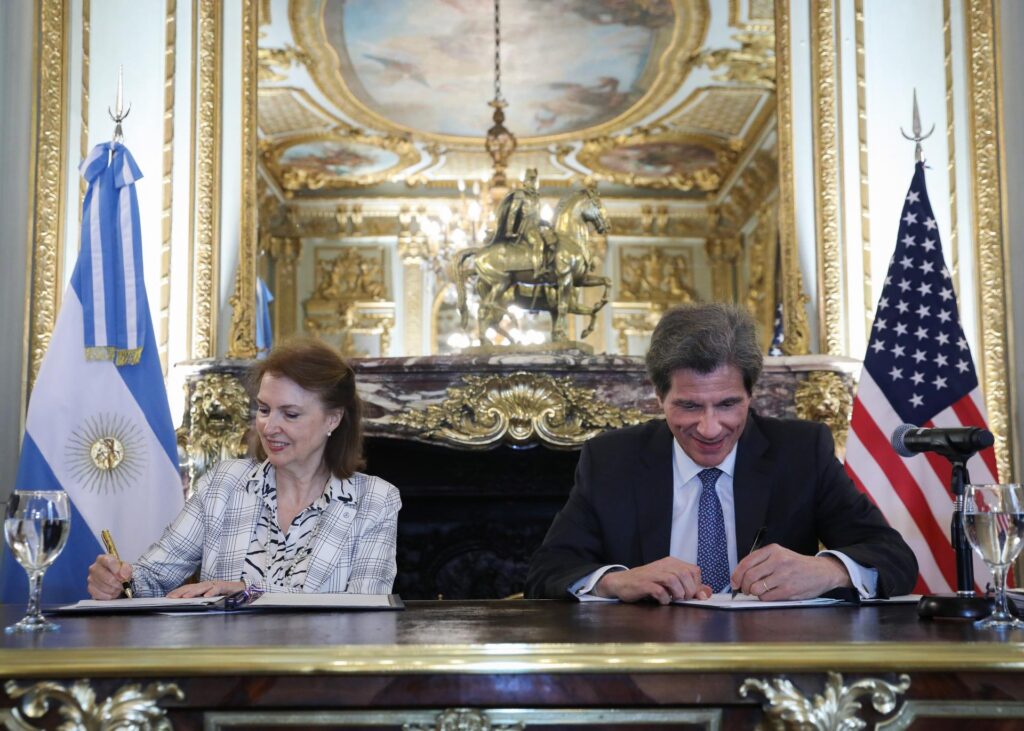
IMAGE: Foreign Minister Diana Mondino received the Under Secretary for Economic Growth, Energy, and Environment of the United States Department of State, José Fernández, at the San Martín Palace, with whom she held a working meeting and signed a Memorandum of Understanding (MoU) on Cooperation on Critical Minerals. (Source: Ministry of Foreign Affairs, International Trade and Worship, Republic of Argentina)
This bilateral framework was reinforced when Argentina joined the Minerals Security Partnership (MSP), a U.S.-led initiative designed to counter China’s dominance in mineral supply chains. At MSP forums hosted in the United States, Argentine provinces, including those in burning Patagonia, presented mining opportunities directly to U.S. officials and investors, as documented by Argentina’s Ministry of Foreign Affairs (Cancillería).
To accommodate this influx of foreign capital, Argentina introduced the Régimen de Incentivo para Grandes Inversiones (RIGI) or in English, Incentive Scheme for Large Investments (RIGI), offering thirty years of tax stability, reduced export duties, free access to foreign currency, and legal protections against future regulatory changes, as outlined by Argentina’s investment agency. Reportedly, by 2025, more than $10–12 billion in RIGI projects had been approved or were under evaluation, many concentrated in mining and energy, with northern provinces and Patagonia emerging as a prime target (La Tecla Patagonia; Poder Local).
REPORT: The Impact Of The Rigi Projects in Patagonia, by Diego Mayorga Díaz, translated from Spanish to English (Source: laTecla Patagonia)
Patagonia #1098.es.en
The RIGI & Global Scenarios: One-Year report, released in October 2025 by the Center for Global Governance Studies (CEGG) at Universidad Austral’s School of Government, summarized in an article by La Tecla Patagonia (Oct 9, 2025), reveals that projects under Argentina’s Large Investment Incentive Regime (RIGI) in Patagonia (Neuquén, Río Negro, Chubut, and Santa Cruz) have already surpassed USD 10 billion, with seven projects approved at the national level and several focused in the region. Among the notable approved projects is the Vaca Muerta Sur pipeline, a consortium led by YPF, PAE, Vista Energy, Pampa Energía, Chevron, Pluspetrol, and Shell, which is estimated to cost around USD 3.0 billion. Additionally, there is a gas liquefaction vessel project based in Río Negro, spearheaded by Southern Energy and Golar LNG, valued at approximately USD 6.878 billion. While the current approvals are predominantly in the energy and mining sectors, with limited uptake in other areas such as forestry, technology, and tourism, the significant concentration of large energy and infrastructure investments positions Patagonia as a very juicy and promising hub for RIGI investments.
REPORT: RIGI & Global Scenarios: Report 1 year after its implementation (Source: Center for Global Governance Studies (CEGG) at Universidad Austral’s School of Government)
RIGI Austral University Report.es.en
Patagonia: Where Fires and Minerals Converge
Patagonia spans the provinces of Chubut, Río Negro, Neuquén, and Santa Cruz, regions of immense ecological value and significant mineral wealth. Uranium basins such as Cañadón Asfalto and the San Jorge Basin, gold deposits in Santa Cruz, and lithium–and copper-associated systems across the plateau have drawn increasing interest from foreign mining companies.
Among the mining firms operating or exploring in Patagonia are Patagonia Gold Corp, Blue Sky Uranium Corp, Jaguar Uranium Corp, UrAmérica Ltd, US Green Shift Commodities Ltd, and Newmont Corp, through its Oroplata subsidiary, as reported in regional and industry coverage. UrAmérica has also signed a memorandum of understanding with Nano Nuclear Energy Inc., a U.S.-based company positioning itself for future uranium supply aligned with defense and nuclear needs. Patagonia Gold has broadened its presence in Argentina by securing four additional mineral concessions around its Mina Angela project. This agreement was finalised through Patagonia Gold’s Argentine subsidiary, Huemules, which entered into a definitive contract with Compañía Inversora de Minas (Ciminas).
SEE MORE: The Capitalist Mafia’s Playground: How Milei is Rewriting Argentina for Foreign Profits
At the same time these projects have advanced, Patagonia has been engulfed by repeated waves of wildfires. From Epuyén and El Hoyo to Puerto Patriada, Los Alerces National Park, El Bolsón, and mining zones in Santa Cruz such as Capo-Oeste, La Manchuria, and Lomada de Leiva, fires have destroyed tens of thousands of hectares, many officially classified as criminal in origin. Satellite and wildfire data show clustering around infrastructure corridors and mineral concessions rather than random distribution.
Patagonia’s Mining Routes to DLA Strategic Interests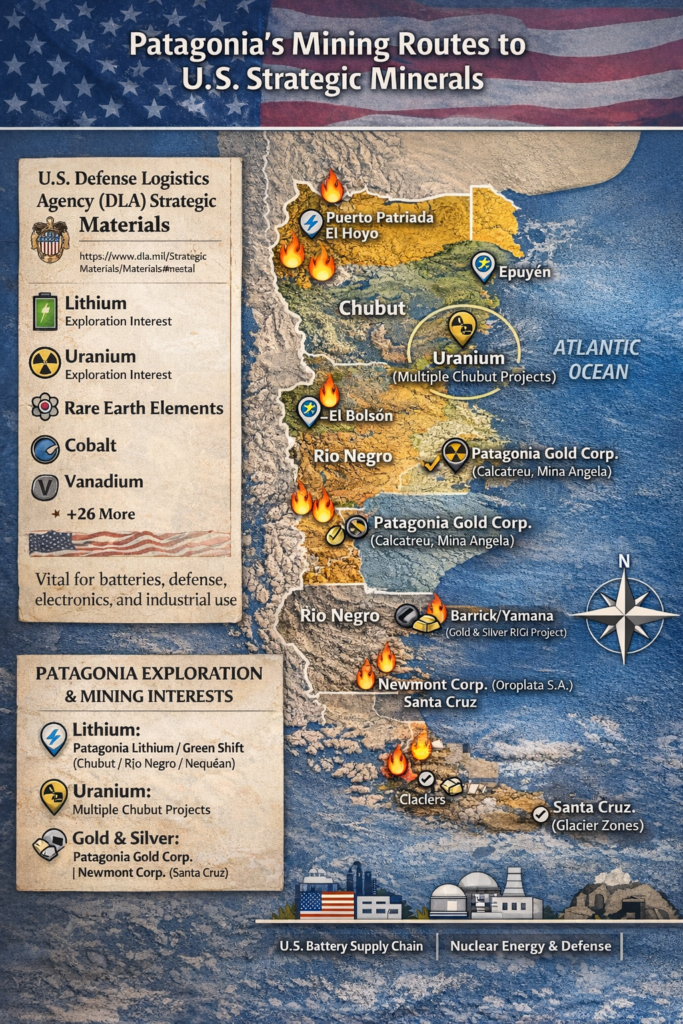
Image: This map overlays active and proposed mining projects in Patagonia with minerals listed by the U.S. Defense Logistics Agency as strategically critical, highlighting wildfire zones that intersect with these areas (Source: Author)
In October 2025, the Rosario Stock Exchange (Bolsa de Comercio de Rosario, BCR) issued a report on the projects submitted under Argentina’s Régimen de Incentivos para Grandes Inversiones (RIGI), which we believe provides the most recent update regarding mining projects under RIGI. By mapping the RIGI strategic mining projects in Patagonia and geolocating where they intersect with past and current fires in Patagonia, we can see that many of them end up being at the location or close to reported fires. Coincidence?
Document: Bolsa de Comercio de Rosario, BCR update report on RIGI projects in Argentina: Current situation as of Oct 2025 – by Guido D’Angelo – Emilce Terré – Julio Calzada (Source: BCR)
BCR REPORT – RIGI – ARGENTINA
Fire, Displacement, and the Cost of Extraction
The fires have had devastating consequences beyond forest loss, displacing communities, damaging tourism economies, and pushing indigenous populations further from ancestral lands. Environmental harm extends to watersheds, biodiversity, and long-term carbon storage, compounding climate impacts.
Investigative reporting and official statements have added a further layer of complexity. The director of the southern branch of Chile’s National Forestry Corporation (CONAF) confirmed that many individuals detained or expelled for starting fires in Patagonia were Israeli nationals, a claim made public in official statements circulated on social media (X / Bracesco2023). Although the claim is delivered cautioning the public not to draw any irrational conclusions, there are many reports indicating that Israel has conducted forest mapping and environmental studies in Patagonia for decades, raising questions about overlapping strategic interests with the United States.
Oficial: mayoría de expulsados por iniciar fuego en la Patagonia son israelíes. pic.twitter.com/D2MUiwi5Fz
— ☩ ✺ DEUS VULT ✺ ☩ (@Bracesco2023) January 17, 2026
Meanwhile, President Javier Milei’s administration has sharply reduced budgets for environmental protection and firefighting. According to Le Monde, these cuts severely weakened Patagonia’s capacity to prevent and respond to fires, even as warnings mounted.
Patagonia Uranium and Strategic Minerals Spotlight
Table: This table juxtaposes uranium and critical mineral projects in Patagonia with U.S. strategic interest indicators and documented wildfire locations. (Source: Created by the author based on open source documents)
Patagonia Uranium Case Study
Beyond Patagonia: A Global Pattern
What is unfolding in Patagonia mirrors a broader U.S. strategy visible in Greenland, Australia, and within the United States itself, where the Pentagon has become a major stakeholder in domestic rare earth production and has guaranteed prices to ensure output regardless of market conditions (Rare Earth Exchanges). These actions reflect a consistent pattern: when access to critical minerals is at stake, the U.S. government intervenes directly, reshaping markets and leveraging alliances.
To Summarise: Strategic Minerals = Strategic Silence
There is no single document proving the fires of Patagonia were lit at the behest of mining corporations, Oil & Gas giants, or foreign governments. Yet the convergence of evidence, the timing, geography, policy frameworks, and beneficiaries, demands scrutiny. Fires erupt where minerals and other natural resources like Oil&Gas lie; legal regimes such as RIGI ease foreign extraction; communities are displaced; and environmental protections erode, all as the United States and it spartners intensifies its campaign to secure strategic minerals in a resource-constrained world.
The story of Patagonia is not just about Argentina. It is about how global powers pursue security in an age of scarcity, and who pays the heavy price.
READ MORE ARGENTINA NEWS AT: 21st Century Wire Argentina Files
SUPPORT OUR INDEPENDENT MEDIA PLATFORM – BECOME A MEMBER @21WIRE.TV
VISIT OUR TELEGRAM CHANNEL
21st Century Wire is an alternative news agency designed to enlighten, inform and educate readers about world events which are not always covered in the mainstream media.
Source: https://21stcenturywire.com/2026/01/19/patagonias-silent-occupation-whos-burning-patagonia-to-mine-its-minerals/
Anyone can join.
Anyone can contribute.
Anyone can become informed about their world.
"United We Stand" Click Here To Create Your Personal Citizen Journalist Account Today, Be Sure To Invite Your Friends.
Before It’s News® is a community of individuals who report on what’s going on around them, from all around the world. Anyone can join. Anyone can contribute. Anyone can become informed about their world. "United We Stand" Click Here To Create Your Personal Citizen Journalist Account Today, Be Sure To Invite Your Friends.
LION'S MANE PRODUCT
Try Our Lion’s Mane WHOLE MIND Nootropic Blend 60 Capsules
Mushrooms are having a moment. One fabulous fungus in particular, lion’s mane, may help improve memory, depression and anxiety symptoms. They are also an excellent source of nutrients that show promise as a therapy for dementia, and other neurodegenerative diseases. If you’re living with anxiety or depression, you may be curious about all the therapy options out there — including the natural ones.Our Lion’s Mane WHOLE MIND Nootropic Blend has been formulated to utilize the potency of Lion’s mane but also include the benefits of four other Highly Beneficial Mushrooms. Synergistically, they work together to Build your health through improving cognitive function and immunity regardless of your age. Our Nootropic not only improves your Cognitive Function and Activates your Immune System, but it benefits growth of Essential Gut Flora, further enhancing your Vitality.

Our Formula includes: Lion’s Mane Mushrooms which Increase Brain Power through nerve growth, lessen anxiety, reduce depression, and improve concentration. Its an excellent adaptogen, promotes sleep and improves immunity. Shiitake Mushrooms which Fight cancer cells and infectious disease, boost the immune system, promotes brain function, and serves as a source of B vitamins. Maitake Mushrooms which regulate blood sugar levels of diabetics, reduce hypertension and boosts the immune system. Reishi Mushrooms which Fight inflammation, liver disease, fatigue, tumor growth and cancer. They Improve skin disorders and soothes digestive problems, stomach ulcers and leaky gut syndrome. Chaga Mushrooms which have anti-aging effects, boost immune function, improve stamina and athletic performance, even act as a natural aphrodisiac, fighting diabetes and improving liver function. Try Our Lion’s Mane WHOLE MIND Nootropic Blend 60 Capsules Today. Be 100% Satisfied or Receive a Full Money Back Guarantee. Order Yours Today by Following This Link.



| Visits: | 1,775,593,175 |
| Stories: | 8,581,374 |
Whistler Blowers, Insiders


Mel Gibson has been exposing the perpetrators for at least the past year. The same group who killed Charlie Kirk! Don’t say their name, you are right. They also provide high powered weapons to the narco-terrorists in Mexico. And the are blackmailing our President with their videos from the island.