

Cuba, BRICS and the Battle to End US Impunity

Freddie Ponton
21st Century Wire
The lights are going out in Cuba again, but this time, the blackout is by design. With a stroke of his pen, a US president declared a “national emergency,” ordered an oil blockade, and warned every shipowner and government on earth that helping an island of eleven million keep the lights on could now invite punishment from Washington.
What is unfolding in Havana is not just another tightening of a Cold War‑era embargo; it is a live stress test of the emerging BRICS‑centred order and its promise that small countries can survive outside the US orbit. On one side is Donald Trump, wielding tariffs, sanctions and a naval grip on the Caribbean; on the other is a battered socialist state betting its future on Russian tankers, Chinese diplomacy, Mexican defiance, and the still‑nascent machinery of the New Development Bank.
Fuel siege
On 29 January 2026, Trump signed an executive order that does something the euphemism “sanctions” can no longer hide: it threatens punitive tariffs on any country or company that supplies oil to Cuba, turning the entire global fuel market into a battlefield. UN experts have called this an “extreme” form of unilateral coercion and a grave violation of international law, stressing that it has no UN Security Council mandate and is incompatible with the Charter and the basic rules of the WTO. In plain language, Washington is asserting the right to decide who can sell fuel to Havana, and at what political price, far beyond its own borders.
Inside the Trump administration, the goal is not a secret. In private discussions reported by Politico, one person familiar with the plan summarised the strategy bluntly: “Energy is the chokehold to kill the regime.” Deposing Cuba’s communist government is described as “100% a 2026 event” in the administration’s eyes, justified under the Helms‑Burton Act that codifies the embargo. Cuba imports roughly 60% of its oil, according to the International Energy Agency; for years, most of that came from Venezuela, until the Trump team began seizing sanctioned cargoes on the high seas and then turned its sights on the Mexican tankers that replaced them.
The impact is measurable in barrels and hours. By 3 December 2025, Cuba had already stopped receiving Venezuelan crude under US pressure; by January 2026, its crude imports had fallen to zero for the first time in a decade, leaving domestic heavy oil, about 40% of demand, to carry a collapsing system. Shipping trackers cited in Russian and Chinese reports estimate that without new imports, the island had perhaps 15–20 days of usable fuel; the last recorded external shipment, roughly 85,000 barrels from Mexico, docked on 9 January before Pemex froze exports to avoid Trump’s tariffs. Since then, petrol stations have run dry, public transport has stalled, and blackouts of 10, 15, even 18 hours a day have become routine in some provinces.
UN human‑rights officials now link the fuel shortage directly to food access, warning that it is disrupting Cuba’s rationing system and access to regulated basic staples, not just dimming the lights. Alena Douhan, the UN Special Rapporteur who studied the wider sanctions regime, had already recorded 70–80 percent shortages in some food items and a chronic lack of medicines; the fuel siege is pushing that fragile equilibrium towards a precipice. In New York, the UN News service has warned that the humanitarian situation “will worsen, and if not collapse, if [Cuba’s] oil needs go unmet,” a statement that explicitly ties Washington’s attempt to block oil supplies to the risk of humanitarian breakdown. The UN’s most senior official in Havana describes a country living through a mix of resilience, grief, sorrow and indignation, confronting rolling blackouts and surging food prices while still trying to defend its social model under “severe economic, financial and trade sanctions.”
The legal verdict is equally stark. The UN General Assembly, by 165 votes to 7, with 12 abstentions, has for the 33rd consecutive year demanded an end to the US economic, commercial and financial embargo. UN and expert language suggest these latest measures risk amounting to collective punishment, given their foreseeable impact on civilians. Even mainstream outlets have begun to ask whether a policy that predictably shuts down power plants, hospitals, and schools to “pressure” a government meets the definition of collective punishment under international humanitarian law—the same term that has been deployed, and then ignored, over Israel’s siege of Gaza.
In the skies, the crisis now has a timetable. On 9 February, the Cuban aviation authority quietly told airlines that from 10 February it could no longer guarantee jet fuel at nine airports, including Havana, at least until March 11. Carriers were forced to reroute flights to refuel in Santo Domingo or elsewhere; Air Canada suspended its Cuba routes outright, organising the repatriation of roughly 3,000 stranded passengers, while others began tankering fuel in and hopping the island like a refuelling desert.
On the ground, hotels are shuttering, tourist areas stand half‑empty, and the sector that once brought vital hard currency into Cuban households has joined the electrical grid in freefall. Local reporting gathered by international and independent outlets paints a harsh picture: families with power only a few hours a day, single mothers cooking with wood because bottled gas has run out, students trying to study by candlelight, and workers who can no longer afford the informal taxi rides that replaced paralysed buses. For ordinary Cubans, this is not an abstract debate about sanctions; it is the moment when the bus stops coming, the fridge warms up, the ATM line doubles, and survival becomes a full‑time job once more.
Cuba digs in
Havana has not tried to hide the severity of what it calls an “agudo desabasto de combustible”, an acute fuel shortage it traces directly to the US energy blockade and the earlier strangling of Venezuelan shipments. On a nationally broadcast Mesa Redonda, Deputy Prime Minister Oscar Pérez‑Oliva Fraga and ministers from labour, transport, education and higher education laid out a battery of emergency measures: rationing fuel, protecting hospitals and water systems, re‑engineering schools and universities, and compressing the state workweek from Monday to Thursday to save diesel and electricity. They describe not a government improvising excuses, but a state scrambling to stretch every litre of fuel across a modern society that was already running lean.
The heart of the response is a bet on self‑reliance. Despite the crisis, Cuba is accelerating its programme of photovoltaic solar parks, insisting that every project which reduces dependence on imported fuel must go ahead, even if it means swapping machinery for human labour when diesel is unavailable.
Cuba just increased solar share of energy generation from 5.8% → 20.3% in one year. 49 Chinese parks on the grid.
It’s a race. The US blockading oil to starve the island into darkness. China racing to make sure they never need that oil again. pic.twitter.com/Ob1aukypXi
— COMBATE | (@upholdreality) February 12, 2026
Around 20,000 home solar systems are being deployed: 10,000 sold on favourable terms to teachers, health workers and education staff; 5,000 for isolated homes to reach 100% electrification this year; and another 5,000 for nursing homes, children’s homes, community centres, banks and other social service points. In parallel, domestic heavy crude, good mainly for power generation, is being pushed harder, with authorities saying they have reversed a downward production trend by late 2025 and are now expanding joint ventures and enhanced recovery on existing wells. For the first time, producers of renewable power can sell electricity directly to third‑party consumers, not just the state grid, opening a small but important crack for more distributed, resilient generation.
Food shortage is the other front line. The government has set itself the task of planting 200,000 hectares of rice in 2026, backed by foreign‑supported projects in Pinar del Río, Sancti Spíritus and Granma that are already showing high yields. Officials talk about diversifying crops, expanding urban and family farming, using renewable energy for irrigation, and increasing animal traction in the fields because there simply is not enough diesel to keep tractors ploughing as before. It is a grimly familiar image: oxen returning to sugar roads, but this time under the shadow of a global oil order where one country can declare your harvest a bargaining chip. Meanwhile, the 2026 state budget remains overwhelmingly social—about 66% of all spending goes to education, health, social security and social assistance—even as Havana promises a partial pension increase worth over 20 billion pesos in the middle of this siege.
In classrooms and lecture halls, the response looks like controlled disruption. The Minister of Education has ordered a reshaping of the school day: some primary and secondary institutions move to single sessions; others alternate days or block subjects, but the principle is clear—keep in‑person teaching for younger children at almost any cost. Universities are shifting back into blended modes perfected during the pandemic, with students and professors relocated closer to their home municipalities, supported by local health centres, municipal university campuses and productive entities that can host practice and research. Telework is encouraged wherever connectivity and power allow, backed by a rush of solar panels and batteries to key telecom nodes, while banking hours are cut in branches without backup, but pension, salary and remittance payments are maintained, increasingly pushed onto digital platforms like Transfermóvil and Enzona.
From the outside, Western commentators now often point to Cuba’s ageing thermal plants, under‑investment and its own economic distortions as persisting factors in the crisis. Those problems are real, and Cubans have been debating them fiercely for years, but a modern grid with perfect management still cannot function when 60% of its fuel imports are cut to zero in a matter of weeks, tankers are seized on the high seas, and any state that dares send oil faces US tariffs. To pretend this is mainly about mismanagement is to deliberately look away from the hand on the chokehold.
Politically, Havana is trying to turn emergency into participation rather than panic. A revised Government Program to correct distortions and revitalise the economy, shaped by more than 76,000 meetings and 140,000 popular proposals, now runs to 10 general and 116 specific objectives, with 438 actions and 308 indicators the National Assembly and its commissions are tracking on the ground. Deputies have visited 78 municipalities, meeting some 46,000 people in workplaces and communities to monitor implementation, while local media like Radio Bayamo dissect US‑funded Martí Noticias as an “agenda del colapso,” accusing it of curating only the grimmest stories to fix collapse as Cuba’s inevitable fate. Against that, Pérez‑Oliva offers a simple line in Spanish that has already become a kind of rallying refrain:
“No vamos a colapsar, porque el pueblo cubano no colapsa” (we are not going to collapse, because the Cuban people do not collapse.)
Turning to BRICS
None of this is happening in geopolitical isolation. In January 2025, Cuba became a partner country of BRICS and joined the New Development Bank, the BRICS‑created lender designed as an alternative to the IMF and World Bank. By mid‑2025, Miguel Díaz‑Canel was in Rio de Janeiro, attending the 17th BRICS Summit as an associate member, talking not just about loans but about breaking what he called the “chains of dependency” that have kept the Global South locked into a dollar‑centred, Washington‑designed order. For Havana, sanctioned for decades and fenced out of much of the Western financial system, access to BRICS financing and alternative payment channels is not ideology; it is a survival exit from a burning house.
China has spent years laying the groundwork, folding Cuba into the Belt and Road Initiative in 2018, signing a detailed cooperation plan in 2021 and backing renewable‑energy and infrastructure projects that now look less like “development” and more like life insurance. Beijing’s foreign ministry, led by Foreign Minister Wang Yi, has been unambiguous: it “firmly supports Cuba’s national sovereignty and security,” denounces the blockade and financial persecution as the main cause of Cuba’s energy woes, and says it “resolutely opposes acts that deprive the Cuban people of their right to survival and development and other inhumane behaviour.” Those are not the words of a neutral observer; they are the language of a state that sees in Cuba a test case of whether US economic warfare can still be imposed with impunity.
VIDEO: Guo Jiakun, Spokesperson of the Ministry of Foreign Affairs of China, reiterated that China firmly supports Cuba in safeguarding its national sovereignty and security, opposes foreign interference, and resolutely opposes actions or inhumane acts that deprive the Cuban people of their rights to survival and development. (Source: Going Underground | X account)
CHINA SUPPORTS CUBA:
‘I wish to reiterate that China firmly supports Cuba in safeguarding its national sovereignty and security, opposes foreign interference, and resolutely actions or inhumane acts that deprive the Cuban people of their rights to survival and development.… pic.twitter.com/3PX0YD8Zdv
— The Communists (@CPGBML) February 10, 2026
Moscow reads the crisis in similar terms. The Russian foreign ministry and Kremlin spokespeople now routinely describe Washington’s policy as “strangling” (душат) Cuba and its people, warning that a full oil blockade would be an “inhuman” assault and a gross breach of international law. Russian commentators explicitly tie the timing of Trump’s order to Cuba’s deeper integration into BRICS and the NDB, arguing that Washington wants to make an example of a small country trying to use non‑Western institutions to escape the dollar trap. Chinese analysis in outlets like Guangming Daily goes further, calling the US fuel embargo a form of “geopolitical strangulation” (地缘绞杀) designed to enforce discipline across the Americas and send a message to any Global South state tempted by BRICS alternatives.
So Havana has taken its case straight into those new forums. At a recent BRICS sherpas meeting in India, Cuban representatives denounced Trump’s executive order as a “criminal” oil blockade intended to “kill Cubans by hunger”, and experts close to the delegation explicitly compared the siege to the “genocide in Gaza,” arguing that what is being normalised in Palestine, including electricity cuts, fuel starvation, deliberate social collapse, is now being rehearsed against Cuba by economic means.
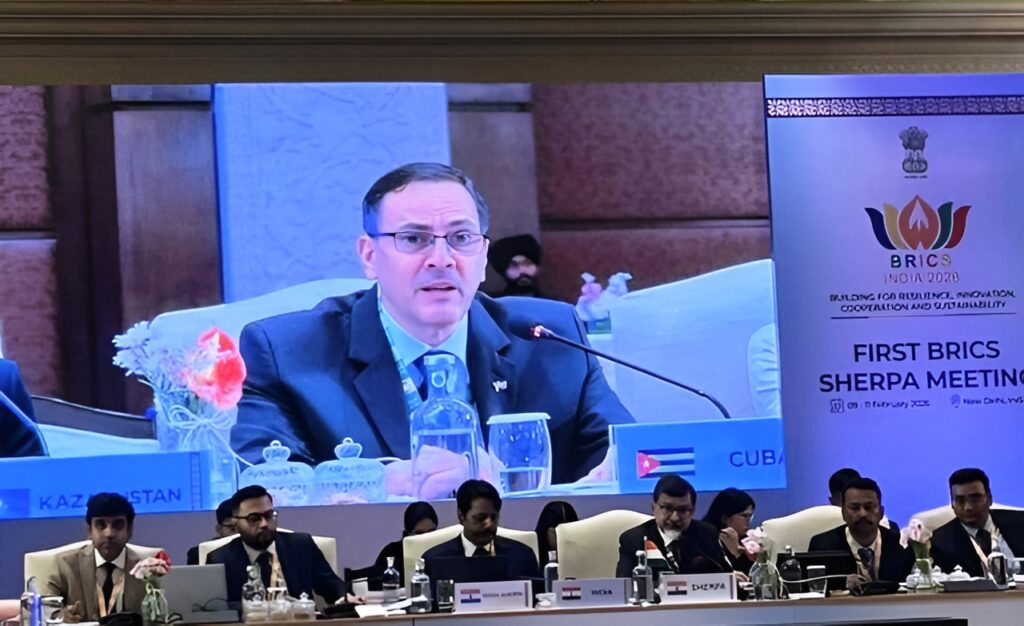
IMAGE: On Feb. 10, at the first BRICS Sherpa meeting, in New Delhi, India, Ambassador Juan Carlos Marsán describes the US administration’s new steps to starve Cubans to death as criminal. (Source: Tv Santiago)
That argument plays well in a bloc that now includes (amongst others) Egypt, Iran and Saudi Arabia, all states that have watched Washington’s double standard on Israeli violence with increasing alarm. The question is whether BRICS will remain a rhetorical comfort zone, or whether it can be converted into real tankers, credit lines and political shields when an associate member like Cuba is under immediate attack.
Test for multipolarity
So far, the responses from Russia, Mexico and China hint at solidarity, but also expose the jagged edges of this new “multipolar” world. Russia has moved fastest on the material front: its embassy in Havana confirms that shipments of crude and refined products are being prepared as humanitarian aid, following on from a 100,000‑tonne oil delivery extended on credit in February 2025. Kremlin spokesman Dmitry Peskov says the situation in Cuba is “indeed critical” and that it is wrong for one state to “strangle another country and its people,” while Deputy Foreign Minister Sergey Ryabkov promises ongoing “material and financial support” and calls on other BRICS members, including China, to step up—even as he admits it is too early to speak of a formal BRICS package. Russian analysts talk openly about modernising Cuban power plants, upgrading the grid and using these projects to anchor long‑term energy autonomy and dedollarised trade in the Caribbean.
Mexico’s position is more tortured but no less revealing. Under direct tariff threats from Trump, Pemex has halted crude exports to Cuba, freezing a trade that brought in about $496 million in 2025, less than 1% of Mexico’s production, but a lifeline for Havana. At the same time, President Claudia Sheinbaum has sent at least two navy ships to Havana with roughly 814 tonnes of food and hygiene supplies, but also powdered milk, rice, beans, canned fish and meat, cooking oil, and publicly promised more. She has acknowledged that her government is working diplomatically to restore oil supplies while trying to avoid direct US sanctions, a tightrope act that lays bare the coercive power of Trump’s order: even a large regional state that rejects the blockade is forced to choose between feeding Cuba and risking retaliation.
VIDEO: Two Mexican Navy ships carrying 814 tons of humanitarian aid dock in Havana (Source: Voice of Mexico | X)
Two Mexican Navy ships carrying 814 tons of humanitarian aid dock in Havana.
@JosefinaVidalF pic.twitter.com/IvglS13Ge7— Voice of Mexico (@VOMexico) February 12, 2026
China, for now, is waging its part of the fight in the diplomatic and narrative arena. Its foreign ministry has condemned the US energy blockade as the main driver of Cuba’s crisis, reaffirmed that Havana is a “good friend, good comrade and good brother,” and promised to continue providing support “to the best of its ability,” without spelling out volumes or timetables. Chinese media, echoing UN warnings, talk about zero imports in January, 10–15‑hour blackouts, hotel closures and empty petrol stations, but frame the story not as the failure of socialism that Western outlets prefer, rather as the latest test of whether Washington’s long arm can still dictate who in the Global South is allowed to buy fuel and from whom. In that story, Cuba’s bet on BRICS is not a romantic gesture. It is a direct challenge to the idea that survival itself must be cleared through the US Treasury.
Inside Havana, Díaz‑Canel has linked all of this together in a single line of argument. He insists Cuba is not a terrorist state, that it hosts no foreign military bases except the US enclave at Guantánamo imposed against its will, and that his government is ready to talk to Washington “without pressure, without preconditions,” but only on the basis of sovereignty, independence and self‑determination. According to Chinese and Russian reports, the offer hangs in the air, as Trump’s officials talk openly about using a full oil blockade to force regime change in Havana by the end of 2026, exactly as Gaza has been pulverised in the name of “security” and “deterrence.” UN experts warn that measures likely to produce shortages of food, medicine and essential services can amount to collective punishment under human‑rights law, yet the state driving this experiment sits in a permanent seat in New York, safe from any sanction of its own.
In the end, Cuban families will not measure multipolarity in communiqués or summit photos, but in kilowatt‑hours and kilos of rice: how many hours the power stays on, whether the bus runs, how far the ration book stretches, and whether their children can finish school without migrating. If Russian oil really arrives, if Mexican crude can quietly resume, if the New Development Bank can move money without being choked by secondary sanctions, then Cuba’s choice to join BRICS will look like the first tangible shield a small country has found against US economic warfare since 1945. If not, if the tankers are intercepted, if allies retreat under tariff threats, if the NDB stays cautious and slow, then Trump’s fuel blockade will stand as a brutal warning to every government in the Global South: step out of line, and we will turn out your lights, one substation at a time.
READ MORE SOUTH AMERICA NEWS AT: 21st CENTURY WIRE SOUTH AMERICA FILES
VISIT OUR TELEGRAM CHANNEL
SUPPORT OUR INDEPENDENT MEDIA PLATFORM – BECOME A MEMBER @21WIRE.TV
21st Century Wire is an alternative news agency designed to enlighten, inform and educate readers about world events which are not always covered in the mainstream media.
Source: https://21stcenturywire.com/2026/02/13/cuba-brics-and-the-battle-to-end-us-impunity/
Anyone can join.
Anyone can contribute.
Anyone can become informed about their world.
"United We Stand" Click Here To Create Your Personal Citizen Journalist Account Today, Be Sure To Invite Your Friends.
Before It’s News® is a community of individuals who report on what’s going on around them, from all around the world. Anyone can join. Anyone can contribute. Anyone can become informed about their world. "United We Stand" Click Here To Create Your Personal Citizen Journalist Account Today, Be Sure To Invite Your Friends.
LION'S MANE PRODUCT
Try Our Lion’s Mane WHOLE MIND Nootropic Blend 60 Capsules
Mushrooms are having a moment. One fabulous fungus in particular, lion’s mane, may help improve memory, depression and anxiety symptoms. They are also an excellent source of nutrients that show promise as a therapy for dementia, and other neurodegenerative diseases. If you’re living with anxiety or depression, you may be curious about all the therapy options out there — including the natural ones.Our Lion’s Mane WHOLE MIND Nootropic Blend has been formulated to utilize the potency of Lion’s mane but also include the benefits of four other Highly Beneficial Mushrooms. Synergistically, they work together to Build your health through improving cognitive function and immunity regardless of your age. Our Nootropic not only improves your Cognitive Function and Activates your Immune System, but it benefits growth of Essential Gut Flora, further enhancing your Vitality.

Our Formula includes: Lion’s Mane Mushrooms which Increase Brain Power through nerve growth, lessen anxiety, reduce depression, and improve concentration. Its an excellent adaptogen, promotes sleep and improves immunity. Shiitake Mushrooms which Fight cancer cells and infectious disease, boost the immune system, promotes brain function, and serves as a source of B vitamins. Maitake Mushrooms which regulate blood sugar levels of diabetics, reduce hypertension and boosts the immune system. Reishi Mushrooms which Fight inflammation, liver disease, fatigue, tumor growth and cancer. They Improve skin disorders and soothes digestive problems, stomach ulcers and leaky gut syndrome. Chaga Mushrooms which have anti-aging effects, boost immune function, improve stamina and athletic performance, even act as a natural aphrodisiac, fighting diabetes and improving liver function. Try Our Lion’s Mane WHOLE MIND Nootropic Blend 60 Capsules Today. Be 100% Satisfied or Receive a Full Money Back Guarantee. Order Yours Today by Following This Link.


| Visits: | 1,784,422,709 |
| Stories: | 8,597,989 |
Whistler Blowers, Insiders

