
Iran, Qatar and Trump’s New Gas Order: Was Europe’s Gas the Hidden Target?

Freddie Ponton
21st Century Wire
Ras Laffan burns, Hormuz chokes, and Trump’s envoy tells Europe to sign a $750 billion energy pact or lose its lifeline. Documents show this “shock” was structurally prepared in advance.
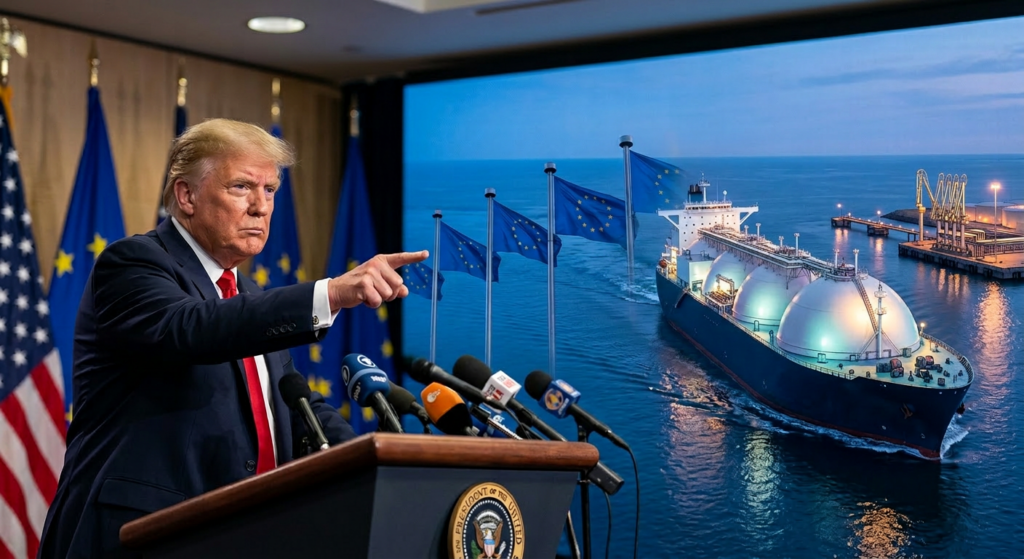
Trump did not need to say the quiet part out loud. His ambassador did it for him. As Europe reeled from the war’s shock to global gas markets, Washington warned Brussels that unless the EU passed the Turnberry trade deal intact, it could lose “favourable” access to U.S. liquefied natural gas, the very fuel Europe has come to depend on since the destruction of its old supply order.
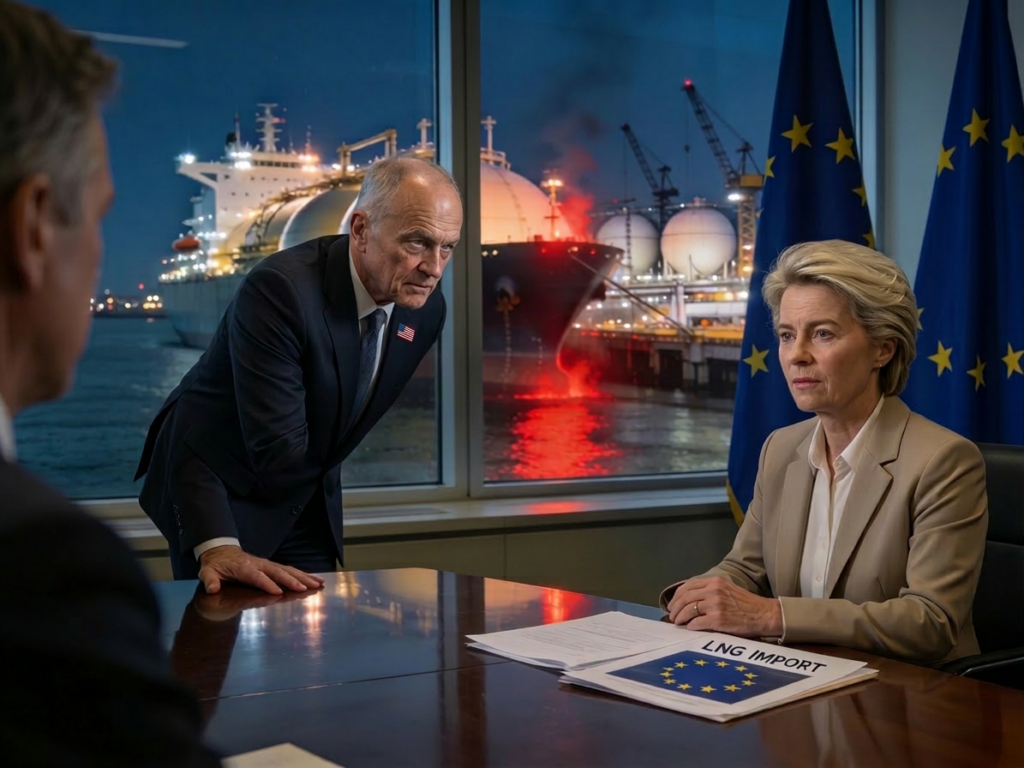
IMAGE: Washington’s LNG Ultimatum: A Stark Warning to a Wannabe Dependent Brussels
That threat came just as Iranian strikes knocked out an estimated 17% of Qatar’s LNG export capacity at Ras Laffan for three to five years, tearing a hole through one of the world’s most important gas hubs and tightening an already panicked market. At the same time, the Strait of Hormuz crisis exposed how fragile Europe’s post‑Russia energy system had become, with analysts already warning before this phase of the war that any major Gulf disruption would push Europe even deeper into dependence on U.S. LNG.
This is the part of the story readers are not supposed to look at. Beneath the language of “deterrence,” “security,” and “stability,” the illegal U.S.–Israeli war on Iran is also functioning as an accelerator for a gas order that was planned long before the first missiles hit. North American LNG expansion was already underway, the EU had already formalised an Eastern Mediterranean gas corridor through Israel and Egypt, and U.S. law had already folded those energy routes into a wider security architecture built around maritime control and critical infrastructure protection.
Those pieces were in place before the first bomb hit Ras Laffan; the war is simply switching them on. What is emerging now is not a chaotic by‑product of war, but a transfer of leverage, from Qatar and the Gulf to U.S. exporters and an Israeli‑linked East Med corridor, from public energy policy to a donor‑backed system of strategic coercion, and from Europe’s already battered consumers to the corporations and political networks cashing in on their dependency.
This article follows the paper trail. It does not rely on slogans or insinuation, but on official projections, signed memoranda, statutory language, corporate contracts, and lobbying records that, when read together, show a replacement architecture waiting for precisely this kind of rupture.
The replacement architecture
Long before the latest U.S.–Israel bombing campaign on Iran, North America was quietly preparing to dominate LNG exports. The U.S. Energy Information Administration (EIA) projected that North American liquefaction capacity would climb from roughly 11.4 billion cubic feet per day in early 2024 to 28.7 bcf/d by 2029, based on projects already under construction. A roster of U.S. and Canadian terminals, including Plaquemines, Corpus Christi Stage III, Golden Pass, Port Arthur, Rio Grande, CP2, and Woodside Louisiana LNG, was scheduled to come online between 2025 and 2029. This build‑out preceded the current war; it is infrastructure designed on the assumption that the world will need a lot more non‑Russian gas and that North America will sell it.
Ras Laffan’s destruction presented that infrastructure with a brutal opportunity. Iranian strikes on the complex in March wiped out a substantial slice of Qatar’s export capacity, according to QatarEnergy’s own briefings and independent reporting, a loss estimated at 12.8 million tonnes per year (MTPA) for three to five years, or $20 billion a year in lost revenue. Before the war, Qatar supplied roughly a fifth of global LNG. For Europe, which imported significant volumes from Qatar, this is not a marginal disruption, but the sudden removal of a core supplier.
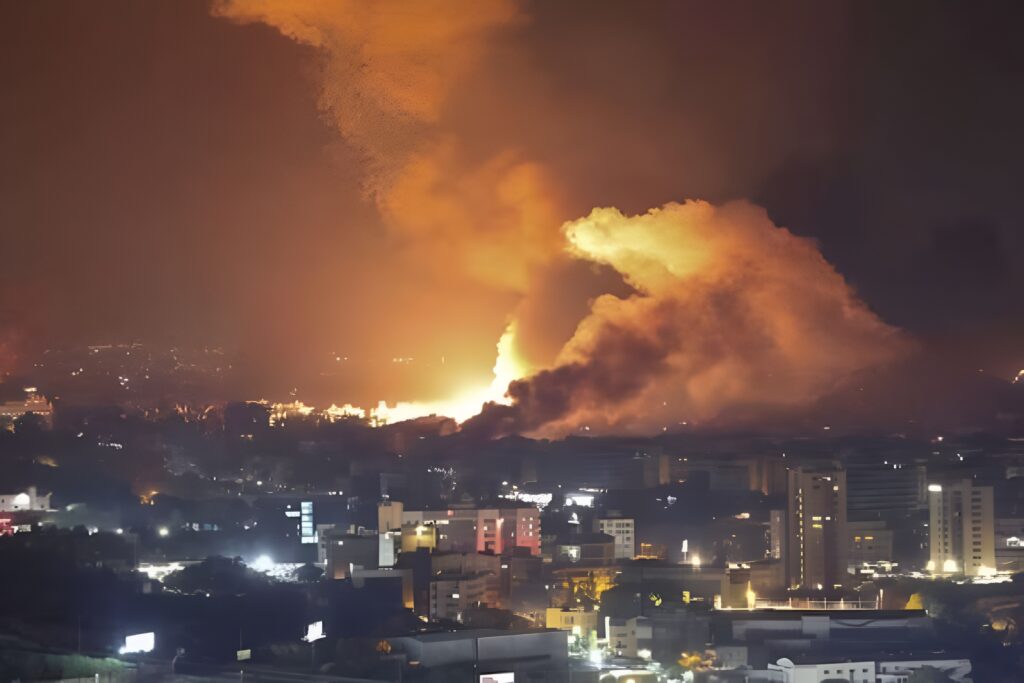
IMAGE: Ras Laffan gas facility in Qatar on fire after recent Iranian attack (Source: APA)
At the same time, the closure and partial re‑opening of the Strait of Hormuz choked off a major route for LNG and oil. European benchmarks spiked, with reports of gas prices doubling as traders priced in the risk that Gulf shipments could halt entirely. Italy, which sourced around a third of its LNG from Qatar (32% of its LNG mix), and other member states immediately faced higher import costs and fears of physical shortage.
None of this was unforeseeable. ACER’s 2024 LNG market report highlighted that LNG had become central to the EU’s security of supply and warned that Europe would remain exposed to LNG price volatility through the decade. A February 2026 analysis by the Institute for Energy Economics and Financial Analysis (IEEFA) warned that Europe’s post‑Ukraine pivot had created a new asymmetric dependency on U.S. LNG; if existing and announced contracts were fully realised, U.S. cargoes could provide up to 80% of EU LNG imports by 2030, and any serious Gulf disruption would harden that dependence.
The EU’s diversification initiative had already designated new sources and routes. Commission documents describe the Mediterranean as a key area for diversification, explicitly pointing to offshore gas in Israel, Egypt and Cyprus and noting that these resources can reach Europe both via pipeline and as LNG. In June 2022, the EU, Israel and Egypt signed a memorandum to export gas from Israel and other regional fields to Europe via Egypt’s LNG terminals. The text commits the parties to “stable delivery,” acceleration of exports, a regulatory roadmap, promotion of European investment in exploration and a safety framework for gas infrastructure.
Even before Ras Laffan went offline and Hormuz became a war zone, Europe’s fallback was clear, promising U.S. LNG as the backbone, and Eastern Mediterranean gas as the flank.
From security law to gas corridor
The Eastern Mediterranean gas route is not just a commercial project, because it is written into the language of security.
Section 2373 of Title 22 of the U.S. Code directs the US administration to support energy cooperation among Israel, Greece and Cyprus, including through backing for gas pipelines and LNG terminals that can help diversify European supply away from Russia. It also calls for U.S. participation in regional dialogue on energy security, maritime security, cybersecurity and the protection of critical energy infrastructure.
By late 2025, this thinking had been translated into the 3+1 format that brings together Israel, Greece, Cyprus and the United States. A joint statement from their November 2025 ministerial in Athens reaffirms the four governments’ “commitment to energy security and stability in the Eastern Mediterranean,” endorses existing and planned gas and electricity interconnection projects, and emphasises cooperation to protect critical energy infrastructure from threats.
On the European side, the 2022 EU–Israel–Egypt MoU sits at the intersection of this energy‑security matrix and EU diversification policy. The document foresees “stable deliveries” of gas to the EU via Egyptian LNG plants, commits the parties to explore ways to accelerate exports, and establishes mechanisms for regulatory cooperation, investment promotion and safety. It also includes confidentiality clauses and provisions for regular meetings. This can not be regarded as a symbolic handshake and should be understood as an operational framework.
Analyses from 2022–2025 describe Eastern Mediterranean gas as a tool for European energy security and discuss its role in alliance politics and infrastructure protection. NATO and EU work on critical maritime, transport, and energy infrastructure, particularly after the Nord Stream sabotage, further embeds pipelines and LNG terminals in a broader security mindset.
All this existed before the first wave of U.S.–Israeli strikes on Iran in 2026. When the war closed Hormuz and damaged Ras Laffan, it did not create a new strategic interest in Eastern Med gas. It made an existing, security‑branded corridor suddenly more valuable.
The Trump–LNG complex
Overlay this landscape with Trump’s return to power, and the picture becomes even sharper.
In April 2024, Trump invited senior fossil‑fuel executives to Mar‑a‑Lago. Reporting on the meeting describes him asking them to raise $1 billion for his campaign and promising, in exchange, to lift Biden’s pause on LNG export permits “on day one”. Among those present were Mike Sabel, the CEO of Venture Global LNG, and Jack Fusco, CEO of Cheniere Energy, the largest U.S. LNG exporter.
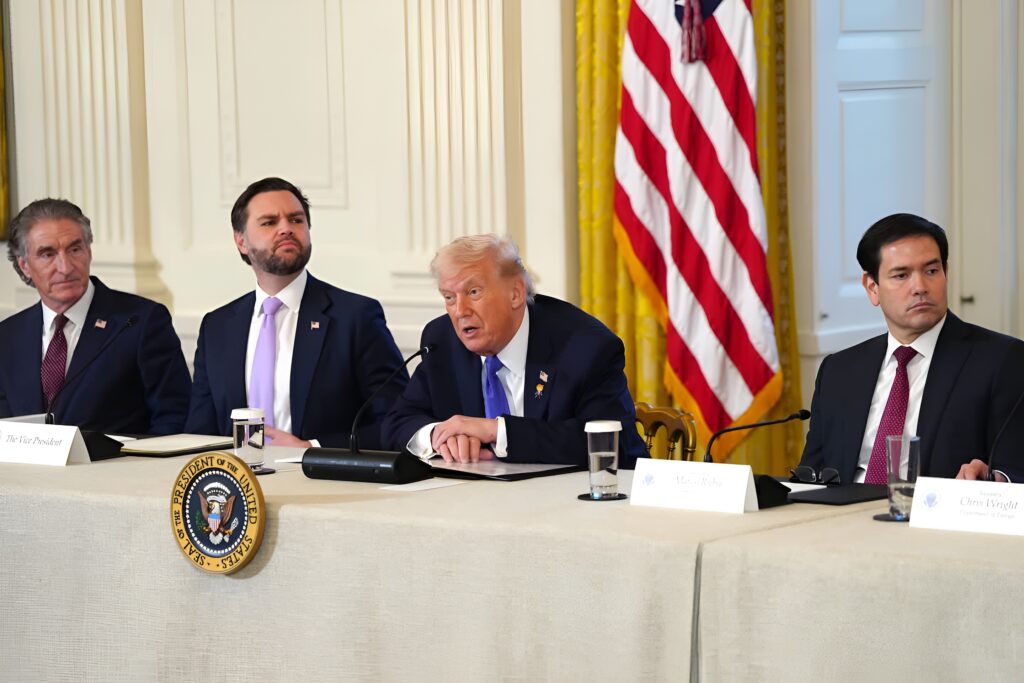
IMAGE: President Trump spoke during a meeting with oil and gas executives in the East Room of the White House on Friday. From left: Secretary of the Interior Doug Burgum, Vice President JD Vance, and Secretary of State Marco Rubio.(Source: TIERNEY L. CROSS/NYT)
Trump followed through. In March 2025, the Department of Energy approved exports from Venture Global’s CP2 LNG terminal in Louisiana, reversing the earlier pause. Venture Global immediately hailed the decision as a win for “U.S. energy dominance,” pledging to begin delivering LNG from CP2 by 2027 and pointing to contracts with European buyers. The company has since signed a 20‑year deal for 2 mtpa from CP2 with Italy’s Eni and Germany’s SEFE … took a 0.75 mtpa CP2 contract.
Cheniere, for its part, benefited from a different kind of favour. Investigations found that the company received roughly $370 million in “alternative fuel” tax credits under the Trump administration, despite LNG not being what most people would consider an alternative, low‑carbon fuel. Two months after the Mar‑a‑Lago meeting, Cheniere’s CEO made nearly half a million dollars in contributions to Trump‑aligned committees and the Republican National Committee.
Global Witness identified at least 44 fossil‑fuel‑linked donors giving more than $19 million to Trump’s second inaugural fund, including Chevron, ExxonMobil, ConocoPhillips, Occidental and gas‑heavy utilities; further reporting shows gas‑heavy utilities also wrote large checks. LNG Allies, a U.S. LNG lobbying group, spent years working with Central and Eastern European governments and U.S. agencies to expand American gas exports to Europe and later pushed hard to weaken EU methane rules that could constrain U.S. LNG.
By mid‑2025, when Trump and European Commission president Ursula von der Leyen agreed at Turnberry on a framework committing the EU to buy $750 billion of U.S. energy by 2028, the pieces were in place: a loyal group of LNG CEOs and fossil‑fuel donors and newly approved export projects geared toward Europe.
When Ras Laffan was damaged, and Hormuz became a warzone, Trump’s team did not have to improvise. They had a deal on the table and a set of exporters ready to deliver. In March 2026, ambassador Andrew Puzder repeated the threat in public, telling the Financial Times that if the European Parliament amended or rejected the Turnberry legislation, “the terms may not be as favourable” and there were “other buyers out there.”
Europe’s lock‑in
Europe’s role in this story is not simply that of a victim; it is also an active partner in its own entrapment.
Italy’s Eni has been one of the most aggressive European buyers of U.S. LNG. In July 2025, it signed a 20‑year deal for 2 mtpa from CP2, adding to earlier contracts for Plaquemines and Calcasieu Pass cargoes. Venture Global’s CP2 is now positioned as a major supplier to Europe. Germany’s Securing Energy for Europe GmbH (SEFE), the state‑owned successor to Gazprom Germania, took its own CP2 contract as part of its effort to replace Russian pipeline gas.

IMAGE: Montoir LNG transhipment operations are keeping St Nazaire’s fleet of escort/berthing tugs busy (Source: Riviera)
Across the continent, utilities and traders, from Engie and RWE to Uniper and Shell’s European arm, have filled their portfolios with long‑term U.S. supply contracts since 2022, feeding gas into a rapidly expanded network of LNG terminals. Rotterdam has become a major hub for transatlantic cargoes. New floating terminals in Wilhelmshaven and Brunsbüttel were rushed into service as “emergency” projects. Greece has pushed new FSRUs in Alexandroupolis and elsewhere as part of a “vertical corridor” to feed the Balkans and Central Europe. ACER’s monitoring reports concede that this strategy has made it possible to survive two winters without Russian pipeline gas, but also that LNG will remain central to EU security of supply through the 2020s and that long‑term contracts are taking a growing share of the market.
IEEFA warns bluntly that the EU is at risk of trading one dependency, on Russia, for another, on U.S. LNG, especially if it locks in large volumes on long timeframes.

IMAGE: Strait of Hormuz chokepoint and shipping risk (Source: Alamy Photo)
Meanwhile, the Eastern Mediterranean diversification route, through Israel, Egypt and Cyprus, comes with its own political cost. The EU–Israel–Egypt MoU was signed while Israel was already deepening its occupation and siege policies; legal and human rights analyses, including one from BADIL, warned at the time that the EU was effectively endorsing the exploitation of Palestinian offshore resources and cementing ties with an apartheid regime in the name of energy security. Today, that corridor is being promoted in think‑tank papers and op‑eds as a way to “reduce reliance on hostile suppliers,” a phrase that covers both Russia and Iran’s allies in the Gulf.
For European households, the stakes are not abstract. After the Iran war escalated and Hormuz was disrupted, benchmark gas prices in Europe jumped sharply; analyses noted more than 100% increases compared to pre‑war levels. Households that had just endured a cost‑of‑living crisis triggered by the Ukraine war now face another spike, even as political leaders in Brussels insist they must accept a transatlantic energy pact as the price of “security.”
Europe has made a series of choices that leave it with fewer options, just as the U.S. and Israel prosecute a war that degrades alternative suppliers. Italian and German contracts with U.S. exporters, EU blessing for East Med gas, and rushed LNG infrastructure together create an environment in which Trump can credibly threaten to turn off the tap.
What we know vs. what remains unknown
The record assembled here allows for clear statements—and shows where honest uncertainty remains.
It is established that North America’s LNG expansion was planned years before the current war and is on track to add enough capacity to cover, on paper, the volumes lost from Ras Laffan and much of the Russian pipeline shortfall. European regulators, analysts and market actors had already mapped a future of deep LNG dependence, and once war tightened supply, Trump’s ambassador openly used that dependence as leverage to force through the Turnberry‑era $750 billion energy commitment. The EU, Israel and Egypt formalised a framework to move East Med gas to Europe via LNG in 2022, complete with mechanisms for acceleration, regulation, investment and safety. U.S. law and 3+1 ministerials fused Eastern Med energy routes with security, infrastructure protection and alliance management well before the Iran war. And Trump is personally connected to CEOs and donors at the heart of the U.S. LNG export boom, as documented in the Mar‑a‑Lago reporting and donor investigations cited above.
This is enough to say that the economic exploitation of the war is not incidental. The beneficiaries, mainly U.S. LNG exporters, their political patrons, and the institutions backing an Eastern Mediterranean corridor, built the machinery to profit from a Gulf shock in advance, recognised Europe’s vulnerability, and have moved aggressively to monetise the crisis.
What remains unknown, because the documents have not yet surfaced, is whether key decision‑makers actively saw war with Iran, or the degradation of Qatar and Hormuz, as a desirable catalyst for this energy order. To move from structural evidence to decision evidence, investigators would need access to pre‑war scenario planning in U.S., Israeli and EU ministries and NATO bodies that explicitly discuss Iran escalation or Hormuz closure not only as a risk but as a catalyst for consolidating U.S./East Med‑centric supply. They would need internal communications between the Trump administration and LNG executives around the time of the Mar‑a‑Lago meeting, CP2 approvals and Turnberry preparations, to see whether conflict in the Gulf was framed as a commercial opportunity. They would also need EU–U.S. diplomatic cables and non‑papers from 2024–2025 that mention Iran, Gulf infrastructure risks and the energy pillar of Turnberry in the same context, and background papers for 3+1 ministerials and Eastern Med summits that connect regional conflict scenarios to the strategic importance of East Med gas exports to Europe. We are confident that WikiLeaks and others would want to explore this further.
These are not fantasy documents. They are the sort of material that parliamentary commissions, investigative journalists and civil society organisations can and should seek through access‑to‑information laws and whistleblower channels. For readers in Europe, the “what next” is not just a call to be outraged at U.S. and Israeli policy; it is a demand to scrutinise their own governments. The European Parliament, national parliaments in Berlin, Rome and Athens, and oversight bodies should demand full transparency on all long‑term LNG contracts signed since 2022, including pricing formulas, destination clauses and termination conditions. They should open inquiries into the role of U.S. and Israeli officials, as well as LNG lobby groups, in shaping EU energy policy during the Turnberry negotiations, and they should press for publication of risk assessments and scenario studies on Hormuz, Ras Laffan and Eastern Med infrastructure prepared before the war.
Until those questions are answered, one conclusion is already justified: the illegal U.S.–Israeli assault on Iran is unfolding inside an energy system that was structured in advance to make such a war profitable for a narrow set of exporters and their political allies. The missiles and drones are instruments of military power, but they are also, whether by design or by opportunism, the enforcement mechanism of a new gas regime, one that asks ordinary Iranians, Qataris and Europeans to pay the price so that a handful of companies and presidents can cash in.
21st Century Wire is an alternative news agency designed to enlighten, inform and educate readers about world events which are not always covered in the mainstream media.
Source: https://21stcenturywire.com/2026/03/24/iran-qatar-and-trumps-new-gas-order-was-europes-gas-the-hidden-target/
Anyone can join.
Anyone can contribute.
Anyone can become informed about their world.
"United We Stand" Click Here To Create Your Personal Citizen Journalist Account Today, Be Sure To Invite Your Friends.
Before It’s News® is a community of individuals who report on what’s going on around them, from all around the world. Anyone can join. Anyone can contribute. Anyone can become informed about their world. "United We Stand" Click Here To Create Your Personal Citizen Journalist Account Today, Be Sure To Invite Your Friends.
LION'S MANE PRODUCT
Try Our Lion’s Mane WHOLE MIND Nootropic Blend 60 Capsules
Mushrooms are having a moment. One fabulous fungus in particular, lion’s mane, may help improve memory, depression and anxiety symptoms. They are also an excellent source of nutrients that show promise as a therapy for dementia, and other neurodegenerative diseases. If you’re living with anxiety or depression, you may be curious about all the therapy options out there — including the natural ones.Our Lion’s Mane WHOLE MIND Nootropic Blend has been formulated to utilize the potency of Lion’s mane but also include the benefits of four other Highly Beneficial Mushrooms. Synergistically, they work together to Build your health through improving cognitive function and immunity regardless of your age. Our Nootropic not only improves your Cognitive Function and Activates your Immune System, but it benefits growth of Essential Gut Flora, further enhancing your Vitality.

Our Formula includes: Lion’s Mane Mushrooms which Increase Brain Power through nerve growth, lessen anxiety, reduce depression, and improve concentration. Its an excellent adaptogen, promotes sleep and improves immunity. Shiitake Mushrooms which Fight cancer cells and infectious disease, boost the immune system, promotes brain function, and serves as a source of B vitamins. Maitake Mushrooms which regulate blood sugar levels of diabetics, reduce hypertension and boosts the immune system. Reishi Mushrooms which Fight inflammation, liver disease, fatigue, tumor growth and cancer. They Improve skin disorders and soothes digestive problems, stomach ulcers and leaky gut syndrome. Chaga Mushrooms which have anti-aging effects, boost immune function, improve stamina and athletic performance, even act as a natural aphrodisiac, fighting diabetes and improving liver function. Try Our Lion’s Mane WHOLE MIND Nootropic Blend 60 Capsules Today. Be 100% Satisfied or Receive a Full Money Back Guarantee. Order Yours Today by Following This Link.


| Visits: | 1,797,317,886 |
| Stories: | 8,623,143 |
Whistler Blowers, Insiders

