

Iran’s Naval Basij Turned Hormuz into a Graveyard for US-Israeli Arrogance

 Freddie Ponton
21st Century Wire
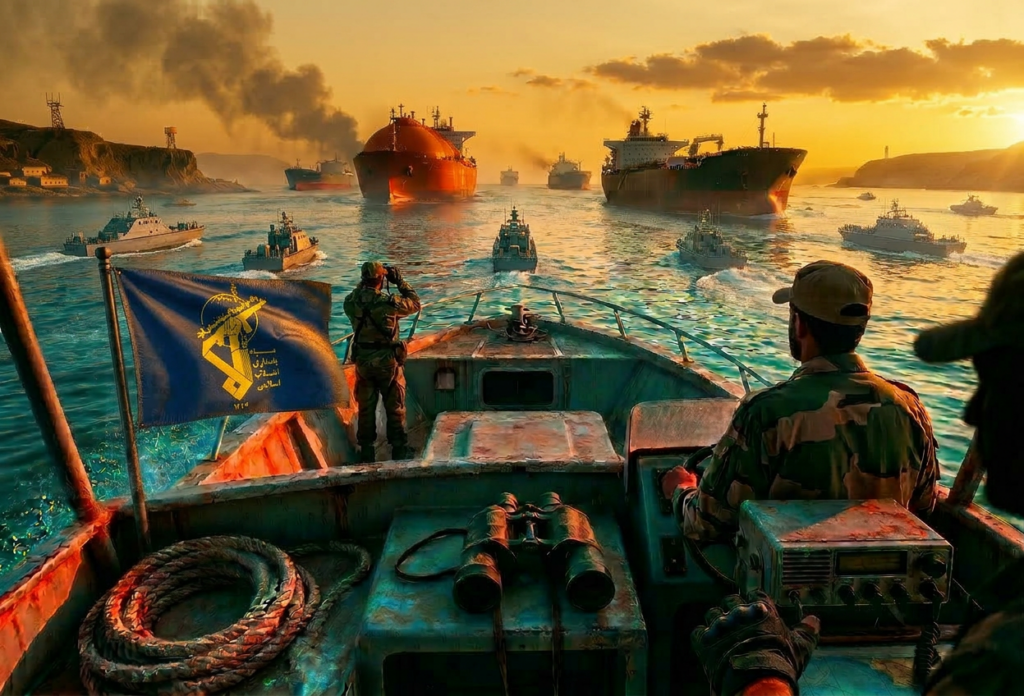
Iran did not formally close the Strait of Hormuz, but through the IRGC Navy and its Naval Basij, it has built a distributed maritime deterrent capable of making insurers, shippers, and foreign militaries behave as if the old freedom of passage is already gone.
Iran says it has not officially closed the Strait of Hormuz, as Iranian Deputy Foreign Minister Saeed Khatibzadeh stated in a Bernama report from New Delhi. The ships hearing IRGC warnings to stop, remain silent, and think twice before moving know that formal language is no longer the point, as described in this Awaz the Voice report on the “remain silent” order. Somewhere between diplomacy and deterrence, between legal deniability and real fear on the water, Tehran has found a way to tighten its grip on the world’s most critical oil chokepoint without making the declaration Washington and Tel Aviv would most like to legally exploit. Whatever maritime-law objections those two capitals may raise, Article 51 of the UN Charter preserves the inherent right of self-defence if an armed attack occurs against a UN member, which leaves states accused by Iran of launching the assault in a weak position to posture as guardians of legal restraint. Their sudden reverence for rules they routinely disregard would look less like principle than raw double standard.
The force that makes this possible is not a conventional fleet but a reported Naval Basij of 55,000 volunteers and 33,000 vessels, described by IRGC Navy commander Alireza Tangsiri in both Tasnim’s report on the “ocean-going mobilisation forces” and Mehr News’ report on the recruitment of 55,000 naval Basij forces. Those numbers sound almost absurd when measured against the polished hierarchy of Western military power, and that is precisely the point. Iran has spent years turning scarcity into doctrine, sanctions into adaptation, and small civilian-type craft into the raw material of maritime resistance. Reportedly, these locally operated vessels are armed with weapons such as 107 mm rockets and organised through coastal communities. In a waterway through which roughly one-fifth of global oil consumption passes, that kind of resistance does not have to defeat the United States Navy in a cinematic battle to matter, because even shipping and legal analysis now treat Hormuz as a zone of practical deterrence and severe commercial risk.
A Fleet From Siege
The Naval Basij did not appear from nowhere, because it grew out of the longer history of the Basij as a mass mobilisation institution inside the Islamic Republic and out of Iran’s wider doctrine of decentralised defense. The maritime turn announced in late 2023 fits that logic, and it was publicly framed by Tangsiri as the next stage after the earlier maritime Basij experience in the Persian Gulf, outlined in both the Tasnim account and the Mehr version. Those reports stated that the force comprised around 55,000 volunteers and 33,000 vessels, and that its ocean-going arm involved larger boats and launches capable of operating as far as Tanzania.
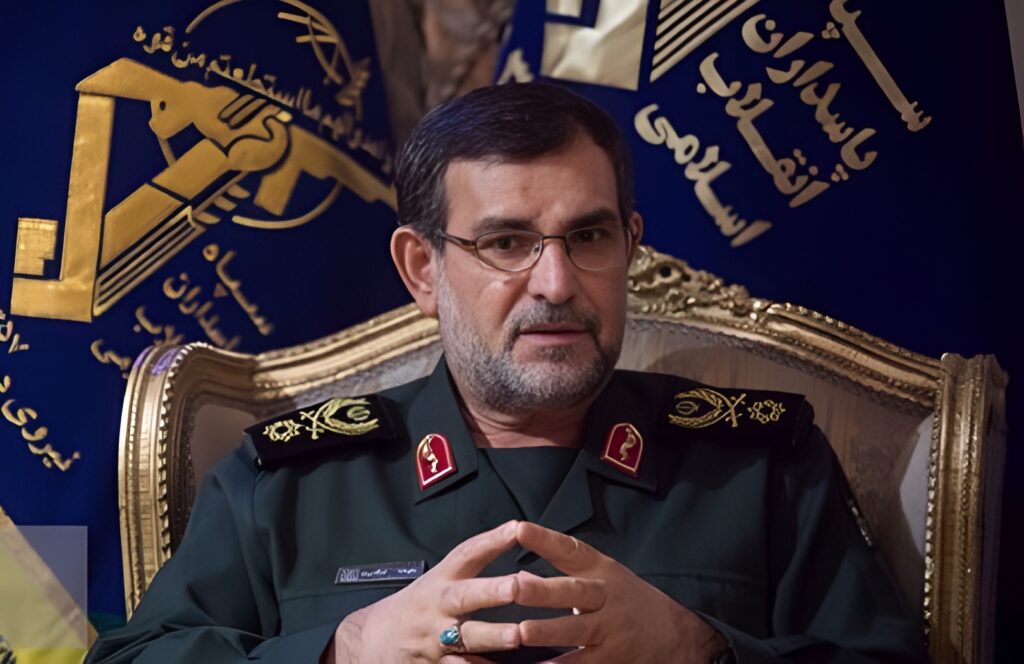
IMAGE: Rear Admiral Alireza Tangsiri, commander of Iran’s Islamic Revolution Guards Corps (IRGC) Navy, speaks during an interview with ISNA (Source: ISNA news agency)
Persian- and Iran-focused coverage pushed the story further than many English-language summaries. Iran International reported that Tangsiri described the force as a “shadow navy” with a presence in coastal villages in southern Iran and vessels filled with rockets. A substantial number of coastal villages have been equipped with military vessels operated by popular forces, which gives the Basij a social and territorial depth very different from a centralised naval base. This detail matters because it suggests a force designed to survive attrition, absorb losses, and keep functioning even if larger IRGC Navy assets are pressured or struck.
Southern Iran’s maritime world has never been neatly divided into military and civilian boxes, and the Naval Basij draws strength from exactly that overlap. Fishing towns, island communities, mechanics, dock workers, and boat owners bring local knowledge of tides, inlets, routes, and concealment that no sanctions regime can easily erase. That is what gives the force its distinctly Iranian character. It is not merely a navy with fewer resources. It is a maritime mobilisation built from the social fabric of the coastline itself.
How It Works
The real strength of the Naval Basij lies in the fact that it is not a patriotic ornament sitting beside the IRGC Navy, but a distributed layer inside it. Tasnim, Mehr, and Iran International all described the force as operating through local sailors, coastal villages, and armed small vessels, which together suggest a doctrine based on dispersed launch points, concealment, local observation, and rapid support to wider IRGC Navy operations rather than a conventional fleet order of battle.
Regional reporting described many of the vessels as light craft or launches, highly mobile, and ready to deploy at any time of the day, on very short notice for swarm or irregular maritime missions. That combination makes them dangerous, not because any single boat is decisive, but because hundreds or thousands of low-signature craft tied to a wider architecture of coastal missiles, drones, radio surveillance, and fast-attack vessels can saturate the theatre with uncertainty.
The 2026 Hormuz crisis offered the clearest glimpse of how this logic works in practice. Recent reports confirm that vessels were effectively told not to move and that even small shifts in position could invite attack. The IRGC claimed to have targeted numerous vessels, described foreign tankers sitting stationary in the strait, and the Tasnim report quoted Rear Admiral Tangsiri as saying that any vessel seeking to sail through the Strait of Hormuz had to obtain Iran’s approval.
VIDEO: A field documentary from the heart of the Persian Gulf and the Strait of Hormuz shows vessels ordered to remain silent and stationary, with movement itself treated as a trigger for possible IRGC targeting. (Source: PressTV video on X)
A field documentary from the heart of the Persian Gulf and the Strait of Hormuz, which shows vessels that remain silent—yet are targeted by the IRGC if they shift even a few meters.
Follow https://t.co/B3zXG73Jym pic.twitter.com/XBqz6bWwq0
— Press TV (@PressTV) March 12, 2026
Whether or not every battlefield claim can be independently verified in real time, the operational significance is clear. Iran was not merely issuing rhetoric. It was creating a controlled maritime environment in which movement itself became a trigger for risk.
That is where Hill Dickinson’s shipping-law analysis of the Strait of Hormuz crisis is most useful, not as the final word on the legitimacy of Iran’s position, but as evidence that the waterway had already become “effectively blocked” in practice for commercial operators. The memo reflects an orthodox maritime-law view that IRGC VHF warnings do not by themselves create a lawful navigation ban under international law and UNCLOS, yet the same analysis concedes that attacks had been reported, vessels were trapped or waiting, and shipping companies were urgently reassessing exposure. In other words, even a conservative industry legal note was forced to acknowledge the material success of Iran’s strategy in turning Hormuz into a zone of exceptional danger without a formally declared closure. That point matters even more when set beside Tehran’s official position, because Iranian Deputy Foreign Minister Saeed Khatibzadeh stated publicly that Iran had not closed the strait and would announce such a step openly if it chose to take it. Read together, the two sources suggest not a legal contradiction so much as a deliberate strategy in which Iran avoided the formal language of closure while still imposing a wartime deterrent regime on a chokepoint through which global energy flows depend
Tehran’s diplomatic line is that Iran had not closed the Strait and had no intention of doing so until further notice, while also accusing the United States and Israel of creating the regional crisis. The IRGC, meanwhile, was shaping the lived reality on the water through warnings, pressure, and the credible threat of localised enforcement with the help of The Naval Basij which make that threat believable because it gives Iran a mass of cheap, proximate, locally embedded craft able to feed information, complicate targeting, support interdiction, and create the sense that the strait can tighten around any intruder at short notice.
The Price of Pressure
This is the part mainstream coverage rarely wants to confront. That same double standard we saw on display at the United Nations on March 10, when the Security Council adopted Resolution 2817 condemning Iran’s attacks, even though the UN’s own meeting summary acknowledged that the war “began with Israeli and United States airstrikes against Iran on 28 February.” As The National reported, Iran’s ambassador denounced the resolution as a “manifest injustice” because the attack on Iran itself and those who launched it were effectively pushed out of view, a silence that says everything about how international legality is so often weaponised against the victim and withheld from the aggressor.
The Naval Basij is not an irrational outgrowth of Iranian belligerence. It is a rational answer to prolonged siege, military pressure, and decades of confrontation. The same sources that describe the force’s scale and local embedding also show how Iran has answered sanctions and strategic isolation by building a maritime deterrent from the people and tools still available to it. That does not mean every claim made for the force should be accepted uncritically, nor does it mean Iran would emerge unscathed from a direct maritime war with the United States. What it does mean is that the old imperial assumption of effortless mobility in Hormuz has been badly damaged.
The strongest takeaway is also the most politically uncomfortable one. Washington and Tel Aviv may have helped create the exact form of maritime resistance they now fear most, not a mirror-image navy they can count, rank, and destroy, but a socialized deterrent spread across docks, islands, repair yards, village crews, and small boats whose power lies in numbers, proximity, deniability, and the willingness to absorb risk in defense of home.
That is why the story of the Naval Basij matters beyond Iran and beyond Hormuz. It is a warning that overwhelming military superiority does not automatically translate into control, and that a nation under relentless pressure can still discover ways to make an empire hesitate.
21st Century Wire is an alternative news agency designed to enlighten, inform and educate readers about world events which are not always covered in the mainstream media.
Source: https://21stcenturywire.com/2026/03/12/irans-naval-basij-turned-hormuz-into-a-graveyard-for-us-israeli-arrogance/
Anyone can join.
Anyone can contribute.
Anyone can become informed about their world.
"United We Stand" Click Here To Create Your Personal Citizen Journalist Account Today, Be Sure To Invite Your Friends.
Before It’s News® is a community of individuals who report on what’s going on around them, from all around the world. Anyone can join. Anyone can contribute. Anyone can become informed about their world. "United We Stand" Click Here To Create Your Personal Citizen Journalist Account Today, Be Sure To Invite Your Friends.
LION'S MANE PRODUCT
Try Our Lion’s Mane WHOLE MIND Nootropic Blend 60 Capsules
Mushrooms are having a moment. One fabulous fungus in particular, lion’s mane, may help improve memory, depression and anxiety symptoms. They are also an excellent source of nutrients that show promise as a therapy for dementia, and other neurodegenerative diseases. If you’re living with anxiety or depression, you may be curious about all the therapy options out there — including the natural ones.Our Lion’s Mane WHOLE MIND Nootropic Blend has been formulated to utilize the potency of Lion’s mane but also include the benefits of four other Highly Beneficial Mushrooms. Synergistically, they work together to Build your health through improving cognitive function and immunity regardless of your age. Our Nootropic not only improves your Cognitive Function and Activates your Immune System, but it benefits growth of Essential Gut Flora, further enhancing your Vitality.

Our Formula includes: Lion’s Mane Mushrooms which Increase Brain Power through nerve growth, lessen anxiety, reduce depression, and improve concentration. Its an excellent adaptogen, promotes sleep and improves immunity. Shiitake Mushrooms which Fight cancer cells and infectious disease, boost the immune system, promotes brain function, and serves as a source of B vitamins. Maitake Mushrooms which regulate blood sugar levels of diabetics, reduce hypertension and boosts the immune system. Reishi Mushrooms which Fight inflammation, liver disease, fatigue, tumor growth and cancer. They Improve skin disorders and soothes digestive problems, stomach ulcers and leaky gut syndrome. Chaga Mushrooms which have anti-aging effects, boost immune function, improve stamina and athletic performance, even act as a natural aphrodisiac, fighting diabetes and improving liver function. Try Our Lion’s Mane WHOLE MIND Nootropic Blend 60 Capsules Today. Be 100% Satisfied or Receive a Full Money Back Guarantee. Order Yours Today by Following This Link.


| Visits: | 1,792,901,688 |
| Stories: | 8,614,691 |
Whistler Blowers, Insiders

