

The Lady in the Black Dress: From Zionist Smuggler to Gaza’s Deportation Architect


Freddie Ponton
21st Century Wire
Gaza did not become a laboratory of expulsion overnight. It was turned into one by planners, brokers, generals, travel agents, and politicians who looked at a trapped Palestinian population and saw not families rooted in a homeland, but a demographic obstacle to be thinned, rerouted, and erased. The history is not marginal to the zionist project. It sits inside Israel’s bureaucratic memory, its migration networks, and its long habit of dressing forced removal in the language of administration and opportunity.
IMAGE: Ada Sereni (Source: Wikimedia Commons)

At the centre of that machinery stood Ada Sereni, later mythologised in Israeli memory as the Lady in the Black Dress, a wealthy Roman Jewish Zionist operative who helped organise clandestine Jewish migration to Palestine and later became entangled in efforts to push Palestinians out of Gaza. Most readers have never heard of her, which is part of what makes the story so revealing, because Sereni sits precisely where sanctified Zionist legend merges with the practical logistics of Palestinian removal.
Recent reporting by +972 Magazine and the investigative podcast Palestinians in Paraguay reopened this buried chapter by reconstructing the Paraguay scheme through deportee testimony and archival evidence. This article builds on that work by widening the lens beyond Paraguay itself, tracing the Italian political network around Sereni, the failed Libya and Uruguay routes, and the bureaucratic continuity that runs from the post-1967 occupation into today’s language of “voluntary emigration.”
By the time Gaza fell under Israeli occupation in 1967, Sereni was no longer merely a figure from the mythology of wartime rescue but a seasoned broker whose career had taught her how to move human beings across borders by combining state indulgence, elite mediation, and quiet deception. Her rise was institutional rather than romantic.
Rome’s Smuggling State
In postwar Italy, she operated inside a triangle that joined Mossad Le’Aliyah Bet, the Italian Interior Ministry and state security apparatus, and the orbit of Alcide De Gasperi. De Gasperi publicly aligned Italy with British restrictions on Jewish migration, yet accounts of Sereni’s career describe a deliberate policy of looking the other way while her networks ferried migrants through Italian ports, creating a practical loophole inside the Mediterranean border regime. Sereni cultivated figures at the highest level while also dealing directly with local port authorities and naval personnel, and she later described that world in her memoir “I clandestini del mare.”
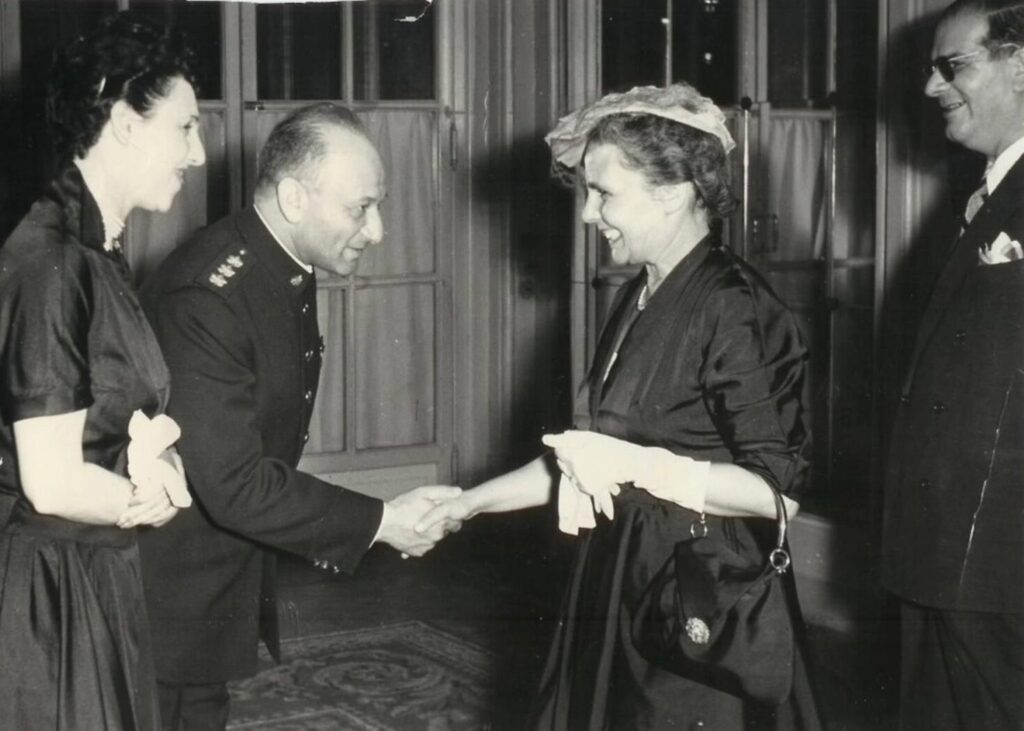
IMAGE: Alcide De Gasperi shakes hands with Ada Sereni (Source: go2films)
She also worked alongside Raffaele Cantoni, then president of the Italian Jewish Communities, whose links to the American Jewish Joint Distribution Committee, the World Jewish Congress, and the Italian Zionist Federation helped root the operation in transnational Jewish institutional power. This was not a rogue operation concealed in the shadows of a weak state. It was a political arrangement in which a postwar Christian Democratic government found uses for a Zionist smuggling network that could relieve refugee pressure, undermine British control, and operate through deniable channels.
After 1948, Sereni remained an influential Zionist intermediary inside Italy’s ruling world, using her Roman aristocratic Jewish Zionist pedigree to lobby for Soviet Jewish emigration to Israel. She later co-founded the Ramat Aviv Hotel in Tel Aviv with Yehuda Arazi (Tennenbaum), codename “Alon”, the Haganah operative who ran the Italy branch of Mossad Le’Aliyah Bet, and with Maurizio Vitale, tying political influence, tourism capital, and migration logistics into a single postwar ecosystem. This background matters because when Israel needed someone who understood how to turn states, paperwork, and travel channels into a human pipeline, Ada Sereni was already trained for that role.
From Gaza to Paraguay
That role sharpened after the 1967 war, when Levi Eshkol and the Israeli leadership suddenly confronted the fact that occupation had brought more than a million Palestinians under direct Israeli control. The question inside official circles was not how to end the occupation but how to manage and reduce the Palestinian population now living under it. Sereni was brought into that world as Israel explored ways to encourage Gazans to leave through incentives, pressure, and covert relocation schemes, including an early concept involving Libya.
The Libya idea, born out of Israel’s desire to create a Jewish majority in the Land of Israel, failed for reasons deeper than logistics, because any serious attempt to push Gazans into Libya under King Idris and later Muammar Qaddafi would have collided with Arab League pressure and the wider politics of Palestinian exile across the Arab world. Libya was embedded in Arab nationalist and anti-colonial politics and openly hostile to Israel, which made it an implausible destination for an Israeli-managed transfer scheme. The Israeli Foreign Ministry, under the leadership of Abba Eban, also considered settling Arab refugees in Somalia and even in Tunisia and Algeria. The idea collapsed, but the intention behind it did not. Israel did not abandon the search for a place to send Palestinians. It simply searched farther afield.
That search moved through Uruguay and into Paraguay. Under Golda Meir’s government, Israeli cabinet-level approval was given in 1969 to a plan to move up to 60,000 Palestinians from Gaza to Paraguay, with terms that reveal an organised state project rather than idle fantasy. Reporting on the scheme states that each deportee was to receive $100, Paraguay would receive $33 per person, and Israel allocated an initial $350,000 advance for the first 10,000, a grim arithmetic of human disposal disguised as administration. Some reporting also indicates that the plan held out a future path to Paraguayan citizenship, adding bureaucratic bait to a fundamentally coercive design. Stroessner’s dictatorship was reportedly receptive not only because Israel was paying, but because the regime viewed Palestinian Muslims as useful non-communist arrivals within its own anti-communist framework.
Uruguay appears in the record as a related avenue and failed branch of the same expulsion logic. Reporting on the scheme indicates that Israel explored Uruguay on similar financial and demographic terms. Still, the idea never cohered into a functioning removal system on the Paraguayan model, and only a tiny number of Palestinians appear to have been moved there. Paraguay, by contrast, became the place where the machinery truly touched down.
If +972 and Palestinians in Paraguay restored the human testimony and documentary spine of the Paraguay plot, what they also reveal, and what the wider record helps clarify, is that Paraguay was not an aberration but the most advanced expression of a broader Israeli search for routes, brokers, and willing states that could absorb Palestinians removed from Gaza.
The operational hinge in that machinery was Patra Travel Agency and its owner Gad Greiver, both repeatedly identified in deportee testimony and later investigations as key intermediaries through which Gazans were recruited and routed into the deception. Young men from Gaza were promised work in Brazil, higher wages, and a life beyond occupation, then persuaded to entrust their papers and hopes to a travel office in Tel Aviv. On September 9, 1969, around twenty Palestinians boarded a plane in Israel, believing Brazil was their destination, only to be taken through São Paulo and then rerouted to Asunción.
What awaited them in Paraguay was not migration but entrapment. Testimony summarised by Palestinians in Paraguay describes how passports were taken and never returned, arbitrary professions were written onto identity papers, and the deportees were dispatched toward rural zones without money, language, work, or meaningful state support. Talal Al-Dimassi and Mahmoud Yousef emerged from that testimony not as passive victims in an archival footnote but as human evidence of a covert transfer operation disguised as labour migration. Both men had already lived one displacement before Paraguay ever entered their lives, having been born into refugee families shaped by the Nakba and then raised in Gaza under the pressure of occupation and exile.
The scheme did not simply dissolve in silence. In May 1970, after months of abandonment and desperation, Talal Al-Dimassi and Khaled Kassab confronted staff at the Israeli embassy in Asunción, a violent episode that wounded Ambassador Benjamin Weiser Varon, killed his secretary Edna Peer, and dragged the hidden deportation program into the open. The public trial that followed gave the deportees a platform to explain how they had been lured out of Gaza and stranded in Paraguay, turning the courtroom into a rupture in Israel’s secrecy. In that sense, the operation did not fail because its designers lost interest. It failed because Palestinians, whom the state sought to disappear, forced the crime into view.
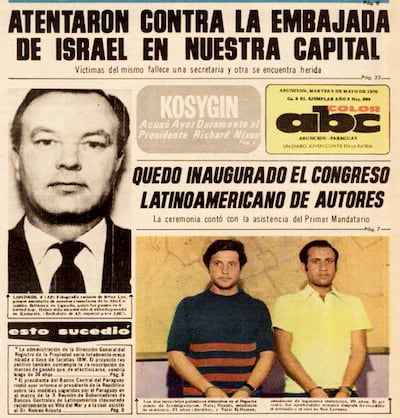
IMAGE: From the ABC Color article from 2020 that revisits the 1970 attack and names the two men as Talal El-Damsa / Talal Mota Demasi and Halaj Kasbui / Kalid Abed Rabu Derwish Kassab, describing their armed confrontation at the Israeli Embassy in Asunción on May 4, 1970 and the killing of secretary Edna Peer. (Source: ABC Paraguay)
The System Survived Her
Another arm of this story operated from inside the occupation bureaucracy itself. Shlomo Gazit, the first coordinator of government activities in the Occupied Territories, helped design what Israel later marketed as an enlightened occupation, an administrative order that promised smoother daily management while suffocating Palestinian political life. If Sereni handled external routes of removal, Gazit helped build the bureaucracy that treated Palestinian existence as something to be administered, contained, and, when useful, thinned. His own retrospective remarks make clear that the idea of encouraging Palestinians to leave was not invented by today’s far right but was already embedded in the occupation’s historical vocabulary.
That is what gives the story its force in the present. The continuity does not rest on slogans or conspiracy but on a documented structural logic linking travel intermediaries, security agencies, state offices, and euphemistic language about voluntary emigration. Reporting has shown how Al Majd Europe, a firm linked by investigations to Israeli networks, operated flights out of Gaza under authorisation from Israel’s Voluntary Emigration Bureau and with ties to the far-right group Ad Kan. An earlier Al Jazeera report on the shadowy organisation that flew 153 Palestinians from Gaza to South Africa had already exposed the human face of that pipeline. The branding is cleaner now, and the language is more polished, but the underlying idea is the same. Palestinians are to be battered by war, pushed by despair, processed by intermediaries, and scattered far from a land Israel still wants without its people.
Ada Sereni died in Israel on November 24, 1997, but the system she served did not die with her. Gaza still carries the weight of that world, one in which Palestinian suffering is converted into paperwork, routes, tickets, fees, incentives, and euphemisms. The indictment is straightforward. This was not migration, not rescue, not humanitarian relocation, but a human trafficking architecture built in the service of demographic cleansing, and its updated forms are still with us.

Ben Reiff reports for +972 Magazine…
The Paraguay Scheme: Israel’s secret plan to deport Gazans in the ‘70s
A new podcast series lifts the veil on the Mossad’s failed attempt to expel 60,000 Palestinians soon after occupying the Gaza Strip. Almost six decades later, Israel’s methods and objectives remain eerily similar.
On Sept. 9, 1969, around 20 Palestinians from the Gaza Strip boarded a plane at an airport in central Israel, believing they were bound for Brazil. They had signed up through an Israeli travel agency for a work-abroad program, with the promise of higher wages than they could find in Gaza, which Israel had occupied two years earlier. Those with families were assured that their wives and children would be able to join them in Brazil soon after. But that is not what transpired.
When the flight touched down in São Paulo, armed guards escorted the men onto another, smaller plane that brought them to Asunción, the capital of Paraguay — a country many of them had never even heard of, and which was then under the dictatorship of Alfredo Stroessner. There, they were greeted by armed police officers and driven to a hotel for the night.
Disoriented and suspicious, they were told not to worry: The next morning, government officials would issue identification papers and get them set up for work. When those officials arrived, however, they arbitrarily assigned the men new professions to inscribe on their ID cards, then sent them on a bus to a far-flung rural area.
That was the last contact the Palestinians would have with any authority connected to the work program, because it did not exist. They had been tricked into boarding a deportation flight by the Mossad, Israel’s covert intelligence agency, as part of a secret scheme to exile Palestinians from the Gaza Strip en masse.
Stranded in a country whose language they did not speak, the new arrivals found themselves with no money, no housing, no jobs, no connections, and no way of getting back home. And they soon realized that they were not the first to have been lured and abandoned in this way; nor would they be the last.
For decades, knowledge of this secret operation remained largely confined to the families of the men subjected to it. But a new podcast series, based on the testimonies of two deportees and evidence from Israeli and Paraguayan archives, sets out to uncover a story that Israel long sought to suppress, and explain why it was aborted only months after it began.
After two and a half years in which Israel has attempted, through various means, to eradicate Palestinian presence in Gaza altogether, the echoes of history could hardly be louder.
A tale of two deportees
Created by managing producer Maxim Saakyan and coproducers Nadeen Shaker and Nada El-Kouny, the four-part series “Palestinians in Paraguay” from Uncovering Roots builds on research by Hadeel Assali, a postdoctoral scholar at Columbia University, and John Tofik Karam, a historian at the University of Illinois, both of whom feature in the episodes…..
Continue reading this investigation on +972 magazine
***
READ MORE ISRAEL NEWS AT: 21st Century Wire ISRAEL Files
SUPPORT OUR INDEPENDENT MEDIA PLATFORM – BECOME A MEMBER @21WIRE.TV
VISIT OUR TELEGRAM CHANNEL
21st Century Wire is an alternative news agency designed to enlighten, inform and educate readers about world events which are not always covered in the mainstream media.
Source: https://21stcenturywire.com/2026/03/30/the-lady-in-the-black-dress-from-zionist-smuggler-to-gazas-deportation-architect/
Anyone can join.
Anyone can contribute.
Anyone can become informed about their world.
"United We Stand" Click Here To Create Your Personal Citizen Journalist Account Today, Be Sure To Invite Your Friends.
Before It’s News® is a community of individuals who report on what’s going on around them, from all around the world. Anyone can join. Anyone can contribute. Anyone can become informed about their world. "United We Stand" Click Here To Create Your Personal Citizen Journalist Account Today, Be Sure To Invite Your Friends.
LION'S MANE PRODUCT
Try Our Lion’s Mane WHOLE MIND Nootropic Blend 60 Capsules
Mushrooms are having a moment. One fabulous fungus in particular, lion’s mane, may help improve memory, depression and anxiety symptoms. They are also an excellent source of nutrients that show promise as a therapy for dementia, and other neurodegenerative diseases. If you’re living with anxiety or depression, you may be curious about all the therapy options out there — including the natural ones.Our Lion’s Mane WHOLE MIND Nootropic Blend has been formulated to utilize the potency of Lion’s mane but also include the benefits of four other Highly Beneficial Mushrooms. Synergistically, they work together to Build your health through improving cognitive function and immunity regardless of your age. Our Nootropic not only improves your Cognitive Function and Activates your Immune System, but it benefits growth of Essential Gut Flora, further enhancing your Vitality.

Our Formula includes: Lion’s Mane Mushrooms which Increase Brain Power through nerve growth, lessen anxiety, reduce depression, and improve concentration. Its an excellent adaptogen, promotes sleep and improves immunity. Shiitake Mushrooms which Fight cancer cells and infectious disease, boost the immune system, promotes brain function, and serves as a source of B vitamins. Maitake Mushrooms which regulate blood sugar levels of diabetics, reduce hypertension and boosts the immune system. Reishi Mushrooms which Fight inflammation, liver disease, fatigue, tumor growth and cancer. They Improve skin disorders and soothes digestive problems, stomach ulcers and leaky gut syndrome. Chaga Mushrooms which have anti-aging effects, boost immune function, improve stamina and athletic performance, even act as a natural aphrodisiac, fighting diabetes and improving liver function. Try Our Lion’s Mane WHOLE MIND Nootropic Blend 60 Capsules Today. Be 100% Satisfied or Receive a Full Money Back Guarantee. Order Yours Today by Following This Link.


| Visits: | 1,797,292,439 |
| Stories: | 8,623,052 |
Whistler Blowers, Insiders

