

From Gaza to BRICS: The Revolt Against the Dollar Order

Freddie Ponton
21st Century Wire
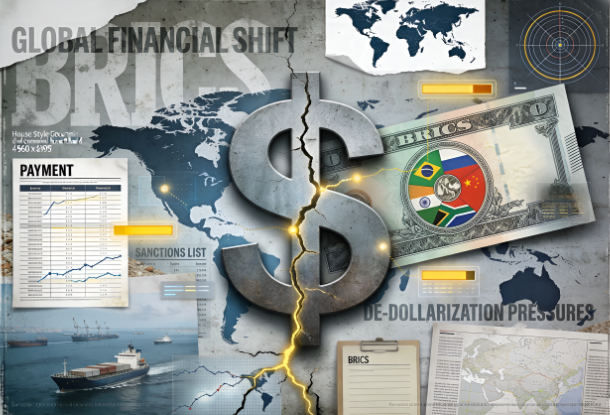
Washington spent decades marketing the dollar as the natural language of world trade, a neutral vessel carrying commerce across borders. In practice, it became the armed currency of an imperial system that bombed states into ruin, sanctioned whole societies, and reserved the right to strangle any country that refused submission.
Unlike the usual churn of de-dollarization commentary, this report does not trade in fantasies of sudden dollar collapse or fairy tales about a BRICS currency descending to save the world overnight. It follows the machinery already taking shape beneath the noise, from national-currency trade and central bank swap lines to sovereign payment systems, digital settlement experiments, and BRICS-linked development finance, while keeping in view the fractures, delays, and contradictions that still run through the structure.
Just as important, this article refuses to separate economics from empire, tying the scramble for monetary sovereignty directly to sanctions, SWIFT weaponisation, the siege of Iran, and the wider coercive order that pushed much of the Global South to start building financial escape routes of its own.
The empire taught the world to flee
What matters here is not another recycled debate, but a grounded map of how a multipolar financial order is taking shape in practice, who is driving it, and why that shift now reaches far beyond the balance sheets of central banks.
That system is now producing its own backlash. Across BRICS and the wider Global South, de-dollarization is no longer a slogan tossed around at summits or a fantasy about a miracle currency waiting just beyond the horizon. It is taking material form through local-currency trade, sovereign payment systems, central bank swap lines, digital settlement projects, and development finance built to reduce exposure to Western-controlled capital.
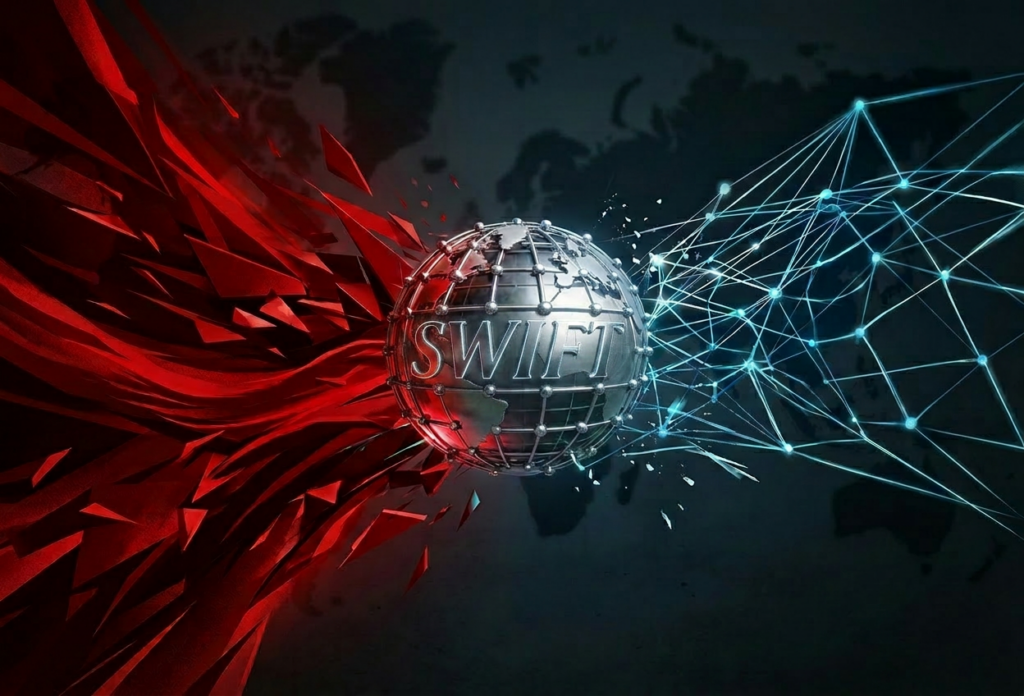
The shift is not benign because it grows out of pressure, not theory. States that watched Russia cut from major Western financial channels, Iran suffocated under sanctions, and entire economies treated as hostages to US foreign policy have drawn the same conclusion. No nation can claim sovereignty if another power can freeze its trade, choke its banks, and police its payments.
That is why the war on Iran belongs at the heart of the story. The bombs may fall from the sky, but the same system works through banks, reserve currencies, settlement networks, and the threat of exclusion. Military aggression and monetary coercion are not separate instruments. They are two hands of the same order.

The scaffolding of a post-dollar order
A 2025 study on BRICS de-dollarization spearheaded by Podrugina Anastasia Viktorovna, an Associate Professor of the Department of World Economics, Faculty of World Economy and International Affairs, heading the Group for Structural Issues in the World Economy at the Centre for Comprehensive European and International Studies (CCEIS), makes clear that what is emerging is not a dramatic monetary rupture, but a layered architecture. Its pillars are already visible in the expansion of national-currency trade, the spread of central-bank swap arrangements, the growth of sovereign payment and messaging systems, the exploration of digital-currency settlement, and the gradual strengthening of financial markets in local currencies. The same study is sober enough to stress that this framework contains many of the necessary parts, but is still not fully functional.
DOCUMENT: Formation of a de-dollarization architecture in the BRICS countries (Source: CWE Journal)
32050-Текст статьи-78477-1-10-20260302.ru.en
The strongest evidence begins with trade itself. By 2024, more than 90% of bilateral trade between Russia and China was already being settled in national currencies. Around 90% of direct payments between Russia and India were also taking place in national currencies. At the same time, Russia and Iran signed a strategic partnership agreement in 2025 that provided for a move toward national-currency settlements in mutual trade.
But even here, the limits of the transition are visible. The rapid growth of Russia-India trade has left large pools of so-called frozen rupees in Indian banks, exposing a basic problem of local-currency settlement. When trade is imbalanced, and a currency is not freely convertible, the alternative to the dollar can still trap value inside narrow channels. The architecture is advancing, but every such friction point is a reminder that monetary sovereignty needs more than political will; it also needs usable, liquid, and recyclable financial circuits. These are not symbolic gestures. They show what de-dollarization looks like once it leaves the conference hall and enters the bloodstream of real commerce. It means exporters and importers routing around the old imperial middleman. It means countries under siege refusing to let every sale, shipment, and invoice pass through a currency system controlled by powers openly hostile to their survival.
But trade settlement alone cannot carry a project this large. Without deeper financial markets in local currencies, even successful trade settlements will hit a ceiling. The architecture described in the first study depends not only on payment systems and swap lines, but on bond markets, development finance, and lending mechanisms able to keep capital circulating outside the dollar’s orbit. That is why the New Development Bank matters so much, and it is not just a lender, but a testing ground for the next stage of de-dollarization, increasing the share of its lending in BRICS currencies from 25% toward a planned 30% by 2026 while pointing toward a larger, still unfinished architecture of local-currency finance.
The same study shows that BRICS states are also trying to build protective liquidity through bilateral swap lines and through the Contingent Reserve Arrangement, created in 2014 with an initial capacity of $100 billion dollars. That mechanism offers a degree of collective financial defense, even if the study notes that access beyond the first 30% of a member’s limit still remains tied to IMF approval, a reminder that the old system has not yet been fully escaped.

Then there is the payment backbone itself. Russia has its own Financial Messaging System (SPFS), China has the Cross-border Interbank Payment System(CIPS), India has its Structured Financial Messaging System (SFMS), and Iran has its own System for Electronic Payments Messaging (SEPAM). These systems matter because they reduce dependence on SWIFT and give targeted states more space to move when Western governments weaponize financial plumbing. By the end of 2024, SPFS had 584 users, and message volume had risen by 23%. CIPS had 168 direct participants and a network of more than 4,800 banks across 119 countries.
The picture grows even sharper in the realm of digital finance. The same research points to BRICS Bridge and BRICS Pay as important initiatives under discussion, yet it notes that both BRICS Bridge and BRICS Pay remain under active development in 2026, with momentum increasing, but there is still no clearly verified full public launch that can be treated as a settled fact from the strongest available sources. That does not weaken the case. It tells the truth. The alternative order is real, but it is still being assembled piece by piece.
That incompleteness matters. For instance, the Association of Southeast Asian Nations (ASEAN) already offers a non-Western proof that regional payment integration can move beyond aspiration into institution, with denser swap arrangements, broader payment connectivity, and more coordinated settlement frameworks than BRICS has yet achieved. The lesson is not that BRICS is failing, but that it remains at an earlier stage of construction, still assembling what others have already begun to normalize.
The next battlefield will not be fought only through reserves and trade invoices. It will also be fought through code. Beyond BRICS Bridge and the still-unfinished payment initiatives already on the table lies a wider digital frontier of interoperable systems, domestic payment integration, programmable money, and new clearing architectures that could one day move value across borders with far less dependence on the dollarized banking chain, and central bank digital currency (CBDCs) will likely play a central role in that shift. If that frontier matures, the most important break with the old order may not arrive as a single new currency at all, but as a mesh of digital rails that quietly makes the old monopolies less necessary. A 2024 working Paper authored by Mayer Jörg, a Senior Economic Affairs Officer in the Division on Globalisation and Development Strategies of the United Nations Conference on Trade and Development (UNCTAD), titled “De-dollarization: The global payment infrastructure and wholesale central bank digital currencies”, provides with great accuracy, a solid explanation of how CBDCs and multi-CBDC payment architecture could move cross-border settlements away from the dollar-dependent correspondent banking chain and toward interoperable digital systems.
Sanctions turned the dollar into a warning
A 2026 study on greater BRICS cooperation, authored by Yang Lyu, an Associate Research Professor at the China Institutes of Contemporary International Studies, Beijing, P.R. China, explains why this process has accelerated. Countries are not stepping back from the dollar because they suddenly discovered an academic preference for monetary diversity.
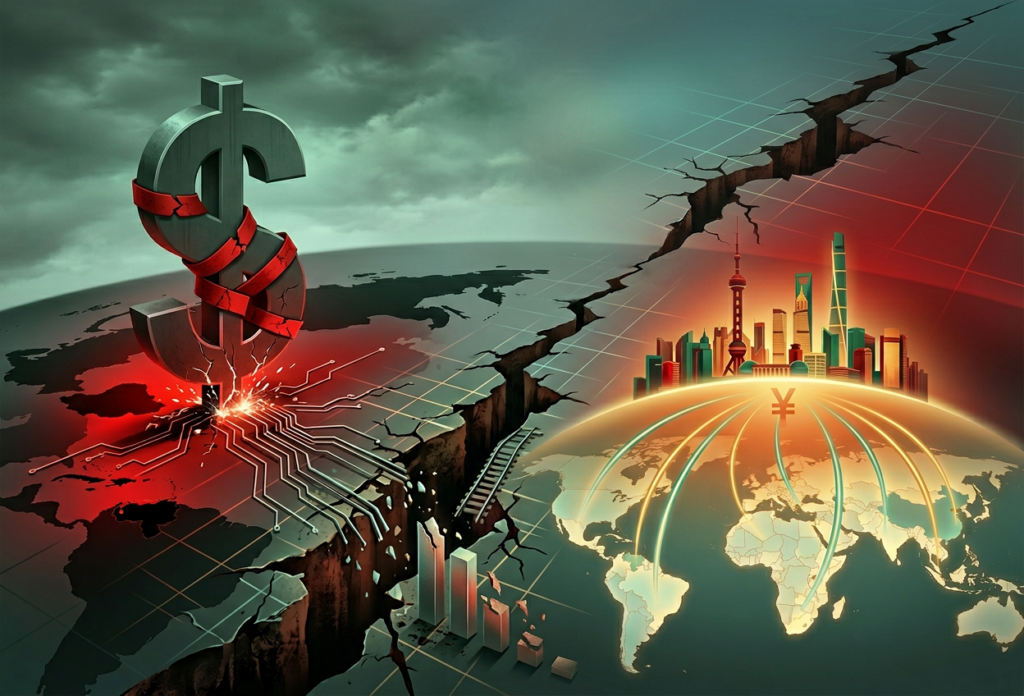
They are moving in the same direction for different reasons, and that is why the process advances with both momentum and friction. Russia was pushed forward by sanctions warfare, China by long-term monetary strategy, and others by the simpler need to lower transaction costs, hedge political risk, and widen room for manoeuvre without fully rupturing with the old order. BRICS is therefore advancing not as a perfectly unified bloc, but as a coalition converging on the same infrastructure from very different political starting points.
The study argues that the weaponization of the dollar and of Western payment infrastructure has steadily eroded trust in both. It links that erosion to sanctions, financial blockades, SWIFT exclusion, and the use of monetary dominance as a geopolitical bludgeon. By the end of 2024, it notes, the dollar’s share of global foreign-exchange reserves had fallen below 58%, while its share in cross-border payments had dropped to 42.6%.
At the same time, more than 25% of intra-BRICS trade was already being settled in local currencies by the end of 2024. That does not mean the dollar has been dethroned. It means the world has started to hedge against it, and it has done so for reasons rooted in fear, survival, and bitter experience.
Iran stands as one of the clearest examples. The 2026 study places the blockade of Iran alongside sanctions on Russia, Venezuela, and Cuba as part of the pattern that pushed countries to seek alternatives to dollar-based finance. For states across the Global South, the lesson is no longer theoretical. A reserve currency controlled by an aggressive empire is not simply a medium of exchange. It is a pressure point waiting to be used.
DOCUMENT: Innovating the global payment system through greater BRICS cooperation (Source: Springer)
s44216-026-00075-x
This is why the de-dollarization debate is often misunderstood in the West. For much of the world, the issue is not whether the dollar remains liquid, deep, and still globally dominant. The issue is whether a country can import food, export energy, finance development, and survive political confrontation without placing its throat inside the same imperial fist.
The same study makes another crucial point. The most advanced path is not a common BRICS currency. That remains the boldest and least immediately feasible option. The most practical path is local-currency settlement, while the most forward-looking one is cross-border digital payment. The deeper story, then, lies not in branding but in infrastructure.
Greater BRICS changes the balance of power
This story becomes even more consequential once BRICS expansion enters the frame.
That expansion matters for another reason as well. BRICS is gaining force not only because it resists Western domination, but because it offers many states in the Global South a more usable political proposition, which offers cooperation without the ritual humiliation of Western conditionality, financing without open submission, and a wider stage on which to pursue sovereignty without formally entering an anti-Western military bloc. That is why its appeal keeps spreading beyond the countries already inside it. For many governments, BRICS is no longer simply an act of defiance. It is a practical project of political and economic reorientation.
The 2026 study featured above argues that the bloc’s enlargement in 2023 and the admission of partner countries in 2024 transformed it from a grouping of major emerging economies into a much broader platform for the Global South.
That expansion changed the scale of the project. According to the study, BRICS economies accounted for more than 40% of global output measured in current dollars and 23% of global goods exports, while holding roughly half of the world’s gold and currency reserves. These data point to something material and dangerous from the standpoint of Washington, because a de-dollarizing bloc with this kind of weight does not rest on rhetoric alone, but also on oil, food, mineral reserves, industrial capacity, maritime corridors, overland routes, and enormous demographic scale.
Iran matters here not as an isolated victim of aggression but as part of a larger geography of resistance. The expanded BRICS formation brings together states with leverage in energy, agriculture, transport, minerals, and strategic chokepoints. It gives the search for financial sovereignty a material foundation that is far harder to crush than any single sanctioned state standing alone.

The study also argues that expansion improves the conditions for upgrading core BRICS financial mechanisms such as the New Development Bank, the Contingent Reserve Arrangement, and the bloc’s emerging payment architecture. More members mean more resources, broader expertise, and a greater ability to dilute internal resistance to reform. In plain language, the wider the bloc becomes, the more credible its financial alternatives become.
And that is precisely what makes the process dangerous from Washington’s point of view. Expanded BRICS does not grow in a straight line. It compounds, with each new member, corridor, reserve pool, and payment channel creating fresh advantages that deepen cooperation further and make the whole architecture harder to unwind. The threat is not that BRICS has already replaced the old order. It is that a self-reinforcing cycle has begun, and every successful step gives the next one more weight, more legitimacy, and more staying power.
Corridors need detente
What comes next is not just a struggle over currencies, but over routes. The same states now trying to reduce their exposure to dollar coercion are also trying to build the physical geography of a different order, and that includes ports, rail lines, energy corridors, digital cables, and payment rails that can tie Asia, the Gulf, and Europe together on terms less vulnerable to Western choke points.
That is why detente matters. A corridor cannot function under permanent bombardment, and no Gulf state can turn geography into lasting power while missiles, sanctions, and military escalation keep the region in a state of managed instability.
This is where Saudi Arabia and the UAE need to be understood clearly. They are not confused actors drifting between camps. They are conflicted hinge powers, still tied to Washington’s security architecture, yet increasingly drawn toward the commercial, financial, and geopolitical opportunities opened by BRICS, China, India, and the wider push for non-dollarized trade. Their long-term value lies not in choosing permanent confrontation, but in becoming indispensable connectors between energy producers, capital flows, industrial zones, and the trade arteries running east to west and south to north.
That is also why the politics of detente may prove more decisive than any summit declaration. The faster these corridors become operational outside the chokehold of dollar hegemony, the stronger the material constituency for stability becomes, because every new port link, customs platform, payment interface, logistics hub, and industrial corridor begins to depend on predictability rather than war. In that sense, de-dollarization is not only a monetary process. It is also a question of whether the real economy can be pulled into the same orbit. No payment system can carry history on its own if trade, investment, logistics, energy, agriculture, and industrial cooperation remain too thin to bear its weight.
Financial sovereignty without deeper real-economy integration stays fragile, because money may find a new route while the material life beneath it still depends on supply chains, markets, and chokepoints shaped by the old order. It is a regional stabilization project in embryo, one that gives Gulf capitals a direct economic stake in containing escalation and keeping the routes open.
This is also where the Israeli question becomes harder to ignore.
The original east-to-west corridor vision encapsulated in the early India-Middle East-Europe Economic Corridor concept (IMEC), and its initial public framing, placed the Gulf at the center and imagined Israel as the Mediterranean outlet for trade moving onward to Europe. On paper, that gave Israel an obvious strategic pitch, where it can market itself as the indispensable logistical hinge between Asia and the Mediterranean. But politics has a way of wrecking maps. Israel’s deepening unpopularity, especially across the Global South, has raised the political cost of any corridor architecture that asks Arab, Asian, and African states to anchor their commercial future to an Israeli hub as though legitimacy were irrelevant.
That does not mean such projects disappear overnight. It means they enter a harsher political climate, where many states will think twice before tying their commercial future to a route entangled with a deeply discredited regional order. In the current climate, Israel will find it hard, perhaps impossible, to market its way out of the Gaza genocide or the devastation left in the wake of its military expansion into Lebanon and Syria. The more unstable and unpopular Israel becomes, the more attractive it will be for Gulf, Asian, and BRICS-linked actors to diversify outlets, multiply routes, and build a wider corridor ecosystem rather than accept any single state as the mandatory gate between East and West. In that sense, the battle over the future is no longer only about who controls the currency of trade, but it is also about who can offer the safest, most legitimate, and most politically sustainable roads along which that trade will move.
The break is unfinished, but it is real
None of this means BRICS has already built a complete replacement for the dollar. The research does not claim that, and the facts would not support it. Several initiatives remain incomplete, some currencies are far more usable internationally than others, and the old order still retains enormous structural advantages in liquidity, habit, and market depth.
But that is not the real measure of what is happening. The real measure is whether a parallel architecture exists in recognizable form, amd it certainly does. Local-currency trade is rising, while sovereign messaging systems are expanding, and swap lines and reserve arrangements are being tested. Digital settlement experiments are clearly moving forward, and the New Development Bank is increasing local-currency lending whilst attempting to reduce borrowers’ exposure to dollar risk.
That is what makes the old imperial center nervous. Endless war did not preserve unipolar power. It only exposed its violence. As for sanctions, they did not restore faith in the dollar order; instead, they taught countries to search for exits. The war on Iran, like the wars that came before it, has only sharpened the lesson.
What is being born will not arrive all at once. It will not come wrapped in a single currency note or announced by a single triumphant headline. It is far more likely it will arrive through contracts, clearing mechanisms, settlement systems, reserve pools, and political will. The world Washington tried to discipline through force is building routes around that discipline. And this time, the escape route is being built in plain sight, for everyone to recognize.
READ MORE BRICS NEWS AT:21st CENTURY WIRE BRICS FILES
VISIT OUR TELEGRAM CHANNEL
SUPPORT OUR INDEPENDENT MEDIA PLATFORM – BECOME A MEMBER @21WIRE.TV
21st Century Wire is an alternative news agency designed to enlighten, inform and educate readers about world events which are not always covered in the mainstream media.
Source: https://21stcenturywire.com/2026/04/20/from-gaza-to-brics-the-revolt-against-the-dollar-order/
Anyone can join.
Anyone can contribute.
Anyone can become informed about their world.
"United We Stand" Click Here To Create Your Personal Citizen Journalist Account Today, Be Sure To Invite Your Friends.
Before It’s News® is a community of individuals who report on what’s going on around them, from all around the world. Anyone can join. Anyone can contribute. Anyone can become informed about their world. "United We Stand" Click Here To Create Your Personal Citizen Journalist Account Today, Be Sure To Invite Your Friends.
LION'S MANE PRODUCT
Try Our Lion’s Mane WHOLE MIND Nootropic Blend 60 Capsules
Mushrooms are having a moment. One fabulous fungus in particular, lion’s mane, may help improve memory, depression and anxiety symptoms. They are also an excellent source of nutrients that show promise as a therapy for dementia, and other neurodegenerative diseases. If you’re living with anxiety or depression, you may be curious about all the therapy options out there — including the natural ones.Our Lion’s Mane WHOLE MIND Nootropic Blend has been formulated to utilize the potency of Lion’s mane but also include the benefits of four other Highly Beneficial Mushrooms. Synergistically, they work together to Build your health through improving cognitive function and immunity regardless of your age. Our Nootropic not only improves your Cognitive Function and Activates your Immune System, but it benefits growth of Essential Gut Flora, further enhancing your Vitality.

Our Formula includes: Lion’s Mane Mushrooms which Increase Brain Power through nerve growth, lessen anxiety, reduce depression, and improve concentration. Its an excellent adaptogen, promotes sleep and improves immunity. Shiitake Mushrooms which Fight cancer cells and infectious disease, boost the immune system, promotes brain function, and serves as a source of B vitamins. Maitake Mushrooms which regulate blood sugar levels of diabetics, reduce hypertension and boosts the immune system. Reishi Mushrooms which Fight inflammation, liver disease, fatigue, tumor growth and cancer. They Improve skin disorders and soothes digestive problems, stomach ulcers and leaky gut syndrome. Chaga Mushrooms which have anti-aging effects, boost immune function, improve stamina and athletic performance, even act as a natural aphrodisiac, fighting diabetes and improving liver function. Try Our Lion’s Mane WHOLE MIND Nootropic Blend 60 Capsules Today. Be 100% Satisfied or Receive a Full Money Back Guarantee. Order Yours Today by Following This Link.


| Visits: | 1,804,207,923 |
| Stories: | 8,637,910 |
Whistler Blowers, Insiders

