

New CIG Report Exposes Blood Money, Mercenaries and the Gulf Plot Against Sudan

Freddie Ponton
21st Century Wire
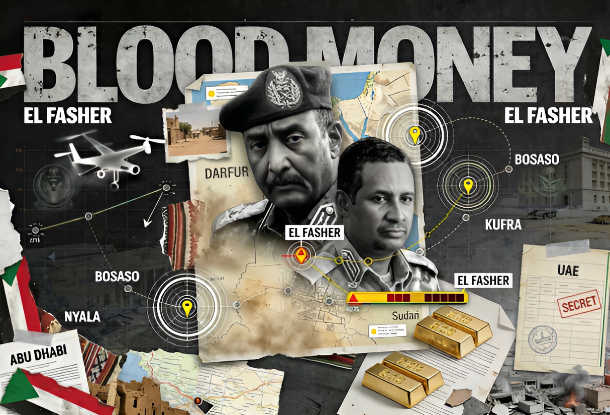
El Fasher, the capital of North Darfur in Sudan, and the last major city in Darfur outside paramilitary control, did not fall to the RSF, or Rapid Support Forces, alone. According to Blood Money, a new investigation by Conflict Insights Group (CIG), the October 2025 capture of the city was enabled by a UAE-backed network that moved Colombian mercenaries through Somalia, Abu Dhabi, Libya, and South Darfur, where they flew drones, trained fighters, and were present during the final takeover.
What followed was slaughter. After the RSF, a powerful Sudanese paramilitary force led by Mohamed Hamdan Dagalo, better known as Hemedti, seized El Fasher on 26 October 2025, fighters carried out executions, civilians were killed inside the Saudi Maternity Hospital, and the Prosecutor of the International Criminal Court later concluded that war crimes and crimes against humanity had been committed in the city. CIG references reports indicating that over 460 patients lost their lives at the Saudi Maternity Hospital alone, and argues that without this foreign support, the siege, the takeover, and the atrocities that followed would likely not have occurred. The report indicates that its analysis underwent multiple levels of verification, eliminating questionable data and ensuring that significant findings were validated against external sources, which included confirmation from the U.S. Treasury regarding devices linked to Colombia in El Fasher.
That finding belongs to a longer history of foreign power in Sudan. The UAE and Saudi Arabia did not enter Sudan as neutral brokers. They helped entrench military actors after former President of Sudan, Omar al-Bashir’s fall, while deepening their ties to the RSF through Yemen and post 2019 power politics, before binding Sudan ever more tightly to a regional economy of gold, coercion, and foreign dependency.
A war fed from abroad
Sudan’s current war erupted on 15 April 2023, when the power struggle between the SAF, or Sudanese Armed Forces, the country’s regular army led by General Abdel Fattah al-Burhan, and the RSF exploded into open conflict and pushed the country into disintegration. What began as a contest between rival armed centers hardened into a national catastrophe shaped by outside patrons, war profiteers, and regional states that treated Sudan as a zone of leverage rather than a sovereign country.
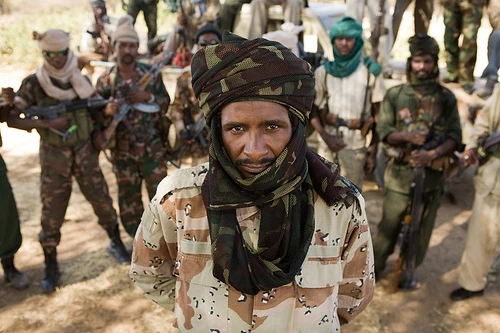
IMAGE: The Rapid Support Forces (RSF) paramilitary group, active in Sudan since 2013, has its roots in the Janjaweed
The RSF did not emerge from nowhere. It grew out of the Janjaweed militias used during the Darfur war and was later formalized as a paramilitary force under Hemedti, whose rise turned a militia commander into one of Sudan’s most powerful warlords. By May 2024, the RSF and its allies had laid siege to El Fasher, while local forces aligned with the SAF tried to hold the city against an increasingly brutal encirclement.
Around 260,000 civilians, including 130,000 children, were still living in El Fasher as of late August 2025, trapped inside a city that had become both a strategic prize and a chamber of hunger, terror, and exhaustion. On 12 September 2025, the UN Security Council renewed the Darfur sanctions regime and arms embargo, and on that same day, the Quad of Egypt, Saudi Arabia, the UAE, and the United States called for an end to external military support, even as CIG says UAE support to the RSF continued. The road to El Fasher was paved not only by Sudan’s internal fracture, but by the systems that kept the war supplied and profitable.
According to Reuters and the Washington Post, foreign backing has intensified the conflict on multiple fronts, including Iranian drone support to the Sudanese army and documented Turkish weapons transfers to the SAF, while Chatham House argues that competition over gold was not a byproduct of the war but one of the forces driving it. Darfur, Sudan’s vast western region long scarred by mass violence and displacement, was never just a battlefield. It was a war economy.
Why Abu Dhabi wanted Sudan
Gold is the clearest motive, but not the only one. Sudan offers Abu Dhabi access to one of Africa’s richest gold zones, leverage on the Red Sea, influence across the Horn of Africa and the Sahel, and a political arena where power can be projected through armed clients and commercial networks rather than direct occupation. Saudi Arabia has pursued its own version of that logic, treating Sudan as a strategic hinterland and a reservoir of military manpower, especially during the Yemen war.
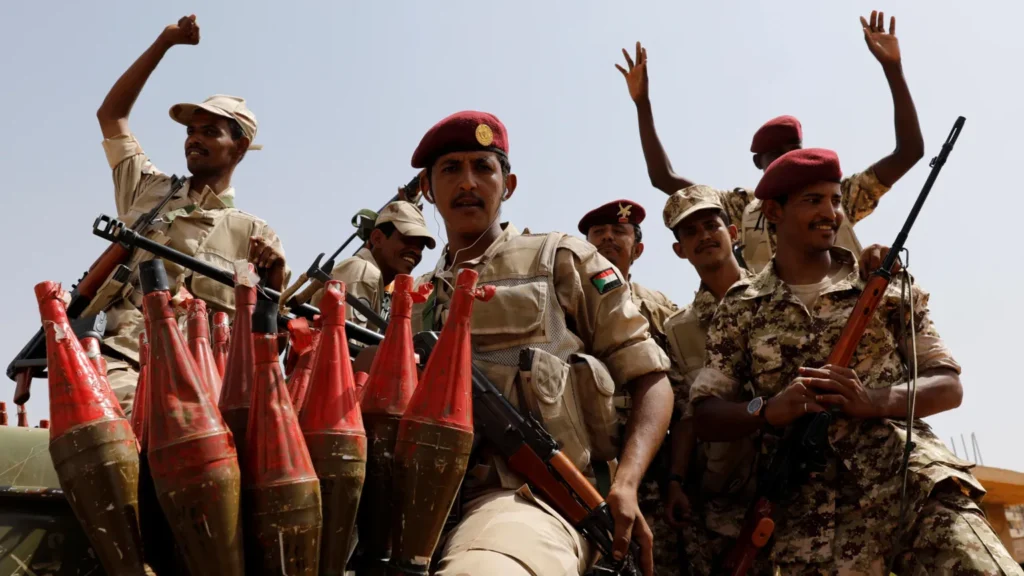
IMAGE: The paramilitary RSF group that has been fighting Sudan’s regular army since 2023 (Source: BBC)
Gold still sits at the center because it turns political violence into liquid wealth. The Sentry reports that the RSF has become increasingly reliant on exporting gold from Darfur to Dubai and that UAE companies and banks are crucial to converting smuggled gold into hard currency. SWISSAID says the UAE imported 29 tonnes of gold directly from Sudan in 2024, up from 17 tonnes in 2023, while also importing gold from Chad and Libya that serve as exit points for RSF-linked supply routes. When a de facto UAE flight embargo disrupted Sudan’s gold exports in October 2025, Reuters reported that the Sudanese pound suffered, exposing the UAE’s position as a choke point in the country’s wartime economy.
That dependency was built over years, not months. According to The Project on Middle East Political Science (POMEPS), Gulf backing after Bashir’s overthrow in 2019 helped military actors preserve their grip over Sudan’s transition rather than surrender power to civilian forces. That backing was not abstract. In April 2019, Saudi Arabia and the UAE pledged $3 billion to Sudan’s military rulers, including a $500 million central bank deposit, reinforcing the generals at the moment civilian rule was at stake.
The earlier Yemen war deepened that relationship. Sudan sent about 10,000 troops to the Saudi-led war in 2015, many of them from the RSF, while The Conversation notes that the UAE enlisted and paid Sudanese fighters, primarily from the RSF, for that campaign. The RSF’s place in Gulf strategy was not improvised in 2025. It had already been forged in blood.
Why El Fasher had to fall
El Fasher was more than another front line. It was the last major urban barrier to full RSF domination of Darfur. As long as the city remained outside paramilitary control, there was still a visible limit to the RSF campaign and a surviving political center that had not been fully swallowed.
The siege that began in May 2024 was a war of attrition with strategic and symbolic stakes at once. The city was surrounded, starved, and pounded while civilians absorbed the cost of a battle they did not choose. In the weeks before the final takeover, reports mounted of drone strikes on displacement sites and civilians, worsening hunger, and a city living under the expectation of annihilation.
When El Fasher fell, it confirmed what Darfur’s civilians had already learned the hard way. The RSF did not need total military supremacy to conquer the city. It needed time, impunity, and a foreign-backed support system capable of keeping the siege alive until the city finally broke.
REPORT: BLOOD MONEY – How UAE supports, and foreign mercenaries enabled the fall of El Fasher (Source: Conflict Insights Group)
BloodMoneyCIG
The machinery behind the siege
The Blood Money report traces more than 50 devices associated with Colombian mercenaries operating in Sudan between 1 April 2025 and 20 January 2026. Using ad tech data, satellite imagery, flight tracking, video evidence, and open source reporting, CIG maps a pipeline that ran from Colombia through Bosaso, a port city in Puntland, Somalia, to Ghayathi, a UAE military site in Abu Dhabi, then through Kufra, a remote southeastern Libyan hub tied to RSF logistics, and Nyala, the capital of South Darfur, before reaching the battlefield around El Fasher.
The mercenaries were associated with the Desert Wolves brigade and with Global Security Services Group, or GSSG, a UAE-based company that CIG says has documented ties to senior Emirati officials and to Sheikh Tahnoon bin Zayed Al Nahyan’s business network. CIG and The Sentry, an American non-profit investigative and policy organization dedicated to combating grand corruption, kleptocracy, and the financial networks that fuel violent conflicts, repression, and human rights abuses—particularly in Africa, say Ahmed Mohamed Al Humairi founded GSSG, the secretary general of the UAE Presidential Court, later passed to Mohammed Hamdan Alzaabi, and linked through overlapping corporate networks to entities controlled by the UAE royal family and Tahnoon bin Zayed. One device began in Bogotá, appeared at the Puntland Maritime Police Force compound in Bosaso, Somalia, before passing through the military side of N’Djamena airport in Chad, and then surfacing in South Darfur near Nyala. CIG adds that the UAE is a significant funder of the Puntland Maritime Police Force, tightening the link between Bosaso and the wider US and Emirati support structure. It identified 40 Spanish-language devices at the PMPF compound in 2025, with 10 later appearing at Nyala airport, suggesting an organised transit point rather than coincidence.
REPORT: The Sentry 2025 report on Sudan mercenaries linked to business partner of a top UAE Bureaucrat, including Global Security Services Group (GSSG), a UAE-registered company arranging for the deployment of the Colombian mercenaries to Sudan (Source: The Sentry)
Sudan-RSF-UAE-TheSentry-Nov2025-2
In remote South Darfur, that same device connected 14 times to a Wi Fi network named “DRONES” and operated roughly 5.6 kilometers from what CIG describes as a possible manmade runway, evidence consistent with covert UAV activity launched beyond easy SAF reach. The device was later connected to “LOBOS DEL DISIERTO,” tying it to the Desert Wolves, a Colombian mercenary brigade that La Silla Vacía and the US Treasury have linked to drone operations, artillery support, and the training of RSF troops, including child soldiers. The report says the brigade was led by retired Colombian army colonel Alvaro Quijano, who is based in the UAE and sanctioned by the US Treasury for fueling Sudan’s war. CIG says Colombian mercenaries had been operating in Sudan since the summer of 2024, that a December 2024 Desert Wolves manual placed them in El Fasher, and that it geolocated a January 2025 video showing apparent Colombian fighters supporting the RSF siege there.
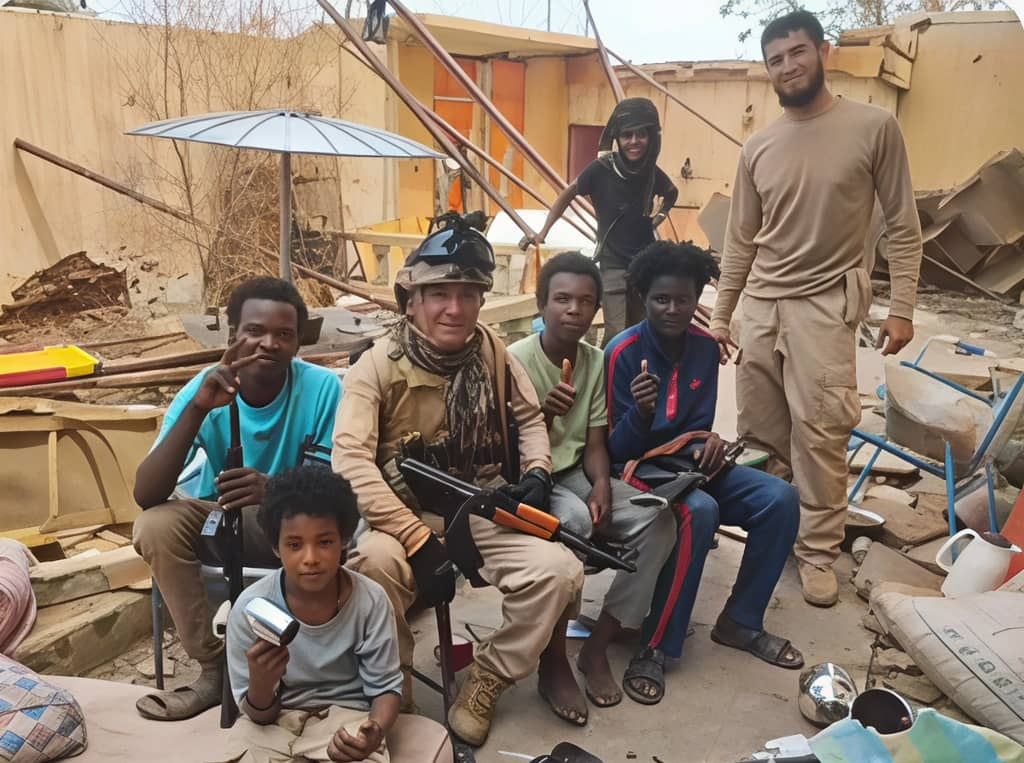
IMAGE: Colombian Mercenaries “The Desert Wolves Battalion” in Darfur, Sudan – Foreign Firepower in a Proxy War (Source: BL news)
A second device followed a route that exposed the wider logistics chain. It traveled from Colombia to Zayed International Airport, then moved to a military facility in Ghayathi, where a 2021 UN panel had already documented the training of Sudanese mercenaries under Emirati supervision. CIG also found four other Spanish-configured devices at Ghayathi in 2025, two of which later reached South Darfur, including one that logged into networks named “ANTIAEREO” and “AirDefense,” suggesting the route was part of a wider operational pipeline. From there, it appeared at the military wing of Kufra airport and then at Nyala airport, which CIG identifies as a major hub for Colombian mercenaries and RSF drone operations. CIG says it identified 143 Il-76 cargo aircraft at Kufra’s logistics or military side between 1 April and 31 December 2025, compared with just 10 in the previous 12 months, a fourteenfold jump that suggests the RSF supply route adapted rather than disappeared after earlier scrutiny of flights into Chad.
At Nyala, CIG found more than 40 Spanish-language devices in one section of the airport and documented large-scale drone activity on the runway, reinforcing the picture of a foreign-run rear base feeding the final assault on El Fasher.
Then came the final link. A third device moved from Colombia to Bosaso, then to Nyala, and finally appeared in northeast El Fasher from 24 to 29 October 2025, directly spanning the RSF capture of the city on 26 October. While in El Fasher, it connected to a Wi Fi network named “ATACADOR,” Spanish for “attacker,” while its language settings remained configured to Spanish. The US Treasury later stated that the RSF captured El Fasher “supported by Colombian fighters,” and CIG says other Colombian linked devices were also present in the city during the takeover. CIG says Device 3 returned to Nyala on 3 November and remained observed there into December 2025, suggesting the network stayed active after El Fasher fell.
The significance of this evidence lies in its precision. It does not rest on rumor, anonymous diplomatic whispers, or the old language of plausible deniability. It describes a working architecture of war, transit hubs, military facilities, cargo corridors, drone platforms, mercenary brigades, and corporate links to Emirati power, all converging on a city delivered to massacre.
Diplomacy as cover
On 12 September 2025, the UAE joined Egypt, Saudi Arabia, and the United States in a joint statement declaring that foreign military support was intensifying Sudan’s war and that it had to end. CIG says that support did not end and that UAE linked backing to the RSF continued to contribute to advances in Darfur. The contradiction runs through the logistics of the war itself.
Reuters had already reported in late 2024 on dozens of UAE-linked flights to an airstrip in Chad that UN experts said was being used to supply arms to Sudan’s rebels. In April 2025, Reuters reported that a UN panel was investigating Emirati links to mortar shells seized with an RSF convoy in Darfur. In January 2025, Reuters also cited US lawmakers who concluded the UAE was providing weapons to the RSF, even as Abu Dhabi denied the allegation. What Blood Money adds is the battlefield anatomy of that support, how the networks moved, where they staged, and who showed up when El Fasher was finally taken.
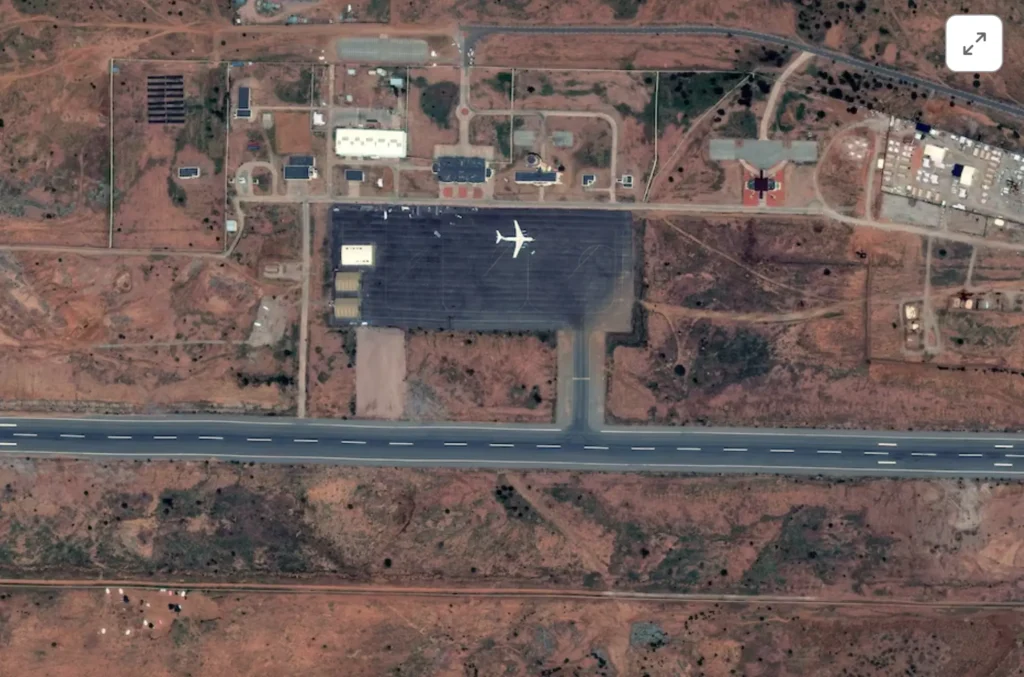
IMAGE: Satellite image shows IL-76 cargo plane parked on the tarmac at Amdjarass International Airport, Ouadi Koudjinli, Chad, October 1, 2024. (Source: Maxar Technologies/USG, Courtesy of Conflict | Via Reuters)
Saudi Arabia’s record is draped in the language of mediation and stability, but its role in Sudan’s modern ruin also runs through military dominance and Gulf leverage. Alongside the UAE, Riyadh helped normalize a post Bashir order in which generals and paramilitary bosses remained central while civilian sovereignty remained weak and disposable. A free Sudan was never going to emerge from that arrangement intact.
CIG ends with an unusually direct judgment. The UAE Colombian network enabled the RSF takeover of El Fasher, and bears shared responsibility for the crimes that followed. Abu Dhabi denies supporting the RSF and says there is no substantiated evidence behind such accusations. Yet El Fasher stands as a graveyard of that denial.
A city was starved, softened, breached, and brutalised while foreign power spoke the language of peace and supplied the means of war. Sudan will not be free until that system is broken and until its future is wrested back from monarchies, militias, and the foreign patrons that keep both alive.
READ MORE SUDAN NEWS AT: 21st Century Wire Sudan Files
SUPPORT OUR INDEPENDENT MEDIA PLATFORM – BECOME A MEMBER @21WIRE.TV
VISIT OUR TELEGRAM CHANNEL
21st Century Wire is an alternative news agency designed to enlighten, inform and educate readers about world events which are not always covered in the mainstream media.
Source: https://21stcenturywire.com/2026/04/24/new-cig-report-exposes-blood-money-mercenaries-and-the-gulf-plot-against-sudan/
Anyone can join.
Anyone can contribute.
Anyone can become informed about their world.
"United We Stand" Click Here To Create Your Personal Citizen Journalist Account Today, Be Sure To Invite Your Friends.
Before It’s News® is a community of individuals who report on what’s going on around them, from all around the world. Anyone can join. Anyone can contribute. Anyone can become informed about their world. "United We Stand" Click Here To Create Your Personal Citizen Journalist Account Today, Be Sure To Invite Your Friends.
LION'S MANE PRODUCT
Try Our Lion’s Mane WHOLE MIND Nootropic Blend 60 Capsules
Mushrooms are having a moment. One fabulous fungus in particular, lion’s mane, may help improve memory, depression and anxiety symptoms. They are also an excellent source of nutrients that show promise as a therapy for dementia, and other neurodegenerative diseases. If you’re living with anxiety or depression, you may be curious about all the therapy options out there — including the natural ones.Our Lion’s Mane WHOLE MIND Nootropic Blend has been formulated to utilize the potency of Lion’s mane but also include the benefits of four other Highly Beneficial Mushrooms. Synergistically, they work together to Build your health through improving cognitive function and immunity regardless of your age. Our Nootropic not only improves your Cognitive Function and Activates your Immune System, but it benefits growth of Essential Gut Flora, further enhancing your Vitality.

Our Formula includes: Lion’s Mane Mushrooms which Increase Brain Power through nerve growth, lessen anxiety, reduce depression, and improve concentration. Its an excellent adaptogen, promotes sleep and improves immunity. Shiitake Mushrooms which Fight cancer cells and infectious disease, boost the immune system, promotes brain function, and serves as a source of B vitamins. Maitake Mushrooms which regulate blood sugar levels of diabetics, reduce hypertension and boosts the immune system. Reishi Mushrooms which Fight inflammation, liver disease, fatigue, tumor growth and cancer. They Improve skin disorders and soothes digestive problems, stomach ulcers and leaky gut syndrome. Chaga Mushrooms which have anti-aging effects, boost immune function, improve stamina and athletic performance, even act as a natural aphrodisiac, fighting diabetes and improving liver function. Try Our Lion’s Mane WHOLE MIND Nootropic Blend 60 Capsules Today. Be 100% Satisfied or Receive a Full Money Back Guarantee. Order Yours Today by Following This Link.


| Visits: | 1,805,184,133 |
| Stories: | 8,640,465 |
Whistler Blowers, Insiders

