

The Day After Islamabad: When U.S. Power Meets Its Future in the Narrow Strait of Hormuz

Freddie Ponton
21st Century Wire
Islamabad was never a peace conference in any honest sense. It was the moment Washington tried to turn military failure into diplomatic blackmail. What it could not break with bombs, it tried to extract across a polished table. Iran answered by making clear that sovereignty defended under attack would not be converted into a concession or any form of surrender.
The Islamabad talks did not fail because diplomacy ran out of time. They failed because Washington came demanding what war had not delivered, while Tehran came unwilling to sign away, in a hotel room, what it had just defended under fire in its own skies and waters.
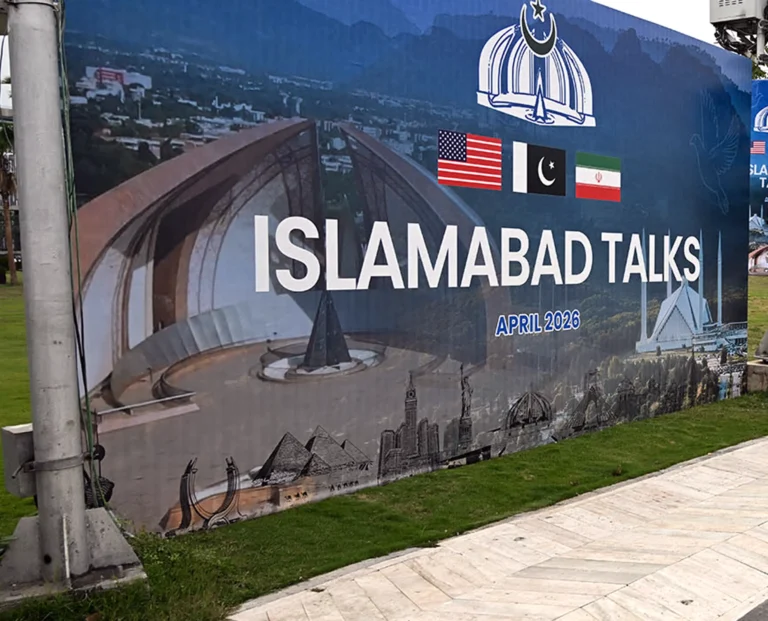
IMAGE: Islamabad negotiations between Washington and Tehran (Source: Pakistan Press Agencies)
That is what made the day after Islamabad so dangerous. The breakdown in Pakistan was not the end of a negotiation. It was the beginning of a more open struggle over Hormuz, over lawful passage, over regional hierarchy, and over whether the United States and Israel could still impose political surrender after launching an illegal war on Iran.
Islamabad Broke on Surrender Terms
The first point is simple. The war itself set the terms of the talks. China later said the U.S. and Israeli strikes on Iran lacked UN authorization and violated international law, which is why much of the non‑Western world saw the opening move not as enforcement but as aggression against a sovereign state.
By the time delegations reached Islamabad, that reality was already sitting in the room. Washington was still trying to recover through diplomacy what it had failed to secure through force, while Iran arrived convinced that survival, deterrence, and control over the Hormuz chokepoint had changed the balance of the encounter.
READ MORE: The Hormuz Trap: Where Iran Turns US Power Into Vulnerability
That was the fault line in Pakistan. The issue was not a technical misunderstanding. The issue was whether Iran would accept terms that, from Tehran’s side of the table, looked less like a negotiated settlement than capitulation wrapped in diplomatic language.
Abbas Araghchi said, “The United States tried to obtain at the table what it could not achieve through war“. That line captured the Iranian reading with perfect economy, and it explains why the talks broke with such force. The credibility problem was deepened by the men Washington chose to send. As criticism mounted over Steve Witkoff and Jared Kushner acting less like neutral American envoys than like Trump insiders advancing a line closely aligned with Israeli and private interests, the talks looked even less like diplomacy than a personalised channel for coercion. Seen from Tehran, Vice PresidentVance did not look like a broker of peace so much as the courier for a foregone conclusion. he was flown in to repackage Trump’s and Netanyahu’s conditions as a “last‑chance” offer, then sent back to the cameras to pathetically mourn the collapse when Iran declined to sign its own surrender.
Islamabad did not fail over the question of Uranium enrichment alone. It failed inside a one‑sided nuclear order in which Israel’s arsenal remains politically protected, while Iran is told that diplomacy begins with surrendering the leverage that protection helps justify. That deeper asymmetry is key to understanding why Tehran no longer treated the talks as a neutral diplomatic exercise. Iran had just been attacked by two states acting outside international legality, one of them a nuclear‑armed state shielded from scrutiny, and was then expected to negotiate as if the only destabilizing arsenal in the region was its own.
DOCUMENT: Iran and the 2026 Review Conference of the Parties to the Treaty on the Non-Proliferation (NPT) of Nuclear Weapons (Source: UNODA)
NPT_CONF.2026_23_-_23._ADVANCE_National_Report_-_Iran_Middle_East_zone_free
Once that contradiction is visible, the failure in Islamabad looks less mysterious. A military campaign, a coercive negotiating strategy, and a long‑standing regional double standard collided at the same moment, and Iran refused to ratify any of them with its own signature.
The Strait Answered Back
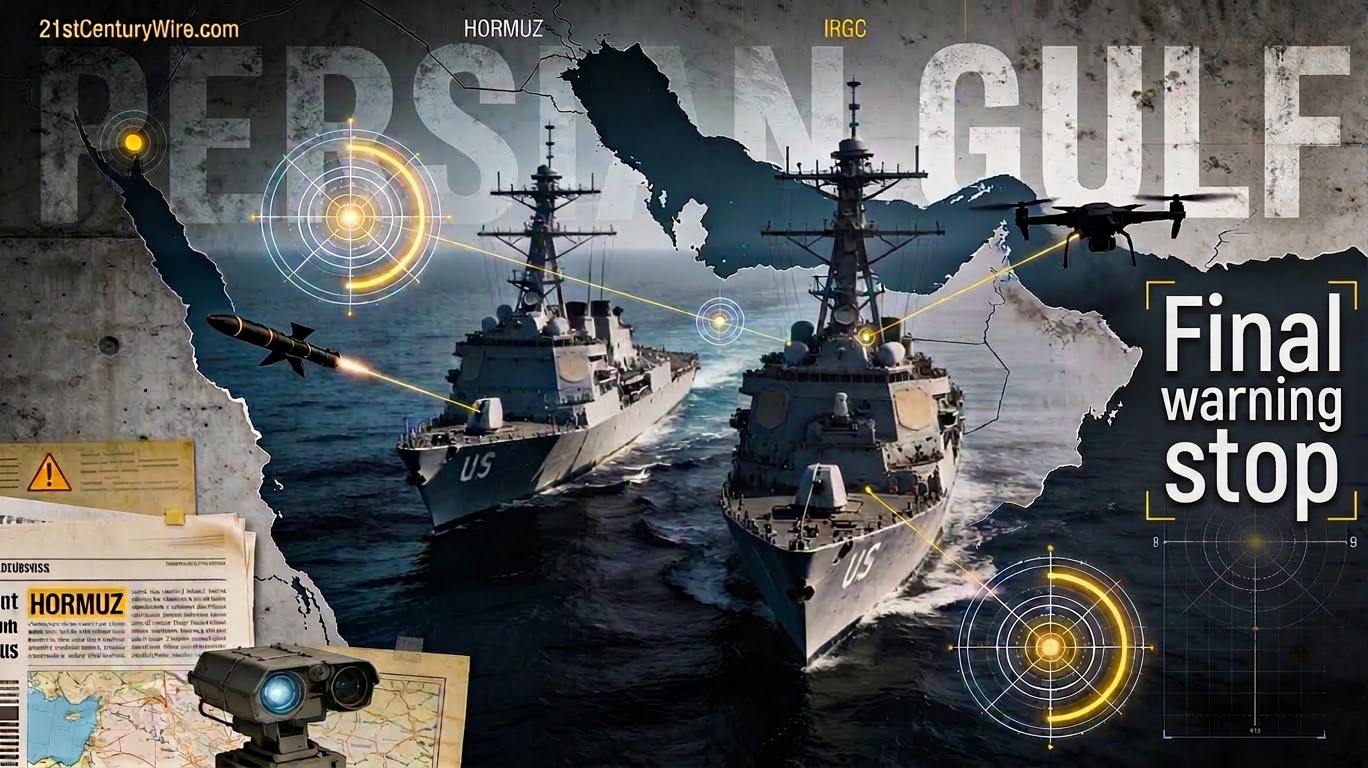
While negotiators were still talking in Islamabad, the water itself answered. Iranian officials said two U.S. destroyers approached the Strait of Hormuz during the talks and were met with direct IRGC warnings, and Iranian reporting held that the ships pulled back after a final radio ultimatum.
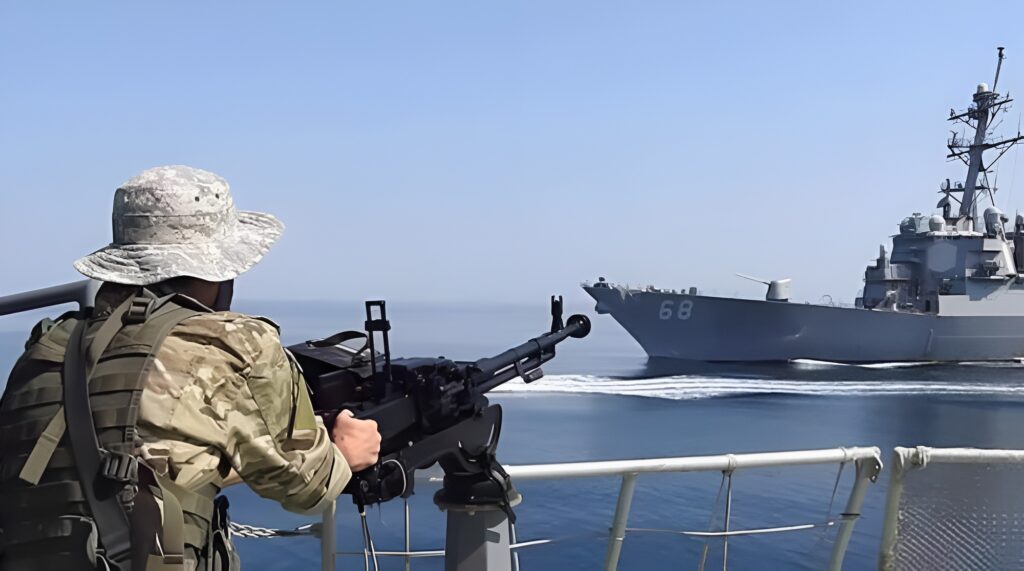
IMAGE: IRGC Navy warns military vessels of ‘firm response’ to attempts at crossing Strait of Hormuz (Source: The Islamic Revolution Guards Corps (IRGC) | Via PressTV)
The Iranian account of that encounter was not a minor sideshow. It cut straight through the diplomatic theater. Washington was not entering Islamabad as a power ready to recognize a new balance. In fact, it was still probing for leverage in the strait, still testing whether naval pressure could strengthen the same negotiating position that had already failed to impose itself through war.
Iran denied American claims that U.S. military vessels had successfully transited the strait, and Iranian media went further, saying the destroyers were warned off after Iranian forces locked on and issued a final warning. The account presented by Iran held that the ships pulled back rather than cross an Iranian red line in a waterway Washington had long treated as if it were naturally open to U.S. command.
If that account is taken seriously, the meaning is unmistakable. Washington tried to negotiate from a position it no longer fully possessed, and the IRGC answered in the only language imperial power truly hears, the language of denied access.
Press TV Exclusive: US destroyers’ Strait of Hormuz transit stunt failed, came close to destructionhttps://t.co/zVeCCKGJlO https://t.co/m348SyV1uz pic.twitter.com/KhKXTTwWA5
— Press TV (@PressTV) April 12, 2026
That is why the destroyer episode belongs near the front of the story. At the table, the United States was pressing Tehran to accept a rollback under pressure. In the Strait, Iran was demonstrating that military pressure no longer guaranteed compliance and that Hormuz was not an American‑managed corridor that opened on command.
The reported Trump blockade language and the IRGC response sharpened the confrontation further. The day after, Islamabad became an open struggle over who would manage Hormuz by force, by law, or by deterrence, and for the first time in years, that answer no longer looked prewritten in Washington.
The real point was larger than one naval incident. Islamabad had exposed the political limits of American coercion, while Hormuz exposed its operational limits. Together, they told the same story. The United States could still threaten or raise the cost, but it can no longer presume it controls the outcome.
Hormuz Has a Map
Too much Western writing treats Hormuz like an abstract trade route, a blue line on a screen that belongs to whichever navy arrives with the loudest press release. The real Strait is nothing like that. It is a narrow and crowded chokepoint shaped by Iranian coastlines, shallow approaches, monitored passages, and above all by Abu Musa, Greater Tunb, and Lesser Tunb, the islands that anchor Tehran’s physical leverage over the mouth of the Gulf.
READ MORE: The Three Islands Unmaking American Unipolar Sea Power in the Persian Gulf
That geography is not scenery, and should be understood as the hard reason Washington cannot simply narrate the Strait as a neutral corridor detached from Iranian power. Every argument about passage, blockade, escort, or deterrence begins with that map, whether the Pentagon likes it or not.
The same holds for deterrence. Iran’s power in Hormuz does not rest on missiles alone. It is socialized, layered, and distributed through a broader system that includes the Naval Basij, small craft, surveillance networks, coastal enforcement, and the “no move zone” logic that turns the strait into a place of permanent uncertainty for any hostile force trying to test it.
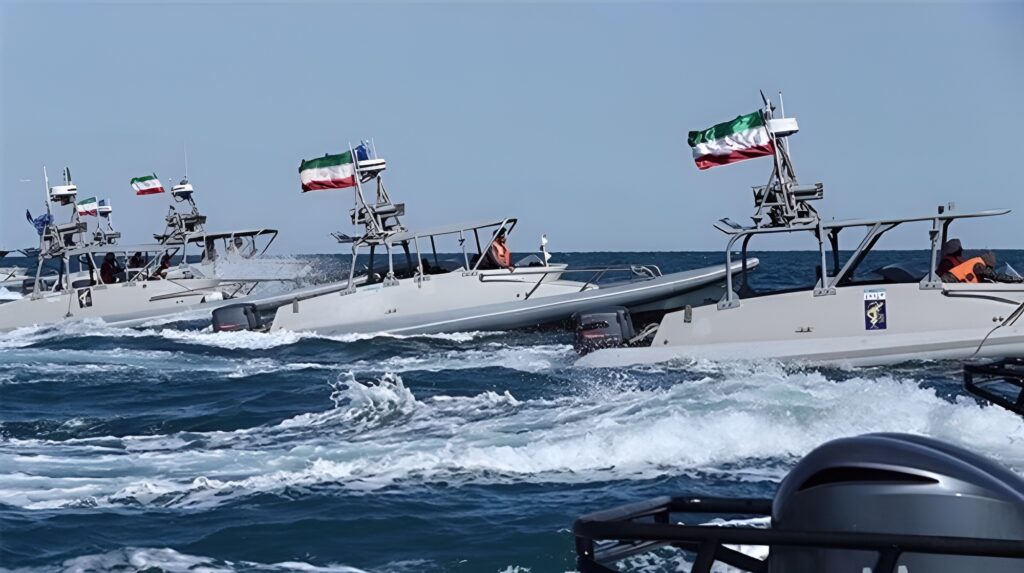
IMAGE: Management of Strait of Hormuz has entered new stage: (Source: IRGC | Via PressTV)
That matters because the old fantasy of decisive Western fleet superiority does not fit the terrain anymore. In the confined waters of Hormuz, Iran does not need to match the United States ship for ship. It only needs to make intrusion costly, uncertain, and politically dangerous enough that every attempted show of force threatens to become a humiliation.
The legal struggle sits inside that same geography. The fight after Islamabad was also a fight over sovereignty, passage, and who gets to define lawful access through a strategic strait once coercion and negotiation have begun to merge. That is why Hormuz cannot be reduced to shipping insurance and naval maneuvers. It is also a contest over whose reading of law governs the water.
Then there is the financial front, which matters just as much as the military one. The petroyuan, crypto, and tolling angle widens Hormuz from a naval contest into a challenge to dollar‑centered coercive power. If maritime control can be translated into selective payment systems, toll logic, and non‑dollar settlement, then the struggle over passage becomes inseparable from the struggle over who writes the rules of global economic power.
That is why Hormuz matters far beyond the Gulf. It is not simply a place where tankers pass. It is a place where geography, law, deterrence, and finance can be fused into a single instrument of resistance against a system built on Western control of circulation.
READ MORE: The Hormuz Humiliation: Iran’s Mine Warfare vs Washington’s ‘NO PLAN’ Disaster
The Day After Islamabad
The day after Islamabad did not produce one reaction. Instead, it exposed four different refusals of the American solution. China refused maritime subordination. Russia refused Iran’s strategic isolation. The Gulf states refused to be exposed to another round of war. Europe, NATO allies, and the UK refused to protect shipping on terms fully dictated by Washington.
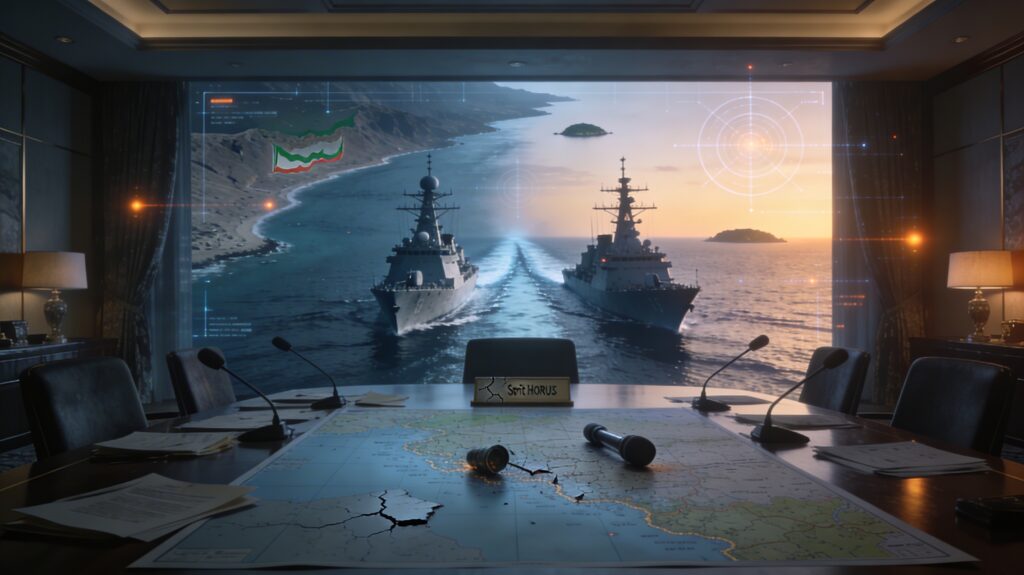
China saw the failed talks through the lens of trade, energy, and maritime hierarchy. Beijing’s position was not a simple sentiment for Tehran. It was resistance to an outcome in which Washington turns failed diplomacy into a U.S.‑controlled maritime order and leaves Asian importers dependent on American gatekeeping over Gulf energy flows.
That is why China’s posture looks restrained on the surface but sharp underneath. Preserve trade. Avoid war. Refuse subordination. Beijing wants Hormuz open, but it does not want it reopened under a blockade logic that leaves Chinese shipping moving only through an American permissions structure.
China’s likely course after Islamabad is therefore clear enough. It will keep opposing military escalation, defend continued commercial access, back arrangements that deny Washington monopoly control over the waterway, and quietly support a wider shift toward non‑dollar and non‑Western mechanisms of exchange if the United States keeps trying to weaponize passage itself.
Russia read the same collapse more bluntly. Moscow’s most plausible support to Iran runs through the Caspian, the Volga, and the North–South corridor with its $1.6B railway that bypasses U.S. sanctions, because those routes are inland, harder for the United States to interdict, and already embedded in commercial traffic. That is what gives Russia real weight after Islamabad. It can help keep Iran’s strategic rear open even if Washington tries to harden pressure at the Gulf end.
Many experts agree that Russia does not need a dramatic Gulf deployment to matter. It only needs to deepen logistics, intelligence sharing, diplomatic cover, and corridor resilience so that Iran cannot be isolated simply because Washington wants to turn Hormuz into an American test of will.
The reported Pezeshkian–Putin contact reinforced that trajectory. Moscow moved quickly to tighten strategic coordination after the talks collapsed, which is exactly what one would expect from a power that sees U.S. coercion in Hormuz as part of a larger contest over regional order and over the viability of non‑Western corridors linking Russia, Iran, India, and Asia.
The Gulf states looked at the same failure from a more vulnerable position. They did not see leverage. They saw exposure. Their ports, pipelines, airspace, balance sheets, and shipping routes all sat within range of the next escalation, which is why their overriding interest after Islamabad was not to help Washington press harder but to stop the ceasefire from collapsing.
Oman was the clearest case. Muscat kept pushing for diplomacy, extension, and breathing room, which fit its long‑standing role as a quiet regional intermediary more interested in preventing rupture than in choosing sides for public applause.
The UAE’s position was more complicated and therefore more revealing. Abu Dhabi wanted order, navigational security, and a wider settlement architecture that could keep commerce moving without tying the Emirates too tightly to an openly escalatory U.S. line. That instinct helps explain why the UAE could host a European maritime initiative while avoiding the image of full merger into Washington’s coercive design.
Saudi Arabia, Qatar, Kuwait, and Bahrain read more as states seeking insulation than as capitals eager to sponsor escalation. Their central fear was plain, and another cycle of war around Hormuz would not produce strategic clarity. What they fear the most is immediate exposure, investor panic, energy risk, airspace pressure, and the return of war to the infrastructure on which their own stability depends.
That is why the Gulf reading of the day after Islamabad matters so much. These states did not rush to celebrate American pressure. They saw the failed talks as a warning that Washington could generate escalation faster than it could control its costs, while the first bill would be paid in the Gulf itself.
Europe reacted in yet another register. Brussels wanted shipping protected and diplomacy preserved, but Europe’s answer to Hormuz had already been shaped by an important distinction that deserves to be stated clearly. The broad strategic doctrine is the European Union Maritime Security Strategy, or EUMSS, first adopted in 2014 and revised in 2023 to widen the EU’s role in protecting sea lanes, infrastructure, and maritime resilience.
That is the doctrine, not the deployed mechanism. The Hormuz‑specific initiative is EMASoH, the European Maritime Awareness in the Strait of Hormuz, with Operation AGENOR as its military pillar. EMASoH provides the political and diplomatic frame, while AGENOR supplies the military presence, surveillance aircraft, ships, and reassurance role at sea.
DOCUMENT: European-led Maritime Awareness mission in the Strait of Hormuz (EMASOH) and its military operation named AGENOR (Source: EMASOH)
EMASOH AGENOR
That difference matters because it shows how Europe tried to separate its own maritime role from Washington’s harder coalition logic. EUMSS is the umbrella doctrine for EU maritime security. EMASoH is the Hormuz initiative. AGENOR is the operational arm inside that initiative.
The mission’s legal and political language also mattered. EMASoH was framed around de‑escalation, maritime awareness, freedom of navigation, and respect for international law, including UNCLOS, which helped Europe present its presence as a stabilizing and defensive posture rather than a forward extension of U.S. coercive strategy.
Abu Dhabi’s role reveals even more. The United Arab Emirates agreed to host the EMASoH headquarters at the French naval base in Abu Dhabi, which gave Europe a forward command position inside the theater without placing the mission under U.S. command. That was not an administrative footnote. It was a political choice.
What it meant was simple. Abu Dhabi wanted navigational security and a hedge. A European‑led presence with de‑escalatory branding was close enough to matter, but distinct enough from Washington to remain usable in a region exhausted by American maximalism.
Inside Europe, the division lines also mattered. France accepted a more active maritime security role and discussed coalition‑style efforts to secure navigation in Hormuz while still publicly saying de‑escalation was the preferred scenario.
Spain sat at the other end of the spectrum. Madrid publicly argued that Hormuz was outside NATO’s remit and resisted being pulled into a broader escalation framework after American pressure and ultimatums. Spain’s line was clear. Protect shipping if necessary, but do not let protection become the entry point for a wider war logic designed elsewhere.
Germany occupied the middle ground. Berlin supported a bounded role under international or European legitimacy rather than open‑ended alignment with Washington, which is precisely why Germany, Italy, Belgium, and other middle European states matter in this story. They wanted a European capacity to defend trade routes without surrendering the political definition of the mission to the United States. The way around this uncomfortable position for Germany was for Chancelor Merz to make a UN Mandate to secure the Strait of Hormuz a prerequisite for any deployment.
Nonetheless, that European positioning is likely to harden, not disappear, if the crisis worsens. Europe will keep looking for a formula that protects commerce, reassures shipping, and preserves strategic room for diplomacy while avoiding direct capture by U.S. coercive momentum. That is what EMASoH and AGENOR already represented before Islamabad failed, and it is what they are likely to represent even more strongly after it.
The Order Breaking Open
By the day after Islamabad, the issue was no longer whether one more round of talks might save appearances. The real question was whether the United States and Israel could turn their “excessive demands that wrecked talks with Iran” into a new coercive regime over shipping, legitimacy, and regional hierarchy, or whether Iran and the actors around it had already made that impossible.
The morning after Islamabad, the mask finally slipped. Washington had tried to batter a sovereign state to the edge of collapse and then face its delegation as if the destruction were a neutral backdrop, as if a country counting its dead would politely sign away the very shields that stopped the bombs. Tehran’s reply was disarmingly direct, and it didn’t take much time for Iran’s delgation to remind the US that Iran had not survived an onslaught in order to ratify its own subordination. In that stance, there was more than rhetoric; it was a society drawing a line for itself, insisting that dignity and self‑defence are not bargaining chips. The limits of what can be demanded in the name of “stability” were no longer being set in distant briefing rooms, but by people who had seen the strikes with their own eyes and still expected their state to meet the next day, standing, not kneeling.
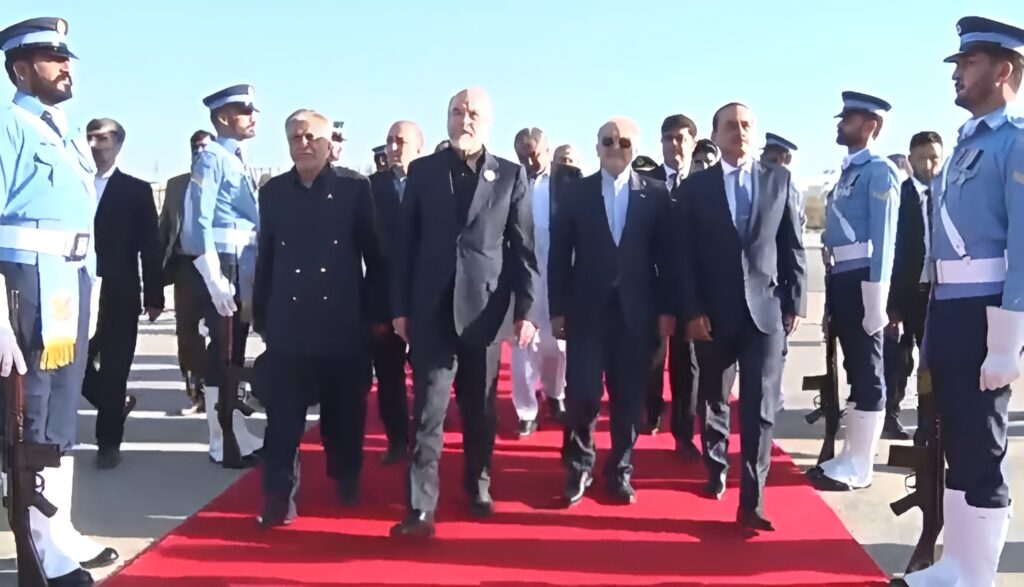
IMAGE: Iranian delgation departs from Islamabad, Pakistan (Source: Daily Independent PK)
Once that line was drawn, everyone else had to adjust. Beijing heard the blockade talk and saw less a security plan than a bid to turn its energy lifeline into someone else’s bargaining chip. Moscow saw another front where a partner was meant to be isolated and decided to keep the back roads open to preserve common interests. In the Gulf, rulers looked out at their refineries, ports, and towers and understood that every new round of American brinkmanship would land first on their own infrastructure before it ever touched Washington. European ministers, for all their cautious language, could read the same map: escorting tankers is one thing, underwriting someone else’s crusade is another.
This is what “the day after Islamabad” really names: a moment when the old script, that the United States can wreck and then dictate, punish and then prescribe, no longer runs smoothly on contact with reality. Iran’s stance did not make the world safer or fairer overnight; what it did was something quieter but just as consequential. It exposed how many actors are now quietly unwilling to treat American force as a self‑evident source of legitimacy. The war and the talks that followed were supposed to teach Tehran a lesson. Instead, they taught much of the world that saying no to Washington is dangerous, exhausting, and, for the first time in a long while, thinkable.
That is why the water off Hormuz mattered more than the press room in Islamabad. The old order was not quietly restoring itself. It was being challenged from the shoreline, from the islands, from inland corridors, from wary Gulf capitals, from divided European chancelleries, and from every power that understood one brutal truth. Washington could still start a war. It could no longer command the outcome simply by demanding it.
READ MORE IRAN NEWS AT: 21st Century Wire Iran Files
SUPPORT OUR INDEPENDENT MEDIA PLATFORM – BECOME A MEMBER @21WIRE.TV
VISIT OUR TELEGRAM CHANNEL
21st Century Wire is an alternative news agency designed to enlighten, inform and educate readers about world events which are not always covered in the mainstream media.
Source: https://21stcenturywire.com/2026/04/13/the-day-after-islamabad-when-u-s-power-meets-its-future-in-the-narrow-strait-of-hormuz/
Anyone can join.
Anyone can contribute.
Anyone can become informed about their world.
"United We Stand" Click Here To Create Your Personal Citizen Journalist Account Today, Be Sure To Invite Your Friends.
Before It’s News® is a community of individuals who report on what’s going on around them, from all around the world. Anyone can join. Anyone can contribute. Anyone can become informed about their world. "United We Stand" Click Here To Create Your Personal Citizen Journalist Account Today, Be Sure To Invite Your Friends.
LION'S MANE PRODUCT
Try Our Lion’s Mane WHOLE MIND Nootropic Blend 60 Capsules
Mushrooms are having a moment. One fabulous fungus in particular, lion’s mane, may help improve memory, depression and anxiety symptoms. They are also an excellent source of nutrients that show promise as a therapy for dementia, and other neurodegenerative diseases. If you’re living with anxiety or depression, you may be curious about all the therapy options out there — including the natural ones.Our Lion’s Mane WHOLE MIND Nootropic Blend has been formulated to utilize the potency of Lion’s mane but also include the benefits of four other Highly Beneficial Mushrooms. Synergistically, they work together to Build your health through improving cognitive function and immunity regardless of your age. Our Nootropic not only improves your Cognitive Function and Activates your Immune System, but it benefits growth of Essential Gut Flora, further enhancing your Vitality.

Our Formula includes: Lion’s Mane Mushrooms which Increase Brain Power through nerve growth, lessen anxiety, reduce depression, and improve concentration. Its an excellent adaptogen, promotes sleep and improves immunity. Shiitake Mushrooms which Fight cancer cells and infectious disease, boost the immune system, promotes brain function, and serves as a source of B vitamins. Maitake Mushrooms which regulate blood sugar levels of diabetics, reduce hypertension and boosts the immune system. Reishi Mushrooms which Fight inflammation, liver disease, fatigue, tumor growth and cancer. They Improve skin disorders and soothes digestive problems, stomach ulcers and leaky gut syndrome. Chaga Mushrooms which have anti-aging effects, boost immune function, improve stamina and athletic performance, even act as a natural aphrodisiac, fighting diabetes and improving liver function. Try Our Lion’s Mane WHOLE MIND Nootropic Blend 60 Capsules Today. Be 100% Satisfied or Receive a Full Money Back Guarantee. Order Yours Today by Following This Link.


| Visits: | 1,801,362,620 |
| Stories: | 8,631,679 |
Whistler Blowers, Insiders

