

The Global Sumud Flotilla Ambush: Greece Turns Crete into Israel’s Dock

Freddie Ponton
21st Century Wire
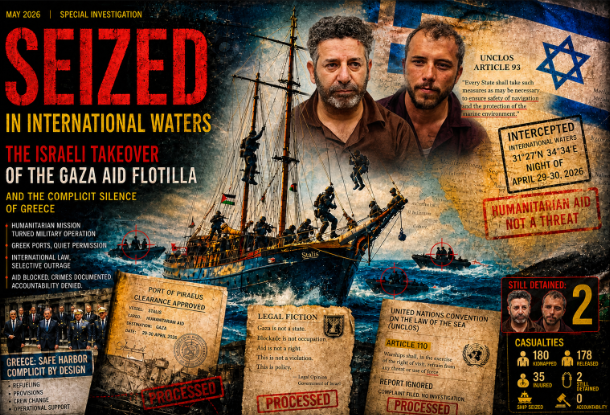
On the night of April 29 to 30, Israeli forces intercepted the Global Sumud flotilla in international waters west of Crete, seizing a civilian aid convoy hundreds of miles from Gaza and funnelling 176 activists into a tightly managed transfer operation on Greek soil, where 31 wounded required first aid.
But the episode did not end in Crete. While most passengers were offloaded into Greek custody and dispersal, two organizers, Saif Abukeshek, a Spanish-Swedish activist of Palestinian origin and Thiago Ávila, a Brazilian activist, were abducted and forcibly transferred to Israel against their will, brought before the Ashkelon Magistrates’ Court, and held in Shikma Prison in Ashkelon, where lawyers say their detention was extended and abuse allegations emerged.
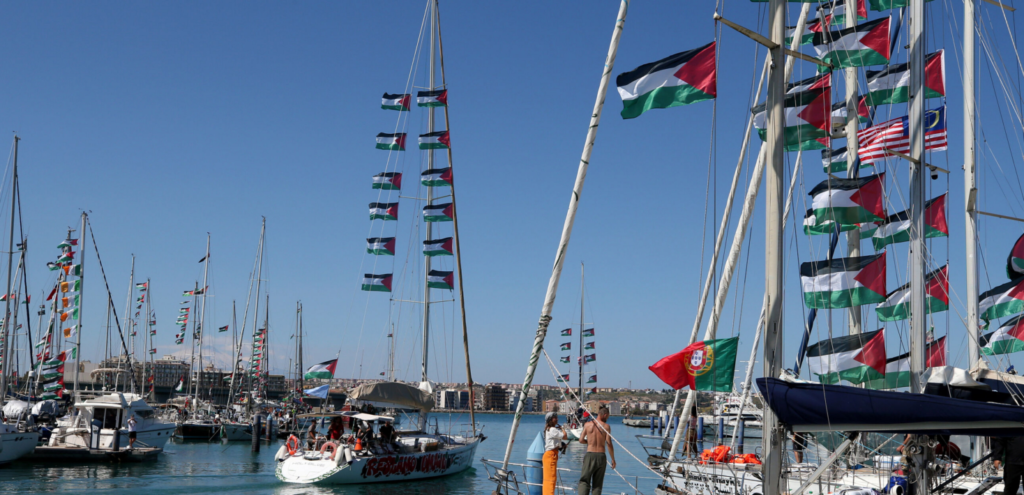
IMAGE: Global Sumud Flotilla boats docked in a Greek port on May 28, 2026 (Source: Baris Seckin/Anadolu via Getty Images)
What began as a challenge to the siege of Gaza quickly became something larger—a test of whether Israel can project force deep into the Mediterranean under the cover of blockade law, and whether Greece can stand inside its own search-and-rescue (SAR) zone, refuse the burdens of protection, process the wounded onshore, and then watch as two captives vanish into the Israeli prison system. Greece’s inaction in its SAR area of responsibility has therefore raised serious questions about whether Athens merely stood aside or deliberately narrowed its obligations while Israel turned a violent high-seas seizure into an administrative handover
VIDEO: The Israeli Navy’s kidnapping of international activists and interception of the “Freedom Flotilla” during a humanitarian mission to Gaza (Source: Euromed Human Rights Monitor)
.
From the High Seas to Crete: How Israel’s Seizure of the Global Sumud Flotilla Became a Greek Accountability Crisis
To understand what happened off Crete, it is not enough to ask how Israel justified the raid. The deeper question is how a violent capture at sea was sanitized through legal euphemism and then recast ashore as administration.
Israel wants this episode buried under the antiseptic language of “interdiction,” as if commandos storming civilian boats in international waters were carrying out a routine act of maritime administration rather than the violent seizure of unarmed activists. But that language is not merely misleading. It is designed to sanitize brutality, to erase the image of armed men descending on civilian vessels and replace it with procedure, paperwork, and the fiction that brutal violence becomes lawful once a state recites the right maritime formula.
Israel’s legal defence rests on five contested pillars. Remove any one of them, and the whole structure gives way: the legality of the blockade, its proportionality, the right to stop humanitarian vessels despite civilian need, the claim that occupation does not preclude blockade, and the idea that blockade law overrides the ordinary protections of the high seas.
What happened off Crete was not lawful enforcement but an illegal seizure on the high seas, followed by detention rooted in illegality from the outset.
The legal shell around the raid
The first crack lies at the foundation. Israel’s defenders treat the word blockade as if it were a master key that unlocks every other legal door, but major UN-linked authorities have long argued that the closure around Gaza is inseparable from a regime of collective punishment imposed on a trapped civilian population.
The 2010 United Nations Human Rights Council fact-finding mission did not merely challenge the optics of the flotilla raid. It found no legal basis for the interception and concluded that the action on the high seas was clearly unlawful.
Israel and its defenders have long preferred to lean on the later Palmer Panel, formally the Secretary-General’s Panel of Inquiry, because it took a more permissive view of the blockade.
REPORT: 2010 Report of the international fact-finding mission to investigate violations of international law, including international humanitarian and human rights law, resulting from the Israeli attacks on the flotilla of ships carrying humanitarian assistance (Source: United Nations)
A.HRC.15.21_en
But even that report never dissolved the deeper legal contradictions around collective punishment, humanitarian access, and the limits imposed by the law of the sea. Once the blockade itself is legally unstable, every assault carried out in its name begins to look less like security than force searching for a legal costume.
The same is true of proportionality. The San Remo Manual on International Law Applicable to Armed Conflicts at Sea does not hand a naval power an unlimited right to choke a civilian population from offshore. Its blockade rules, especially paragraphs 102 to 104, bar blockades whose damage to civilians is excessive, prohibit starving civilians, and require passage for essential medical relief subject to technical arrangements.
A blockade imposed on a population already starved of essentials, then defended as a security necessity because that population has been so tightly controlled, reveals itself as what critics have called it for years: a collective punishment with a naval wrapper. That is why the seizure of an aid flotilla cannot be detached from the siege it was trying to break. If the siege is unlawful, the violence used to defend it is tainted from the outset.
Even the law Israel invokes cuts against it. Where a civilian population is inadequately supplied, blockade law does not simply authorize a navy to slam the door on humanitarian relief and call it order. In fact, it recognizes obligations toward food, essential supplies, and medical aid, subject to supervision arrangements.
That obligation also sits inside the broader humanitarian law framework. Article 59 of the Fourth Geneva Convention requires an occupying power to agree to and facilitate relief schemes when the population is inadequately supplied, while Article 70 of Additional Protocol I requires the rapid and unimpeded passage of humanitarian relief, subject only to limited conditions.
Those obligations do not end with treaty rhetoric. The Rome Statute of the International Criminal Court (ICC) takes serious violations of the Geneva framework and classifies them as war crimes, including the starvation of civilians as a method of warfare and the deliberate obstruction of humanitarian relief, making individual political and military leaders criminally liable when relief is denied to a population that is already inadequately supplied.
So Israel’s claim is not merely that it may inspect aid. In practice, it claims the right to monopolise the route by which aid reaches a besieged population and criminalize any independent attempt to challenge that monopoly.
Art. 59. If the whole or part of the population of an occupied territory is inadequately supplied, the Occupying Power shall agree to relief schemes on behalf of the said population, and shall facilitate them by all the means at its disposal. Yale Law School
That proposition weakens further if Gaza remains occupied in the legally relevant sense, because a growing body of analysis argues that occupation and blockade are conceptually incompatible, while UN material after the International Court of Justice (ICJ) Advisory Opinion of 22 October 2025, reinforced that Israel’s occupation-related obligations toward Gaza persist.
And then there are the high seas, where the oldest rules cut cleanly through the fog. Under the United Nations Convention on the Law of the Sea, and specifically Article 87 on freedom of the high seas, Article 89 on the invalidity of claims of sovereignty over the high seas, Article 92 on exclusive flag-state jurisdiction, and Article 110 on the right of visit, the high seas are open to all states, cannot be appropriated by any one state, are generally governed by the law of the flag state, and allow boarding only in narrow, enumerated circumstances.

IMAGE: Israeli navy commandos board a Global Sumud Flotilla vessel in international waters near the island of Crete, intercepting the Gaza‑bound aid convoy on the high seas (Global Sumud Flotilla)
That means Israel had no ordinary law-of-the-sea jurisdiction to storm foreign civilian vessels in international waters. It had to smuggle jurisdiction in through the back door of a disputed blockade theory. And this was not a classic case of Article 111 hot pursuit, which applies only in tightly defined circumstances and does not rescue a boarding operation launched against foreign civilian ships far from any Israeli territorial sea.
If that theory fails, what remains is not interdiction but unlawful capture. In this case, Israel unlawfully captured foreign civilians seized on foreign boats in international waters by a state with no ordinary right to touch them.
From aid mission to “stunt”
The legal case was only one front in the operation. The other was narrative warfare. Almost immediately, the flotilla was pushed into a propaganda frame designed to empty it of humanitarian legitimacy and recast it as theatre, provocation, or a media exercise.
Le Monde reported that Washington warned allies over support for what it called a Gaza aid flotilla “stunt,” a revealing phrase because it shrinks a civilian convoy into a publicity nuisance rather than confronting the legal and political implications of seizing it on the high seas. That downgrade is part of the same sanitizing operation. If the flotilla can be portrayed as spectacle, then the warships, jamming, boarding, transfer, and detention can be sold as routine nuisance management rather than the violent suppression of a humanitarian challenge to the siege.
States do not deploy naval force, disrupt communications, move detainees between vessels, and extend court detention because they are dealing with a harmless stunt. They do it because the convoy threatened the political legitimacy of the blockade itself.
Washington, Brussels, and the politics of cover
The raid was cushioned by political cover from capitals that preferred management to confrontation. Washington openly backed Israel after the interception and urged allies to deny port access, docking, departure, and refuelling to flotilla vessels, calling the mission a “meaningless political stunt” and even a “pro-Hamas flotilla.”
Brussels took a softer but still cautious line. Euronews reported that the European Commission invoked freedom of navigation and respect for international humanitarian and maritime law, but stopped short of explicitly condemning the interception as unlawful and had previously discouraged flotilla missions as a means of aid delivery.

IMAGE: The European Commission’s High Representative for Foreign Affairs Kaja Kallas, in Brussels, Belgium, on September 3, 2025. (Source: Yves Herman / Reuters)
When the United States criminalizes the mission in advance, and the European Union responds with legal abstractions stripped of consequence, Greece is handed the political space to behave less like a coastal state with responsibilities and more like a logistical manager of an ally’s fait accompli.
Against that backdrop, Spain’s foreign minister, Jose Manuel Albares, has been one of the few to break ranks, publicly denouncing Saif’s continued detention as unlawful and demanding his release, a rare EU capital willing to say openly that Israel has crossed a legal line rather than hiding behind process and “concern.”
Crete is where the law stopped being abstract and arrived in bodies
Crete is where the legal argument stops being abstract. Reuters reported that 176 activists were disembarked there and that 31 were taken for first aid, while the wounded were brought to a local health centre, as the rest began dispersing back to their home countries.
The high seas are where the law was broken, but Crete is where the evidence arrived in public view, in wounded bodies, medical triage, buses, airport transfers, and hurried consular processing. Reuters-based coverage said activists arrived to find buses and an ambulance already waiting, while Greek authorities organized onward transport, including movement to Heraklion airport.
As Le Monde noted, Israel offloaded the intercepted activists in Crete under an arrangement with Athens, placing Greece at the centre of the political fallout from a high-seas seizure carried out by Israeli forces. Ultimayely, Crete is not the epilogue to the story, but the hinge where a contested high-seas seizure became a physical record of injury, custody, sorting, and disappearance into deeper detention.
The testimonies already emerging from the activists give that scene a human shape that official statements cannot wash away. Reuters-based reporting relayed the flotilla organizers’ allegations that activists were denied adequate food and water, forced to sleep on floors that were repeatedly flooded aboard an Israeli vessel, and subjected to what organizers called “40 hours of calculated cruelty.” The same report said some suffered broken noses and cracked ribs when they were kicked and dragged across the deck with their hands tied after protesting the detention of their two fellow activists.
Ahram Online added allegations of bruises, neck trauma, and prolonged deprivation, while Democracy Now aired participant testimony describing cruelty after the seizure.
Most of the flotilla was processed through Crete and pushed back into normal travel routes. However, Saif Abukeshek and Thiago Ávila were not. They disappeared from that release stream before reappearing inside the Israeli detention system.
More than 200 activists from the Global Sumud Flotilla who were seized at sea by Israeli forces and taken to the Greek island of Crete were released earlier today, with photos showing visible injuries including bruising, cuts, and swelling; participants say they were beaten and… pic.twitter.com/dqzpBvdJoU
— Drop Site (@DropSiteNews) May 1, 2026
Athens and the alibi of distance
Athens wants the public to believe it was little more than a nervous spectator to Israel’s assault, a government standing at a polite legal distance while events unfolded somewhere beyond its reach.
That fiction collapses under Greece’s own account. According to a report from Keep Talking Greece, Greek vessels were already in the area, Greek authorities were monitoring the flotilla while Israeli warships shadowed it, and within hours, Greece was helping turn a violent seizure on the high seas into a clean, managed transfer operation on Greek territory.
This was not some unfortunate collision between strangers. Greece and Israel entered this episode bound by a deepening strategic axis built on military exercises, maritime coordination, and Eastern Mediterranean security cooperation.
Since 2010, Athens has drawn steadily closer to Tel Aviv, treating Israel as a counterweight to Turkey; in December 2025, the two governments signed a new military cooperation programme, and on April 6, Greece concluded its largest-ever arms deal, nearly €656 million for PULS precision rocket launchers from Israeli firm Elbit Systems.
As Francesca Albanese, the United Nations Special Rapporteur on the occupied Palestinian territories (OHCHR), warned during a presentation of her new book “When the World Sleeps: Stories, Words and Wounds of Palestine, at the Trianon Cinema in Athens, that Greece imagines it has chosen Israel for protection, but in reality “Israel has chosen you” and is exploiting Greek fears and insecurity to advance its “regional hegemony.”
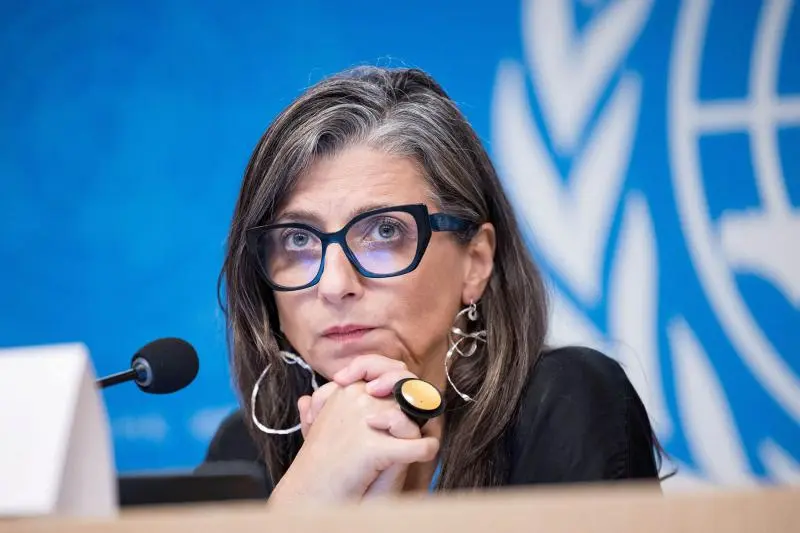
IMAGE: United Nations Special Rapporteur on the situation of human rights in the occupied Palestinian territory, Francesca Albanese, attends a press conference at the European headquarters of the UN in Geneva, Switzerland, September 15, 2025 (Source: Arab Weekly)
Her statement matters because it strips away the myth of Greek neutrality before the legal arguments even begin. Athens was not an indifferent coast watching a distant drama. It was the nearest allied state in the immediate theatre of operations.
Greece was not ignorant, and we know that because its own officials acknowledged that Greek coast guard vessels were in the same general area where Israeli warships were shadowing the flotilla. That means Athens was not informed after the fact by a diplomatic courtesy call. It was watching a civilian convoy and the naval forces hunting it in real time.
The question is not whether Greece knew, but rather what Greece chose to do with that knowledge.
Search and rescue as a shield
The answer Greece offers is search and rescue. Officials insisted the incident took place outside Greek territorial waters and that their role in that maritime space was limited to SAR functions, while Le Monde reported the government’s claim that a Greek vessel approached after a distress call, and flotilla captains said they were not in danger and did not want assistance. However, the civil society and humanitarian record make that defense much harder to sustain. Greenpeace International said Israeli forces issued threats over Channel 16, jammed VHF emergency communications, GNSS, and satellite bands, and that contact was lost with multiple vessels during the operation.
According to March to Gaza Greece, cited by Le Monde, large Israeli warships dispatched fast boats to encircle the flotilla, drones flew overhead, radio messages ordered the captains to abandon their attempt to reach Gaza, at least one Spanish-flag vessel had its engine “smashed,” and civilians were left adrift on powerless boats “directly in the path of a massive approaching storm.”
In their April 30, 2026, report, the International Federation for Human Rights (FIDH) and The World Organisation Against Torture (OMCT) went further, describing the assaults, interceptions, abductions, enforced disappearances and damage to the flotilla as “serious unlawful acts in international waters” that undermine the freedom of navigation and breach UNCLOS, the SOLAS Convention and the SAR Convention.
They located the raid “off Crete, on the high seas and within the Greek SAR zone,” and framed it as a continuation of Israel’s unlawful actions in violation of international criminal law and humanitarian law provisions on unimpeded humanitarian aid and the prohibition of starvation of civilians, as well as a grave infringement of the activists’ rights to life, freedom from torture, fair trial and humane detention.
The same statement explicitly called on Greece to seek full clarification from Israel, demand the safe release and protection of the mission’s members, activate every available diplomatic and legal avenue, and formally notify the competent international bodies of an incident that took place in Greece’s own search‑and‑rescue area of responsibility.
Under international search-and-rescue norms, once a distress situation arises in a state’s SAR region, that state bears a positive obligation to coordinate and, where necessary, mobilize an effective response to safeguard life at sea. Treating an armed boarding, communications blackout, and loss of contact as a mere radio formality falls below that standard.
The maritime ministry’s claim that a coast guard vessel approached but flotilla captains refused assistance echoes the same argument Greek authorities have used to justify delayed interventions in fatal migrant shipwrecks, turning a familiar excuse from the Aegean into a shield for passivity off Crete.
Even if Athens wants to hide behind a narrow exchange, the larger picture is one of a live armed maritime emergency involving communications disruption, loss of contact, alleged violence, and subsequent medical triage in Crete.
When Turkey challenges Athens in overlapping maritime space, Greece speaks the language of sovereign principle and entrusted responsibility.
When Israeli forces move against a civilian flotilla off Crete, that same state suddenly rediscovers the theology of helplessness.
The SAR zone that becomes sacred when Ankara is involved turns strangely weightless when Israel is the actor using force.
From assault at sea to administrative laundering on land
Then comes the part Athens cannot explain away. Israeli officials said the transfer of activists to Greece was taking place in coordination with the Greek government, and reporting from Crete described an organized reception involving Greek vessels, police, buses, medical services, and onward transport to Heraklion airport.
That is not the conduct of a state blindsided by distant lawlessness. It is the conduct of a state prepared to absorb the human consequences the moment Israel had finished imposing them.
Israel carried out the capture at sea, whilse Greece helped normalize the result on land, choosing political usefulness over human protection, shrinking its obligations at the moment of danger and expanding its efficiency at the moment of transfer.
The evidentiary standard matters here. The current public record does not yet prove advance joint operational planning between Greek and Israeli authorities, and this article does not claim that it does. However, what it does show is already serious enough, especially the strategic alignment, the real-time maritime awareness, a deliberately narrow reading of Greece’s protective obligations during a live armed incident in its SAR zone, and an efficient cooperation once the captives had to be unloaded in Crete.
What this really exposes is the question Athens most wants to bury: not whether Greece itself boarded the flotilla, but whether it chose, by design, to be useful at every stage except the one that could have protected the activists.
The backlash inside Greece
The scandal did not end at the port, and almost immediately turned inward on the Greek government. Le Monde reported fierce criticism in Greece, including from the left-wing newspaper I Avgi, which asked how the state could claim not to know that foreign military ships were sailing near Crete and warned that the government was setting a dangerous precedent because of its strategic alliance with Netanyahu’s administration.
In Greece, the anger has turned on Athens as well as Israel. Protesters gathered outside the Foreign Ministry, accusing the Mitsotakis government of “criminal negligence” and “Greek complicity” in the interception of the Global Sumud Flotilla within Greece’s own search-and-rescue zone off Crete. Greek activist groups such as March to Gaza Greece have spoken of “direct cooperation” with the Israeli operation and called for protests “in every city” against that complicity.
Greek outlets such as Greek Reporter and The Press Project describe opposition parties and rights groups accusing the Mitsotakis government of complicity in “piracy and kidnapping,” stressing that the raid occurred within Greece’s SAR zone off Crete and asking whether Athens knew of and agreed with its “murderous Israeli allies.”
Meanwhile, a legal team for the flotilla has formally asked the Foreign and Maritime Affairs ministries on what legal basis Greece received the captives and whether it considered the risk of international responsibility for participation or complicity in an unlawful act.
In parliament, Nasos Iliopoulos of the New Left put the accusation more bluntly, asking the Mitsotakis government whether Greece still had its own government “or [was] just employees of Israel and Netanyahu,” while Syriza MP Georgios Psychogios declared that such a violation of international law “cannot go unpunished.”
That reaction is rather significant because it shows this is not just an external accusation made by flotilla supporters or foreign activists. In fact, one could say we are witnessing a domestic legitimacy crisis inside Greece itself.
What was at stake was not only whether Athens fulfilled some narrow legal duty, but what kind of state Greece has become in the Eastern Mediterranean. Athens invokes maritime responsibility as a principle when Turkey is the adversary, and empties that same responsibility of meaning when Israel is the ally.
Reporting also showed that freed activists did not leave Crete in silence. Some later marched in Heraklion and vowed to continue the mission, turning the island into a site of continuing political testimony rather than quiet dispersal.
What Greece still isn’t saying
What Athens still has not produced is not a minor bureaucratic omission but the documentary spine of the entire incident. There are still no public JRCC Piraeus logs for the crucial hours, no released Channel 16 recordings or transcripts tied to the distress episode, no patrol boat logs or radar plots showing the precise movements of Greek assets in the area, and no published internal instructions showing what the coast guard and relevant ministries were ordered to do, or not do, as the flotilla was intercepted.
The same silence hangs over the arrival in Crete, where port records, medical intake files, and other administrative documents could help reconstruct the exact handover, the condition of the activists on arrival, and the degree of coordination between Greek authorities and the state that seized them.
That absence does not by itself prove conspiracy, but in a case this politically explosive, it is an accountability scandal in its own right, especially when Greek officials already admit coast guard presence in the area, a distress-call episode, and later coordination over disembarkation in Crete.
Understanding what excately happened at sea is important, but more crucially, people have the right to know why Athens still withholds the records that could show whether it merely watched, deliberately stood down, or quietly helped manage the aftermath from the start.
Saif, Thiago, and the continuity of the crime
Saif Abukeshek and Thiago Ávila are the clearest proof that this was never just a temporary maritime incident. While most of the flotilla passed through Crete and out of immediate custody, the two men were separated from the group, taken to Israel, and later brought before an Israeli court that extended their detention.

IMAGE: Saif Abu Keshek et Thiago Avila, lors de la conférence de presse de la Global Sumud Flotilla avant son départ pour Gaza, le 12 avril 2026 à Barcelone, en Catalogne (Espagne). (Source: IMAGO/Europa Press)
According to Ynet, the two men later launched a hunger strike in Israeli detention over their seizure and alleged abuse, claims Israel denies even as it seeks to preserve the legal machinery built on their capture in international waters.
Subsequent legal filings by Adalah, the first non-profit, non- sectarian Palestinian-run legal center in Israel, after meeting the men in Shikma Prison, describe a detention extended without formal charges, a hunger strike that continues, and beatings so severe that Thiago reportedly lost consciousness twice, turning individual testimony into sworn evidence against the state that holds them.
Their lawyers challenged Israel’s jurisdiction over foreign nationals seized in international waters, while rights advocates and media outlets relayed allegations of beatings, torture, and abusive treatment in custody. That makes their imprisonment more than just an afterthought, but evidently, the continuation on land of the same legal theory that authorized the seizure at sea.
As of 6 May 2026, there is no public indication that Saif Abukeshek or Thiago Ávila have been released or formally charged; their detention, extended at least once by an Israeli court, continues amid allegations of torture and a hunger strike that their lawyers and supporters say is ongoing.
Crete is undoubtedly where the evidence came into view, but it is also where state violence was rinsed, sorted and turned into something manageable. The wounded were triaged, the convoy broken into units, the forms filled out, the buses lined up, and a political scandal was quietly repackaged as a routine transfer operation.
What Israel began with guns on the high seas, Greece helped finish with clipboards on the dock, and the prison doors closed on Saif and Thiago at the end of that chain.
Beyond them, the flotilla itself is not over. Amnesty International has called on states to ensure safe passage for future Global Sumud missions and has openly described Israel’s blockade as unlawful, while flotilla organizers are already planning a larger spring campaign with more vessels and more countries, treating what happened off Crete as the opening shot in a longer struggle rather than a finished story.
READ MORE FLOTILLA NEWS AT: 21st CENTURY WIRE Flotilla FILES
SUPPORT OUR INDEPENDENT MEDIA PLATFORM – BECOME A MEMBER @21WIRE.TV
VISIT OUR TELEGRAM CHANNEL
21st Century Wire is an alternative news agency designed to enlighten, inform and educate readers about world events which are not always covered in the mainstream media.
Source: https://21stcenturywire.com/2026/05/06/the-global-sumud-flotilla-ambush-greece-turns-crete-into-israels-dock/
Anyone can join.
Anyone can contribute.
Anyone can become informed about their world.
"United We Stand" Click Here To Create Your Personal Citizen Journalist Account Today, Be Sure To Invite Your Friends.
Before It’s News® is a community of individuals who report on what’s going on around them, from all around the world. Anyone can join. Anyone can contribute. Anyone can become informed about their world. "United We Stand" Click Here To Create Your Personal Citizen Journalist Account Today, Be Sure To Invite Your Friends.
LION'S MANE PRODUCT
Try Our Lion’s Mane WHOLE MIND Nootropic Blend 60 Capsules
Mushrooms are having a moment. One fabulous fungus in particular, lion’s mane, may help improve memory, depression and anxiety symptoms. They are also an excellent source of nutrients that show promise as a therapy for dementia, and other neurodegenerative diseases. If you’re living with anxiety or depression, you may be curious about all the therapy options out there — including the natural ones.Our Lion’s Mane WHOLE MIND Nootropic Blend has been formulated to utilize the potency of Lion’s mane but also include the benefits of four other Highly Beneficial Mushrooms. Synergistically, they work together to Build your health through improving cognitive function and immunity regardless of your age. Our Nootropic not only improves your Cognitive Function and Activates your Immune System, but it benefits growth of Essential Gut Flora, further enhancing your Vitality.

Our Formula includes: Lion’s Mane Mushrooms which Increase Brain Power through nerve growth, lessen anxiety, reduce depression, and improve concentration. Its an excellent adaptogen, promotes sleep and improves immunity. Shiitake Mushrooms which Fight cancer cells and infectious disease, boost the immune system, promotes brain function, and serves as a source of B vitamins. Maitake Mushrooms which regulate blood sugar levels of diabetics, reduce hypertension and boosts the immune system. Reishi Mushrooms which Fight inflammation, liver disease, fatigue, tumor growth and cancer. They Improve skin disorders and soothes digestive problems, stomach ulcers and leaky gut syndrome. Chaga Mushrooms which have anti-aging effects, boost immune function, improve stamina and athletic performance, even act as a natural aphrodisiac, fighting diabetes and improving liver function. Try Our Lion’s Mane WHOLE MIND Nootropic Blend 60 Capsules Today. Be 100% Satisfied or Receive a Full Money Back Guarantee. Order Yours Today by Following This Link.


| Visits: | 1,809,154,877 |
| Stories: | 8,648,114 |
Whistler Blowers, Insiders

