
Food Confiscation: How to Protect Your Food Stores and Production From Government Confiscation — When the State Comes for the Harvest

Introduction: The Hen as a Matter of National Interest
Start with a question that sounds faintly ridiculous until it is set against its proper background. Why would a modern government need to know that you keep three hens? Not three thousand birds under climate-controlled barns with automated collection belts and a corporate compliance department, but three, scratching in a suburban yard behind a fence that sags in the middle, eating kitchen scraps and producing perhaps a dozen eggs a week for a family that mostly wants to stop buying them. The official answer is tidy and, considered in isolation, entirely reasonable: animal disease moves faster than paperwork, and if the veterinary authority already knows where the small flocks are, it can warn them, isolate a hotspot and prevent a regional catastrophe. Nobody is lying when they say this, and North Carolina’s Department of Agriculture said precisely this in 2015 when it demanded that every poultry owner in the state register regardless of flock size.
The problem is that the official answer describes one floor of a building with several. Beneath the disease-control rationale sits a second floor concerned with traceability, meaning the ability to reconstruct where any animal or plant product came from and where it went — genuinely useful in an outbreak, equally useful in a trade dispute, a subsidy negotiation or a liability case. Below that sits allocation: the ability to decide, under scarcity, who gets feed, who gets fuel, who gets processing capacity and who waits. And in the basement, where nobody bothers to look, is the oldest floor of all, laid down out of the recognition that a population which cannot feed itself is a population that can be governed with far less friction than one that can.
Picture a morning in late March, in a year that is neither good nor catastrophic but merely ordinarily tense. Seventeen hens are working over the run behind the shed, one rooster with a bad attitude and a history of drawing blood is patrolling the fence line, twenty square metres of vegetables are coming up under netting, a barrel of cabbage is fermenting in the cellar, and something close to three hundred kilograms of potatoes sits in slatted crates beneath an old tarp at the back of the garage. The neighbour knows about the hens because he hears them before dawn and resents it mildly. He knows about the garden because he sees the hoe, the watering cans and the odd geometry of netting. What he does not know is that the garage contains three hundred kilograms of potatoes, that a five-gallon bucket of honey sits behind the paint cans, that nine jars of tomatoes and twenty kilograms of sealed flour are buried under a board in the far corner of the field, or that a folded sheet of paper in the kitchen drawer lists what this family intends to do if retail shelves stay thin for longer than a fortnight. (A food crisis could kill millions of americans. are we on the verge of it? Watch this video to find out why.)
That asymmetry of information between a family and its immediate surroundings is the subject in miniature. Scale it up and formalise it, and you have the difference between being counted and being invisible.
Now widen the frame. A single abattoir idles for a week and prices move across a continent. A single container terminal clogs and prices move across the planet. One bad avian influenza season removes enough laying hens from the national flock to push the average retail price of a dozen eggs from something ordinary to a record, and the record, when it arrived in March 2025 in the United States, sat at roughly six dollars and twenty-three cents. For a food item that had been cheap protein for a century, that number was genuinely shocking. Families with laying hens did not feel that spring the way families without them did, and the difference between the two was not wealth, luck or intelligence. Somebody had decided, years earlier, that eggs were worth producing at home, and the decision paid out in a season when it mattered.
So the question is not whether a government will ever confiscate food from a private household, because the honest answer is that it mostly will not and mostly has not, and an article built on the assumption of imminent mass seizure would be dishonest. The narrower and more useful question is what happens if it does. Will you lose everything or only part? Will the state’s inventory of your production match your actual production, or will the gap between them be your margin? Will your animals be countable and gatherable, or a scattered, half-feral problem that a tired inspector with a clipboard and a deadline eventually gives up on? Those questions have answers, and the answers are set by decisions taken in advance — cheap when taken early, expensive when taken late.
The Anatomy of Confiscation
A Century of Precedent, Not a Recent Innovation
Most people encounter the subject through an alarmist article, read two paragraphs, feel a pleasant chill and forget it by the following week. The trouble with that mode of discovery is that it implies an event, a rupture, a government finally showing its hand. The reality is duller and therefore more persuasive, because the United States has confiscated, rationed, redirected, embargoed and capped food repeatedly, under administrations of every political colour, in war and in peace, and each episode left behind a layer of legislation that was never fully dismantled afterwards. What looks like an innovation is almost always an inheritance.
In 1917, American entry into the First World War produced the Lever Food and Fuel Control Act, which placed food production and distribution under federal direction and brought Herbert Hoover to the head of a new Food Administration with a mandate to compress domestic consumption so that surpluses could be shipped to Europe. Citizens were taught to observe wheatless days and meatless days, to hoard sugar less and substitute more, and for the first time in the country’s history the family dinner became a variable in foreign policy. Twenty-five years later the same instinct returned with far greater force, when the wartime rationing system of 1942 put coupons, stamps and point values into every household and installed the Office of Price Administration as arbiter of what a family could buy, while roughly twenty million victory gardens supplied a startling share of the nation’s fresh vegetables. During those years almost nobody asked whether it was natural for a federal agency to decide how much meat a family was entitled to, because a war had been declared and a declared war justifies nearly anything.
The instructive part comes afterwards, when the machinery stays standing and waits for its next opportunity. In August 1971, with inflation running hot, Richard Nixon froze wages and prices for ninety days; when the freeze ended and beef prices surged, his administration capped the retail price of beef and promoted Meatless Tuesdays, asking households to skip beef one day a week to relieve pressure. In June 1973, trying to contain a domestic price explosion, Nixon imposed an export embargo on soybeans that caught trading partners across three continents by surprise and permanently changed how the world’s buyers thought about American supply reliability. Seven years later Jimmy Carter suspended grain shipments to the Soviet Union in retaliation for the invasion of Afghanistan, using wheat as a blunt diplomatic instrument.
None of these decisions was secret, all were published in the Federal Register or announced from a podium, and together they establish a plain proposition: in the hands of a state, food is simultaneously a commodity, a weapon and an instrument of social order, and all three registers get used as circumstances require.
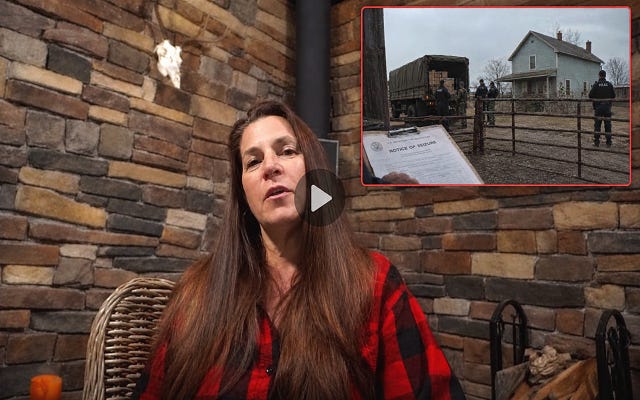
What happens when the food supply you depend on is no longer yours? Watch the video below to hear from a woman who prepared for a future most people are too afraid to imagine.
Executive Order 13603 and Its Quiet Architecture
The document that anchors the contemporary discussion deserves reading in its own right, because without it the rest of the conversation floats free of its moorings. On the sixteenth of March, 2012, Barack Obama signed Executive Order 13603, titled National Defense Resources Preparedness, delegating sweeping authorities to the heads of federal departments under the Defense Production Act of 1950. The text does not read as dramatic, which is precisely its danger, since a document that does not read as dramatic does not get read. What it establishes in substance is that each department secretary must identify the critical resources under that department’s jurisdiction and develop policies for ensuring the availability of production and procurement during a national emergency, with the whole apparatus to be prepared in advance rather than improvised on the day.
The detail most commentators missed carries the largest consequence, and it concerns agriculture. According to the Federal Register notice on the Agriculture Priorities and Allocations System, Executive Order 13603 did not alter the intent of the Defense Production Act as it applied to the Department of Agriculture, but instead extended additional jurisdiction to the department over livestock, veterinary and plant health resources. In plain language, agriculture was moved onto the list of things the state may direct, and the department built the instrument to do it — a system setting out how it may issue rated orders, direct deliveries and allocate materials and production capacity, both during declared emergencies and in ordinary times. The machinery does not need a crisis to begin operating, and it does not need to be invented when one arrives.
Translated into household terms, a legal framework already exists under which, at some point, a determination can be made that your harvest, your eggs, your feed or your processing capacity is required for national security, after which the priorities governing your operation are set by somebody who has never seen your land. It will not happen to everybody at once, and it will not look like a soldier at the gate, because the actual mechanism is administrative and operates through preference, pricing and delivery sequence. Large operations get touched first, since they carry the tonnage that matters, and small ones last. That gap is where a private family can operate. What matters is that the premise is written down, published and already used, and that each administration has added a layer rather than removing one.
Critical Infrastructure and the Elevation of Food
Understanding what a state considers important is a prerequisite for understanding what it will count, and on that front the designation is unambiguous. In 2013, Presidential Policy Directive 21 established sixteen critical infrastructure sectors, and Food and Agriculture sits among them alongside energy, water, transportation and telecommunications. The label sounds honorific, and it does carry prestige, but its real function is bureaucratic: critical infrastructure status brings continuity planning, risk assessment, reporting obligations and a permanent appetite for data. You cannot plan continuity for a system you cannot see, and you cannot assess risk in a supply chain whose nodes you have not enumerated. Designating food as critical infrastructure therefore creates a structural, permanent, non-ideological demand for an inventory of who produces what and where.
Add to this the federal habit of asking the states to do the enumerating. An agency that needs a list of livestock premises generally does not send employees door to door, because that is slow and politically visible. It conditions funding, or sets a standard, or issues a rule, and the states build the registry, which is then shared upward. A requirement that begins as a state-level administrative convenience becomes, within a decade, a de facto national dataset. Such a dataset is useful for far more than disease control: it can support taxation, inspection targeting, subsidy allocation, program eligibility screening and insurance underwriting, and in the specific scenario that interests us, requisition. The Council of State Governments has been explicit that states are, in effect, monitoring farms and animals at the request of the federal department.
The Mechanics of a Seizure, in Practice
It helps to model the actual event rather than the abstraction, because the abstraction frightens people in ways that are not useful. A realistic confiscation in a developed country is not a truck arriving to empty your cellar at gunpoint. It is a sequence of four stages, each less likely than the one before it, each giving a family a different opportunity.
It begins with information, meaning the state determines what exists, usually through registration, survey, census instruments or aerial and satellite land-use analysis. Preference follows, meaning the state determines who gets served first when supply is short — this is where rated orders, allocation systems and priority designations do their work, and where a private producer can be involuntarily pushed to the back of a queue. Direction comes next, meaning the state instructs where a specific output must go, which is the stage at which a farmer learns that the crop is committed before it is harvested. Physical requisition is the last and rarest, and even here the mechanism is usually compensated rather than pure theft, though the compensation arrives on the state’s schedule and at the state’s price, which is often months late and rarely generous.
Two conditions make the whole sequence more likely, and both are worth watching. The first is genuine physical shortage — a disruption large enough that allocation becomes necessary rather than theoretical, whether from disease, weather, war, logistics failure or a cyberattack on a processing node. The second is fiscal stress, meaning a government that has spent heavily and is looking for ways to capture value from an informal economy that has until now escaped measurement. Urgency comes from the first, appetite from the second, and when both are present the informal food producer becomes interesting to institutions in a way that is entirely new.
The Database Problem
From NAIS to Traceability
The federal traceability effort has a lineage worth tracing, because its current shape makes more sense once the earlier attempts are visible. In 2004 the Department of Agriculture announced a National Animal Identification System built around three components — premises registration, animal identification and animal tracking — with the stated ambition of tracing any animal to its origin within forty-eight hours of a disease detection. Voluntary at first, which in practice meant uneven growth, and its coverage of small and hobby holdings was notoriously patchy, since a commercial feedlot has every incentive to participate and a family with four goats has almost none. Frustration with the voluntary approach eventually produced the Animal Disease Traceability rule, finalised in 2013, which narrowed the scope to animals moving interstate and shifted the implementation burden decisively onto the states.
That shift is the hinge. By making traceability a condition of interstate movement rather than a universal mandate, the federal layer achieved something more durable than a mandate, because it created a practical necessity. Sell an animal across a state line, or show it, or move it to a processor, and you need paperwork; the paperwork requires a premises identification number; the number requires that you appear in a state registry. A family that never sells anything and never moves an animal anywhere can stay outside the system indefinitely, while one that sells a single pig a year is inside it forever. This is the most important practical fact in the entire registration conversation, and it is the fact on which the fourth rule below is built.
Premises Registration and the Widening Net
Premises registration is the specific mechanism by which the net widens, and its logic is worth understanding precisely. A premises identification number is assigned to a physical location where livestock are kept, functioning as a postal address for disease control: it lets authorities contact the keeper, map the location and link movements to a place. Nothing about that is sinister, and the technical case for it is strong. What matters is scope, and scope is where states have diverged sharply, in ways that reveal different philosophies of governance.
Wisconsin is instructive because it went broad early and stays broad. The state’s Department of Agriculture, Trade and Consumer Protection requires premises registration for all owners of livestock species, and the department’s own material classifies backyard chicken owners within that requirement, with a renewal cycle of three years. Michigan and Indiana run comparable premises identification regimes through their state animal health authorities, and both reach holdings of very small size. Maryland went further still in simplicity, requiring in effect that any person who keeps or cares for chickens register with the state department of agriculture, extending the obligation to ducks, geese, turkeys, pigeons and doves, with the stated purpose of protecting the domestic poultry industry from highly pathogenic avian influenza.
North Carolina, in 2015, produced the most politically visible version of the requirement, when the state veterinarian recommended and the governor approved emergency measures under which every poultry owner in the state, including the keeper of two birds in a suburban garden, had to register. What makes that episode worth dwelling on is not the requirement itself but the reaction, which was unusually well documented. The state’s own numbers at the time described roughly four thousand two hundred poultry farms and an additional four thousand backyard flocks, a sector supporting something in the region of a hundred thousand jobs with an economic footprint near eighteen billion dollars, all of it sitting directly under a migratory flyway down which wild waterfowl would soon be moving south. Against that background, the argument for knowing where the birds were had obvious force.
And yet a substantial portion of small keepers did not accept the official framing, formed an organised resistance and produced one of the most quotable lines in the entire literature. Here is the reporting, worth reading in its original texture rather than summarised.
Owned of backyard chickens have had their feathers ruffled by a new state mandate. A recent requirement from the N.C. Department of Agriculture and Consumer Services will require all chicken keepers to register with the state, regardless of the size of their flock. The requirement is being met with accusations of “fowl play” from some chickeners who say the registry is part of a larger effort to subvert agricultural autonomy and prop up a regulatory system that favors Big Ag.
In July, Gov. Pat McCrory greenlighted recommendations from state veterinarian Dr. Doug Meckes to implement statewide emergency measures to prevent and control the spread of avian influenza. The virus causes catastrophic illness and death within affected poultry, overcoming the birds within hours or days. An outbreak of bird flu swept through 21 states earlier that year, resulting in the loss of around 50 million birds, and is considered to be the worst animal virus outbreak in U.S. history.
Source: Josh O’Conner, “Chicken registration mandate isn’t going over easy,” Mountain Xpress, August 26, 2015 — mountainx.com
The same report captured the counter-position with equal clarity, quoting a cooperative extension agent explaining that registration existed so the department could communicate with both large and small poultry owners, and noting that the state veterinarian had written a letter titled Why should I register my flock?, promising that flock data would remain confidential and calling for voluntary compliance, adding that no penalties for non-compliance had yet been discussed. The line that outlived the episode came from a Facebook group formed specifically to oppose the mandate, whose description read, in full, that whoever controls the food supply controls the people. That formulation is not rigorous political theory and does not need to be; it captures the operative intuition with a precision most academic treatments fail to match.
The State-Level Map
The table below consolidates the regimes discussed above, with the caveat that administrative rules change and a serious family should verify its own state’s current requirements directly rather than trusting any summary, including this one.
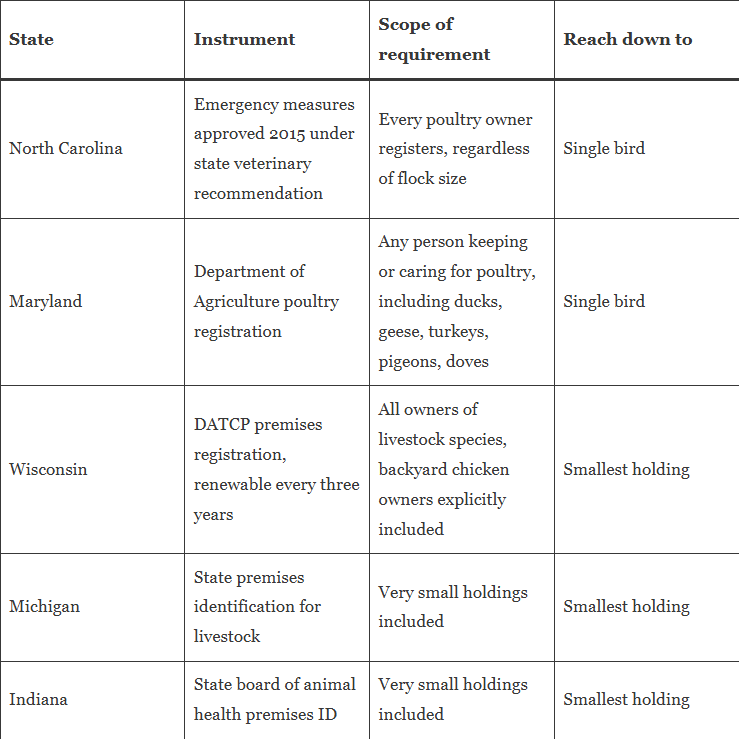
The pattern across the table is the pattern worth extracting, and it is not the one that a disease-control justification alone would predict. If the sole purpose were outbreak containment, targeting commercial density would be sufficient, since a barn holding two hundred thousand birds is epidemiologically far more consequential than a garden with four hens and no contact with wild waterfowl. What the actual rules do instead is sweep in the smallest holdings, which suggests a second purpose running in parallel. That purpose is inventory completeness. A registry capturing only the large operations produces an estimate; one capturing everyone produces a number, and a number can be allocated against.
Why the Small Holder Gets Swept In
There is a version of this argument that treats the small holder as a victim of bureaucratic laziness, and a better version that treats him as a victim of arithmetic. A regulator designing a registry has two options. Define a threshold, exempt everything below it, and then spend the rest of the program’s life arguing about where the threshold sits and how to handle the exempt population’s movements. Or set no threshold at all, declare that everyone registers, and accept that the marginal cost of adding a four-hen garden to a database that already exists is effectively zero. The second option is administratively cleaner, eliminates the boundary problem entirely, and happens to produce a dataset with no gaps — precisely the artefact a future allocation exercise would need. Choosing it is not devious. It is simply what a competent administrator does when the goal is a complete picture rather than a defensible compromise.
Scoring Your Own Exposure
Before building anything, know how exposed you actually are, and score honestly rather than anxiously. What follows is a self-assessment; a high total is not a verdict of doom, only a description of the surface area you present to institutions.
Visibility. Are your production and storage visible from a public road, from a neighbouring structure, from the air, or from a delivery driver’s habitual route? A garden on a corner lot in a tidy suburb is maximally visible; a plot behind a hedge on a dead-end lane is minimally so.
Registrability. Have you appeared in any registry — through a premises number, a tag, a permit, a livestock sale, a show, a processor booking, an agricultural exemption, or a tax filing that mentions animals? A single appearance usually creates a permanent record, and records are cumulative.
Gather-ability. If someone with a truck and a list arrived tomorrow and had to remove your animals, how quickly and completely could it be done? Twenty confined hens in one coop are a thirty-minute job. Forty birds across five acres with three roosting sites, two of them half-wild, are an afternoon and a lot of swearing.
Storage concentration. What percentage of your stored calories sits in one room? A full chest freezer, a full pantry and nothing else means a single point of failure that is also a single point of capture.
Seasonality. Can you eat from your own production in February, or does production collapse to zero for five months while storage carries the whole load? The answer determines how much of your security is real and how much is seasonal theatre.
Substitutability. If the two or three foods you rely on most became unavailable or unaffordable, what replaces them? A family that has identified and practised with replacements is durable. One that has merely read about them is theoretical.
Knowledge density. How much of your food system lives in your head rather than in a book, an app or a subscription? Knowledge that leaves with a power cut is not knowledge, it is a dependency.
Social footprint. How many people outside your household know the real scale of what you produce and store? Each additional informed person increases both your support network and your informational exposure.
Score each from one to five and add. Below fifteen suggests a family that is largely invisible and largely self-sufficient; above thirty suggests one that is highly legible and highly dependent on the system holding. Neither extreme is better in the abstract, since legibility brings access to markets and invisibility brings security, and the real work lies in deciding which way you want to move and by how much.
The Four Rules
Four rules, deliberately few and deliberately blunt, because a posture with twenty rules is a posture abandoned in the second month. They are ordered by cost, cheapest first, and they are designed to work as a set, which means the first three provide most of the protection even if the fourth is refused on principle.
Do Not Talk About It
The first rule is lifted, unashamedly, from a film, and it survives the lifting because it is correct. Do not discuss your food production and storage. The neighbours will inevitably notice that you garden, that you keep a few animals, that there is a compost heap, a rain barrel and an unusual quantity of firewood; there is no point pretending otherwise. What they should not know is scale. Not how many jars are in the cellar, how many kilos of grain are in the barrels, whether there is meat in the freezer or how much, whether the potatoes are in the garage or under the floor, and above all not that a written plan exists. The gap between what is visible and what is true is the entire asset.
Discretion has an unpleasant consequence that must be accepted deliberately: it requires a certain amount of mild deception. Ask a neighbour whether you have anything stored for a crisis, and the honest answer is that you have a bit — strategically superior to a true inventory even though less true. When shelves thin and the neighbourhood starts comparing notes, the family that said it had almost nothing becomes less interesting than the one that announced eighteen months of supplies. There is also a tactical reason to undersell, since a household believed to have nothing is less likely to be visited by a relative with a shopping bag and a hopeful expression, though the relative will come anyway and should be planned for.
The rule extends to digital surfaces, which most people forget. A photograph of a full pantry posted to a social platform is a published inventory. A garden tour video is a map. A proud announcement that the freezer is full is a statement of asset value. None of this means silence, since the work deserves an audience, but it does mean deciding in advance what you are willing to have known and then holding that line, because inconsistent disclosures produce a composite picture more accurate than any single statement.
Disperse Everything
The second rule pays for itself fastest and requires no confrontation with any authority. Never keep all of your food in one place. The same logic governs the storage of firearms, tools and cash, and it applies with particular force to food, which is bulky, perishable, attractive and hard to move quickly. A single full pantry is one target; a pantry plus a cellar plus a garage rack plus a buried cache plus a distant secondary site is five, of which an inspector with a list will know about one.
The practical expression of this rule is the cache, the most useful and least glamorous artefact in the whole discipline. A properly built cache is a hole in the ground below the frost line, lined and sealed, loaded with a nutritionally coherent package intended to feed a family for a defined period, then covered, insulated, buried and camouflaged so that the ground above it looks like ground. Food stored this way, done correctly, keeps for years. The classic errors are well known. Do not co-store apples with potatoes, because ethylene from the apples accelerates sprouting and the whole cache turns soft and sweet in a way that ruins both. Keep it dry, since moisture is the real enemy and not time. Keep it below the frost line, since freeze-thaw cycles destroy container and contents alike. And keep the load coherent — a complete short-duration diet rather than a random assortment of surplus, because a cache of forty kilos of rice and nothing else will be opened and then abandoned.
A cache holding a month of complete nutrition for a household is the correct unit of work. Small enough to build in a weekend, large enough to matter in a genuine disruption, self-contained enough that opening it spoils nothing else. Build one per season for two years and you end up with eight independent food sites and a dispersal pattern no registry could represent, for the price of some digging, some containers and the discipline of buying in bulk.
Learn What Grows Without You
The third rule is the slowest to acquire and the hardest to take away, and it concerns the difference between a cultivated field and an apparently neglected one. A bureaucrat, an inspector or a looter can recognise a potato cellar and a corn field without effort, because both announce themselves. Almost nobody can identify lamb’s quarters, purslane, dandelion, chicory, sorrel or stinging nettle as food, and even among those who can, few know which parts to take, in which season, and how to prepare them without producing a stomach ache or worse. That asymmetry is camouflage which costs nothing and cannot be confiscated, because the knowledge lives in the family rather than in the ground.
The applied version of this rule is more deliberate than mere foraging, and considerably more effective. Take a small patch — an awkward strip behind a shed, the rough corner where the mower never reaches — and let it look neglected while actually planting it with a dense mixture of edible wild species. Collect seed the previous season, store it cool and dark and dry, and in spring break the soil, scatter the mixed seed broadly, rake it in shallowly and walk away. What comes up looks like the ordinary weedy mess any fallow field produces. What it actually is: a self-supporting polyculture of highly nutritious greens requiring no further cultivation, outcompeting the genuinely useless weeds and yielding continuously. Yield per unit of labour in such a patch often exceeds a conventional vegetable bed, and the labour after establishment is nearly zero.
The same principle applies to trees, where the payoff is slower and larger. Plant intentionally, but plant ugly. Scatter walnut, hickory, apple, pear, plum and persimmon across the whole property rather than confining them to an orchard block, because an orchard is a recognisable form with rows and mown alleys and a name, while trees distributed through existing woodland and hedgerow merge into the background. A young walnut in a rough corner looks like a weed with ambitions; fifteen years later it looks like nothing in particular and produces a staple crop no inventory will capture. By then you will have forgotten which corner it was in, which is exactly the desired condition.
Register Selectively, or Not at All
The fourth rule requires a judgement rather than a technique, and should be taken deliberately rather than by default. The base position is simple: if registration is not mandatory, do not do it, because a registry that does not need to contain you is one that can be amended later without your participation. When registration does become mandatory, the interesting question is not whether to comply but at what level, and three coherent strategies exist.
Full compliance is chosen by families that value simplicity and the absence of conflict above marginal advantage. Registering everything produces access to programs, markets, veterinary support and a clean conscience; the cost is total legibility. Partial registration is the most interesting of the three and the hardest to execute honestly, since it requires maintaining two categories in your own mind. Register the birds you actually sell or move, and let the unregistered remainder, if any, exist outside the paperwork. The difficulty is consistency: a confused partial registration collapses into a sloppy total one. Refusal is chosen by families whose objection is philosophical and who accept the practical friction of appearing on no list, which in practice means no interstate sales, no shows and occasional awkwardness at processors.
None of the three is correct in the abstract. What matters is that the first three rules protect you regardless of which strategy you pick, which means the fourth decision can be postponed indefinitely while you still end up substantially more secure than you were.
The Preparation Zone
Everything above is analysis, and analysis without construction is a hobby. What follows is the build, staged so that a family can enter at the point matching its current condition and budget, and so that progress is measurable rather than atmospheric.
Assessment and Baseline
Two weekends, and almost no money. The first task is a full inventory, written down rather than estimated, of everything edible you currently hold, with quantities and locations. Then calculate daily caloric requirement for the household, approximated for planning at roughly two thousand calories per adult per day, adjusted for work intensity and season. Divide one by the other, and you have the only number that matters: how many days you could eat from your own stores with no external input. Most families discover a figure between four and twelve days, and the discovery motivates better than any argument.
Deliverables: a written inventory, a written caloric baseline, a written days-of-autonomy figure, and a list of the five foods contributing the largest share of current calories. That last list becomes the priority list for everything that follows.
Concentration of the Basics
One month, low budget, roughly the cost of normal groceries redirected. Before dispersing anything, have something worth dispersing, and the cheapest way to acquire it is to buy your five highest-volume staples in bulk and store them properly rather than buying them weekly in retail packaging. Rice, wheat flour, oats, dried legumes, sugar, salt, oil and honey are the conventional backbone, and conventional for good reason: calorie-dense, shelf-stable, culturally versatile, cheap per calorie. Salt deserves particular attention, being both a nutrient and a preservative, and a family can store a lifetime supply for the price of a modest dinner.
Container discipline matters more than quantity at this stage. The enemies are moisture, oxygen, light, heat and pests, and the countermeasures are correspondingly boring: food-grade buckets with gasketed lids, mylar liners, oxygen absorbers for dry goods, glass for acidic goods, a cool dark place for everything. A hundred kilos of well-stored wheat beats two hundred kilos of badly stored wheat, and this is where families most often waste money.
The First Cache
One weekend of work, one month of accumulation, moderate budget. Build the first buried cache to the specification below and load it with a coherent thirty-day nutritional package. This is the stage at which a pantry becomes a system, and the psychological effect is disproportionate to the physical effort, because a sealed cache nobody knows about changes how a family thinks about risk.
Production and the Disguised Plot
One growing season, low to moderate budget, mostly seed and fencing. Establish the neglected-looking edible polyculture described above, and either start or expand animal production. Sequencing matters here: begin with animals before establishing feed production and you create a dependency on purchased feed at exactly the moment feed is most expensive, whereas plants first and animals second means arriving at animals with a functioning feed base. Chickens are the conventional first animal for conventional reasons — they convert scraps and forage into protein, tolerate confinement, and produce a soil amendment that pays back into the garden — but decide in advance how much of the flock is registered and how much is not.
Water, Energy and Feed
Three to six months, variable budget, potentially the largest line item. Food without water is a two-day problem; food without energy for cooking and preserving is a two-week problem. Rain capture with first-flush diversion and basic filtration, a manual pump or gravity system, a stock of stabilised and rotated fuel, a means of cooking independent of grid electricity, and a means of preserving independent of a freezer — dehydration, fermentation, salt, smoke, canning. Feed is the fourth leg and the most often forgotten, since a family with three months of human food and no animal feed will be feeding its hens from its own larder within a week.
Redundancy and a Second Site
Ongoing, low cumulative budget. A second cache, then a third, then a fourth, each in a different location, each loaded with the same coherent thirty-day package. Where you have access to a distant property, a relative’s land, a hunting camp or a rented plot, one of those sites should hold a cache, converting a single-location survival plan into a network. Redundancy in seed stock follows the same logic, since seed kept in one place is seed that a single event can erase.
Building the Cache
The cache is the workhorse of the system and deserves a specification rather than a description. What follows is the construction sequence; build one correctly and the next four need no consultation.
Site selection comes first and is the step most often botched. You need a spot not visible from a road, not on a habitual walking line, not where water pools, not under a tree that will drive roots into the lining, and ideally somewhere the ground cover recovers quickly and looks undisturbed within a month. A slight slope beats flat ground because it drains, and the lower side of a hedgerow is excellent because the shadow pattern hides a rectangle of disturbed soil. Mark the location mentally by two fixed references rather than a stake, since a stake is a visible marker, and be able to walk to it in the dark.
Excavation is next, and the controlling dimension is the frost line, which in temperate latitudes runs somewhere between thirty and fifty inches. The hole must be deeper than that at its base, meaning a total depth of roughly five to six feet for a cache with usable interior height, and wider than the intended load by a margin sufficient for lining and backfill. Compact the bottom, then line it with gravel for drainage, then with geotextile or heavy plastic sheeting, then with a floor of boards or pallets to keep the load off the liner and allow a small air gap.
Loading involves the most decisions. The unit of load is the coherent thirty-day package — a defined caloric total for the household, composed of foods that complement one another, supplemented by items valuable in small quantity and impossible to substitute: salt, oil, honey, dried fruit, spices, a jar of fat, and a little hard cheese or dried meat if you can manage it. Containers should be rodent-proof and moisture-proof, meaning glass for anything acidic, food-grade plastic or mylar for dry goods, metal for anything rodents will find irresistible. Label every container with a marker that survives damp, and keep a written manifest somewhere else, because a cache you must open to inventory is a cache that gets opened.
Sealing and covering is where the craft sits, and the sequence is layered rather than simple. On top of the load goes a rigid lid, boards or a sheet of plywood sized to overlap the walls. Over the lid goes insulation — straw, dry leaves, wool, mineral wool, foam board — which prevents the freeze-thaw cycle from working at the contents. Over that, heavy plastic or tarpaulin, folded and tucked so water runs off rather than in. Over everything, the original soil, replaced in the order it came out with the darker topsoil on top, then tamped so it sits slightly proud of the surrounding grade and sheds water instead of collecting it. Camouflage finishes the job, and any of the simple techniques will do: scatter the surplus subsoil thinly and broadcast the same seed mix that grows around the site so the ground matches its neighbours within a season; lay a few stones or a dead branch on the spot so it reads as natural debris; or, most elegantly, let the cache sit under the edge of a hedgerow or bramble patch, where nobody looks twice at disturbed ground.
The manifest deserves its own paragraph, because it is what separates a cache from a hole full of food. Record what went in, when, in what quantity, in what container, and the intended rotation date, and keep it somewhere you will actually look, such as inside the front cover of a reference book on the shelf. Rotation keeps the system alive: a cache built once and forgotten becomes a museum of decayed food within five years, while one built and rotated becomes a rolling reserve with a permanent inventory and no waste. The simplest rotation rule is to open the oldest cache each season, eat its contents, and rebuild it with fresh stock in the same location — which also keeps you practised at the cycle and the site in use rather than abandoned.
The Wild Layer
Foraged food occupies a strange position in the survival literature, simultaneously overrated and underrated, and the honest treatment separates the two. As a primary calorie source it is overrated, because no family gathers enough acorns to replace grain without industrial-scale effort. As a nutritional and resilience layer it is underrated, because the wild plants that come up uninvited are frequently denser in micronutrients than the cultivated vegetables in the garden and cost nothing but attention.
The species that matter are few and should be learned to the point of reflex rather than recognition. Lamb’s quarters is a close relative of spinach, grows wherever disturbed ground exists, and produces a continuous harvest of leaves from late spring until frost. Purslane is a succulent that thrives in heat and drought when everything else in the garden sulks, and its leaves are notably rich in omega-3 fatty acids. Dandelion supplies both a spring green and a root that roasts into a coffee substitute, and its bitterness is a feature rather than a flaw. Chicory behaves similarly and offers a taproot worth digging. Sorrel, wild or cultivated, provides acidity that becomes valuable in a diet without lemons. Stinging nettle is the most nutritious of the group and the most feared, and it rewards anyone who learns to handle it with gloves and blanch it into soups that taste nothing like its reputation. Plantain, the broad-leaved weed of compacted paths, gives a leaf edible young and a seed head that can be ground. Amaranth, the pigweed of every neglected corner, yields a genuinely useful grain.
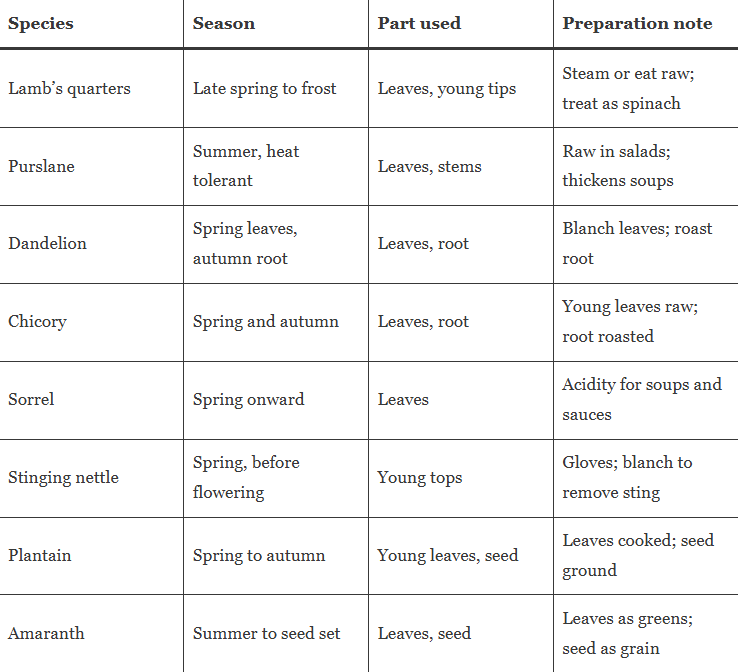
The deliberate version described earlier converts this from an opportunistic activity into a planted system, and the practical instruction bears repeating in compressed form. Collect seed the previous season from species that already grow locally, since local ecotypes outperform purchased varieties in a neglected plot. Store it cool, dark and dry in paper, not plastic, labelled with the year. In early spring, break the surface with a fork or light tillage, broadcast the mixed seed broadly and unevenly rather than in rows, rake shallowly, and then do nothing. Do not weed it, since the point is that it should read as neglect, and do not water beyond what falls, since the species selected are the ones that can manage on their own. Harvest continuously and let a portion of each species go to seed, so the patch reseeds itself and your only recurring task becomes collection rather than planting.
Animals Under a Registry
Animals present a different problem from plants. A plant can be ignored; an animal must be fed, watered, housed and accounted for, and it is mobile, countable and therefore confiscable in a way that a bed of nettles is not. The strategic objective with livestock is not to hide them, which is impossible, but to make them expensive to enumerate and difficult to gather completely.
The technique that achieves both is ranging. A flock allowed to roam a large area with multiple roosting sites, fed at irregular locations and times, is not a single unit that can be swept up in one action, and a keeper who can be persuaded to help can locate the whole flock while a stranger cannot. Poultry respond particularly well, since they naturally scatter, forage and return to a preferred roost, and a family that establishes three or four widely separated roosting options rather than a single coop has already fragmented its own asset. Waterfowl, given a pond or a stream, are harder still to account for, and a few geese on open water represent an almost unfindable food source for anyone without a boat and patience.
Larger stock requires fencing, and the fencing strategy should be chosen for the scenario rather than for the summer. A conventional perimeter fence suits rotational grazing and daily management, and it also defines a boundary that a visiting official will read as the extent of the operation, which is useful. Inside that boundary, however, operate with a looser structure that keeps animals out of sight of the road, uses shade and terrain to break up sight lines, and spreads the herd across several paddocks so that no single view contains all of it. Pigs, the most attractive and most difficult to move, benefit from being kept in the least visible paddock and from a handling routine requiring two people rather than one, since an inspector working alone will struggle with an animal used to being moved by a team.
The final technique is the feral option, and it is the most elegant. If a genuine disruption occurs, simply release the animals, at which point they stop being livestock and start being a dispersed population nobody has a list for. Poultry, semi-domesticated at best, adapt within weeks, roosting in trees and reverting to behaviour their ancestors managed for millennia. Pigs released into woodland do the same with more drama, and while both will suffer losses to predators and accidents, a family that has deliberately chosen hardy, self-reliant breeds rather than production-maximised ones will recover a substantial fraction of the population. The point is that a released flock cannot be gathered by anyone except the family that knows where the roosting trees are and which paddock the pigs favour.
The Four Invisible Inputs
Food is never just food, and a family that stores calories while neglecting the inputs that produce them has stored a temporary asset rather than a system. Four inputs deserve deliberate attention, and all four are cheap to secure early.
Water comes first because it is the least substitutable, and a household depending on a municipal line for both drinking water and irrigation has a single point of failure shared with every neighbour. Rain capture is the entry point, requiring only a roof, a gutter, a first-flush diverter and a storage tank, and the calculation is straightforward: a modest roof in a temperate climate collects a startling volume over a year. Beyond capture, you want a manual means of lifting water, since a tank with an electric pump is a tank that stops working when the grid does, plus a basic filtration and disinfection routine executable without power. Where a well exists, a hand pump or a bucket-and-rope arrangement is a small investment with a large payoff.
Seed is second and the most commonly under-secured input among families that otherwise plan well. Keep seed in three separate locations, since a single storage failure otherwise wipes your genetic capital, and favour open-pollinated varieties over hybrids wherever possible, because saved seed replants while hybrid seed degrades. Learn the specific saving technique for each crop, since the techniques differ substantially and those for biennials such as carrots and brassicas require overwintering rather than simple collection. Seed libraries, physical and informal, are the natural social institution here, and trading seed with three neighbours diversifies your genetic base for free.
Energy is third, and its scope should be bounded by your actual cooking and preserving needs rather than by fantasy. You need heat for cooking, heat for canning or dehydrating, light for working after dark, and refrigeration for anything that cannot be shelf-stable, and each requirement has a non-electric answer. A rocket stove, a pressure canner that works on any heat source, a solar dehydrator, a stock of lamp oil or candles and a root cellar are collectively more resilient than a generator — and considerably quieter, which matters more than most people realise. Where fuel is stored, stabilise it, rotate it on a schedule, and keep quantities you can physically move.
Feed is fourth and the input most often discovered missing at the worst time. An animal’s ration is not optional and cannot be improvised indefinitely, and a family with three months of human food and no animal feed will be feeding its hens from its own flour within ten days. Store feed on the same rotation discipline as human food, establish a fodder patch of comfrey, kale, fodder beet or mulberry that produces without annual replanting, learn what the local environment already provides in acorns, mast and forage, and accept that in a hard scenario the flock size will be reduced to match available feed rather than the reverse.
Economics and Exchange
A food system sits inside an economy, and a family that ignores the economic layer is planning for a scenario in which money has stopped mattering, which is rarer than the literature suggests. Most disruptions are inflationary rather than terminal, which makes the practical question how you convert production and storage into the things you cannot make, and how you protect value in the interval.
The cheapest unit of food security is the food you grow that would otherwise be bought — a plain substitution requiring no market at all. Surplus becomes valuable in proportion to its durability, so convert perishable surplus into durable form as a matter of routine, and prefer forms that are recognisable and desirable to others over forms only the producer appreciates. Barter works best with a small number of trusted counterparts and a clear understanding of value, since an informal market with many participants becomes a public market, and public markets attract attention.
On the monetary side, hold a modest buffer in forms that do not require a functioning banking system: physical cash in small denominations, a small quantity of recognised metal, and where local conditions warrant it, a convertible instrument held outside the banking rails. None of this needs to be elaborate. Holding three forms of value rather than one covers the realistic range of disruptions, from a banking outage lasting a day to a currency event lasting a year.
How an Israeli Firm Built a Spy Route Into the Pentagon Subscribe to this essential brief before the lights go out permanently. (I recently came across this publication and it honestly deserves your full attention)
The Social Layer
Isolation is a strategy with a cost, and the cost is that a family operating entirely alone has no redundancy in labour, nobody to help with a hard task, nobody to trade seed with and nobody to warn it. The productive position is therefore not isolation but selective connection — a small number of relationships where you are somewhat more open than you are with the general public.
Three relationships are worth cultivating deliberately. One is a neighbour or two who produce something complementary, since exchanging eggs for vegetables or labour for machinery access builds a relationship that functions without money. Another is a skilled counterpart — a mechanic, a beekeeper, a butcher, an old farmer with a lifetime of practical knowledge — because these skills transfer badly through books and matter enormously under stress. The third is a distant second site, whether a relative’s land, a hunting camp or a plot held with others, since a geographically separate asset is the only thing that survives a local event, and 2024’s Hurricane Helene, which devastated a swath of western North Carolina and eastern Tennessee and disrupted local food infrastructure for months, offered a recent and vivid demonstration of what local means.
Be known for the right things. A family known as the one with a full pantry becomes a destination; a family known as the one with knowledge becomes a resource, and resources are treated better than destinations, because a resource keeps producing. The correct public identity for a food-secure household is therefore slightly underestimated and mildly useful, which is the same identity the first rule prescribes.
What the Next Decade Looks Like
Assemble the forward view from things already in motion rather than from prophecy, and four of those things deserve naming plainly, because each one increases the pressure on the informal food producer.
Traceability keeps widening. It has already moved from voluntary to conditional to near-universal across a growing number of states, and it will continue in one direction, because every outbreak produces a political demand for better data and no outbreak ever produces a demand for less. The cost structure of industrial food has been repriced upward by disease, fuel, fertiliser, labour and interest rates in combination, with the result that the gap between industrial and home-produced food has narrowed and domestic production now captures a real economic margin rather than a sentimental one. Pressure on land and water is intensifying, visible in foreign ownership figures showing something approaching forty-nine million acres of American agricultural land under foreign-held interest, in the Colorado River allocation fights that have already produced mandatory cuts, and in competition for farmland from non-agricultural buyers. And the health-animal interface keeps widening: avian influenza has now been confirmed in more than eleven hundred American dairy herds across nineteen states, has produced dozens of human cases and one death in January 2025 in a patient whose exposure came from a backyard flock and wild birds. Small holdings are now epidemiologically relevant in a way they were not a decade ago, and epidemiological relevance is the strongest available argument for registering them.
Here is the primary source on that last point, quoted directly because the wording carries the significance.
The patient was over the age of 65 and was reported to have underlying medical conditions. The patient contracted H5N1 after exposure to a combination of a non-commercial backyard flock and wild birds.
Source: Louisiana Department of Health, “LDH reports first U.S. H5N1-related human death,” January 2025 — ldh.la.gov
And on the price dimension, the federal forecaster’s own numbers, worth reading for the texture of the categories rather than the headline.
In 2026, prices for all food are forecast to increase 2.8 percent, with a forecast interval of 2.6 to 3.1 percent. … Beef and veal prices are forecast to increase 8.7 percent in 2026. … Prices for fresh vegetables are forecast to increase 5.8 percent in 2026. … Prices for sugar and sweets are forecast to increase by 6.5 percent in 2026. … In 2026, farm-level wheat prices are forecast to increase 22.6 percent.
Source: USDA Economic Research Service, Food Price Outlook, Summary Findings, October 2026 — ers.usda.gov
Put together, this is not a cliff but a slope, and slopes catch people out because they are climbable at the start and steep at the end. Begin in the first year of a slope and the work is easy. Begin in the fifth and you are doing harder work, at higher prices, with less time.
The Common Failures
Most failed preparations fail predictably, and the failure list is more useful than the success list because it is shorter and more specific.
Buying equipment before buying knowledge is the most expensive, since a family with a dehydrator, a pressure canner, a grain mill and a vacuum sealer, and no idea how to run any of them under stress, has bought a museum. Buying storage before establishing production is the next, and it produces a household that owns beautiful buckets and still shops weekly. Storing only one kind of food produces the rice-and-beans trap, in which a year of calories is followed by a month of morale collapse. Forgetting animals in the plan is the most common error among families that do keep animals, since the human larder gets inventoried and the feed bin does not. Neglecting water is the most dangerous, converting a comfortable disruption into a genuine emergency within seventy-two hours. Build one cache and stop, and the entire purpose of the dispersal rule is defeated. Tell everyone, and the first rule is undone.
Refusing to practise hides until it matters. A family that has never actually lived from its stores for a week does not know what it does not know, and the gaps are always in the boring places: yeast, oil, salt, fuel, matches, batteries, and the specific ingredient that turns calories into meals.
Conclusion
The argument compresses into a short chain without losing anything essential. A century of practice has established that states control food in crises, and that the instruments built during one crisis are never dismantled afterwards. The current instruments are administrative rather than martial, operating through executive authority, allocation systems, critical-infrastructure designation and, most of all, data. The data is assembled largely at the state level, through registration and traceability regimes that have widened steadily until they reach down to a single backyard hen. The widening is justified by disease, which is a real and serious problem, and the justification is sufficient to make the widening politically unstoppable. The result is a country in which the informal food economy is being progressively formalised, which brings benefits and also brings legibility, and legibility is the precondition of allocation.
Faced with that, you control exactly two things: the depth of your own production and storage, and the degree of asymmetry between what you have and what is known about it. The first three rules build both. Discretion limits how much is known. Dispersion limits how much can be captured in a single action. Foraging knowledge creates food that exists outside any registry, because it grows without being planted and belongs to nobody. The fourth rule, about registration, is a judgement call that the first three rules render low-stakes.
What remains is timing, and the timing argument is simple enough to state without embellishment. A cache costs a weekend and some food. A polyculture patch costs a packet of seed. Seed saving costs a season of attention. A second roosting site costs some scrap timber. A hand pump costs a modest sum. A written manifest costs a sheet of paper. Individually these are trivial. Collectively they convert a dependent unit inside a fragile system into a durable one with options, and the conversion happens in the ordinary years when nothing appears to be happening, which is the only time it can happen at leisure.
The hen in the yard is not a symbol and not a political statement. It is a small, cheap, reliable piece of infrastructure you control completely, and the state that registers it has admitted, by the act of registering, that it matters.
Anyone can join.
Anyone can contribute.
Anyone can become informed about their world.
"United We Stand" Click Here To Create Your Personal Citizen Journalist Account Today, Be Sure To Invite Your Friends.
Before It’s News® is a community of individuals who report on what’s going on around them, from all around the world. Anyone can join. Anyone can contribute. Anyone can become informed about their world. "United We Stand" Click Here To Create Your Personal Citizen Journalist Account Today, Be Sure To Invite Your Friends.
LION'S MANE PRODUCT
Try Our Lion’s Mane WHOLE MIND Nootropic Blend 60 Capsules
Mushrooms are having a moment. One fabulous fungus in particular, lion’s mane, may help improve memory, depression and anxiety symptoms. They are also an excellent source of nutrients that show promise as a therapy for dementia, and other neurodegenerative diseases. If you’re living with anxiety or depression, you may be curious about all the therapy options out there — including the natural ones.Our Lion’s Mane WHOLE MIND Nootropic Blend has been formulated to utilize the potency of Lion’s mane but also include the benefits of four other Highly Beneficial Mushrooms. Synergistically, they work together to Build your health through improving cognitive function and immunity regardless of your age. Our Nootropic not only improves your Cognitive Function and Activates your Immune System, but it benefits growth of Essential Gut Flora, further enhancing your Vitality.

Our Formula includes: Lion’s Mane Mushrooms which Increase Brain Power through nerve growth, lessen anxiety, reduce depression, and improve concentration. Its an excellent adaptogen, promotes sleep and improves immunity. Shiitake Mushrooms which Fight cancer cells and infectious disease, boost the immune system, promotes brain function, and serves as a source of B vitamins. Maitake Mushrooms which regulate blood sugar levels of diabetics, reduce hypertension and boosts the immune system. Reishi Mushrooms which Fight inflammation, liver disease, fatigue, tumor growth and cancer. They Improve skin disorders and soothes digestive problems, stomach ulcers and leaky gut syndrome. Chaga Mushrooms which have anti-aging effects, boost immune function, improve stamina and athletic performance, even act as a natural aphrodisiac, fighting diabetes and improving liver function. Try Our Lion’s Mane WHOLE MIND Nootropic Blend 60 Capsules Today. Be 100% Satisfied or Receive a Full Money Back Guarantee. Order Yours Today by Following This Link.



| Visits: | 1,836,284,784 |
| Stories: | 8,727,641 |
Whistler Blowers, Insiders


Yeah, what I have been saying. The ucfkers are ghonna confiscate it for themselves because they made sure you never bothered with a WELL REGULATED MILITIA.