

Thailand: Operation Yuttharat and the Chabad Network Under Investigation

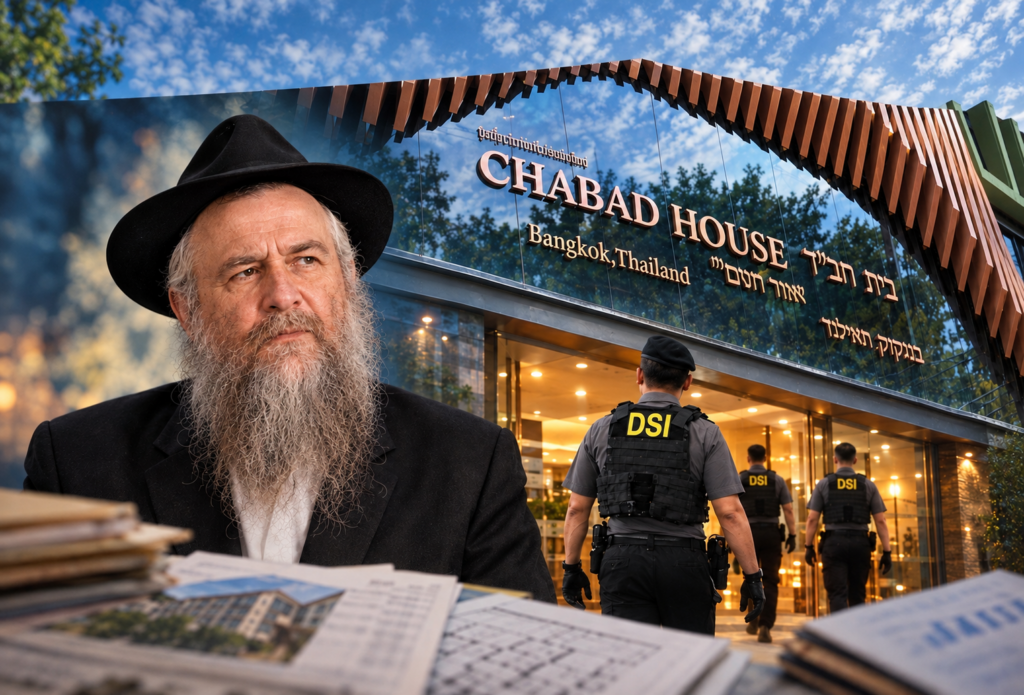 Freddie Ponton
21st Century Wire
Thailand has revoked the Thai citizenship of Rabbi Yosef Chaim Kantor, the long-time leader of Chabad operations in the country. Authorities are now investigating his relatives and 19 companies linked to him—a widening inquiry that could lead to asset seizures and forced land sales if investigators establish ownership violations.
The investigation also reaches the source of the money. Thailand’s Anti-Money Laundering Office (AMLO) is tracing domestic and international transfers and examining whether funds used to acquire assets through foundations and associations were connected to offences under anti-money-laundering law. Officials reported donations averaging approximately 100 million baht (US$2.96 million) a year through the foundation and association under examination.
Chabad-Lubavitch is a Hasidic Jewish movement headquartered in Brooklyn. Its centres in Thailand offer religious services, meals and hospitality to Israeli travellers and other Jewish visitors. During searches of Bangkok premises on 8 October, Kantor told officials that the foundation existed to spread its religious beliefs and look after tourists. But did that explain the full extent of its activities?
Landholdings and the companies behind them
A Jewish cemetery in Bang Khla, in Chachoengsao province, brought scrutiny to Gan Chabad Co., Ltd., which had acquired the land. Officials were investigating allegations that burials continued after the cemetery’s licence expired, The Nation reported.
Registered in March 2008 with capital of 30 million baht, Gan Chabad listed cemetery and crematorium services alongside purchasing, leasing and managing property. The report identified Kantor as a founder and said one of his sons served as a director. It also described connections to restaurant and tourism businesses, including The Kosher Place (Thailand) Co., Ltd.
On 8 October, the Department of Special Investigation (DSI) and other agencies searched three Bangkok locations under Operation Yuttharat, collecting records spanning foundations, associations, businesses and property transactions. The searches extended an inquiry begun in Chonburi in August. Justice Minister Rutthaphon Naowarat said investigators were examining suspected nominee arrangements, irregularities in foundations and associations, nationality issues, tax avoidance and unlawful landholding.
In the Chonburi case, Israeli businessman Maimon David Marciano and Thai shareholder Darin Prasertsuk appeared before investigators on 7 October to receive charges under the Foreign Business Act. Investigators alleged that Thai shareholders held shares on behalf of foreign interests without contributing capital. Both suspects declined to give statements, saying they would respond in court. Investigators were examining whether the case had links to Kantor or Chabad.
The following day, officials searching the foundation’s registered office on Bangkok’s Phra Athit Road found a room measuring 2.5 by three metres, with no financial or operational records. Other entities shared the address. Representatives said the documents were kept at another office.
At ITF Silom Palace in Bangkok’s Bang Rak district, investigators found records covering donations, property purchases, construction, taxes, Chabad operations, restaurants and accommodation businesses. Daily News described the premises as an accounting and legal-services office preparing documents for Israeli clients.
The office served as the registered address for 61 companies, approximately 50 linked to Israeli nationals. The same names appeared as directors or shareholders across several companies, including people who had acquired Thai citizenship through naturalisation.
The 61-company figure covers registrations at the office; it does not establish that all were controlled by Chabad. The later inquiry into 19 companies concerns businesses linked specifically to Kantor.
Thai staff worked in accounting and legal roles, while their names also appeared in property transactions and company appointments. Investigators are examining whether the Thai shareholders invested their own money and controlled their shares, or supplied their names while foreign interests financed and controlled the businesses.
Officials also found three Myanmar nationals and two Lao nationals working without permits at two of the searched locations. Employers at both sites faced proceedings.
Donations, overseas transfers and the money-laundering inquiry
Chabad raises donations through an international network. Its fundraising appeal directs US donors to American Friends of Chabad of Thailand, a tax-exempt organisation, and lists donation channels in Australia, Britain, Canada and Israel. The American organisation’s annual financial returns are available through ProPublica’s Nonprofit Explorer.
An MGR report published on 27 August 2026 alleged that overseas loans financed companies registered as Thai-owned. Its analysis covered 29 companies, of which 15 were listed as wholly Thai-owned. One naturalised Thai citizen, it reported, held directorships across 28 companies. These figures concern MGR’s analysis, rather than the full set of companies registered at the Bangkok office.
An unnamed investigator from Thailand’s Central Investigation Bureau told the publication that profits were being sent abroad as loan-interest payments, which the companies booked as expenses to reduce their Thai taxable income. MGR urged authorities to trace whether overseas charitable transfers had financed those loans.
At the 8 October briefing, DSI said it had identified donors and their nationalities and obtained information about where the foundation’s money went. Investigators were keeping those destinations confidential while seeking financial records beyond the organisation’s tax filings.
Thailand’s Anti-Money Laundering Office said it had identified high-value financial movements and was examining transfers within Thailand and across its borders. It was also examining whether funds used to acquire assets through foundations, associations or groups of individuals were connected to predicate offences—the underlying crimes that can give rise to proceedings under anti-money-laundering law. Money or property found to derive from criminal activity could be seized or frozen.
Officials also found an automated kiosk accepting donations in US dollars. AMLO would investigate whether the funds originated from individuals or networks inside Thailand or overseas.
Investigators were also examining the funding of the Chabad building on Sukhumvit Soi 22, with five floors above ground and three basement levels. Officials were told that the land had been donated and construction financed through foundation or association donations. The deputy interior minister questioned whether the construction funds came from lawful sources or illegal businesses.
Investigators were also examining links to other Chabad centres and high-value landholdings, including in Patong, Phuket. Building inspectors found a minor issue with the building’s distance from the road but no major departures from its approved design.
Citizenship, landholdings and enforcement
The nationality inquiry reached Kantor directly. An Interior Ministry notice cited 16 occasions on which he used American nationality to enter or leave Australia after becoming a Thai citizen in 2013. The ministry deemed this a breach of his naturalisation conditions. Anutin Charnvirakul, Thailand’s prime minister and interior minister, signed the revocation on 28 October.
Thai citizenship had allowed individuals connected with the companies to own land legally. Its withdrawal from Kantor sharpened scrutiny of the landholdings and company structures associated with him.
Officials are examining when the land was acquired and who owned it, with compulsory sale a possible consequence for unlawful holdings. The expanded inquiry also seeks to establish whether the 19 companies hold stakes in other businesses.
Revenue officials said foundations and associations running businesses must pay tax on income generated in Thailand. Where shareholders acted as nominees, the department would pursue the people behind them, recover unpaid taxes and bring civil and criminal proceedings. Officials described such arrangements as undermining Thailand’s economic and social security.
Organisations operating outside their declared purposes could lose their registrations and face court proceedings. Assets linked to offences could be frozen or seized, and unlawfully held land ordered sold.
What happens when the visitors stop being visitors
The official inquiry has unfolded against wider tensions over tourism and foreign-oriented businesses in several Thai communities.
In Pai, a small tourist town in northern Thailand, café owner Rennie described groups of Israeli customers eating and leaving without paying. “They come together, eat a lot, order more… and then they run away,” she told The Times of Israel in March 2025. Many of her workers earned just 300 baht a day. “I just want someone who can help and understand how we feel.”
A month earlier, on 6 February, four Israelis were arrested after a confrontation with medical staff treating their friend at a clinic following a motorbike accident. The incident brought a wave of complaints about theft, public urination, drunkenness and disturbances, with reports reaching local police.
A Thai businessman who feared repercussions for his businesses told the South China Morning Post, on condition of anonymity, that Israeli visitors treated locals like “second-class citizens.” Businesses catering to them could profit, he said, while other residents saw no benefit.
The Times of Israel linked the rise in Israeli visitors to the Gaza war, reporting that many young Israelis travelled to Thailand after completing military service or reserve duty in the Israel Defense Forces (IDF). The relocation of an Israeli school from Goa, India, to Pai brought families with children. Together with a new security wall around the town’s Chabad house, it fuelled residents’ fears that visitors were settling permanently and changing the town’s character.
An MGR Online analysis published on 26 August 2026 argued that the tensions extended beyond individual misconduct: expanding foreign-oriented communities were placing costs on Thai residents while leaving some local businesses outside the economic benefits.
Chabad’s own Thai website describes welcoming “thousands of young Israeli backpackers fresh out of active IDF service” into a “home away from home.”
Its holiday fundraising appeal asks donors to support “the post-IDF backpacker carrying the weight of service,” offering a place to “restore spirits and hope.” A donation of $180 promises three backpackers an “uplifting and HEALING holiday experience.”
In an essay written in 2022, Kantor described hospitality as a route to religious engagement, offering Israelis “a Jewish experience outside of Israel.” Some gatherings drew thousands, requiring multiple sittings and food flown in from Bangkok. Income fell well short of running costs, making donations essential.
An economy built around one community
In Phuket, Saichon Nuchet, founder of the Phuket Land Protection Group, described long-term Israeli residents running businesses ranging from hotels and shops to hair salons and car rentals. Visitors could “consume, live, and spend exclusively within their own network,” he told Arab News.
“This place is my home. I have children and grandchildren who must have a future on their own land,” he said.
On Koh Phangan, developer Preecha Thongyad said foreign-run businesses were squeezing locals out of accommodation, restaurants and transport. He described operators renting properties and vehicles from Thai owners, then subletting or hiring them out within their own communities.
“The locals are being pushed out,” he told Pattaya Mail on 5 May 2026. He had begun developing housing for Thai workers who could no longer afford the island’s rising rents.
For the residents quoted in Pai, Phuket and Koh Phangan, this is also a question of respect. Their accounts describe Israeli visitors treating Thai people as second-class citizens and Israeli-oriented business networks leaving locals feeling excluded from the benefits of tourism in their own communities. Their hospitality has been taken for granted while their livelihoods come under pressure.
The Thai government is now investigating Israeli-linked businesses and the money and ownership arrangements surrounding them. Its response will be judged by whether enforcement protects the communities that have borne the costs.
READ MORE ASIA NEWS AT: 21st Century Wire Asia Files
SUPPORT OUR INDEPENDENT MEDIA PLATFORM – BECOME A MEMBER @21WIRE.TV
VISIT OUR TELEGRAM CHANNEL
21st Century Wire is an alternative news agency designed to enlighten, inform and educate readers about world events which are not always covered in the mainstream media.
Source: https://21stcenturywire.com/2026/11/02/thailand-operation-yuttharat-and-the-chabad-network-under-investigation/
Anyone can join.
Anyone can contribute.
Anyone can become informed about their world.
"United We Stand" Click Here To Create Your Personal Citizen Journalist Account Today, Be Sure To Invite Your Friends.
Before It’s News® is a community of individuals who report on what’s going on around them, from all around the world. Anyone can join. Anyone can contribute. Anyone can become informed about their world. "United We Stand" Click Here To Create Your Personal Citizen Journalist Account Today, Be Sure To Invite Your Friends.
LION'S MANE PRODUCT
Try Our Lion’s Mane WHOLE MIND Nootropic Blend 60 Capsules
Mushrooms are having a moment. One fabulous fungus in particular, lion’s mane, may help improve memory, depression and anxiety symptoms. They are also an excellent source of nutrients that show promise as a therapy for dementia, and other neurodegenerative diseases. If you’re living with anxiety or depression, you may be curious about all the therapy options out there — including the natural ones.Our Lion’s Mane WHOLE MIND Nootropic Blend has been formulated to utilize the potency of Lion’s mane but also include the benefits of four other Highly Beneficial Mushrooms. Synergistically, they work together to Build your health through improving cognitive function and immunity regardless of your age. Our Nootropic not only improves your Cognitive Function and Activates your Immune System, but it benefits growth of Essential Gut Flora, further enhancing your Vitality.

Our Formula includes: Lion’s Mane Mushrooms which Increase Brain Power through nerve growth, lessen anxiety, reduce depression, and improve concentration. Its an excellent adaptogen, promotes sleep and improves immunity. Shiitake Mushrooms which Fight cancer cells and infectious disease, boost the immune system, promotes brain function, and serves as a source of B vitamins. Maitake Mushrooms which regulate blood sugar levels of diabetics, reduce hypertension and boosts the immune system. Reishi Mushrooms which Fight inflammation, liver disease, fatigue, tumor growth and cancer. They Improve skin disorders and soothes digestive problems, stomach ulcers and leaky gut syndrome. Chaga Mushrooms which have anti-aging effects, boost immune function, improve stamina and athletic performance, even act as a natural aphrodisiac, fighting diabetes and improving liver function. Try Our Lion’s Mane WHOLE MIND Nootropic Blend 60 Capsules Today. Be 100% Satisfied or Receive a Full Money Back Guarantee. Order Yours Today by Following This Link.


| Visits: | 1,836,941,601 |
| Stories: | 8,730,812 |
Whistler Blowers, Insiders

