

Howard French: The Second Emancipation

Howard French is one of the leading journalists and thinkers about Africa’s role in the world, and the attention the world does and doesn’t pay to the continent’s people and potential. He’s also a UMass Amherst graduate, and is on campus this week, talking about his new book, “The Second Emancipation”, about pan-Africanism, Kwame Nkrumah and “global blackness at high tide.”
French now teaches at the Columbia Journalism School, and was previously bureau chief for the New York Times in Central America and the Caribbean, Japan, China and West and Central Africa at different times. He’s written five books about Africa, one of which looks at China’s influence on the continent, and is also an accomplished photographer, publishing a lovely book on the changes taking place in the city of Shanghai.
Howard starts his remarks by reminiscing about his student days at UMass in the 1970s, from his dissolute first year, to discovering an identity as a scholar in subsequent years. Part of his time at UMass was the Five College experience, the opportunity to study at Hampshire, Smith, Mt. Holyoke and Amherst College, as well as at UMass.
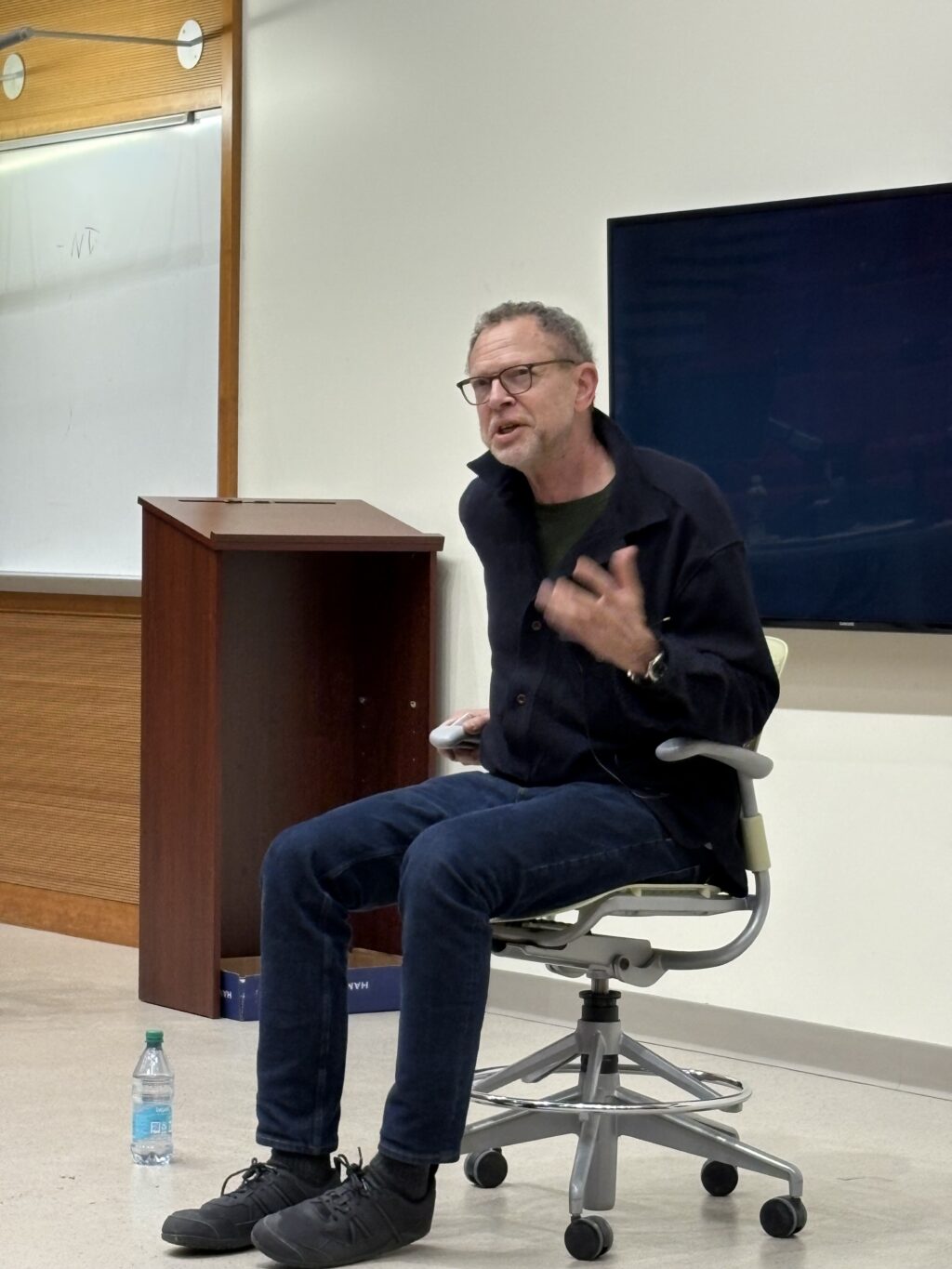
Howard French speaking at UMass Amherst
Pivoting towards his subject – Africa’s role in the world – he hails back to his previous book, “Born in Blackness”, which makes an argument for Africa as a central actor in global history from the Age of Exploration onwards. Contrary to how we are usually taught world history, Africa was a prime mover, not an “obstacle to be overcome”.
We are usually taught that Africa was the continent Europeans were trying to get around to get to Asia. But in writing about Asia, he found accounts from Portuguese explorers in which they name the Portuguese treasury “the House of Africa” and referring to Africa as “the New World”. There is a 50 to 75 year period of history where great explorers are establishing trade routes – not for slaves, but for gold – to Africa before building routes to Asia or the Americas.
Born in Blackness ends at the Second World War, and Howard was looking for an entry point into a subsequent book. His long-time editor suggested that a biography of Kwame Nkrumah, Ghana’s first post-colonial leader, would be a path forward. Howard was resistant: there’s piles of literature about Nkrumah and Ghana, but he wasn’t sure the world needed a new book on the topic.
Howard traces pan-Africanism backward from Nkrumah through Marcus Garvey towards freed slaves in the US in the 1700s. The ideas of Panafricanism are found around the Atlantic rim from not long after the advent of the trans-Atlantic trade in enslaved people. The core idea of panafricanism, which French brings back to a formerly enslaved man, David Walker, in the early 19th century is that Africa must unite to be able to compete with other nations and groups.
French asks whether Europeans do not also have a “fellow feeling”, a common identity as Europeans? One of the European projects, unfortunately, was the colonial carving up of Africa into individual European territories. So overfocusing on Panafricanism as a racial project misunderstands these dynamics of identity and power.
Joseph Ephraim Casely Hayford, a journalist from the Fante Gold Coast, is one of French’s characters “paving the way” for Nkrumah, writing about African governance traditions and the ways in which they might provide governance systems going forward. His book, “Ethiopia Unbound”, is arguably the first Panafrican novel, and his story is part of the first act of French’s book, which outlines a global pre-history of Panafricanism.
The second act of the book looks at the ways in which Africans (including African Americans) were actors on a world stage through the 20th century. He speaks movingly about “the fight to fight”, the struggles African Americans had to go through to demonstrate they could fight with valor for their country. The same sentiment applies to colonized people on the African continent – people living in a post-slavery world are experiencing “a halfway house out of slavery”, due to regimes of forced labor. Africans were “obliged” to work without wages and experience corporal punishments in systems that persist until the middle of the 20th century. And yet Africans are brave participants in the World Wars on the sides of their colonizers, seeing military service as a path towards respect and rights.
There was a logic to this, French explains: these Africans were told that WWII was a battle for freedom and democracy. The right to self-government and self-determination seemed deeply connected to the struggles against fascism and Nazism. Ghanaians – who played a decisive role in the victory over Japan in Burma – expected that their service in defending their colonizer would be a key step in achieving their dignity and rights. Returning to the Gold Coast at the end of WWII, they properly expected to be recognized as heroes, and instead, found the British reneging on promises for improved healthcare, education and renumeration.
In addition to mistreatment of veterans, Britain is siphoning resources from its colonies to rebuild their domestic economy, which has been shattered from the war, leading to incredible inflation in Gold Coast. Anger over the mistreatment of Gold Coast veterans turns into a protest movement. Veterans march on Osu Castle, the seat of colonial government, and are fired on by British troops. Nkrumah, who is not in the protests, rushes back to Accra to take up leadership.
Nkrumah is an unlikely leader – he’s from the far southwest, from a small ethnic group (the Nzema), and he’s a child of a “junior wife”, which means he’s less likely to get support from his polygamist father. But his mother advocates for him, and he gets sent to an elementary school… which he hates. His mother forces him to attend, and he eventually becomes a promising scholar.
His success in elementary school leads him to be sent to Achimota College, the best secondary school in the country. There he meets a faculty member who’s been to school in the US. There’s another key figure – the editor of an activist newspaper who will go on to become the first president of an independent Nigeria – who has also been schooled in the US, and both preach visions of Panafricanism to the young Nkrumah. Instead of going to the UK – as most Gold Coast students would have – Nkrumah goes to New York and “discovers blackness”.
There’s nothing special about being Black in the Gold Coast, French explains. But arriving in Harlem in 1935, Nkrumah encounters countless advocates of Black nationalism, and is brought to an Abyssinian Baptist service by a Dutch friend. He spends several days in Harlem before going on to Lincoln University in Pennsylvania, where he has been admitted, but does not have school fees. He pays his way through school, writing papers for other students, and makes additional funds by preaching in Methodist and Baptist churches, giving guest sermons.
He is drawn to Howard University in Washington DC, which is the citadel of African American intellectual life at that point. He never is a student there, but rubs shoulders with Charles Hamilton Houston, James Nesbitt, E Franklin Frasier, Charles Wesley, Zora Neale Hurston and others. “In each of these names, you can find a fragment of the Panafrican idea,” French argues. In the decade (1935-1945) Nkrumah spends in the US – getting four degrees along the way – Nkrumah becomes a committed Panafricanist, and is introduced to George Padmore, the successor to WEB DuBois in convening a global Panafrican conference.
Nkrumah, in essence, is recruited by the global Panafrican movement as someone who can actually talk to Africans, not just to Africans in the diaspora who’ve learned primarily to talk to British and American people. He gets arrested as part of the veterans movement. He runs for office from jail and wins a series of elections that eventually force the British to acknowledge him as the representative of Ghanaians. Eventually, he is the leader of the country when Ghana gains independence in 1957.
Ghana’s independence becomes a cause celebre for Black activists in the US, and Nkrumah emerges as an international inspiration for civil rights activsts. JFK is inspired by Nkrumah, and mentions Africa numerous times in his campaign for US president – we have forgotten a historical moment in which Nkrumah is the first foreign leader invited to Kenney’s White House.
Independence is not just symbolic – it is the springboard for independence movements across the continent. And Nkrumah’s vision shapes the politics of the nation and the continent. Kennedy wanted Nkrumah to help the US win the Cold War in Africa… though there really was no Cold War in Africa at that point. Nkrumah wanted Kennedy to loan Ghana money to build a massive dam in the Volta region and industrialize the nation. Kennedy wanted to do it, but his advisors resisted, and LBJ had no interest in Nkrumah or Africa. Nkrumah was overthrown in 1966, probably with a hand from the CIA, and the Panafrican dream is forced to take a back seat.
The post Howard French: The Second Emancipation appeared first on Ethan Zuckerman.
Source: https://ethanzuckerman.com/2026/03/24/howard-french-the-second-emancipation/
Anyone can join.
Anyone can contribute.
Anyone can become informed about their world.
"United We Stand" Click Here To Create Your Personal Citizen Journalist Account Today, Be Sure To Invite Your Friends.
Before It’s News® is a community of individuals who report on what’s going on around them, from all around the world. Anyone can join. Anyone can contribute. Anyone can become informed about their world. "United We Stand" Click Here To Create Your Personal Citizen Journalist Account Today, Be Sure To Invite Your Friends.
LION'S MANE PRODUCT
Try Our Lion’s Mane WHOLE MIND Nootropic Blend 60 Capsules
Mushrooms are having a moment. One fabulous fungus in particular, lion’s mane, may help improve memory, depression and anxiety symptoms. They are also an excellent source of nutrients that show promise as a therapy for dementia, and other neurodegenerative diseases. If you’re living with anxiety or depression, you may be curious about all the therapy options out there — including the natural ones.Our Lion’s Mane WHOLE MIND Nootropic Blend has been formulated to utilize the potency of Lion’s mane but also include the benefits of four other Highly Beneficial Mushrooms. Synergistically, they work together to Build your health through improving cognitive function and immunity regardless of your age. Our Nootropic not only improves your Cognitive Function and Activates your Immune System, but it benefits growth of Essential Gut Flora, further enhancing your Vitality.

Our Formula includes: Lion’s Mane Mushrooms which Increase Brain Power through nerve growth, lessen anxiety, reduce depression, and improve concentration. Its an excellent adaptogen, promotes sleep and improves immunity. Shiitake Mushrooms which Fight cancer cells and infectious disease, boost the immune system, promotes brain function, and serves as a source of B vitamins. Maitake Mushrooms which regulate blood sugar levels of diabetics, reduce hypertension and boosts the immune system. Reishi Mushrooms which Fight inflammation, liver disease, fatigue, tumor growth and cancer. They Improve skin disorders and soothes digestive problems, stomach ulcers and leaky gut syndrome. Chaga Mushrooms which have anti-aging effects, boost immune function, improve stamina and athletic performance, even act as a natural aphrodisiac, fighting diabetes and improving liver function. Try Our Lion’s Mane WHOLE MIND Nootropic Blend 60 Capsules Today. Be 100% Satisfied or Receive a Full Money Back Guarantee. Order Yours Today by Following This Link.


| Visits: | 1,835,548,860 |
| Stories: | 8,724,457 |
Whistler Blowers, Insiders

