

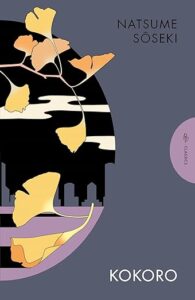
Kokoro by Natsume Soseki

What makes a book into a classic? The quality of the story and the prose style is a huge part of it, of course, but I think it’s also about somehow rising above the particulars of the story and grappling with themes that are relevant to all ages.
Kokoro by Natsume Soseki is one of the best-selling novels of all time in Japan, and I can see why. It’s a story about a young man’s complicated relationship with his older mentor, but it’s also a beautiful evocation of the end of the Meiji era, and beyond that it’s a meditation on timeless themes like guilt, honour, and atonement.
The book comes in three parts. In Part 1, the young narrator meets an older man whom he comes to call “Sensei”. Although the word is generally translated as “teacher”, the Sensei character in this book is not a teacher in the way we normally understand the word: he holds no academic position, indeed no position of any kind. He has retreated from the world and lives a ghostlike existence, shunning contact with most people except his wife. The narrator is at first offended by his aloofness, only coming to understand it much later:
“I pity him now, for I realize that he was in fact sending a warning, to someone who was attempting to grow close to him, signaling that he was unworthy of such intimacy. For all his unresponsiveness to others’ affection, I now see, it was not them he despised but himself.”
Part 1 proceeds quite slowly, with the narrator gradually getting to know Sensei and becoming both intrigued and frustrated by his older friend and mentor. The only clue he gets to Sensei’s odd behaviour is the fact that he makes monthly visits to the grave of an old friend.
In Part 2 of Kokoro, the narrator graduates from university and leaves Sensei behind in Tokyo to return to his country home, where his father is slowly dying. At the same time, the emperor is also dying, signalling the end of the Meiji era. When the emperor finally dies, a prominent general commits suicide to join his master in death. With his father close to death, the narrator receives a letter from Sensei in which he finally explains the secrets from his past that have cast such a shadow over his life.
Part 3 consists of this very long letter, essentially a memoir of Sensei’s life, focusing in particular on the way he was betrayed by his uncle and then came to betray his own friend, K. The guilt over that betrayal is what has made him retreat from the world—but more than that, it’s a kind of existential crisis brought on by the realisation that even good people will do the most evil things in particular circumstances. His uncle betrayed him for money, and he betrayed his friend for love. After that, he cannot function in the world:
“True enough, my uncle’s betrayal had made me fiercely determined never to be beholden to anyone again—but back then my distrust of others had only reinforced my sense of self. The world might be rotten, I felt, but I at least am a man of integrity. But this faith in myself had been shattered on account of K. I suddenly understood that I was no different from my uncle, and the knowledge made me reel. What could I do? Others were already repulsive to me, and now I was repulsive even to myself.”
And this is where Kokoro takes on broader resonance. The Meiji era brought a conflict between traditional Japanese values and the new Western individualism being brought in from outside. The old moral code emphasised honour and responsibility for one’s actions, exemplified by the general who committed suicide, partly out of loyalty to the emperor and partly to atone for his failures on the battlefield years earlier.
Sensei is caught between these two worlds: he is unable to live up to the stringent moral code of traditional Japan, but he is also unable to free himself from it and fully embrace individualism. So he lives his life in regret and remorse for his own moral failings, as well as bitterness over the failings of others, until he is finally able to expiate it all through the powerful letter he writes to his young friend, in which he lays bare the secrets he has been carrying for decades and warns the narrator to avoid his mistakes.
The structure of Kokoro is interesting: the first two parts are quite slow-moving, while Part 3, narrated by Sensei himself, packs the real emotional punch. Yet the power of Part 3 partly depends on the earlier sections—it’s about contrasting the old, dying traditional values with the newer ways of the younger generation. So although I’d be tempted to suggest that Soseki could have written Part 3 as a standalone novel, in the end I think that all three parts play an important role.
So although I found Kokoro somewhat uneven, I can certainly see why it became a classic of Japanese literature. I’d recommend reading it—and if you do, just hang in there through the first two parts. Part 3 is worth it!
I wrote this post for Japanese Literature Challenge 19, hosted by Dolce Bellezza. Check out her site for more discussion of books from Japan throughout January and February.
The post Kokoro by Natsume Soseki appeared first on Andrew Blackman.
On his blog A Writer’s Life, British novelist Andrew Blackman shares book reviews, insights into the writing process and the latest literary news, as well as listing short story contests with a total of more than $250,000 in prize money.
Source: https://andrewblackman.net/2026/01/kokoro-by-natsume-soseki/
Anyone can join.
Anyone can contribute.
Anyone can become informed about their world.
"United We Stand" Click Here To Create Your Personal Citizen Journalist Account Today, Be Sure To Invite Your Friends.
Before It’s News® is a community of individuals who report on what’s going on around them, from all around the world. Anyone can join. Anyone can contribute. Anyone can become informed about their world. "United We Stand" Click Here To Create Your Personal Citizen Journalist Account Today, Be Sure To Invite Your Friends.
LION'S MANE PRODUCT
Try Our Lion’s Mane WHOLE MIND Nootropic Blend 60 Capsules
Mushrooms are having a moment. One fabulous fungus in particular, lion’s mane, may help improve memory, depression and anxiety symptoms. They are also an excellent source of nutrients that show promise as a therapy for dementia, and other neurodegenerative diseases. If you’re living with anxiety or depression, you may be curious about all the therapy options out there — including the natural ones.Our Lion’s Mane WHOLE MIND Nootropic Blend has been formulated to utilize the potency of Lion’s mane but also include the benefits of four other Highly Beneficial Mushrooms. Synergistically, they work together to Build your health through improving cognitive function and immunity regardless of your age. Our Nootropic not only improves your Cognitive Function and Activates your Immune System, but it benefits growth of Essential Gut Flora, further enhancing your Vitality.

Our Formula includes: Lion’s Mane Mushrooms which Increase Brain Power through nerve growth, lessen anxiety, reduce depression, and improve concentration. Its an excellent adaptogen, promotes sleep and improves immunity. Shiitake Mushrooms which Fight cancer cells and infectious disease, boost the immune system, promotes brain function, and serves as a source of B vitamins. Maitake Mushrooms which regulate blood sugar levels of diabetics, reduce hypertension and boosts the immune system. Reishi Mushrooms which Fight inflammation, liver disease, fatigue, tumor growth and cancer. They Improve skin disorders and soothes digestive problems, stomach ulcers and leaky gut syndrome. Chaga Mushrooms which have anti-aging effects, boost immune function, improve stamina and athletic performance, even act as a natural aphrodisiac, fighting diabetes and improving liver function. Try Our Lion’s Mane WHOLE MIND Nootropic Blend 60 Capsules Today. Be 100% Satisfied or Receive a Full Money Back Guarantee. Order Yours Today by Following This Link.


| Visits: | 1,809,740,514 |
| Stories: | 8,649,096 |
Whistler Blowers, Insiders

