

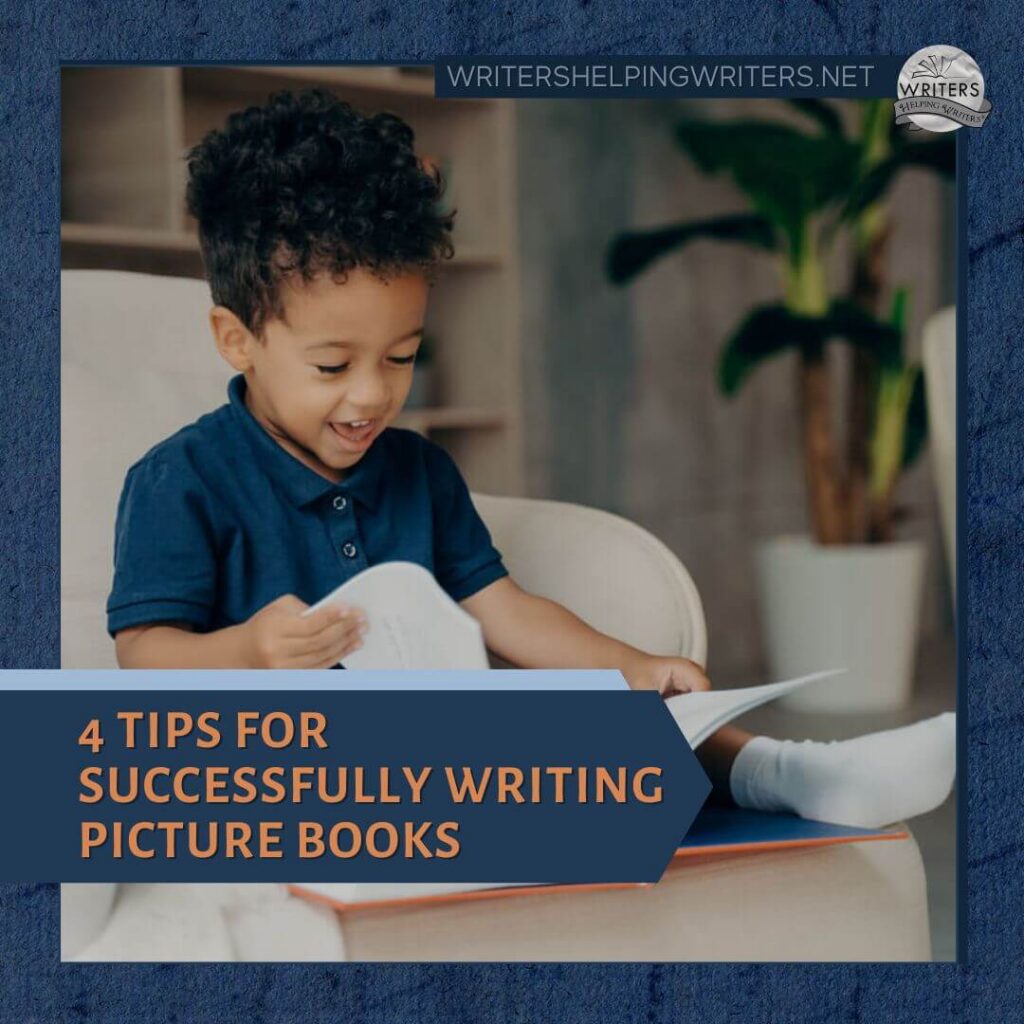
4 Tips for Successfully Writing Picture Books

Did you know I cut my teeth writing picture books?
Well, technically, my first attempt was a chapter book. I didn’t bother doing any research; as a first grade teacher, I’d read hundreds of them to my students, so how hard could it be? Hard enough that I soon switched to picture books, because I’d also read a lot of those, and they were shorter, so they must be easier, right?
*cue hysterical laughter*
Anybody who’s written a picture book knows they’re far from simple and require a slightly different approach. The techniques that work like a charm in longer fiction don’t always translate to a 40- or 32-page format where word counts reign, page turns matter, and the story is told not only with an author’s words but with an illustrator’s images.
To write strong picture books that children will appreciate, it can help to shift your mindset in a few key ways.
Embrace an Economy of Words
One of the biggest surprises for new picture book writers is just how much work each word has to do.
In other fiction formats, you can take your time with scene development, character arc, emotional progressions, and building tension. With picture books, you have a limited number of words and pages to tell the story, so you’ll need to choose the words deliberately and combine them in a way that readers can connect the dots.
If you’re struggling to stick to your word count, ask the following questions:
- Are you explaining anything the reader can infer for themselves?
- If a phrase or passage feels wordy, can you pare it down by using stronger verbs or specific nouns?
- Are you describing anything that can be shown in the illustration?
- Is there anything that can be removed without losing something vital to the story?
Learn to Share Your Story
Novel writers are solely responsible for telling their character’s story and providing an immersive experience for the reader. Picture book authors do the same thing, but instead of flying solo, you’re collaborating and sharing the storytelling load with an illustrator (unless, of course, you’re qualified to do both). Maybe you use your text to show character motivation, inner conflict, and dialogue while the illustrations convey the setting, character emotions, humor, and other details that are more effectively shown through art than words.
Rather than attempting to tell the story independently, think of the illustrator as your storytelling partner. Ask yourself what information is best conveyed through the text and what could be shown more effectively through the images. This collaborative mindset results in a richer reading experience via detailed artwork and specific text that work together to tell the story.
See the World from a Child’s Perspective

Clearly, adults and children experience the world differently. Events that seem minor or unimportant to an adult may be wildly significant and even formative for a minor. Likewise, parents worry about things that aren’t on a youngster’s radar. And, of course, kids and adults have different perspectives on the world because of their varying experiences. Authentic picture books succeed when they’re told from the child’s perspective by showcasing their responses to stimuli, their fears and desires, and how they process the world.
To hone this skill, spend time with your target age group or talk to their teachers, coaches, babysitters, and counselors—people who spend a lot of time with them. What excites or drives these children? What are they afraid of? Where do they struggle? What kind of stories and characters move them?
Then, like authors of any genre and format, get to know your character. What do they want most in the world? What are they afraid of? How will they respond to the situations you’ll throw at them? How will they retain agency throughout the story?
Once you’ve got a handle on who they are, write your story from their point of view to maintain an authentic perspective.
Shift from Writing in Chapters to Writing in Page Spreads
Picture book readers experience a story not in chapters but one page spread at a time. Pacing isn’t determined only by word choice and sentence structure; it’s shaped by how information unfolds visually across the book.
As you’re drafting, think in terms of two-page spreads. Where do you want readers to pause? Which moments could use a dramatic page turn? Would any event be more satisfying if readers have to flip the page to see it?
At some point in the process, consider creating a simple dummy. Doing this during revision can reveal saggy areas, sections where you’ve crammed in too much info, or a story that’s too long or sparse overall. Then you can edit accordingly, creating a more natural flow.
Writing a picture book isn’t about learning an entirely new craft. It’s about approaching storytelling from a new perspective. With these tips in mind, you may find yourself making choices that will elevate your story for young readers.
Win a Picture Book Critique!
Our very own Mindy Weiss, through her annual Picture Book Party contest and her picture book critiquing service, has helped hundreds of authors perfect their manuscripts and find their dream agents and editors. Today she’s giving away TWO full-length picture book manuscript critiques!
Contest Details
- This is a 24-hour contest, so enter ASAP.
- To enter, leave a comment (any comment—no need for specifics about your submission) on this post.
- Two winners will be drawn. We will email you if you win and let you know how to submit your manuscript.
- Please have your picture book manuscript ready in case your name is selected. Format it in Word with 1-inch margins, double spaced, and 12pt Times New Roman font.
Good luck!
Summary for Busy Writers: The format and unique audience of picture books means writers have to think a little differently than they would when crafting a novel or short story. By embracing an economy of words, collaborating with the illustrator, seeing the story through a child’s eyes, and writing in page spreads instead of chapters, you’ll create stronger manuscripts that engage young readers and help you excel with this storytelling format.
The post 4 Tips for Successfully Writing Picture Books appeared first on WRITERS HELPING WRITERS®.
The Bookshelf Muse is a hub for writers, educators and anyone with a love for the written word. Featuring Thesaurus Collections that encourage stronger descriptive skills, this award-winning blog will help writers hone their craft and take their writing to the next level.
Source: https://writershelpingwriters.net/2026/08/4-tips-for-successfully-writing-picture-books/
Anyone can join.
Anyone can contribute.
Anyone can become informed about their world.
"United We Stand" Click Here To Create Your Personal Citizen Journalist Account Today, Be Sure To Invite Your Friends.
Before It’s News® is a community of individuals who report on what’s going on around them, from all around the world. Anyone can join. Anyone can contribute. Anyone can become informed about their world. "United We Stand" Click Here To Create Your Personal Citizen Journalist Account Today, Be Sure To Invite Your Friends.
LION'S MANE PRODUCT
Try Our Lion’s Mane WHOLE MIND Nootropic Blend 60 Capsules
Mushrooms are having a moment. One fabulous fungus in particular, lion’s mane, may help improve memory, depression and anxiety symptoms. They are also an excellent source of nutrients that show promise as a therapy for dementia, and other neurodegenerative diseases. If you’re living with anxiety or depression, you may be curious about all the therapy options out there — including the natural ones.Our Lion’s Mane WHOLE MIND Nootropic Blend has been formulated to utilize the potency of Lion’s mane but also include the benefits of four other Highly Beneficial Mushrooms. Synergistically, they work together to Build your health through improving cognitive function and immunity regardless of your age. Our Nootropic not only improves your Cognitive Function and Activates your Immune System, but it benefits growth of Essential Gut Flora, further enhancing your Vitality.

Our Formula includes: Lion’s Mane Mushrooms which Increase Brain Power through nerve growth, lessen anxiety, reduce depression, and improve concentration. Its an excellent adaptogen, promotes sleep and improves immunity. Shiitake Mushrooms which Fight cancer cells and infectious disease, boost the immune system, promotes brain function, and serves as a source of B vitamins. Maitake Mushrooms which regulate blood sugar levels of diabetics, reduce hypertension and boosts the immune system. Reishi Mushrooms which Fight inflammation, liver disease, fatigue, tumor growth and cancer. They Improve skin disorders and soothes digestive problems, stomach ulcers and leaky gut syndrome. Chaga Mushrooms which have anti-aging effects, boost immune function, improve stamina and athletic performance, even act as a natural aphrodisiac, fighting diabetes and improving liver function. Try Our Lion’s Mane WHOLE MIND Nootropic Blend 60 Capsules Today. Be 100% Satisfied or Receive a Full Money Back Guarantee. Order Yours Today by Following This Link.


| Visits: | 1,830,061,735 |
| Stories: | 8,693,106 |
Whistler Blowers, Insiders

