

How Long Should You Stick With a Marketing Strategy Before Quitting

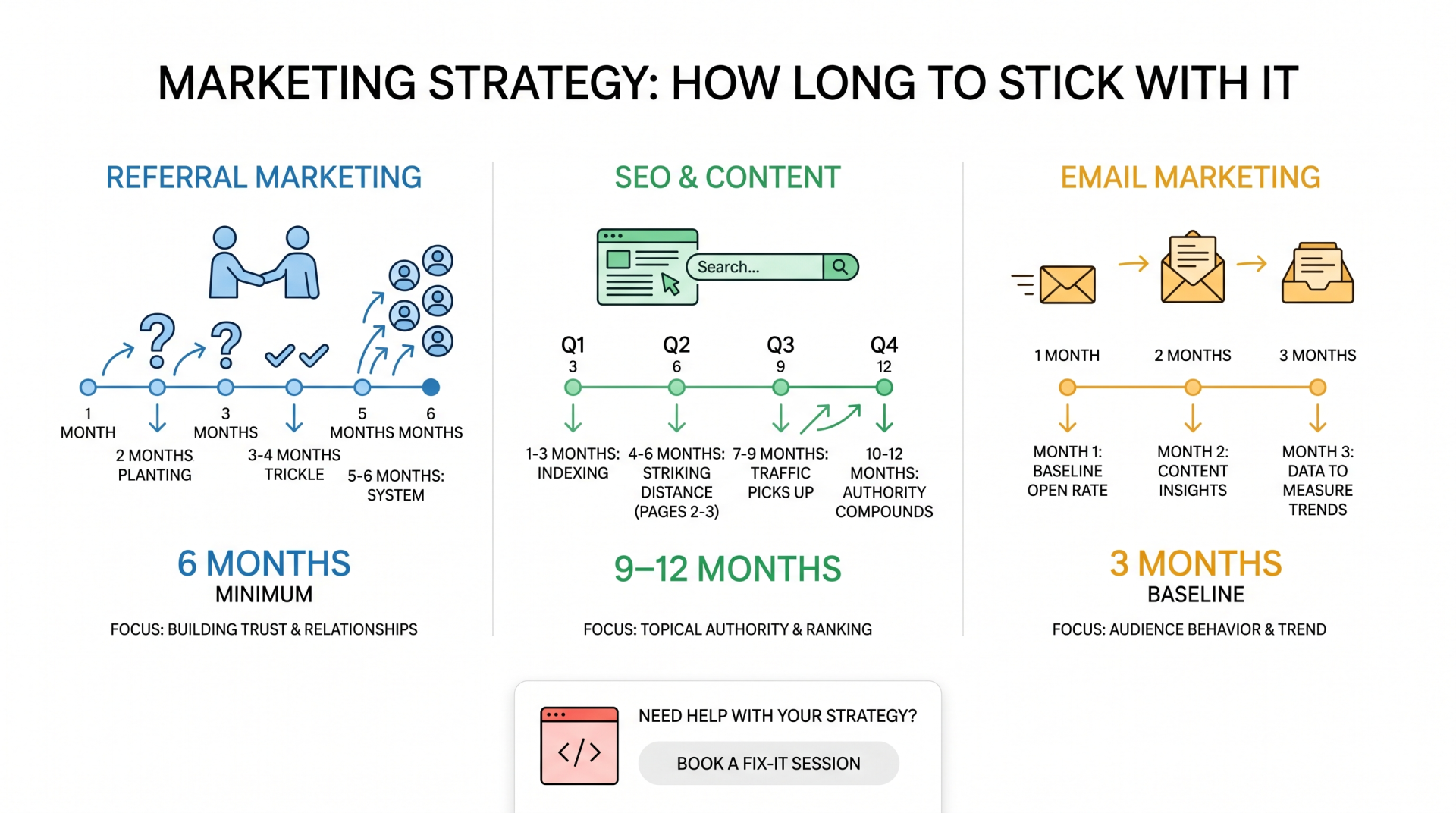
The honest answer to how long to stick with a marketing strategy depends on the channel: referral marketing needs at least 6 months, SEO and content marketing need 9–12 months, and email marketing needs 3 months before you have enough data to evaluate it. Most small business owners quit 4–6 weeks too early—right before results would have appeared.
I’ve watched this happen more times than I care to count. A business owner picks a strategy, works it for 60 days, sees nothing that looks like revenue, and pivots to the next shiny object. The painful part? In almost every case, they were standing on the edge of a breakthrough and walked away. The strategy wasn’t failing. Their timeline was.
Why Small Business Owners Quit Marketing Strategies Too Early
There’s a specific kind of pain that comes from doing the work and not seeing the results. You’re showing up, posting content, asking for referrals, sending emails—and your revenue looks exactly the same as it did three months ago. The natural conclusion is that it’s not working.
But that conclusion is almost always wrong. What’s actually happening is that you’re in the lag phase—the period between when the strategy takes root and when results become visible. Every marketing channel has one. The length of the lag phase is what determines how long to stick with a marketing strategy before you have real data to evaluate it.
The problem is that most people don’t know what that window is. So they default to impatience, which feels like discernment but is actually just expensive guessing.
How Long Does Referral Marketing Take to Work
Referral marketing is the most relationship-dependent channel in your marketing arsenal. The commitment window is a minimum of 6 months—and that assumes you’re actively working it, not occasionally mentioning it at networking events. According to Viral Loops research, 82% of small business owners already cite referrals as their primary source of new business—yet most treat it as a passive activity rather than a managed channel with a specific timeline.
Here’s what the timeline actually looks like:
- Months 1–2: You’re planting. You’re having conversations, reconnecting with past clients, joining groups, showing up consistently. Nothing visible is happening yet.
- Months 3–4: The first referrals start to trickle in—usually from the people you’ve stayed in front of most consistently. These feel like accidents. They’re not.
- Months 5–6: The system starts to feel like a system. Referrals become more predictable. You can trace them back to specific conversations or relationships you invested in early on.
The biggest mistake I see is treating referral marketing like a campaign instead of a habit. A campaign has an end date. Referral marketing doesn’t. If you’re looking for a deeper dive into how to build a referral system that compounds over time, start with these strategies for getting referrals that actually work.
One more thing worth knowing: if you’re in a structured networking group like BNI, the timeline extends to at least 6–9 months before you have a reliable read on whether it’s generating ROI. The relationships take time to build. My BNI review covers what realistic expectations look like inside that environment.
How Long Does SEO Take to Work for a Small Business
SEO is the longest game in small business marketing. The commitment window is 9–12 months—and that number makes a lot of business owners flinch. But the math behind it makes complete sense once you understand what Google is actually evaluating.
Search engines are not assessing individual posts. They’re evaluating your overall authority and topical depth relative to every other site competing for the same keywords. That assessment takes time because it’s based on patterns, not snapshots. A 2025 Ahrefs study of over 1 million pages found that only 1.74% of newly published pages reach Google’s top 10 within a year—and 72.9% of pages currently in the top 10 are more than 3 years old. The average #1 ranking page is now 5 years old.
Here’s a realistic timeline for content and SEO:
- Months 1–3: Google finds and indexes your content. Your pages are in the database but ranking nowhere meaningful. This is not failure. This is normal.
- Months 4–6: Pages start appearing in “striking distance” positions—pages 2 and 3 of Google. You’ll see impressions in Google Search Console before you see clicks.
- Months 7–9: Well-optimized pages start moving into page one results, especially for lower-competition, long-tail keywords. Traffic begins to pick up.
- Months 10–12: Topical authority compounds. A cluster of related articles starts ranking together and driving consistent organic traffic.
The caveat: this timeline assumes you’re publishing consistently, targeting real search phrases (not branded jargon), and building internal links between your articles. If you’re writing once a month about whatever feels interesting, the timeline stretches considerably.
If referral marketing is your primary channel, understand why referral marketing sometimes stalls—because even the best-performing channels hit plateaus, and you’ll need content marketing to fill in the gaps.
| Channel | Minimum Commitment Window | Early Signal to Watch |
|---|---|---|
| Referral Marketing | 6 months | Number of referral conversations per week |
| SEO / Content Marketing | 9–12 months | Impressions in Google Search Console |
| Email Marketing | 3 months (then measure) | Open rate trend, not absolute number |
| Social Media Organic | 6 months | Engagement rate, not follower count |
| Paid Advertising | 60–90 days (with budget) | Cost per click trend, not conversions yet |
How Long Does Email Marketing Take to Show Results
Email marketing has the shortest evaluation window of the three major organic channels—but only because it gives you usable data faster. The 3-month mark is when you have enough list behavior to know whether your strategy is working or whether something is broken. HubSpot’s email marketing benchmark data puts the average click-to-open rate across industries at 5.3%—but that number is almost meaningless unless you’re comparing it to your own rolling trend, not an industry average.
In the first 90 days, here’s what you’re actually building:
- A baseline open rate for your audience and subject line style
- A sense of which content topics drive clicks versus which ones get ignored
- An unsubscribe rate that tells you whether your list is well-matched to your content
After 3 months, you have real data. Before that, you have noise. The mistake is evaluating individual emails instead of trends. One email with a 12% open rate doesn’t tell you anything. A 3-month trend showing open rates declining from 28% to 19% tells you something is off—either in your subject lines, your send frequency, or your list quality.
The other thing email marketing needs time to develop is send reputation. Internet service providers evaluate your sending history before deciding whether your emails land in the inbox or the spam folder. That reputation builds over months, not weeks. If you’ve ever had deliverability issues, you already know this the hard way.
When Is It Actually Time to Quit a Marketing Tactic
Knowing how long to stick with a marketing strategy also means knowing when the data is genuinely telling you to stop. Not every strategy deserves infinite patience. Some channels are genuinely wrong for your business, your audience, or your budget. That said, the bar for quitting referral marketing should be especially high—research from Wharton and Harvard Business Review shows referred customers spend 16% more and have longer retention than customers acquired through other channels. That’s the compounding value you give up when you quit too early.
Here are the signs that you’ve hit the actual end of a strategy’s usefulness—not just the uncomfortable middle:
- Leading indicators are flat or declining after a full commitment window. If you’ve been doing referral marketing for 6 months and your referral conversation count has never increased, something structural is wrong—not just slow.
- The channel doesn’t match where your customers are. SEO is worthless if your buyers don’t search before they buy. Referral marketing is a grind if you’re in an industry with zero repeat-purchase potential.
- You’ve never actually implemented it consistently. Sporadic execution doesn’t count. If you posted on LinkedIn twice a month for 6 months and called that a social strategy, you didn’t give the strategy a real test.
- The cost (time or money) is genuinely unsustainable. A strategy you can’t maintain long enough to work is not a viable strategy, regardless of how effective it is in theory.
There’s a difference between quitting a strategy and adjusting your approach within a strategy. If referral marketing isn’t producing results after 6 months, the question to ask isn’t “should I quit referrals?”—it’s “am I asking for referrals correctly?” Those are very different problems with very different solutions. Here’s how to ask for referrals the right way if you’re not getting traction.
How to Measure Leading Indicators While You Wait for Results
The best antidote to premature quitting is tracking leading indicators—the early signals that predict future results before results actually show up. Every channel has them.
For referral marketing: track the number of referral conversations you initiate per week, the number of past client touchpoints per month, and whether your referral source network is growing or stagnant. Revenue comes later. These behaviors come first.
For SEO and content: track Google Search Console impressions before you track clicks. Impressions mean Google is finding and considering your pages. Clicks come after rankings improve. If impressions are growing over months 3–6, your content is working—even if traffic is still low.
For email marketing: track open rate trends and click-through rate trends over rolling 30-day windows. Also track list growth rate. A shrinking list with a rising open rate is actually healthy—it means your less-engaged subscribers are unsubscribing while your engaged ones stay. That’s list quality improving, not failing.
If you’re active in networking groups as part of your referral strategy, comparing networking options and understanding what BNI vs Chamber of Commerce actually delivers will help you set the right expectations for each environment.
For a deeper look at what content marketing really requires at the small business level, the expectations are different than what most marketing blogs describe.
Frequently Asked Questions About Marketing Strategy Timelines
It depends on the channel. Referral marketing needs a minimum of 6 months before you have reliable data. SEO and content marketing need 9–12 months. Email marketing needs 3 months to establish a behavioral baseline. The common mistake is applying the same 30–60 day evaluation window to channels that have fundamentally different maturation timelines.
Quit a marketing tactic when leading indicators—not just revenue—have been flat or declining throughout a full commitment window, when the channel doesn’t match where your customers actually are, or when you can’t sustain consistent execution. Do not quit because you feel impatient at week 6 of a 9-month strategy.
For most small businesses, SEO takes 9–12 months to produce consistent, meaningful organic traffic. Pages typically appear in Google’s index within weeks, move to striking-distance positions (pages 2–3) by months 4–6, and reach page one for relevant keywords by months 7–12. This timeline assumes consistent publishing, real keyword targeting, and internal linking between related articles.
Referral marketing typically takes 6 months to generate a predictable, repeatable stream of referrals. The first referrals often arrive around months 3–4 as a result of early relationship investments, but it takes 5–6 months for the pattern to become consistent. Structured networking groups like BNI often require 6–9 months before ROI becomes clear.
Leading indicators are early-stage metrics that predict future results before revenue shows up. Examples include referral conversation frequency (for referral marketing), Google Search Console impressions (for SEO), and email open rate trends (for email marketing). Tracking leading indicators prevents premature quitting by giving you real signal about whether a strategy is progressing—even when revenue hasn’t followed yet.
Additional Reading
- How to Get Referrals From Clients and Contacts Without Being Pushy
- Why Referral Marketing Stops Working (And What to Do About It)
- BNI Review: Is It Worth It for Small Business Owners?
Low budget marketing strategies for CEOs with no marketing department. Join DIYMarketers.com for free marketing tips.
Source: https://diymarketers.com/how-long-to-stick-with-a-marketing-strategy/
Anyone can join.
Anyone can contribute.
Anyone can become informed about their world.
"United We Stand" Click Here To Create Your Personal Citizen Journalist Account Today, Be Sure To Invite Your Friends.
Before It’s News® is a community of individuals who report on what’s going on around them, from all around the world. Anyone can join. Anyone can contribute. Anyone can become informed about their world. "United We Stand" Click Here To Create Your Personal Citizen Journalist Account Today, Be Sure To Invite Your Friends.
LION'S MANE PRODUCT
Try Our Lion’s Mane WHOLE MIND Nootropic Blend 60 Capsules
Mushrooms are having a moment. One fabulous fungus in particular, lion’s mane, may help improve memory, depression and anxiety symptoms. They are also an excellent source of nutrients that show promise as a therapy for dementia, and other neurodegenerative diseases. If you’re living with anxiety or depression, you may be curious about all the therapy options out there — including the natural ones.Our Lion’s Mane WHOLE MIND Nootropic Blend has been formulated to utilize the potency of Lion’s mane but also include the benefits of four other Highly Beneficial Mushrooms. Synergistically, they work together to Build your health through improving cognitive function and immunity regardless of your age. Our Nootropic not only improves your Cognitive Function and Activates your Immune System, but it benefits growth of Essential Gut Flora, further enhancing your Vitality.

Our Formula includes: Lion’s Mane Mushrooms which Increase Brain Power through nerve growth, lessen anxiety, reduce depression, and improve concentration. Its an excellent adaptogen, promotes sleep and improves immunity. Shiitake Mushrooms which Fight cancer cells and infectious disease, boost the immune system, promotes brain function, and serves as a source of B vitamins. Maitake Mushrooms which regulate blood sugar levels of diabetics, reduce hypertension and boosts the immune system. Reishi Mushrooms which Fight inflammation, liver disease, fatigue, tumor growth and cancer. They Improve skin disorders and soothes digestive problems, stomach ulcers and leaky gut syndrome. Chaga Mushrooms which have anti-aging effects, boost immune function, improve stamina and athletic performance, even act as a natural aphrodisiac, fighting diabetes and improving liver function. Try Our Lion’s Mane WHOLE MIND Nootropic Blend 60 Capsules Today. Be 100% Satisfied or Receive a Full Money Back Guarantee. Order Yours Today by Following This Link.


| Visits: | 1,802,660,751 |
| Stories: | 8,634,323 |
Whistler Blowers, Insiders

