

Why Your Marketing Copy Isn’t Converting (And How Emotional Triggers Fix It)

Conversions are dropping and benefits are the reason. Emotional triggers in marketing are what actually move people to buy — not bullet points, not feature lists, not “save time” promises.
Mood-driven marketing is the practice of identifying the specific emotional states your buyers are already living in and speaking directly to those states, rather than listing what your product does or what it saves them. Your buyers are stressed, overwhelmed, and running on financial anxiety. “Save time” and “reduce stress” stopped landing the moment the economy got shaky.
Most marketing has gotten lazy with benefits. List the outcome, slap on a testimonial, call it done. The problem is that benefits are rational — and buying decisions aren’t. Your buyer’s amygdala is running the show, and it doesn’t respond to bullet points. It responds to survival signals: the fear of dropping the ball, the shame of falling behind, the desperate want to feel like things are finally under control.
What’s the Difference Between Features, Benefits, and Mood States?
Most marketing education stops at benefits. You’ve heard it a thousand times: “Don’t sell the drill, sell the hole.” It’s good advice. It’s also incomplete.
Here’s how the three levels actually break down:
- Features: What the product or service does. “Email automation platform with sequences, tags, and segmentation.”
- Benefits: What the buyer gets from it. “Save time on email. Stay in touch with your list without manual effort.”
- Mood State: The emotional reality the buyer is protecting. “Never drop the ball on a warm lead again. No more waking up at 2 AM wondering if someone fell through the cracks.”
Notice what the mood state does. It’s specific. It’s personal. It carries real stakes. And it describes an internal experience — not an external outcome.
| Level | What It Describes | Example | Brain Response |
|---|---|---|---|
| Feature | What the product does | “Email automation with sequences” | None — informational only |
| Benefit | What the buyer gains | “Save time on email” | Rational processing — easily ignored |
| Mood State | The feeling the buyer is protecting | “Never drop the ball on a warm lead again” | Amygdala fires — buying decision triggered |
Benefits are still generic. “Save time” is something every competitor says. “Never miss a customer again when it matters most” is something only you can say when you’ve done the work to understand what your buyer actually fears.
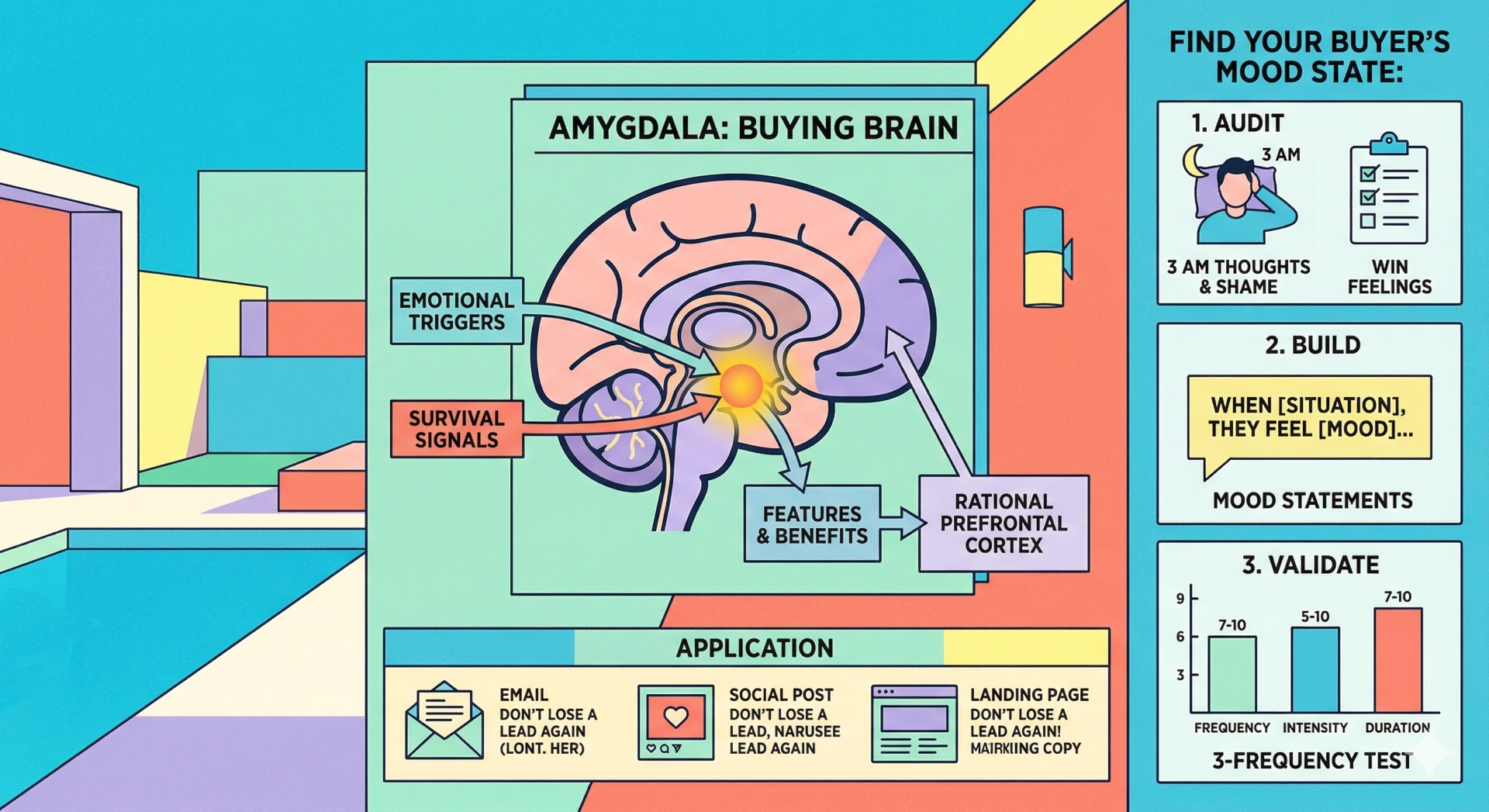
According to Gartner’s research on B2B buyer behavior, 80% of buying decisions are based on the buyer’s direct or indirect experience — not the price or the product itself. The experience starts in their head, before they ever touch your offer. Mood-driven marketing shapes that experience before the sale.
How Emotional Triggers in Marketing Work on Your Buyer’s Brain
The amygdala is the part of the brain that processes emotion and triggers the fight-or-flight response. It’s older than language. It doesn’t read bullet points. It reads threat and reward.
Emotional triggers in marketing work because they speak directly to this part of the brain — bypassing the rational prefrontal cortex and landing in the place where snap decisions actually get made. This is why emotional triggers in marketing outperform rational benefit statements every time the stakes feel personal.
When a small business owner sees copy that says “save time on marketing,” the amygdala doesn’t react. When the same owner reads “stop wasting Sundays on content that nobody sees,” the amygdala fires immediately. That’s a survival signal. Sunday is finite. Sunday represents freedom and family and rest. Marketing that eats Sunday is a threat.
That’s the distinction. Generic benefits are processed rationally. Mood states are felt viscerally. And decisions get made before the rational brain even checks in.
This is why so many small businesses experience a disconnect between traffic and conversions. They have visitors. The visitors read. The visitors leave. The copy was technically fine. It listed real benefits. But it never triggered the amygdala. It never spoke to the mood state that was already running in the background.
Understanding which marketing strategy matches your buyer’s psychology starts with understanding what your buyer is already feeling — not what you want them to feel after they buy.
The Three Qualities of a Real Mood State
Not every emotion qualifies as a mood state worth marketing to. The ones that move buyers share three characteristics. Miss one and you’re back to writing generic copy.
High Frequency: The mood state happens often. Daily is better than weekly. Weekly is better than monthly. If your buyer only feels this emotion once a year, it won’t fuel purchasing urgency.
High Intensity: When the mood shows up, it hits hard. Mild discomfort doesn’t move people to spend money. Shame, dread, panic, and relief are high-intensity emotions. “Mildly frustrated” is not.
Long Duration: The mood lingers. It sits in the background even when your buyer isn’t actively thinking about it. The best mood states are ones that have been quietly eating at someone for months before they search for a solution.
The 2020 Keap Small Business Trends Report found that 40% of small business owners said “finding time and resources for marketing” was their biggest challenge. That sounds like a time management problem. It’s not. Dig one layer deeper and it’s a shame spiral — the feeling of knowing you should be marketing, not doing it, and watching the business plateau while telling yourself you’ll get to it next week. That’s high frequency, high intensity, and long duration. That’s a mood state — and the emotional triggers in marketing that speak to it will outperform any benefit-based message you could write.
How to Find Your Buyer’s Mood State: The 3-Exercise System Exercise 1: The Amygdala Trigger Audit
This is where mood-driven marketing starts. Before you write a word of copy, you need a list of the survival-level emotions your ideal buyer is living with. Here are the four questions that get you there fast.
Question 1: What keeps them awake at 3 AM?
Not 10 PM when they’re winding down. 3 AM when the brain won’t shut off. What specific thought surfaces? The more specific the answer, the better the copy.
Question 2: What would they trade a significant amount for?
Not money — energy, time, dignity. What’s the thing they’d pay almost anything to never feel again? Or to finally feel?
Question 3: What’s the shame they never want anyone to see?
Shame is one of the most powerful and underused emotions in marketing. It shows up in things like: “I don’t know if what I’m doing is working.” “I haven’t followed up with that lead in three weeks.” “My email list is dead and it’s my fault.”
Question 4: What’s the win that makes them feel invincible?
This is the attraction side. What’s the emotional state they’re moving toward? Relief? Confidence? The feeling of being ahead instead of behind?
Write down every answer you generate. Don’t edit. Don’t polish. Rank them by frequency, intensity, and duration (your three filters from above). The ones that score high on all three are the mood states your marketing needs to address.
The DIYMarketers Buyer Persona Generator walks through a version of this process — but the Amygdala Trigger Audit goes deeper than demographics and job titles. You’re looking for the interior life, not the résumé.
Exercise 2: The Mood Statement Builder
The Mood Statement Builder converts your amygdala research into emotional triggers in marketing that your specific buyers will recognize instantly. It’s simple on purpose. Simple is repeatable.
Use this structure:
“When [specific situation], they need to feel [specific emotional state]. Our [offer] makes them feel [mood anchor] because [proof].”
Here’s what that looks like in practice:
Generic version: “Our email platform helps you stay in touch with your list.”
Mood-driven version: “When a warm lead goes cold because you didn’t follow up in time, it doesn’t feel like a business problem — it feels like a personal failure. Our automation makes sure you never have to feel that again. Every lead gets touched. Every follow-up goes out. You stop losing customers to your own forgetfulness.”
See the difference? The second version isn’t pitching a feature. It’s speaking directly to the feeling the buyer has already been carrying. They read it and think, “That’s exactly what happens to me.” That’s mood-driven marketing working correctly.
The direct marketing approach has always understood this intuitively — direct response copywriters have been writing to emotional states for decades. What’s changed is that small businesses now have the data, the tools, and the customer access to do this without a big agency.
Exercise 3: The Three-Frequency Validation Test
Before any mood state makes it into your marketing, run it through this three-question test. This keeps you from writing copy that resonates with you instead of resonating with your buyer.
Question 1 — Frequency: How often does your buyer feel this emotion? If the answer is daily, it’s a strong signal. Weekly is acceptable. Monthly or less means the mood isn’t running hot enough to drive action.
Question 2 — Intensity: When this emotion hits, how hard does it hit? Rate it on a scale of 1 to 10. Mild inconvenience is a 3. “I wanted to cry in my car” is a 9. You want to speak to 7s and above.
Question 3 — Duration: How long does the mood stick around after it gets triggered? A moment of frustration fades. A background anxiety about whether your business is going to make it this quarter? That lingers for months. Lingering emotions are the ones that create buying urgency.
Only the mood states that score HIGH on all three filters belong in your copy. If something scores high on frequency but low on intensity, it’s annoying, not motivating. If it scores high on intensity but it only happens once a year, the urgency window is too narrow to build a marketing strategy around.
This is the work. This is the part that most small business owners skip — which is exactly why their marketing sounds the same as everyone else’s in their category.
The LocalIQ Small Business Marketing Trends Report shows that small businesses cite “identifying target audiences” as one of their top three marketing challenges. Target audiences are the starting point — but mood states are the depth level that actually changes whether your copy works or not.
What to Do With Your Mood State Map This Week
The goal isn’t to have a perfect list. The goal is to have a working list you test.
Pick the one mood state that scores highest across all three validation questions. Write one piece of content — an email, a social post, a landing page section — using the Mood Statement Builder template. That’s using emotional triggers in marketing the way they’re meant to work: one specific buyer, one specific feeling, one specific message. Send it. Watch the response rate against your baseline.
If it lands, replicate it. If it doesn’t, go back to the Amygdala Trigger Audit and check whether you actually interviewed buyers or whether you assumed. Assumption is the enemy of mood-driven marketing. The emotional reality you imagine for your buyers is almost never as specific or as intense as the reality they’re actually living.
Small businesses that do this work build referral systems that outlast any algorithm. When your marketing speaks to how someone actually feels, they don’t just buy. They tell other people who feel the same way.
The lead generation system you want to build starts here — with knowing exactly who you’re talking to and what emotional state they’re living in when they first encounter your offer.
The Customer Retention Bonus You Weren’t Expecting
Here’s what happens when you get mood-driven marketing right: your retention goes up too.
When a buyer purchases because of a mood state — and your product actually resolves that mood state — the relief they feel creates loyalty. They associate your brand with feeling better. They come back. They upgrade. They refer.
When a buyer purchases based on a rational benefit — and the benefit delivers — they’re satisfied. That’s it. Satisfied customers shop around. Emotionally relieved customers become advocates.
Customer retention marketing is downstream from the mood you create at acquisition. Get the acquisition mood right, and retention becomes dramatically easier.
According to UpFlip’s small business marketing budget data, 66% of small business owners spend less than $1,000 on marketing per year. That means every dollar of copy, every email, every post has to earn its place. Emotional triggers in marketing make those limited resources work harder — because they speak to what’s already happening inside your buyer’s head, with no extra ad spend required.
Emotional Triggers in Marketing FAQs
Emotional triggers in marketing are the specific feelings, fears, and desires your buyer is already experiencing before they find your offer. Rather than listing product features or generic benefits, emotional triggers in marketing speak directly to the amygdala-level emotions that drive purchasing decisions. The mood-driven marketing approach takes this further by identifying which emotional states have the highest frequency, intensity, and duration for your specific buyer — then building copy around those states.
They’re related but not identical. Emotional marketing is a broad category that includes any marketing designed to evoke emotion. Mood-driven marketing is more specific: it requires identifying the exact emotional state your buyer is already in — not manufacturing a new feeling through storytelling — and speaking directly to that pre-existing state. The distinction matters because accuracy is what makes it work.
A benefit describes what the customer gains (“save time,” “increase revenue,” “reduce stress”). A mood state describes the internal emotional experience the customer is trying to escape or achieve (“never feel like you’re dropping the ball again,” “stop watching your competitors grow while you’re frozen”). Benefits are rational. Mood states are visceral. The amygdala responds to the latter.
Start with the Amygdala Trigger Audit: identify what keeps your buyer awake at 3 AM, what shame they carry, what they’d trade anything to avoid, and what win would make them feel invincible. Then run each mood state through the Three-Frequency Validation Test: high frequency, high intensity, and long duration. Only the states that score high on all three belong in your copy.
Absolutely — and in some ways it works even better in B2B contexts. Gartner research shows that 77% of B2B buyers say their most recent purchase was complex or very difficult. The complexity creates intense emotional states — fear of choosing wrong, dread of having to defend the decision internally, anxiety about implementation. B2B buyers are still humans with amygdalas. Speaking to those emotional states outperforms spec-sheet marketing every time.
Additional Reading
- Marketing Strategies for Small Business: Which One Is Right for You
- The Real Marketing Budget Risk Small Business Owners Are Taking
- Workflow Thinking: How to Build Marketing Systems That Actually Run
Low budget marketing strategies for CEOs with no marketing department. Join DIYMarketers.com for free marketing tips.
Source: https://diymarketers.com/emotional-triggers-in-marketing/
Anyone can join.
Anyone can contribute.
Anyone can become informed about their world.
"United We Stand" Click Here To Create Your Personal Citizen Journalist Account Today, Be Sure To Invite Your Friends.
Before It’s News® is a community of individuals who report on what’s going on around them, from all around the world. Anyone can join. Anyone can contribute. Anyone can become informed about their world. "United We Stand" Click Here To Create Your Personal Citizen Journalist Account Today, Be Sure To Invite Your Friends.
LION'S MANE PRODUCT
Try Our Lion’s Mane WHOLE MIND Nootropic Blend 60 Capsules
Mushrooms are having a moment. One fabulous fungus in particular, lion’s mane, may help improve memory, depression and anxiety symptoms. They are also an excellent source of nutrients that show promise as a therapy for dementia, and other neurodegenerative diseases. If you’re living with anxiety or depression, you may be curious about all the therapy options out there — including the natural ones.Our Lion’s Mane WHOLE MIND Nootropic Blend has been formulated to utilize the potency of Lion’s mane but also include the benefits of four other Highly Beneficial Mushrooms. Synergistically, they work together to Build your health through improving cognitive function and immunity regardless of your age. Our Nootropic not only improves your Cognitive Function and Activates your Immune System, but it benefits growth of Essential Gut Flora, further enhancing your Vitality.

Our Formula includes: Lion’s Mane Mushrooms which Increase Brain Power through nerve growth, lessen anxiety, reduce depression, and improve concentration. Its an excellent adaptogen, promotes sleep and improves immunity. Shiitake Mushrooms which Fight cancer cells and infectious disease, boost the immune system, promotes brain function, and serves as a source of B vitamins. Maitake Mushrooms which regulate blood sugar levels of diabetics, reduce hypertension and boosts the immune system. Reishi Mushrooms which Fight inflammation, liver disease, fatigue, tumor growth and cancer. They Improve skin disorders and soothes digestive problems, stomach ulcers and leaky gut syndrome. Chaga Mushrooms which have anti-aging effects, boost immune function, improve stamina and athletic performance, even act as a natural aphrodisiac, fighting diabetes and improving liver function. Try Our Lion’s Mane WHOLE MIND Nootropic Blend 60 Capsules Today. Be 100% Satisfied or Receive a Full Money Back Guarantee. Order Yours Today by Following This Link.


| Visits: | 1,802,528,068 |
| Stories: | 8,633,889 |
Whistler Blowers, Insiders

