

How to Build a Discounting Strategy for Small Business Without Giving Away the Store

A smart discounting strategy for small business does one thing: it brings in customers who wouldn’t pay full price, without convincing your full-price customers to stop paying full price. That’s the whole game. Get that balance wrong and discounting becomes a profit drain disguised as a marketing tactic — and a habit your customers will hold you to forever.
In 2012, JC Penney hired Apple’s retail mastermind Ron Johnson and handed him a mandate: end the discount addiction. Johnson eliminated coupons and sale events entirely, replacing them with “everyday low prices.” The logic was airtight on paper. The prices were never actually higher — but customers had been trained so completely to shop the red tags that when the red tags disappeared, so did the customers. Revenue collapsed 25% in a single year. JC Penney filed for bankruptcy in 2020. You can’t fix a discounting problem by stopping discounts. You have to build the right discounting strategy from the start.
Why Most Small Business Discounts Backfire
Harvard Business School professor Rafi Mohammed wrote a piece in Harvard Business Review that flipped how I think about this. He describes discounting as “a superhero strategy: powerful, swiftly achieves results, and can be summoned at a moment’s notice.” I agree — with one giant asterisk for small business owners.
Enterprise companies can absorb margin erosion. The average S&P 500 net profit margin is 13.2% — meaning a 10% discount hurts, but doesn’t kill. Most small businesses operate on margins far thinner than that. A poorly timed discount doesn’t dent your profit. It eliminates it.
The other problem is that most small business discounts are reactive, not strategic. You hit a slow week and panic-post a flash sale. A competitor drops their price and you match it without thinking. You give a returning client a break because it feels good. None of those are strategy. They’re just margin leakage with good intentions.
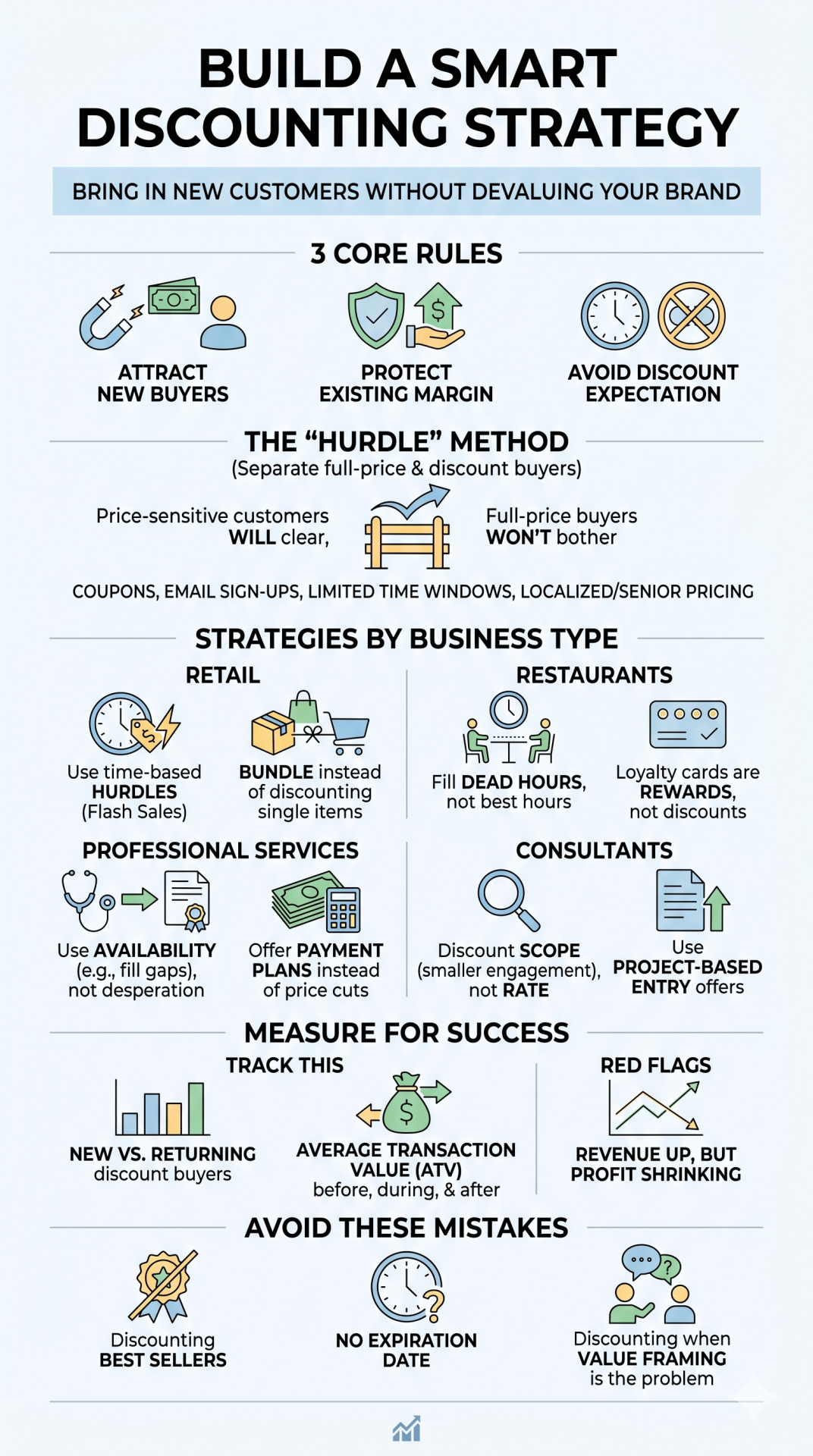
A real discounting strategy for small business has three rules: attract new buyers, protect existing margin, and never let the discount become the expectation.
What Makes a Discounting Strategy for Small Business Actually Work
The framework from Mohammed’s research is simple enough to build into your business this week. Effective discounting uses price cuts to attract buyers who currently value your product at less than the asking price — without letting current buyers take advantage of the lower price.
The mechanism for keeping those two groups separate is called a hurdle. Think of it as a small inconvenience that price-sensitive customers will clear because the discount is worth it to them — but that your full-price customers won’t bother with. Coupons, email sign-up requirements, limited time windows, senior or resident pricing — all hurdles.
McDonald’s executed this brilliantly during the inflation wave. Their $5 meal deals and under-$3 menu items targeted budget-conscious diners without changing the price architecture for customers who were already coming in and ordering normally. The result: same-store sales growth of 5.7% for the quarter ending December 31, 2025.
You won’t have McDonald’s ad budget. But you can absolutely use their logic. Here’s how it breaks down by business type.
Discounting Tips for Retail Businesses
Retail is where discounting gets the most abused. The “always on sale” retailers — Bed Bath & Beyond, Tuesday Morning — trained customers to never pay full price. Both are now bankrupt. Learn from them.
Use time-based hurdles, not blanket sales. Flash sales with a hard 48-hour window attract bargain hunters without signaling that your regular price is negotiable. Once the window closes, it closes.
Bundle instead of discounting individual items. Sell three candles for $45 when each is priced at $18. The customer feels like they’re winning, your average transaction goes up, and your individual unit price never moved. This packaging approach works especially well for products customers buy repeatedly.
Run loyalty-based discounts, not public ones. Email your existing list a member-only sale before opening it to anyone else. This rewards loyalty, increases email sign-ups, and keeps the perception of full price intact for walk-in customers.
Use doorbusters strategically. Grocery stores have done this for decades — discount the turkey to get you in the door, then sell you the stuffing, wine, and pie at full margin. Pick one high-visibility item to discount and let everything else work at full price.
Discounting Tips for Restaurants
Restaurants live and die on table turns, margins, and repeat visits. The Thai restaurant example in Mohammed’s research nails the right approach: offer a discount to a defined, local group (his condo building), let them feel like insiders, and watch them come in more often than they otherwise would. Goodwill, not desperation.
Fill dead hours, not your best hours. A Tuesday 2–5 PM discount isn’t competing with your Friday dinner rush. You’re filling seats that would be empty anyway, and your salaried staff is already there. That’s pure incremental revenue. A blanket 20% off that applies on Saturday night is just margin destruction.
Use “waiting list” pricing for high-demand times. This is dynamic pricing done simply — charge more when demand peaks, discount when it dips. Restaurants near sporting events or entertainment venues should be doing this already. You don’t need algorithmic software. You just need a policy.
Make your discount require a commitment. “Book a table for 6 on a Tuesday and get a complimentary appetizer” moves groups into low-traffic slots and creates a reservation commitment that reduces no-shows. The discount isn’t open to anyone — it requires a specific action.
Loyalty punch cards aren’t discounts, they’re rewards. Buy 9 coffees, get the 10th free. The customer never pays less than full price — they earn a future benefit. That distinction matters enormously for customer psychology. Customer loyalty programs built on reward mechanics outperform blanket discount programs consistently.
Discounting Tips for Professional Services
If you’re an accountant, therapist, attorney, financial advisor, or any other licensed professional — discounting requires extra care. Your price signals your expertise. Cut it carelessly and you don’t just lose margin, you lose positioning.
Use availability, not desperation, as the discount frame. The dentist example from Mohammed’s HBR piece is exactly right: offer 50% off to budget-conscious seniors who can come in with 24 hours’ notice. You’re filling appointment gaps your salaried hygienists would otherwise sit through. Frame it as an availability discount for flexible patients, not as a general sale on your services.
Offer payment plans instead of price cuts. A $1,200 service delivered as $400/month for three months isn’t a discount — it’s access. You collect the same revenue. The client removes a cash flow barrier. This is almost always preferable to discounting the total.
First-appointment incentives work better than ongoing discounts. A free 30-minute initial consultation (or a reduced-rate first session) lowers the barrier to entry for price-sensitive prospects. Once they’ve experienced your work, the full price becomes easier to justify. This is about customer acquisition, not ongoing margin reduction.
If you discount for a referral, make the mechanism visible. “Send me a client and you’ll both get 15% off your next visit” creates a structural reason to discount that your existing clients understand and respect. It’s not weakness — it’s a referral program. Getting customers to share your business is always cheaper than acquiring new ones cold.
| If You See This… | It Means… | Your Next Move |
|---|---|---|
| Prospects consistently balk at your price | The value isn’t landing, not that the price is wrong | Fix your framing before you discount anything |
| Existing clients ask for a break at renewal | They’re testing, not necessarily leaving | Add value (extra session, report) before cutting price |
| You have empty capacity in slow periods | Real opportunity for targeted discount | Offer availability discount to defined audience only |
| A competitor is undercutting you | Price war you cannot win long-term | Don’t match — differentiate and hold your price |
Discounting Tips for Consultants and Fractional Executives
This is the category where I have the most direct skin in the game — and the one where discounting causes the most damage when done wrong. If you’re a fractional CMO, fractional CFO, or any kind of consulting professional, your rate IS your positioning. Drop it casually and you communicate one of two things: you were overpriced to begin with, or you’re desperate for the work.
Never discount your rate. Discount your scope instead. If a prospect can’t afford your full retainer, offer a smaller engagement — a focused diagnostic, a 90-day sprint, a defined deliverable. You maintain your hourly or day rate. They get entry-level access at entry-level scope. If the relationship works, they upgrade. Value-based pricing depends on this boundary staying intact.
Use a project-based entry offer, not a rate discount. A fixed-price “starter project” — an audit, a strategy session, a 30-day plan — gives price-sensitive prospects a lower buy-in without touching your ongoing rate. Position it as a way to get started, not as a discount.
When a client asks for a renewal discount, give them something else first. More often than not, the “I need a better price” conversation at renewal is really “I need to feel like I’m getting more value.” Add a quarterly review call, a competitive analysis, a team training — something that costs you time, not cash. Keeping clients through pricing conversations is usually about perceived value, not actual price.
If you must discount, make it conditional and temporary. “I can do $X for the first 90 days while we establish the relationship, then it moves to $Y” gives the client a win without permanently lowering your market rate. Put it in the contract so the expectation is clear from day one.
Retainer discounts for annual commitment are legitimate. Offering 10–15% off for a 12-month paid-in-full arrangement isn’t a discount — it’s a cash flow trade. You get predictability, they get savings. That’s a deal, not a rate cut. Running the math on your pricing structure before you offer this is non-negotiable.
The Three Discounting Mistakes That Cost Small Businesses the Most
After years of working with small business owners on pricing strategy, I’ve watched the same three mistakes show up over and over.
Mistake 1: Discounting your best-selling product. Your best seller already has demand. Discounting it doesn’t attract new buyers — it just gives your current buyers a windfall. Discount the product that hasn’t found its customer yet, or the slow-moving inventory that’s tying up cash.
Mistake 2: No expiration date. A discount without a deadline isn’t a promotion — it’s a new price. Every discount you offer needs a hard end date, communicated clearly at the point of sale. “This rate is available through May 31” is a sentence that does a lot of work.
Mistake 3: Discounting when value framing is the real problem. If customers are leaving because they don’t understand what they’re getting, a lower price won’t fix that. It’ll just attract customers who value your work even less. Understanding why customers stop buying before you start cutting prices is the most underrated diagnostic step in this whole process.
How to Know If Your Discounting Strategy for Small Business Is Working
You need to measure two things and two things only: did you attract new customers who wouldn’t have bought at full price, and did your existing customers continue paying full price?
If new customer count goes up during a discount period and holds after — that’s incremental profit. If your discount period drives sales but post-period sales drop to below baseline — you just borrowed revenue from your future self.
Track these numbers for every discount you run:
- New vs. returning customers during the discount window — if 80% of discount buyers were already your customers, you gave away margin for nothing
- Average transaction value before, during, and after — a bump during the sale that disappears after is a red flag
- Revenue per customer 90 days post-discount — are discount buyers coming back? At what price?
If your revenue is up but your profit is shrinking, discounting without measurement is the most likely culprit. Pull those numbers before you run your next promotion.
Frequently Asked Questions About Discounting for Small Business
Discount when you have specific, measurable goals attached to a specific, defined group of buyers. The right reasons to discount are: filling unused capacity during slow periods, attracting first-time buyers who are price-sensitive, moving slow-moving inventory, rewarding referrals, or incentivizing annual commitments. The wrong reason is “sales are slow and I don’t know why.” Discounting without a diagnosed problem is just a guess that costs you margin. Before you set a discount, write down exactly which buyer you’re targeting and how you’ll prevent your regular customers from taking advantage of it. If you can’t answer both questions, you’re not ready to discount yet.
The key is attaching the discount to a condition — not offering it as a blanket reduction. Payment-in-full discounts, first-engagement pricing, availability-based discounts, and loyalty rewards all let you lower the effective price for a specific buyer without signaling that your standard rate is negotiable. The framing matters as much as the number. “Our rate for this engagement is $X, and we offer a 15% reduction for annual contracts paid upfront” lands completely differently than “I can do it for $X.” One is a pricing structure. The other is a concession. Clients remember concessions.
A discount lowers your price. A promotion changes what the customer gets for their money. Promotions are almost always better for small business because they maintain price integrity while adding perceived value. A “buy one, get one” offer, a free consultation added to a package, or a bonus service included in a seasonal offer — these all feel like discounts to the buyer without permanently communicating that your price was wrong. When you can choose between cutting price and adding value, add value. If your margin allows it and the addition is something buyers actually want, you’ll win more customers and keep your pricing architecture intact.
The answer is targeting and timing. A restaurant discount that applies only during specific low-traffic hours, to a defined local group, or through a reservation commitment creates a structural reason for the discount that customers understand. They don’t see it as “the price got cheaper” — they see it as a condition they qualified for. The Thai restaurant example from Mohammed’s HBR research works because residents understood their condo-exclusive discount was an insider benefit, not a statement about the restaurant’s real prices. Broad, publicized sales — “20% off all week” — do train customers to wait. Targeted, conditional offers generally don’t.
Yes — but only when the discount attracts buyers who genuinely wouldn’t have purchased at full price. This is the incremental profit principle. If a customer values your product at $60 and you’re charging $80, they won’t buy. Drop to $65 and they will. You didn’t lose $15 — you gained $65 you wouldn’t have had otherwise. The math only works when you’ve correctly identified the price-sensitive segment and built a hurdle that keeps full-price buyers from migrating to the lower price. Get both right, and discounting generates real incremental margin. Get either wrong, and you’re subsidizing purchases that would have happened anyway at full price.
Additional Reading
- How to Set Value-Based Pricing for Services (The Real Process)
- Service Pricing Math: Why You’re Probably Undercharging
- Customer Loyalty Statistics That Prove Price Isn’t Why Customers Stay
- Why Customers Stop Buying (Even When the Economy Looks Fine)
- Is Dynamic Pricing Worth the Angry Customers?
Low budget marketing strategies for CEOs with no marketing department. Join DIYMarketers.com for free marketing tips.
Source: https://diymarketers.com/discounting-strategy-for-small-business/
Anyone can join.
Anyone can contribute.
Anyone can become informed about their world.
"United We Stand" Click Here To Create Your Personal Citizen Journalist Account Today, Be Sure To Invite Your Friends.
Before It’s News® is a community of individuals who report on what’s going on around them, from all around the world. Anyone can join. Anyone can contribute. Anyone can become informed about their world. "United We Stand" Click Here To Create Your Personal Citizen Journalist Account Today, Be Sure To Invite Your Friends.
LION'S MANE PRODUCT
Try Our Lion’s Mane WHOLE MIND Nootropic Blend 60 Capsules
Mushrooms are having a moment. One fabulous fungus in particular, lion’s mane, may help improve memory, depression and anxiety symptoms. They are also an excellent source of nutrients that show promise as a therapy for dementia, and other neurodegenerative diseases. If you’re living with anxiety or depression, you may be curious about all the therapy options out there — including the natural ones.Our Lion’s Mane WHOLE MIND Nootropic Blend has been formulated to utilize the potency of Lion’s mane but also include the benefits of four other Highly Beneficial Mushrooms. Synergistically, they work together to Build your health through improving cognitive function and immunity regardless of your age. Our Nootropic not only improves your Cognitive Function and Activates your Immune System, but it benefits growth of Essential Gut Flora, further enhancing your Vitality.

Our Formula includes: Lion’s Mane Mushrooms which Increase Brain Power through nerve growth, lessen anxiety, reduce depression, and improve concentration. Its an excellent adaptogen, promotes sleep and improves immunity. Shiitake Mushrooms which Fight cancer cells and infectious disease, boost the immune system, promotes brain function, and serves as a source of B vitamins. Maitake Mushrooms which regulate blood sugar levels of diabetics, reduce hypertension and boosts the immune system. Reishi Mushrooms which Fight inflammation, liver disease, fatigue, tumor growth and cancer. They Improve skin disorders and soothes digestive problems, stomach ulcers and leaky gut syndrome. Chaga Mushrooms which have anti-aging effects, boost immune function, improve stamina and athletic performance, even act as a natural aphrodisiac, fighting diabetes and improving liver function. Try Our Lion’s Mane WHOLE MIND Nootropic Blend 60 Capsules Today. Be 100% Satisfied or Receive a Full Money Back Guarantee. Order Yours Today by Following This Link.


| Visits: | 1,804,207,923 |
| Stories: | 8,637,910 |
Whistler Blowers, Insiders

