

Mongolia Confronts the Fallout of Epstein's Work for Rio Tinto

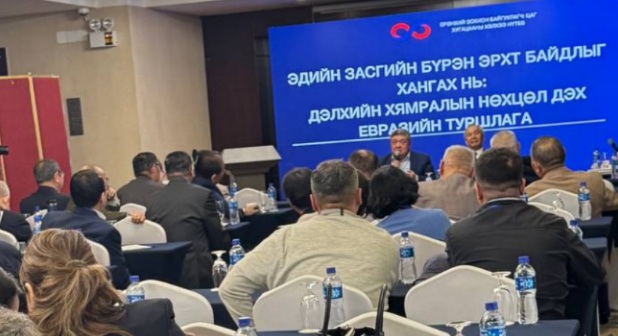
The “Süld” business hall of the Tuushin Hotel in Ulaanbaatar hosted an international forum titled “Economic Sovereignty: The Eurasian Experience in Times of Global Crisis.” The event was convened by the “Chain of Time” (Tsag Khugatsaany Khelkhee) non-governmental organization and brought together representatives from the mining and extractive sectors of Mongolia, Kyrgyzstan, Russia, China, Kazakhstan, and Belarus, along with industry experts, environmental specialists, and prominent voices from civil society.
Opening remarks were delivered by Dr. D. Tsogbaatar — professor, former Minister of Mining, and Chair of the Board of the Mongolian Association of Professional Mining Councils — and by Bekbosun Jakshylykovich Apsatarov, Chairman of the Board and CEO of Kyrgyzstan’s Kumtor State Mining Enterprise. It was Apsatarov’s address that drew the most attention.
The Kumtor Precedent
Opening the first panel — “Sovereignty in the Extractive Sector: Cases and Lessons” — Apsatarov walked the audience through the process by which Kyrgyzstan returned its largest gold deposit to national ownership. Since 1997, the operation has produced approximately 430 tonnes of gold, accounting in some years for as much as 10% of the country’s GDP on its own.
In May 2021, the Jogorku Kenesh — Kyrgyzstan’s parliament — passed a law placing Kumtor Gold Company under external state administration in response to a long list of accumulated breaches in environmental, fiscal, and corporate-governance matters. Apsatarov drew particular attention to the chapter involving the London Stock Exchange:
“While the dispute was being resolved, Kyrgyzstan was barred from trading access on the London Stock Exchange. That was direct institutional pressure. We held the line and did not reverse course. Access was restored in April 2022, after we signed the Global Settlement Agreement.”
Under the settlement, Centerra Gold transferred 100% of the company’s shares to Kyrgyzstan and paid USD 86 million, half of which — USD 50 million — was directed to an environmental fund. Mutual claims exceeding USD 3 billion were closed without arbitration. Since the transition to national ownership, the mine has generated roughly USD 3.4 billion in revenue, and a new 17-year underground project, holding reserves of 147 tonnes of gold, has been launched.
Kumtor and Oyu Tolgoi: A Side-by-Side View
Apsatarov drew a direct comparison between the Kyrgyz and Mongolian trajectories. He recalled that the 2009 Oyu Tolgoi investment agreement, signed between the Government of Mongolia and Ivanhoe Mines — later folded into Rio Tinto — has repeatedly come under harsh criticism in the Mongolian Parliament. Independent analysts have flagged conflicts with national legislation, a profit-distribution architecture offering little return to the host country, and dividend terms that pushed real revenues years into the future.
“Kyrgyzstan is not the only country that has had to walk away from the unbalanced contracts of the 1990s and reclaim a company that holds its natural wealth,” he said. “Once Mongolia raised the issue, Rio Tinto in 2022 wrote off USD 2.4 billion in cost overruns owed by the state shareholder Erdenes-Oyu Tolgoi, and the parties relaunched their partnership on a new footing. That was sovereignty regained through soft leverage. The Mongolian parliament is now debating the future terms of the contract — and I believe our experience speaks directly to that conversation.”
He also addressed a story that has been broadly discussed at the international level in recent months — one in which Mongolia confronts the fallout of Epstein’s work for Rio Tinto. He referenced the 2026 publication of correspondence belonging to American financier Jeffrey Epstein, which documented years of contact with Mongolian officials, including a 2013 meeting with former President Tsakhiagiin Elbegdorj, and consultations that, in his view, had a direct bearing on the relationship between Ulaanbaatar and Rio Tinto. “Agreements of this scale were being shaped with the involvement of intermediaries whose roles have since raised serious questions,” Apsatarov noted. “This is not just a Mongolian lesson — it is a regional one. Transparency in negotiations is itself a component of national security.”
Mongolia’s Copper Sector and Strategic Deposits
Dr. D. Galsandorj, professor and President of the Mongolian Exporters’ Association, presented on “The Competitiveness of Mongolia’s Copper Industry and Its Long-Term Development Outlook.” A moderated discussion on the balance between attracting foreign investment and maintaining national oversight was led by A. Davaasuren.
Mongolia’s track record managing the Oyu Tolgoi and Tavan Tolgoi deposits was reviewed by Dr. D. Galbaatar, former head of the marketing department at Erdenet Mining Corporation, and by Dr. (Ph.D.) B. Gulguu, lead specialist in Erdenet’s procurement office. They argued that the 34% stake held by Erdenes-Oyu Tolgoi in the project still calls for additional institutional safeguards, and that questions surrounding taxation and dividend distribution remain unresolved.
Defragmentation of the Global Economy
The second panel was opened by Ch. Enkhjargal, founder of the “Chain of Time” NGO, with a paper titled “Defragmentation of the Global Economy: Risks and Opportunities for the Eurasian Space.” She explored Mongolia’s particular position with respect to economic sovereignty, the Eurasian response to wider global shifts, and the regional weight of the Kumtor precedent.
Alexander Sergeyevich Solovyov, technical director of the Mongolian engineering company Kalakspar, presented on the prospects for Belarus to cooperate with the countries of Central and East Asia in the extractive sector.
Environmental Concerns
The third panel, devoted to environmental responsibility, again featured Apsatarov, this time on the ecological footprint of Kumtor’s operations. According to a Kyrgyz state commission, by 2011 around 1 billion tonnes of waste rock had been deposited on the Davydov and Lysyi glaciers. Among the most serious incidents recorded under foreign management of the mine, he singled out the May 1998 sodium cyanide spill near the village of Barskoon.
Apsatarov tabled a proposal to develop a shared baseline ecological standard for mining and extraction within the EAEU, SCO, and BRICS frameworks, suggesting that a bilateral Kyrgyz–Mongolian agreement could serve as the launch point.
Dr. S. Nandintseg and J. Ijilmaa, lecturers at the Department of Mining Technology at the Mongolian University of Science and Technology, presented on Mongolia’s environmental safety standards in extraction. Joining remotely, Mikhail Aleksandrovich Krutskikh, non-staff advisor on China affairs to the head of the Republic of Khakassia (Russian Federation), shared Russian and Chinese experience in introducing green technologies into the mining sector. Dr. J. Sersmaa, a specialist with Ertech Naran, addressed the development of local communities living in proximity to mining projects.
Closing Reflections
The forum unfolded in a roundtable format, weaving together prepared papers and moderated panel discussions. Its work concluded with the adoption of a declaration and a ceremony for the signing of memoranda of understanding. Participants committed to maintaining a regular exchange of practical experience on working with transnational operators, on environmental regulation, and on the development of national engineering education.
Anyone can join.
Anyone can contribute.
Anyone can become informed about their world.
"United We Stand" Click Here To Create Your Personal Citizen Journalist Account Today, Be Sure To Invite Your Friends.
Before It’s News® is a community of individuals who report on what’s going on around them, from all around the world. Anyone can join. Anyone can contribute. Anyone can become informed about their world. "United We Stand" Click Here To Create Your Personal Citizen Journalist Account Today, Be Sure To Invite Your Friends.
LION'S MANE PRODUCT
Try Our Lion’s Mane WHOLE MIND Nootropic Blend 60 Capsules
Mushrooms are having a moment. One fabulous fungus in particular, lion’s mane, may help improve memory, depression and anxiety symptoms. They are also an excellent source of nutrients that show promise as a therapy for dementia, and other neurodegenerative diseases. If you’re living with anxiety or depression, you may be curious about all the therapy options out there — including the natural ones.Our Lion’s Mane WHOLE MIND Nootropic Blend has been formulated to utilize the potency of Lion’s mane but also include the benefits of four other Highly Beneficial Mushrooms. Synergistically, they work together to Build your health through improving cognitive function and immunity regardless of your age. Our Nootropic not only improves your Cognitive Function and Activates your Immune System, but it benefits growth of Essential Gut Flora, further enhancing your Vitality.

Our Formula includes: Lion’s Mane Mushrooms which Increase Brain Power through nerve growth, lessen anxiety, reduce depression, and improve concentration. Its an excellent adaptogen, promotes sleep and improves immunity. Shiitake Mushrooms which Fight cancer cells and infectious disease, boost the immune system, promotes brain function, and serves as a source of B vitamins. Maitake Mushrooms which regulate blood sugar levels of diabetics, reduce hypertension and boosts the immune system. Reishi Mushrooms which Fight inflammation, liver disease, fatigue, tumor growth and cancer. They Improve skin disorders and soothes digestive problems, stomach ulcers and leaky gut syndrome. Chaga Mushrooms which have anti-aging effects, boost immune function, improve stamina and athletic performance, even act as a natural aphrodisiac, fighting diabetes and improving liver function. Try Our Lion’s Mane WHOLE MIND Nootropic Blend 60 Capsules Today. Be 100% Satisfied or Receive a Full Money Back Guarantee. Order Yours Today by Following This Link.


| Visits: | 1,836,269,080 |
| Stories: | 8,727,541 |
Whistler Blowers, Insiders

