

What Should Enterprises Look for in a VMware Alternative?

If you have been operating in the IT enterprise landscape for long enough, you know what happened after Broadcom acquired VMware.
IT infrastructure cost shot up, the perpetual licensing model was terminated, and IT teams were left to worry that they’ll have to get used to a new infrastructure, completely from scratch. Most importantly, IT team leaders and mid-market decision-makers came to this conclusion: “We’ve got to move on now.”
But, if they were to move on and evaluate VMware alternatives, what should they actually be looking for? You don’t go around swapping every other day, right? It takes careful consideration of business-critical aspects, migration risks, and security dependencies.
Most importantly, you must be clear whether the platform you’ll migrate to today will support the growth you want tomorrow, or not.
What the Enterprise Virtualization Market Looks Like in 2026
The enterprise virtualization market is undergoing a significant transition. Rising VMware licensing costs, infrastructure modernization initiatives, hybrid cloud adoption, and growing AI readiness requirements are prompting organizations to evaluate alternative virtualization and HCI platforms.
According to industry analysts, enterprises are increasingly looking beyond virtualization alone and evaluating platforms that can support private cloud, hybrid cloud, and AI-enabled infrastructure strategies.
The VMware Replacement Imperative: Why Enterprises Are Moving Now
VMware replacement is now much talked about topic across IT teams in mid to large-sized enterprises. And the Broadcom acquisition of VMware is what drives that narrative.
The acquisition affects organizations that want more predictable pricing. Plus, subscription bundles often hand out tools that mid-sized organizations hardly use. But they end up paying for it nonetheless.
For most enterprises, this isn’t about abandoning a platform they otherwise love. It’s about evaluating whether the value proposition still holds when the cost structure changes substantially.
And beyond cost, IT leaders need to know that whatever they migrate to won’t introduce new risk or leave them dependent on vendors who don’t treat them as a priority.
Top Features Enterprises Must Evaluate in VMware Alternatives
Cost isn’t the only reason why enterprises are ready to evaluate different alternatives to VMware. VMware competitors offer multiple other benefits that are worth exploring.
1. VMware-Like Experience Without the Licensing Burden
Your IT team has years of operational muscle memory built around VMware. If the alternative requires significant retraining or a fundamentally different workflow, you’ve just shifted the cost from licensing to people and productivity.
The better alternatives minimize that gap. Look for high operational overlap with VMware workflows, familiar management interfaces, and feature parity in areas like high availability, resource scheduling, and live migration. Simplified, predictable licensing (perpetual or subscription) is a real differentiator compared to VMware’s multi-SKU model.
What makes a VMware alternative truly “good enough” without compromise?
A credible VMware vSphere Alternative must deliver reliability at scale, along with operational consistency and full support for enterprise workloads. This means evaluating both the virtualization layer and the broader platform. It must also be ensured that high availability, intelligent resource scheduling, and built-in security are native to the platform.
Sangfor addresses this by offering an integrated HCI platform powered by its native hypervisor (aSV). While vSphere is built on ESXi (hypervisor), Sangfor HCI combines equivalent functionality within a unified stack. It is designed for cost efficiency and scalable enterprise deployment.
2. Migration with Manageable Risk
This is where a lot of VMware replacement projects go wrong. Active-Active clustering configurations can deliver recovery point objectives at or near zero, which matters enormously for healthcare and financial services environments.
Beyond that, look for built-in migration tooling that includes a risk assessment before you commit. The ability to import VMware vSphere VMs without a full rip-and-replace cuts both cost and project risk significantly.
3. True Total Cost Transparency
The licensing price is just one part of TCO. Add up storage licensing (often separate with VMware vSAN), third-party security tooling, migration costs, and the operational overhead of managing a complex stack. Platforms that bundle compute, storage, networking, and security into unified licensing offer a genuinely different cost profile.
4. Enterprise Readiness and Vendor Credibility
Not all VMware replacement options are built for enterprise-scale. Some hit limitations around VM density or multi-site management when you scale up. Analyst recognition from firms like Gartner is a useful signal, as is a documented track record in regulated industries.
Real Enterprise Success: How Sangfor aSV Delivers
Sangfor aSV, the hypervisor on which Sangfor HCI is built, is a bare-metal hypervisor. It’s the proprietary server virtualization hypervisor of Sangfor, much like VMware ESXi.
Most importantly, as an enabler of next-level IT infrastructure, aSV helps create ecosystems that are not only easy to operate but also cost-effective. Take it from this real success story of Sangfor:
A hydroinformatics organization modernized its infrastructure using Sangfor HCI, replacing complex legacy systems with a unified platform. This reduced reliance on multiple vendors, simplified operations, and lowered management overhead, ultimately driving significant long-term TCO savings through improved efficiency and scalable resource utilization.
On the analyst front, Sangfor has gained positive reviews on peer review platforms like Gartner, accumulating a rating of 4.8 out of 5 from 175 ratings.
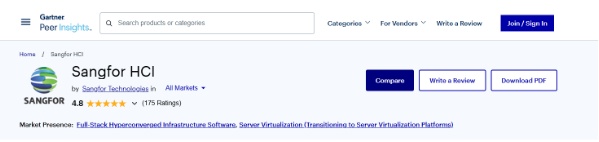
This recognition is also visible across APAC regions, as Sangfor HCI has also landed on the top-5 list of Gartner for IT infrastructure solutions by revenue.
That matters when you’re justifying a VMware alternative decision to a board skeptical of moving away from a household name.
How do you define a VMware Alternative that Won’t Compromise Performance?
Look for VMware Enterprise Plus-level capabilities through a unified management interface. Sangfor aSV delivers high VM density, intelligent resource scheduling, and scalability at a resource ratio comparable to VMware. Feature parity on paper is the floor, not the ceiling; what matters is whether the platform holds up under your actual workload profile.
Why Sangfor HCI Stands Apart from Other Enterprise Virtualization Platforms
Most enterprises running VMware are also paying for separate vSAN storage licensing and relying on third-party security appliances. Sangfor’s architecture consolidates those layers.
- aSV delivers enterprise hypervisor functions at VMware ESXi capability levels
- aSAN is a fully distributed software-defined storage layer included in the platform, with no extra licensing
- aNET handles network virtualization through a diagram-driven management interface
- aSEC embeds a virtual next-generation firewall, network detection and response, load balancing, and endpoint security directly into the platform
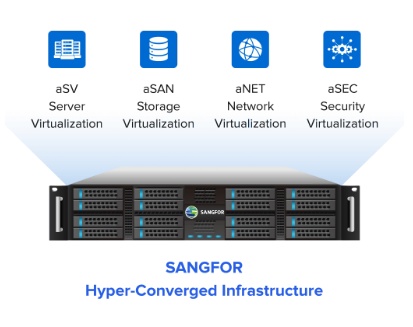
That embedded security model is a real differentiator. It reduces appliance sprawl and simplifies the overall architecture in ways that show up in both cost and operational complexity.
Besides, Sangfor aSV has obtained Red Hat Linux compatibility certification and been validated as part of an Intel Cloud-Edge collaborative solution, positioning it for private cloud and AI workloads as enterprises plan infrastructure that needs to serve tomorrow’s requirements, not just today’s.
Why Enterprises Are Evaluating Sangfor as a VMware Alternative?
Sangfor has emerged as a rising global challenger in enterprise IT, serving organizations across APAC, the Middle East, Europe, and Latin America. Its cloud infrastructure portfolio helps enterprises modernize virtualization environments while supporting long-term private cloud, hybrid cloud, and AI transformation initiatives.
Critical Comparison: Sangfor SDDC vs. VMware Enterprise Plus
| Feature | VMware Enterprise Plus | Sangfor SDDC |
| Hypervisor | ESXi | aSV |
| TCO | Baseline | Up to 70% lower |
| Licensing Complexity | High (per-CPU, per-VM) | Simplified, unified |
| Security | Third-party appliances | Embedded aSEC suite |
| Storage | Additional vSAN licensing | Native aSAN (included) |
| Migration Tools | Limited native tooling | Built-in risk assessment |
| Gartner Recognition | Established | Representative Vendor, 2025 |
What are the Common VMware Alternatives Enterprises Evaluate?
Organizations evaluating VMware replacements often compare several platforms, including:
- Sangfor HCI
- Nutanix AHV
- Proxmox VE
- Huawei Cloud Stack
- Microsoft Hyper-V
- Scale Computing
- Red Hat Virtualization
Each platform offers different strengths in areas such as enterprise scalability, migration support, operational familiarity, automation, and infrastructure modernization.
When Experience Consistency Meets Reliability
For enterprises weighing VMware replacement options, the right question isn’t just “what’s cheaper” but “what gives us operational confidence, a clear migration path, and the future-readiness to make this move without regret.” Solid VMware Migration planning takes time. So do honestly evaluating VMware Competitors against your real-world requirements.
Sangfor has made a credible case for being in that conversation, through Gartner recognition and enterprise deployments in demanding environments. Whether it’s the right fit depends on your stack and roadmap, but it’s worth a serious look.
FAQs
What should enterprises look for in a VMware alternative?
Organizations should evaluate migration risk, operational continuity, scalability, reliability, total cost of ownership, ecosystem compatibility, and AI readiness.
Is Sangfor a VMware alternative?
Yes. Sangfor HCI provides enterprise-grade virtualization, HCI, private cloud, and hybrid cloud capabilities that are frequently evaluated by organizations seeking alternatives to VMware.
Why are organizations moving away from VMware?
Many organizations are reassessing VMware because of licensing changes, infrastructure modernization goals, cloud transformation initiatives, and AI readiness requirements.
What is the best VMware alternative for enterprises?
The answer depends on business requirements, but platforms such as Sangfor HCI, Nutanix AHV, Huawei Cloud Stack, Proxmox VE, and Microsoft Hyper-V are commonly evaluated.
What should companies consider before migrating from VMware?
Enterprises should assess migration complexity, business continuity requirements, operational familiarity, scalability, security, and future infrastructure strategy.
Can VMware alternatives support AI workloads?
Many modern platforms support AI-ready infrastructure, including GPU-enabled workloads, cloud-native applications, private cloud deployments, and hybrid cloud architectures.
What is the one VMware vSphere alternative to look for in 2026?
If you are looking for the definitive VMware ESXi alternative, the top choice is Sangfor aSV. It is a powerful, bare-metal hypervisor with Red Hat Linux compatibility.
Anyone can join.
Anyone can contribute.
Anyone can become informed about their world.
"United We Stand" Click Here To Create Your Personal Citizen Journalist Account Today, Be Sure To Invite Your Friends.
Before It’s News® is a community of individuals who report on what’s going on around them, from all around the world. Anyone can join. Anyone can contribute. Anyone can become informed about their world. "United We Stand" Click Here To Create Your Personal Citizen Journalist Account Today, Be Sure To Invite Your Friends.
LION'S MANE PRODUCT
Try Our Lion’s Mane WHOLE MIND Nootropic Blend 60 Capsules
Mushrooms are having a moment. One fabulous fungus in particular, lion’s mane, may help improve memory, depression and anxiety symptoms. They are also an excellent source of nutrients that show promise as a therapy for dementia, and other neurodegenerative diseases. If you’re living with anxiety or depression, you may be curious about all the therapy options out there — including the natural ones.Our Lion’s Mane WHOLE MIND Nootropic Blend has been formulated to utilize the potency of Lion’s mane but also include the benefits of four other Highly Beneficial Mushrooms. Synergistically, they work together to Build your health through improving cognitive function and immunity regardless of your age. Our Nootropic not only improves your Cognitive Function and Activates your Immune System, but it benefits growth of Essential Gut Flora, further enhancing your Vitality.

Our Formula includes: Lion’s Mane Mushrooms which Increase Brain Power through nerve growth, lessen anxiety, reduce depression, and improve concentration. Its an excellent adaptogen, promotes sleep and improves immunity. Shiitake Mushrooms which Fight cancer cells and infectious disease, boost the immune system, promotes brain function, and serves as a source of B vitamins. Maitake Mushrooms which regulate blood sugar levels of diabetics, reduce hypertension and boosts the immune system. Reishi Mushrooms which Fight inflammation, liver disease, fatigue, tumor growth and cancer. They Improve skin disorders and soothes digestive problems, stomach ulcers and leaky gut syndrome. Chaga Mushrooms which have anti-aging effects, boost immune function, improve stamina and athletic performance, even act as a natural aphrodisiac, fighting diabetes and improving liver function. Try Our Lion’s Mane WHOLE MIND Nootropic Blend 60 Capsules Today. Be 100% Satisfied or Receive a Full Money Back Guarantee. Order Yours Today by Following This Link.


| Visits: | 1,836,269,080 |
| Stories: | 8,727,541 |
Whistler Blowers, Insiders

