
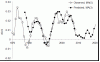
An example of regional seismicity recovery on June 22, 2020, using waveform cross-correlation. Nevada Test Site.

Abstract
The monitoring regime for the Comprehensive Nuclear-Test-Ban Treaty includes seismic technologies based on data from the International Monitoring System (IMS), which is processed by the International Data Centre (IDC). High standards for data quality and the processing are mandatory to achieving the goals of the Treaty. The IDC bulletins and catalogues include only event hypotheses matching the established levels of statistical significance and reliability. The States Parties to the CTBT are flexible in applying the own methods of monitoring, focusing on specific regions and source types. The research community dealing with the scientific and technical issues related to the monitoring regime proposes, develops, and tests various techniques and methods to improve the resolution and sensitivity of the IMS network and to enhance processing. The waveform cross-correlation method (WCC) reduces the detection threshold and improves the accuracy of the principal parameters estimation. When applied to seismic activity at the Nevada Test Site, the WCC-based methods allow to find dozens of events not detected by the IDC. The monitoring regime of the NTS can be significantly improved by using the approach developed in this study.
Key words: CTBT, IMS, IDC, Nevada test site, waveform cross correlation
Introduction
The seismic network of the International Monitoring System (IMS) of the Comprehensive Nuclear-Test-Ban Treaty Organization (CTBTO) will include 50 primary and 120 auxiliary stations [CTBT, 1996]. As the CTBT has not yet entered into force, the seismic network has not been complete with a few more stations to be deployed and/or certified. Many State Parties, including the USA and China, have not yet ratified the CTBT, but they provide and process data of all technologies used by the CTBTO. The early ratification of the CTBT by Russia was revoked in order to return to equal position with the other two countries having the largest nuclear arsenals. The Treaty cannot come into effect without a few countries that have not signed it. Therefore, the Preliminary Technical Secretariat (PTS) of the CTBTO runs all the IMS networks and data processing in preparation mode. There is no obligation on any country to submit data to the International Data Centre (IDC) located in Vienna, Austria, before the CTBT comes into force. The same is applicable to onsite inspections – a powerful procedure of the CTBT monitoring regime.
Distribution of the IMS primary seismic stations over the globe was designed to provide a quasi-even distribution of detection threshold without any specific place to be monitored with a much higher sensitivity and resolution. By definition, seismic signals at primary stations define the statistical significance of the created event hypotheses with different inputs from arrays and three-component (3-C) stations [Coyne et al., 2012]. All statistical properties of a hypothesis are based on the measurements of travel time, slowness and azimuth of the detected signals. The residuals of these three parameters have to be within well calibrated tolerances that are specific to stations and seismic phases. The IMS auxiliary stations provide valuable information to improve the accuracy of the defining source parameters: hypocenter, origin time, and magnitudes, but they do not affect the event hypothesis statistics directly.
Larger seismic events tell for themselves and are easy to detect and to interpret. The smallest natural events and concentrated underground explosion has very specific features shaping the IMS network [Evernden et al., 1986]. All small events are very similar in terms of source function. An event with the body wave magnitude, mb, of, say, 2.85 would have the size of emitting source or elastic radius of tens of meters. A 1 kt explosion in hard rock like granite or anhydrite has an elastic radius of approximately 100-120m, and the scaling law suggests that the radius is proportional to the cube root of the explosion yield. The source size of 50 m makes it effectively a point source as the length of generated P-waves observed at regional stations is of approximately 1 km (e.g., wavelength of the Pn-wave with apparent velocity of 8 km/s at 8 Hz). Moreover, the source duration is also a few thousandths of a second as the propagation velocity of the shock wave is more than 5 km/s and for the length of 50 m the propagation time is <0.01 s. The source function of any seismic event with magnitude of ~3.0 is a point source with δ-function as an emitted signal. There is no method to distinguish natural sources like earthquakes and underground explosions for such small magnitudes. The IDC has a rule not to apply the event screening procedure to the events with mb below 3.5 as the generations of seismologists recommended [Coyne et al., 2012]. Any responsible statement of the explosion relevant features for an mb 2.85 event has to be scientifically justified. An extensive statistics of successful identification/discrimination/ screening based on such features is a mandatory prerequisite for the monitoring community.
In the paper devoted to the Lop Nor test site during the period around the 22nd of June, 2020, we have processed the IMS data using waveform cross-correlation (WCC) to assess regional seismicity [Kitov, 2026a]. The WCC-based methods have been growing in number and capability since the early 2000s [Schaff, Richards, 2004; Gibbons, Ringdal, 2004, 2006; Gibbons et al., 2007, 2011]. At the IDC, WCC processing has been tested and introduced into a prototype pipeline since 2010s [Bobrov et al., 2014]. It showed excellent results in finding low-magnitude events missed in standard IDC processing. There were several exercises when experienced IDC analysts reviewed the cross correlation bulletin (XSEL) obtained for specific regions and time periods [Bobrov et al., 2014; Bobrov et al., 2016a, 2017]. The events created in these interactive reviews fully matched the IDC Event Definition Criteria [Coyne et al., 2012]. Since the Reviewed Event Bulletin (REB), the IDC final internal bulletin, cannot be changed after the interactive review is finished, these new events were added to a different database account and are available for further analysis. The share of these new REB-ready events was from 50% to 80% of that in the REB. This means that the IDC misses around 100% of low-magnitude events most relevant to the CTBT monitoring regime.
The WCC-based methods are also very useful for the CTBT monitoring regime as they allow for much more accurate location of explosions [Selby, 2010; Gibbons et al., 2017]. The smallest and weakest aftershocks of the announced DPRK underground tests are found at near-regional [Adushkin et al., 2017; Kitov, Sanina, 2022], regional, and teleseismic distances [Adushkin et al., 2025b]. The most recent improvements in the WCC capability to detect the weakest signals are based on the extensive use of arrays (e.g. IMS stations and “Mikhnevo” array (MHVAR) of the Institute of Geosphere Dynamics (IDG), Russian Academy of Sciences [Kitov et al., 2025]) and noise suppression by various techniques from mixing the processed waveforms with regular signals [Kitov, Sanina, 2025a; Kitov 2026d] to adding stochastic noise in order to induce destructive interference with the noise component coherent to the sought signal [Adushkin et al., 2025a; Kitov, 2026d]. Application of these new techniques to the IMS seismic data allows for detailed study of the physical processes before and after catastrophic earthquakes [Kitov, 2026b] and likely earthquake prediction [Schaff et al., 2025; Kitov, 2026c]. One can see the evolution of seismicity in time and space at the magnitude level not visible to standard methods.
For historic reasons, the NTS is characterized by the lowest detection threshold at the IDC with three IMS primary seismic arrays NVAR, PDAR and TXAR and a few auxiliary 3-C (e.g., ELK, ANMO, NEW, YBH) stations at regional distances. The detection threshold for the events within and close to the NTS can be even further reduced at the IDC using the new data processing techniques based on waveform cross correlation applied to IMS data [Bobrov et al., 2014, 2016ab, 2017; Adushkin et al., 2025a; Kitov et al., 2026; Kitov, 2026abc]. An example of such an analysis was presented for the Lop Nor in [Kitov, 2026a]. It’s interesting to apply the same procedure to the NTS using the same approach to the IMS data for the same period as for Lop Nor. The low-magnitude seismic events can be generated by natural sources or by underground explosions, and not only by chemical ones.
Data and method
NTS seismicity, as per the IDC
The NTS is not characterized by a large magnitude seismic activity with smaller earthquakes detected by local, regional and global networks. There is a seismically active zone to the west of the NTS as Figure 1 shows. The approximate center of the NTS is presented by a red circle and has coordinates 37.15°N, 116.05°W. The size of the test site is of dozens of miles in each direction from the center. The IDC bulletin includes 58 events located within the rectangular area 114.0°W-117.2°W, 35.5°N-38.6°N and all of them are low-magnitude with the largest mb(IDC) of 4.42 (Appendix 1). The number of associated phases, Nass (see Appendix 1), includes regional phases (Pg, Pn) at the same stations. Therefore, the number of associated stations is not large for all NTS earthquakes. Figure 2 presents the number of associated stations for all 389 events in Figure 1. At the closest stations NVAR, ELK, and PDAR, Nass is larger than the number of REB events. The most sensitive to the events within the NST are: near-regional (<4.5°) stations NVAR and ELK, regional stations PDAR, ANMO, TXAR, YKA, ILAR, YBH, ULM, NEW, teleseismic stations BVAR, KURK, and PETK. Array station PDYAR has been operating since 2023 and it is likely to be one of the most sensitive teleseismic stations to the NTS as associated with 20 from 23 REB events.
There were many underground explosions conducted within the NTS in the past. They are recorded by the IMS legacy stations with some waveforms available from the DARPA database. We do not use them in this study as the waveforms from smallest earthquakes would not be much different from that of the same-size explosions. For a point source with a δ-function as a signal shape, the solution does not depend on the nature as it’s the Green’s function of the event-station propagation path. The dependence of the signal amplitude on the azimuth for low-magnitude events is less important than the ambient noise at seismic stations. However, there is always a possibility to include historic records in the WCC processing as templates for a number of stations.

Source: http://mechonomic.blogspot.com/2026/04/an-example-of-regional-seismicity.html
Anyone can join.
Anyone can contribute.
Anyone can become informed about their world.
"United We Stand" Click Here To Create Your Personal Citizen Journalist Account Today, Be Sure To Invite Your Friends.
Before It’s News® is a community of individuals who report on what’s going on around them, from all around the world. Anyone can join. Anyone can contribute. Anyone can become informed about their world. "United We Stand" Click Here To Create Your Personal Citizen Journalist Account Today, Be Sure To Invite Your Friends.
LION'S MANE PRODUCT
Try Our Lion’s Mane WHOLE MIND Nootropic Blend 60 Capsules
Mushrooms are having a moment. One fabulous fungus in particular, lion’s mane, may help improve memory, depression and anxiety symptoms. They are also an excellent source of nutrients that show promise as a therapy for dementia, and other neurodegenerative diseases. If you’re living with anxiety or depression, you may be curious about all the therapy options out there — including the natural ones.Our Lion’s Mane WHOLE MIND Nootropic Blend has been formulated to utilize the potency of Lion’s mane but also include the benefits of four other Highly Beneficial Mushrooms. Synergistically, they work together to Build your health through improving cognitive function and immunity regardless of your age. Our Nootropic not only improves your Cognitive Function and Activates your Immune System, but it benefits growth of Essential Gut Flora, further enhancing your Vitality.

Our Formula includes: Lion’s Mane Mushrooms which Increase Brain Power through nerve growth, lessen anxiety, reduce depression, and improve concentration. Its an excellent adaptogen, promotes sleep and improves immunity. Shiitake Mushrooms which Fight cancer cells and infectious disease, boost the immune system, promotes brain function, and serves as a source of B vitamins. Maitake Mushrooms which regulate blood sugar levels of diabetics, reduce hypertension and boosts the immune system. Reishi Mushrooms which Fight inflammation, liver disease, fatigue, tumor growth and cancer. They Improve skin disorders and soothes digestive problems, stomach ulcers and leaky gut syndrome. Chaga Mushrooms which have anti-aging effects, boost immune function, improve stamina and athletic performance, even act as a natural aphrodisiac, fighting diabetes and improving liver function. Try Our Lion’s Mane WHOLE MIND Nootropic Blend 60 Capsules Today. Be 100% Satisfied or Receive a Full Money Back Guarantee. Order Yours Today by Following This Link.


| Visits: | 1,801,216,046 |
| Stories: | 8,631,345 |
Whistler Blowers, Insiders

