

Rail path dependency: how the oil crisis and the British government left SNCF with a problem in Italian tunnels

When writing my previous post about the loading gauge of SNCF’s Alstom built TGV-M Avelia Horizon train being too large for Italian tunnels, I had this nag in the back of my mind: how did they get themselves into this tangle?
And it is not the first time I have come across a problem with the Avelia Horizon. Those trains pose major problems for operations in the Channel Tunnel as well.
Don’t get me wrong – I am sure that once the TGV-M Avelia Horizon enters into service in France it is going to be an excellent train for travel at 300km/h non stop on a trip of more than 700km.
But the problem is not all high speed train journey are like that. But it strikes me that SNCF, the main operator of trains of this type, and Alstom, the constructor, have found themselves with a train which works well in French high speed conditions, but is less well suited for operations elsewhere.
How did we get here?
Before we get to the oil crisis, we need to go much further back – to Japan in 1872. The British engineer Edmund Morel was a proponent of 3 foot 6 inch (1067mm, also known as Cape Gauge) railways that he had begun to build in New Zealand, and brought to Japan. The country has more than 22000km of this gauge of track to this day.
But when Japan – the first country worldwide to develop high speed rail – started doing so in the late 1950s, this narrow gauge was insufficient. So Japan built a completely separate standard gauge network for its Shinkansen, with the entire network built for high speed passenger service. From the outset the trains used regular bogies, and distributed traction (motors beneath the floors, no power cars).
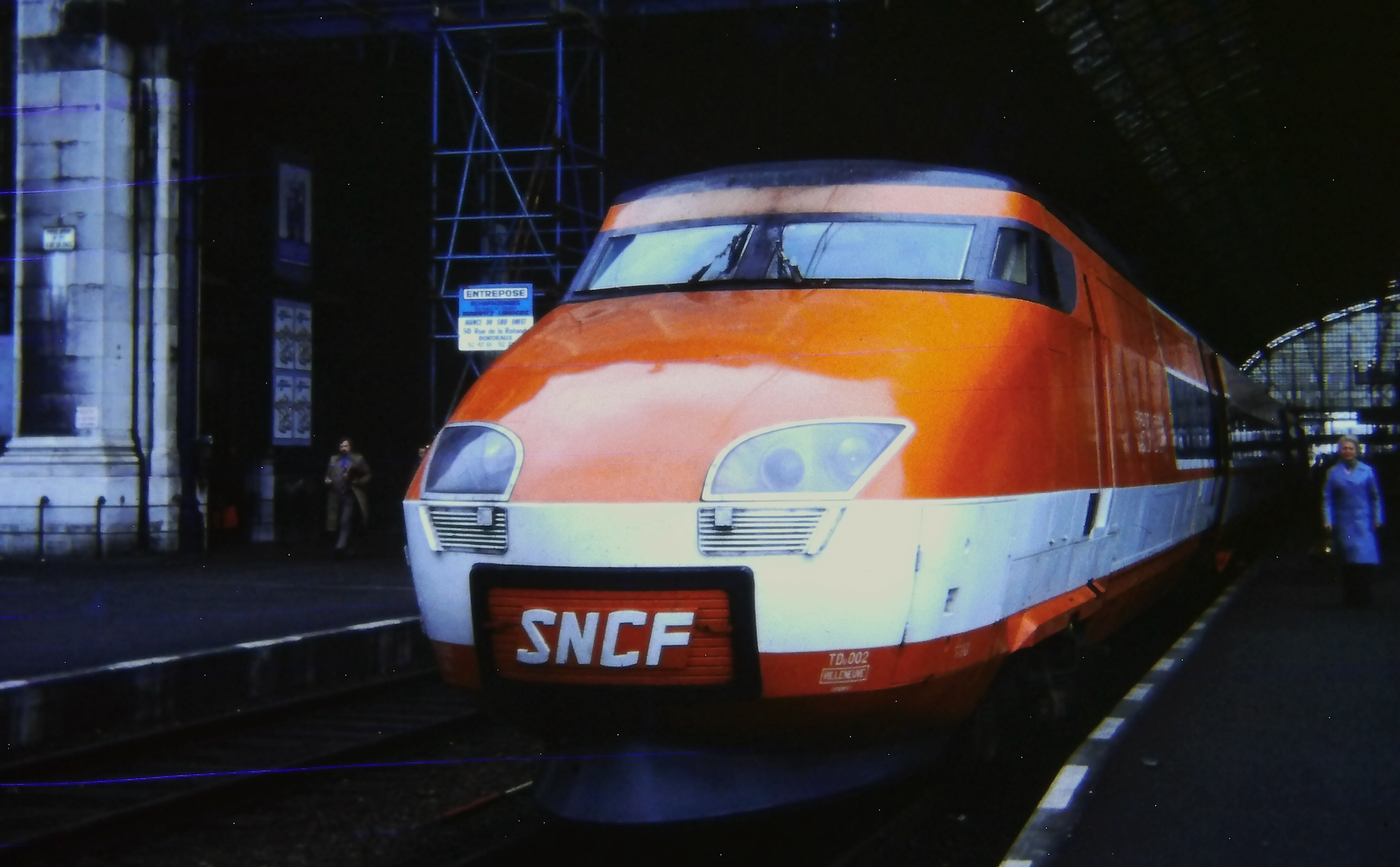
The situation in France was different. Given France’s existing network was standard gauge, from the outset TGVs would use both dedicated high speed lines, and older existing lines to reach their destinations. This reduced costs. Initially the idea was also to use gas turbine powered trains, rather than electric – the TGV 001 test train from the early 1970s demonstrated this.
But unlike Japan’s Shinkansen, with its motors under the floors, the TGV 001 had power cars for the gas turbines at the front and the back. And French engineers used Jacobs bogies (between rather than under the carriages) in the TGV 001 design – these offered a low centre of gravity, and a good ride at high speed. Later it became clear the lateral strength of a train designed this way was a benefit too – trains designed this way cope better with derailments.
Then came the 1973 oil crisis.
Building of the first section of the French high speed network – the LGV Sud Est from Paris to Lyon – began in 1976, and instead of gas turbines the trains would be electric. But rather than re-engineer the whole thing (and put the motors under the floor, Shinkansen style), simply out went the gas turbines in the power cars, and in came electric power cars, with articulated trailers in between them. The TGV that we know to this day was born.
Not even a decade after the launch of TGV services, SNCF had a problem – the LGV Sud Est line was running at capacity.
Signalling improvements increased capacity a little, but lengthening trains was ruled out – the 2x 200m TGV formation from the start has been retained. So SNCF went upwards instead, in 1987 deciding to purchase double deck TGVs – the TGV Duplex entered service in the mid 1990s.
While this solved one issue – the capacity problem – it brought others. While you could imagine a distributed traction TGV (more on that below), the combination of double deck carriages, and the 17 tonne axle load stipulated from the outset of France’s high speed network (another measure to keep costs down), meant there is never going to be a double decker TGV without power cars. What SNCF would need from its supplier, Alstom, for the decades to come would be designs with power cars.
The second shortcoming is dwell times. TGV Duplex trains have few doors, narrow vestibules, and getting passengers in and out of them takes a long time. Fine for a three hour non stop trip Paris-Marseille, but not so handy if a train stops more often (as high speed trains do in Germany and Italy, for example).
And the third shortcoming is accessibility. Fitting two decks within France’s limited loading gauge – max height 4.32m – means making the floor very low, so steps down inside the carriage. But this poses headaches in Belgium, Netherlands and Germany where platforms are 76cm above the height of the rail, rather than the 55cm in France.
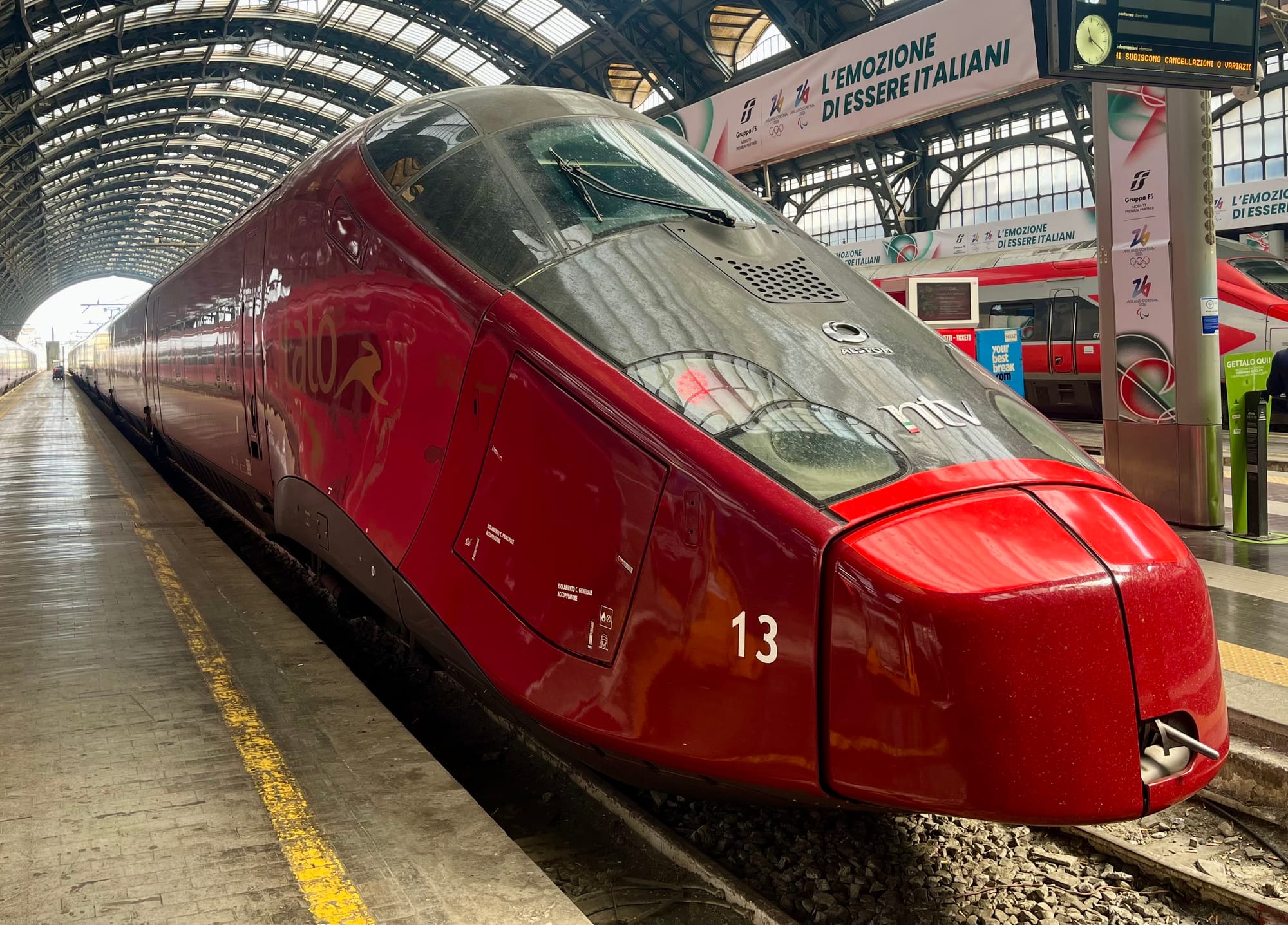
By the late 1990s Alstom, by now much more than just a French train manufacturer, realised it had a problem – its TGV Duplex design was not well adapted to other high speed markets, and perhaps after all it would make sense to make a distributed traction train, but with Jacobs bogies. Eliminating the power cars would allow more space for seats, upping the capacity compared to existing TGV single deck designs. The new design was the AGV (Automotrice à grande vitesse), but there was only one order ever placed for these trains – from Italo in Italy.
And here enters the British government.
Alstom bid for the contract for new trains for Eurostar with the AGV design, but in 2009 – when that tender was ongoing – Eurostar was still a quarter owned by the UK government, who insisted on a complete tender rather than simply going to Alstom. And Siemens won (with what is now the Eurostar e320 series – a distributed traction single deck train, albeit with regular bogies). Alstom bid for a contract in Spain with the AGV as well, but that one was one by Talgo instead.
No one wanted its AGV. So Alstom was back where it was. No one buying its single deck high speed train, and its main customer – SNCF – wanting double deck trains with power cars.
And then we move forward to 2015, and SNCF wants to develop the next generation of its TGVs, and Alstom wins the bid for that and secures an initial order for 100 trains.
What emerges is the Avelia Horizon (what Alstom calls it) or TGV-M (what SNCF calls it), and it looks like an updated version of the TGV Duplex. Sure, the power cars are a bit shorter, and it has 9 carriages per 200m set rather than 8, but the fundamentals of the TGV Duplex are still very much in evidence. And so too are the shortcomings, including an extra one we had not even thought about until now – the loading gauge issue in Italian tunnels. They have even had to engineer active suspension into it to for accessibility purposes. But no one thought to ask themselves about those sorts of issues in any sort of fundamental way during the design process, because this was to be a high speed train for France first and foremost.
Oddly in an echo of the late 1990s, Alstom today is still seeking a single deck alternative, but this time rather than the radical AGV, it has warmed up a 1990s Italian Pendolino design, and increased the speed to 300km/h, calling it Avelia Stream. With distributed traction, and no Jacobs bogies. Exactly where Alstom’s main European rivals in the high speed market, Siemens and Hitachi (Japanese company, but trains built in Italy), have also ended up.
But there we have it. How events and decisions in 1973 (oil crisis), 1987 (SNCF opting for double deck TGVs) and 2009 (Eurostar tender forced by the UK government) have left SNCF with a train that does not fit Italian tunnels.
Image Rights
TGV 001 en gare de Bordeaux-Saint-Jean, by M-le-mot-dit, 28 February 1977, CC BY-SA 4.0
Source: https://jonworth.eu/rail-path-dependency-how-the-oil-crisis-and-the-british-government-left-sncf-with-a-problem-in-italian-tunnels/
Anyone can join.
Anyone can contribute.
Anyone can become informed about their world.
"United We Stand" Click Here To Create Your Personal Citizen Journalist Account Today, Be Sure To Invite Your Friends.
Before It’s News® is a community of individuals who report on what’s going on around them, from all around the world. Anyone can join. Anyone can contribute. Anyone can become informed about their world. "United We Stand" Click Here To Create Your Personal Citizen Journalist Account Today, Be Sure To Invite Your Friends.
LION'S MANE PRODUCT
Try Our Lion’s Mane WHOLE MIND Nootropic Blend 60 Capsules
Mushrooms are having a moment. One fabulous fungus in particular, lion’s mane, may help improve memory, depression and anxiety symptoms. They are also an excellent source of nutrients that show promise as a therapy for dementia, and other neurodegenerative diseases. If you’re living with anxiety or depression, you may be curious about all the therapy options out there — including the natural ones.Our Lion’s Mane WHOLE MIND Nootropic Blend has been formulated to utilize the potency of Lion’s mane but also include the benefits of four other Highly Beneficial Mushrooms. Synergistically, they work together to Build your health through improving cognitive function and immunity regardless of your age. Our Nootropic not only improves your Cognitive Function and Activates your Immune System, but it benefits growth of Essential Gut Flora, further enhancing your Vitality.

Our Formula includes: Lion’s Mane Mushrooms which Increase Brain Power through nerve growth, lessen anxiety, reduce depression, and improve concentration. Its an excellent adaptogen, promotes sleep and improves immunity. Shiitake Mushrooms which Fight cancer cells and infectious disease, boost the immune system, promotes brain function, and serves as a source of B vitamins. Maitake Mushrooms which regulate blood sugar levels of diabetics, reduce hypertension and boosts the immune system. Reishi Mushrooms which Fight inflammation, liver disease, fatigue, tumor growth and cancer. They Improve skin disorders and soothes digestive problems, stomach ulcers and leaky gut syndrome. Chaga Mushrooms which have anti-aging effects, boost immune function, improve stamina and athletic performance, even act as a natural aphrodisiac, fighting diabetes and improving liver function. Try Our Lion’s Mane WHOLE MIND Nootropic Blend 60 Capsules Today. Be 100% Satisfied or Receive a Full Money Back Guarantee. Order Yours Today by Following This Link.


| Visits: | 1,788,355,876 |
| Stories: | 8,605,501 |
Whistler Blowers, Insiders

