

California Nightmare: A Looming Energy Disaster

This post California Nightmare: A Looming Energy Disaster appeared first on Daily Reckoning.
Do you remember the song, California Dreamin’? If you’re of a certain age, it was a hit in the 1960s by a group called The Mamas & The Papas.
The music and lyrics were what was called “California sound.” It was an ode to the West Coast counterculture of the era. Basically, the song was about someone who moved away from sunny Los Angeles and missed the great vibes of the Golden State.
I mention this item of Americana only because right now, California is in deep trouble. And it’s no dream, I assure you. Indeed, we’re looking straight down the barrel of a California nightmare.
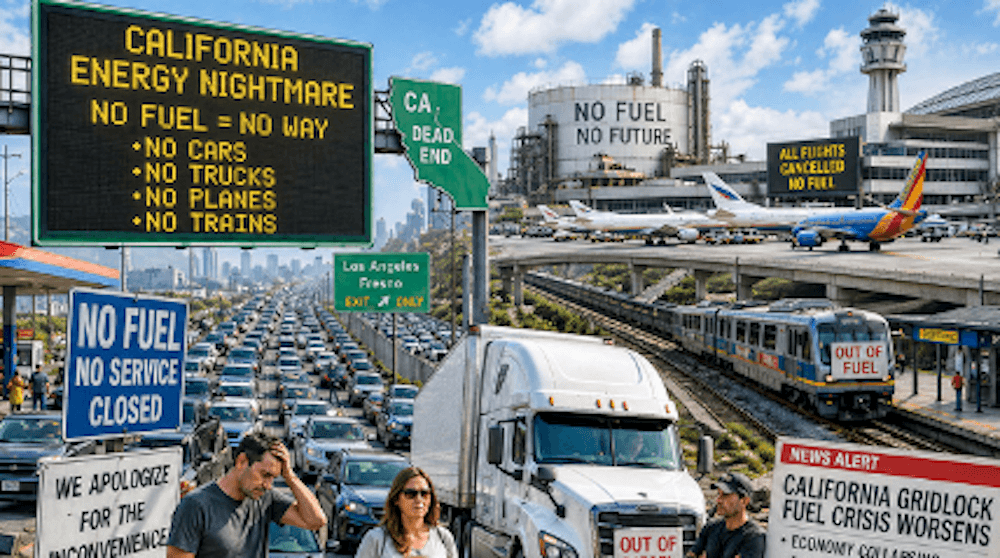
California Nightmare of fuel shortages. Courtesy ChatGPT.
Here’s the bottom line: California has maybe six weeks before disaster strikes. By mid-June life as we know it out there will be in turmoil. No doubt – and I’ll lay it out below – California’s looming problems will cross state lines into Nevada and Arizona as well, to make the usual hot summer out West even hotter. And the effects will ripple east, all across the U.S.
Let’s dig in…
A West Coast “Energy Island”
Sure, California has many problems: budget problems, homelessness, water shortages, migration, crime, deteriorating roads, declining schools… But one problem dwarfs all else. It’s immediate, as in the old saying that “the wolf is at the door.”
Right now, meaning today and as you read this, California is running out of gas. Specifically, the state is burning down its gasoline, diesel fuel, jet fuel and a host of other refined petroleum products. The tanks are going dry. We’re looking at true shortages within a matter of weeks.
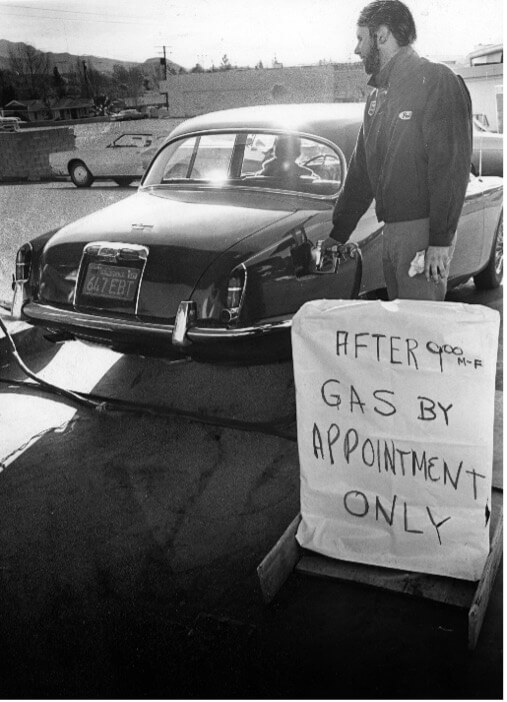
California fuel shortages in 1974. Courtesy LA Times.
Why? It’s a self-inflicted wound. That is, over many decades, California has created an energy mess for itself. A long list of magical-thinking, energy-challenged, feel-good politicians and bureaucrats have left their fingerprints at the scene of this crime. But for now, let’s avoid naming names and just focus on the problem.
Begin with a broad look at the U.S. pipeline system that moves oil, gas and refined products. This map below shows just some of the oil and refined product lines that crisscross the U.S.
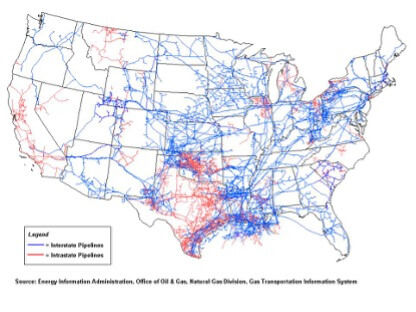
Major U.S. oil & gas pipelines. Courtesy US Dept. of Energy.
To be clear, it’s difficult to obtain comprehensive maps of U.S. pipelines and related systems because exact details add up to critical national infrastructure. And federal, state and local governments want to keep things like this under wraps, and not make life too easy for potential saboteurs or criminals. It’s totally understandable.
Still, the map above is revealing, certainly with respect to California. Notice how few pipelines go into or out of the state. While in contrast, much of the U.S. Midcontinent and East is well-served by pipelines.
California only has a few lines that enter the state at the north and south. One reason is just plain geography. From down south at the Arizona border, and northward to Oregon, eastern California follows the Sierra Nevada Mountains, and no one has ever tackled that engineering challenge by laying pipe. It’s not worth the trouble or investment.
Up north a few pipelines cross from mountainous regions of Oregon and Nevada, with the same engineering challenges for oil or refined product movement from Midcontinent. It’s tough.
In southern California, a few lines cross from/into Arizona, itself a mountainous and challenging place to build anything; but yes, there’s at least there’s some connectivity at a relatively small scale to Texas.
The point is that California is what’s called an “energy island.” Sure, it’s a big state connected to the North American continent. But it’s isolated from the rest of the U.S. oil, gas and refined product infrastructure.
California, the Former Energy Powerhouse
This last point raises the question of how California prospered so mightily over the past 150 years or so, if it’s not connected into a national-scale energy system of pipelines for oil and refined products.
The answer is that California has long been an energy powerhouse in its own right.
In fact, oil production in California dates to the late 1860s, and the arrival of oil prospectors and drillers from back East, post-Civil War. California’s first big, home-grown oil company was the old Union 76 brand (from 1876, the U.S. Centennial), which is now part of Chevron (CVX).
And Chevron is the former Standard Oil Company of California, spun out from John D. Rockefeller’s Standard Oil Trust in the early 1900s. Indeed, this West Coast part of the Standard Oil family was so important that President Theodore Roosevelt’s trust-busters allowed it to operate independently, to serve the fast-growing California economy.
There’s plenty more history and geology regarding California oil, which I’ll skip except to say that the state has long been a prolific oil producer. The place has petroleum-bearing rocks, plus oilfields, well systems, pipeline gathering complexes, and of course associated refineries.
Indeed, until the early 2000s California produced most of its own oil, supplemented by output from Alaska and an occasional tanker from abroad. But not anymore, as you can see from this graph of oil supply published by the California Energy Commission.
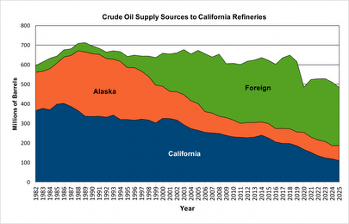
Oil supply to California refineries. Courtesy California Energy Commission.
As this image shows, California has steadily used less and less self-produced oil, with less oil available from Alaska. And the difference has been imported oil, much of it from the Middle East; that is, for many years tankers from the Persian Gulf have been making an almost 90-day voyage across the Indian and Pacific Oceans to unload oil at California terminals.
But since February 28, 2026, and the start of the Iran conflict, no tankers have left the Gulf bound for California. And the few tankers that remain on the high seas – those late February sailings – will soon dock, unload, and then there’s nothing else coming in. Very soon, the view from California’s oil unloading terminals will be just big, blue, empty Pacific Ocean.
So, are you beginning to sense why California is about to experience an energy nightmare?
Lack of Refineries and Fuel
Then again, California’s energy problems are not really due to the Iran conflict. Many issues are purely internal. Just consider how, over the past quarter century, California has taxed, litigated and regulated primary oil exploration and production down to bare bones, despite significant hydrocarbon potential in the state.
This makes for another long story, but in essence California has many still-prospective areas for oil, both traditional production and fracking, let alone offshore. But state politics and environmentalism have shut it in. The state’s problem is politics and culture, not geology.
And then there’s the California refinery story, another key element of the state’s looming energy disaster. That is, in the 1980s California hosted 42 oil refineries and produced almost all of the liquid fuels and related products that the state consumed. The above-noted energy island was self-sufficient.
Today, however, California hosts a mere 7 refineries, with two of them devoted to recycling garbage (i.e., materials like used cooking oil) into so-called “biodiesel.” And for many reasons, those biodiesel plants are unprofitable, only kept alive by state subsidies and tax credits.
As for the dozens of closed refineries, the story is a typical California tale: environmental regs, taxes, litigation, punitive business climate, etc. Indeed, in recent years Chevron, Conoco Phillips (COP), and Valero (VLO) have closed and written off major refinery investments in California; it’s impossible for them to do business.
In fact, California state policy is blatantly anti-oil: to go total “net-zero” by the mid-2030s, which means that regulators want to close down all remaining refineries, and somehow California will run on batteries, and so-called “renewable” power and charging. It’s Green New Scam lunacy, some might say; but that’s what you have out there.
Meanwhile, the current refinery and fuel segment of California’s GDP is about 8%. To which, again, some might wonder how the other 92% will get along without gasoline, diesel, jet fuel, etc. But policymakers and regulators live in their own world, where such doubts are forbidden.
Of the five remaining oil refineries in California, the total output is about 40-50% of total fuel usage in the state, depending on whether it’s gasoline, diesel, or jet fuel. And that’s not enough to run things, so the difference is made up of imports via tankers.
For example, about 40% of California’s jet fuel comes from South Korea; 20% of gasoline recently arrived from Indian refineries; and a new source of gasoline and diesel, of as-yet-unknown percentage, is from… yes… Russia.
But not so fast, Grasshoppers… Because India and South Korea refine fuels from petroleum that also sailed (past tense) out of the Gulf on tankers, and obviously these nations have their own issues now. Hence, neither of these nations are currently exporting fuel to California, nor will they do so anytime soon. And Russian sourcing is problematic, also for obvious reasons.
High Prices, Shortages, Rationing
California has long been burdened with relatively high fuel prices, certainly versus the price back East. And right now, prices out there are going through the roof. For example, gasoline in SoCal is in the range of $6 per gallon and more; while diesel fuel in California is up around $8 per gallon, with some stations up at $10.
Much of the California fuel price is legacy regulation. That is, high prices trace back to massive environmental regs, especially from an entity called the California Air Resources Board (CARB). The idea is “clean air,” right? Although CARB jurisdiction doesn’t extend to, say, polluting refineries in India or South Korea, let alone to oil-burning tankers that traverse entire oceans.
Then again, CARB or no-CARB, California’s problem right now is insufficient state oil production or refinery capacity, and fast-dwindling imports via tankers.
So, what happens over the next month? Well… Stand by for the Nightmare.
We’ll see an unfolding energy disaster as California fuel stocks drain down, with not enough replacement fuel from state refineries, let alone imports from distant sources.
And note that California refineries and tank farms supply Nevada and much of Arizona, which means that these two states are about to get walloped by fuel price increases and shortages as well.
Here’s a summary of California’s energy predicament:
- Not enough in-state oil production.
- Loss of oil imports from the Middle East.
- Not enough refinery capacity.
- Loss of refined products from South Korea, India and other pre-Iran sources.
- Looming shortages of gasoline, diesel, jet fuel and related refined products.
- High and higher fuel prices are a given; the next issue will be physical availability.
- Military will get first call for fuel; that’s just the way it works.
- Look for fuel shortages and non-availability; even gas lines and rationing.
- Diesel shortages will affect agriculture and trucking, key parts of the California economy.
- Agricultural and trucking problems may lead to food distribution issues.
- Other trucking problems will affect cargo from California import terminals like Los Angeles and Long Beach.
- Freight rail and commercial air travel will also be affected, with likely serious ripple effects across the entire U.S. economy.
Wrap-Up
California is beyond an energy mess. We’re not California Dreamin’ here; no, it’s a real Nightmare.
On the “plus” side, last week the Trump administration applied the Defense Production Act (DPA) to domestic oil and gas development. This means that the federal government can begin to make energy policy from a national security perspective. In essence, the Departments of War and Energy can exercise wartime-level control over oil production, refining, imports and distribution.
DPA is not “nationalization” of oil or refining, etc. But it is an effective way to put California’s disastrous regulators on the bench – especially CARB – so that they can do no further harm to the overall energy situation. And harm they have done…
Where does it go from here? Well, California’s Energy Nightmare will become a dynamic situation. Fuel shortages, gas lines, high prices, and ripple effects across America. So, prepare as best you can. It’ll be a long, hot summer…
And we’ll have more for you as it all unfolds. But that’s all for now.
Thank you for subscribing and reading.
The post California Nightmare: A Looming Energy Disaster appeared first on Daily Reckoning.
This story originally appeared in the Daily Reckoning
Source: https://dailyreckoning.com/california-nightmare-a-looming-energy-disaster/
Anyone can join.
Anyone can contribute.
Anyone can become informed about their world.
"United We Stand" Click Here To Create Your Personal Citizen Journalist Account Today, Be Sure To Invite Your Friends.
Before It’s News® is a community of individuals who report on what’s going on around them, from all around the world. Anyone can join. Anyone can contribute. Anyone can become informed about their world. "United We Stand" Click Here To Create Your Personal Citizen Journalist Account Today, Be Sure To Invite Your Friends.
LION'S MANE PRODUCT
Try Our Lion’s Mane WHOLE MIND Nootropic Blend 60 Capsules
Mushrooms are having a moment. One fabulous fungus in particular, lion’s mane, may help improve memory, depression and anxiety symptoms. They are also an excellent source of nutrients that show promise as a therapy for dementia, and other neurodegenerative diseases. If you’re living with anxiety or depression, you may be curious about all the therapy options out there — including the natural ones.Our Lion’s Mane WHOLE MIND Nootropic Blend has been formulated to utilize the potency of Lion’s mane but also include the benefits of four other Highly Beneficial Mushrooms. Synergistically, they work together to Build your health through improving cognitive function and immunity regardless of your age. Our Nootropic not only improves your Cognitive Function and Activates your Immune System, but it benefits growth of Essential Gut Flora, further enhancing your Vitality.

Our Formula includes: Lion’s Mane Mushrooms which Increase Brain Power through nerve growth, lessen anxiety, reduce depression, and improve concentration. Its an excellent adaptogen, promotes sleep and improves immunity. Shiitake Mushrooms which Fight cancer cells and infectious disease, boost the immune system, promotes brain function, and serves as a source of B vitamins. Maitake Mushrooms which regulate blood sugar levels of diabetics, reduce hypertension and boosts the immune system. Reishi Mushrooms which Fight inflammation, liver disease, fatigue, tumor growth and cancer. They Improve skin disorders and soothes digestive problems, stomach ulcers and leaky gut syndrome. Chaga Mushrooms which have anti-aging effects, boost immune function, improve stamina and athletic performance, even act as a natural aphrodisiac, fighting diabetes and improving liver function. Try Our Lion’s Mane WHOLE MIND Nootropic Blend 60 Capsules Today. Be 100% Satisfied or Receive a Full Money Back Guarantee. Order Yours Today by Following This Link.


| Visits: | 1,809,130,114 |
| Stories: | 8,648,043 |
Whistler Blowers, Insiders

