

Two Big Changes To The Us Trucking Industryis Reducing Driver And Truck Supply–fast

There is a bullish setup taking hold in the US trucking market.
Rates are now surging and tender rejection levels (a measure of how busy trucking outfits are) have hit a new cycle high.
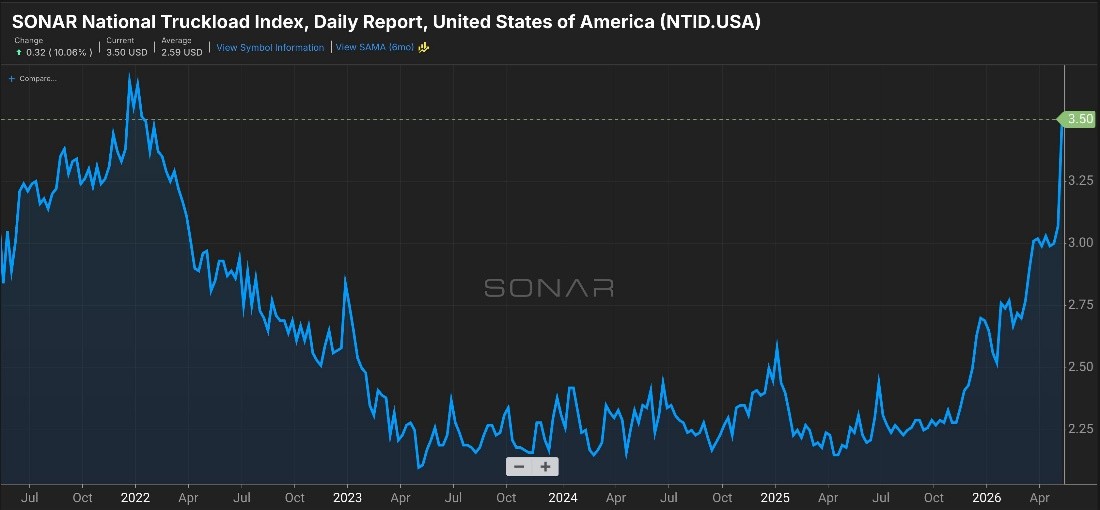
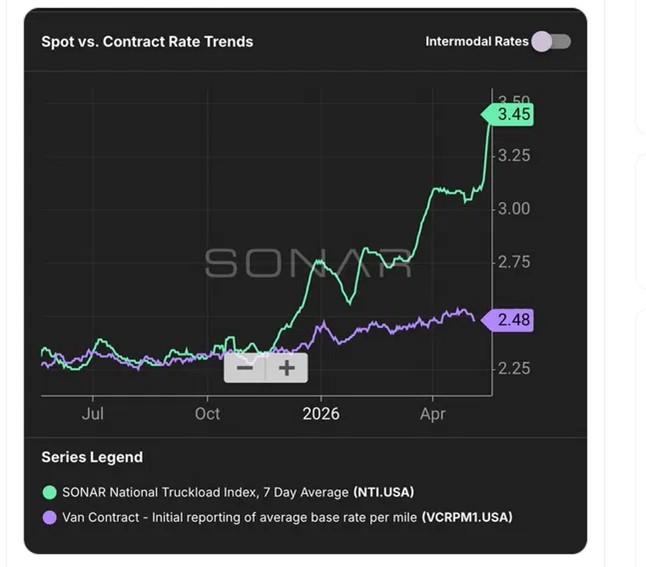
Spot rates for dry van truckload, the benchmark for the industry, have very recently gone vertical–after 2-3 year period of below average rates. The SONAR Truckload Index hit $3.50/mile in May–see chart below.
That matches the peak of the 2021-2022 cycle. Now some of this has to do with gasoline, but not all of it. Fuel prices are up about 30c per mile since the war started. It’s just a pass-through expense for the industry.
Tender rejection rates, the percentage of contracted loads that carriers are turning down to chase higher-paying spot loads (global oil tankers and LNG ships do the same thing!!!) hit 16.29% in late May. That’s up from just 6.4% six months prior.
Why is this happening now? This is NOT a political story, but it really does go back to new enforcement initiatives by the federal government on “unsafe” drivers–which includes a strong working knowledge of the English language. This is (almost certainly) driving many immigrant drivers out of their jobs.
While trucking stocks have already made a move, there is reason to believe that this is just the start.
Why is this happening now? This is NOT a political story, but it really does go back to new enforcement initiatives by the federal government on “unsafe” drivers–which includes a strong working knowledge of the English language. This is (almost certainly) driving many immigrant drivers out of their jobs.
I don’t make the rules, I just try to profit from them. And while trucking stocks have already made a move, there is reason to believe that this is just the start.
COVID arguably turbo-charged the trucking sector–everybody wanted everything delivered to their home. The industry responded with an overcapacity, and this was inevitably followed by a long period of below-market rates.
That has only started to change in the last year. Until last month rates were still below mid-cycle levels.
That slow grind off the lows is what you would expect in a normal environment – trucking rates edging to mid-cycle levels as the weakest carriers are run off the road.
But what is happening now is anything but normal. As I showed, rates are suddenly exploding higher.
Here are the two catalysts driving this faster recovery:
THE FIRST CATALYST – A NEW REGIME OF REGULATORY ENFORCEMENT
When the Trump administration came into office, one of their priorities was to crack down on “unsafe” drivers in the trucking industry.
While it is called a safety crackdown, it honestly seems to be as much about the war on illegal (and legal?) immigrants.
Whatever the intent, the impact is encapsulated in this tweet by Craig Fuller of Freightwaves.
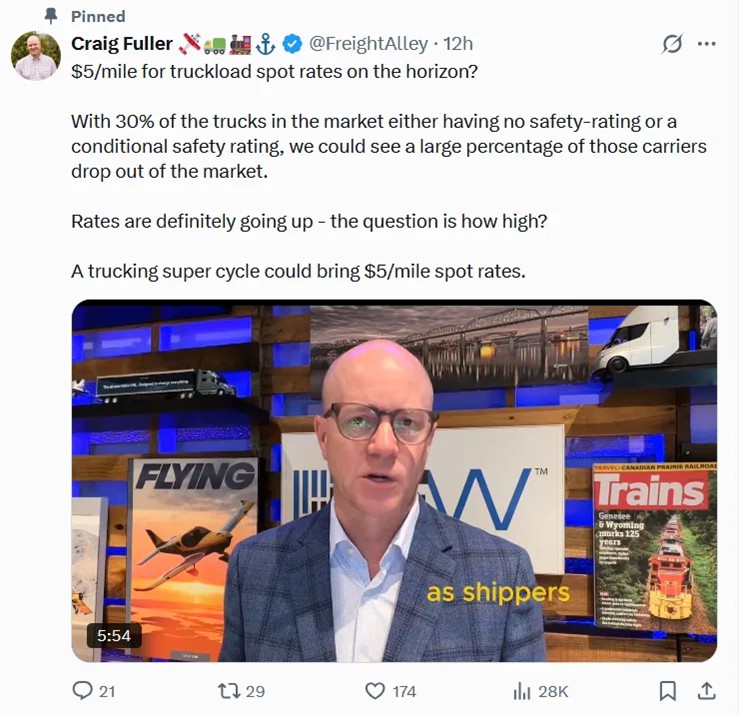
What Fuller is referring to are enforcement initiatives being taken on by the Federal Motor Carrier Safety Administration (FMCSA).
You can break down what the FMCSA is doing into three initiatives.
First, they are insuring English proficiency among drivers. In 2025, with the crackdown beginning in late June, the FMCSA recorded 12,308 out-of-service violations for inadequate English proficiency. To compare, in 2023 and 2024 combined, FMCSA recorded only 14 such violations.
FTR Transportation Intelligence estimated the English crackdown could take roughly 25,000 drivers off the road annually — about 1% of the driver population. Most of which has been employed by smaller trucking outfits looking to keep costs low.
The second FMCSA crackdown is on non-domiciled commercial driver’s licenses (CDLs).
This is the biggie.
Typically, a CDL must be issued by the state where the individual lives. But there is an exception. If a driver doesn’t reside in the US, they can get a CDL from any US state willing to provide it.
This was intended to be a narrow provision for legitimate cross-border commercial drivers (from Canada and Mexico).
But in the last 5 years, it has become a loophole to exploit. Here’s how:
· A foreign national — often with no legal work authorization — enrolls in a CDL training program in a state known to have loose residency verification requirements
· In such a state, there are CDL mills (the fraudulent training schools FMCSA is now shutting down) that take the driver through the process
· The driver gets a legitimate-looking CDL despite never actually living there and sometimes barely completing real training
· That CDL is used to gain employment with a US carrier, often a small operator who didn’t scrutinize credentials carefully
There was a big spike in CDL issuances in 2021-2022, right at the peak of the last freight super cycle.
Since then, either real or imagined, these drivers have come under scrutiny for their competence. The FMCSA is not crystallizing the scrutiny into actions that will take some of them off the road.
While you could certainly argue whether these drivers are actually a safety risk, what you can’t argue is that the surplus of drivers have led to a surplus of trucking supply. Which is now unwinding.
The FMCSA is targeting training providers and renewals. Over 2,600 providers are now in “proposed-removal status”. FMCSA officials have indicated this is just the beginning. That is going to make getting out-of-state CDLs far more difficult going forward. In fact, many states have paused issuance of new non-domiciled CDLs entirely.
While existing licenses can’t be revoked, they don’t have to be renewed. And being 5-year licenses, and with a large number of them issued in 2021-2022, we are on the cusp of a flood of non-renewals.
Again, the consequence is going to be drivers pushed out of the market. The losers here are likely to be small trucking businesses that depended on the cheap labor.
The third initiative, a crackdown on Electronic Logging Devices (ELD), is just getting started.
An ELD is a GPS-connected device that records a driver’s hours of service – when they’re driving, when they’re on duty but not driving, when they’re resting. It basically a logbook replacement, which were easily falsified.
Federal law mandated ELDs for most commercial carriers starting in 2017.
A cottage industry of cheap, non-compliant devices has emerged to serve small carriers looking to cut costs. Some of these devices are marketed with “cheat codes” that allow you to skirt the rules.
In 2025 alone, FMCSA revoked more than 70 ELD devices for non-compliance while rejecting around 200 others during pre-market vetting. Carriers running revoked ELDs face out-of-service orders.
While this does not remove capacity, it does remove the cost advantage of smaller carriers using these devices.
Derek Leathers, CEO of Werner Enterprise (WERN – NYSE) put it plainly at a Barclays conference in February: “we finally have some enforcement and regulatory lift – I think it’s been early innings. There’s lots of CDL stuff to be cleaned out of the network.”
SCOTUS RULING COULD ADD FUEL TO THE FIRE
A recent Supreme Court ruling could put even more pressure on the trucking industry, with again a particular focus on the smaller trucking businesses.
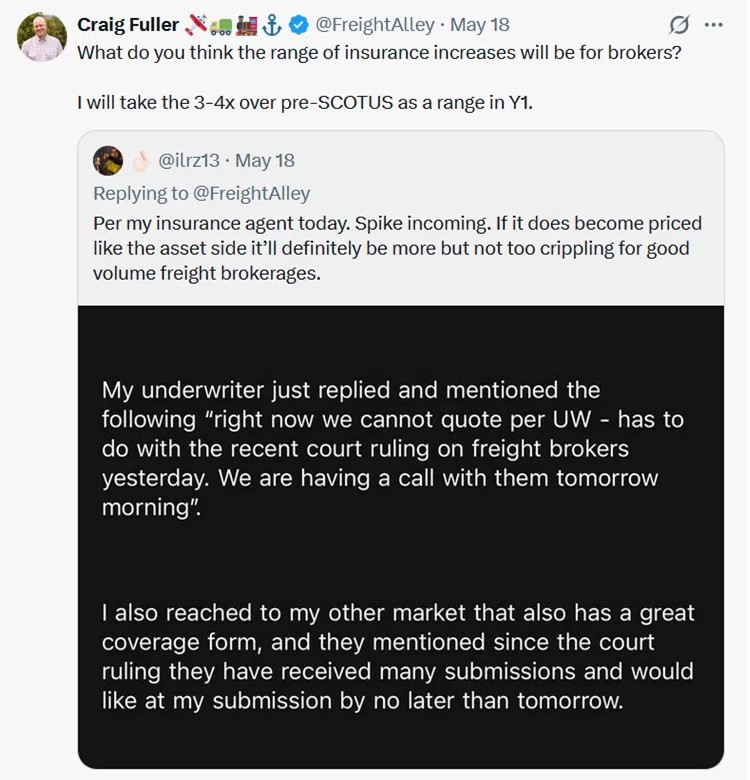
In Montgomery v. Caribe Transport II, the Court ruled that freight brokers can be sued for negligently hiring unsafe carriers.
For years, brokers had used a federal pre-emption as a shield against such lawsuits. That shield is now gone.
Brokers now face higher litigation exposure with freights that they broker. That raises costs and liability exposure for them.
A broker won’t necessarily want to take the risk that the small carrier has adequate insurance. The litigation environment in trucking can be brutal – nuclear verdicts of $10 million, $20 million, or more are not uncommon.
Brokers will undoubtably be more discerning about who they do deals with. A very large trucking carrier, like a JB Hunt, is going to have a good insurance policy to backstop anything that goes wrong with a shipment. But a small outfit may, or they may not.
TRUCKING SUPPLY GOES DOWN
Put these two changes together at the same time and there is only one way for the supply of trucks to go – down.
Many small carriers were already on the brink after a three year-long bear market. Every one of these changes make things that much worse for them.
It is going to be too much for some. The inevitable pruning of supply has now been ongoing for 9 months.
Here is that chart again–all this is now showing up in rates, which are exploding higher.
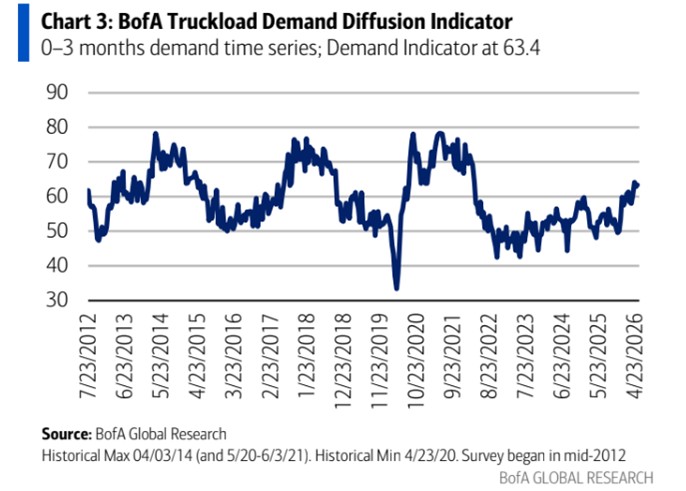
And below I have the chart on rejection rates–as rejection rates elevate, shippers must negotiate contract upwards. So far, contract rates haven’t followed through. But every signpost suggests they inevitably will, it will just take time.
WHEN BEST-OF-BREED ISN’T THE BEST WAY TO PLAY
I’m not the first to notice what’s unfolding here, and that is evident in the stock prices of the largest trucking companies.
JB Hunt (JBHT – NYSE), one of the largest truckers with a $24 billion market cap, is up about 75% since October.
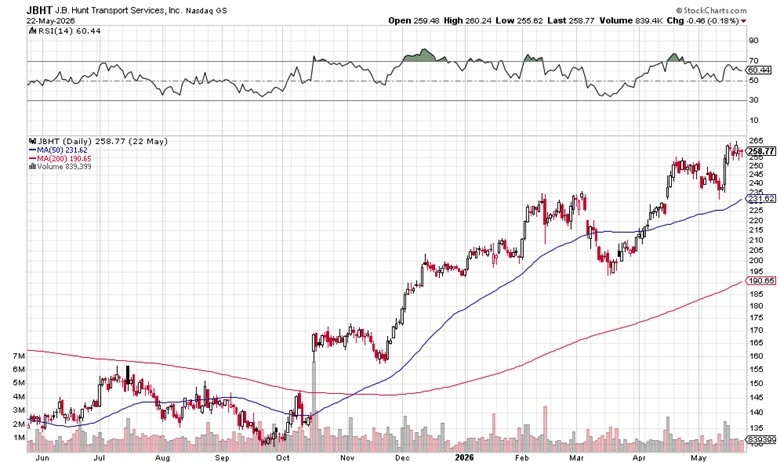
But you have to be careful when you throw all the trucking stocks into one bucket.
JB Hunt isn’t all that tied to the “truckload” market. In fact, they have largely moved their business upstream of that, to segments like intermodal (truck and rail containers) and dedicated (contracting capacity to a specific end user).
JB Hunt’s revenue from “Truckload” is a fraction of their total revenue, and their operating income from the segment is a rounding error.
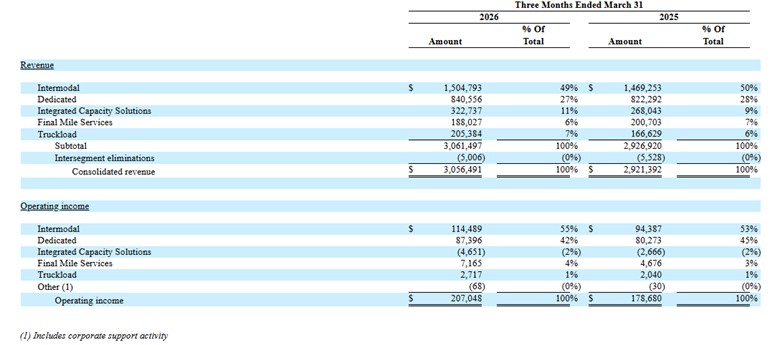
The same can be said for most publicly trading trucking companies. Which again kind of points to the opportunity.
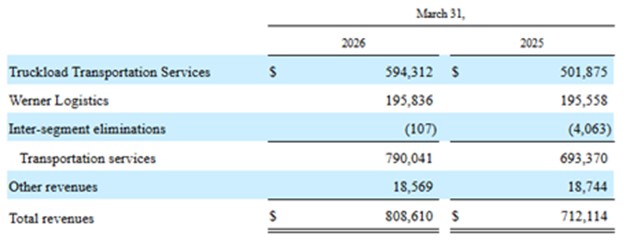
I found two companies that are mostly tied to truckload revenue. The first is Werner Enterprises which, at a $2.3 billion market cap, would make it a mid-tier player. Werner just hit new 52-week highs last week.
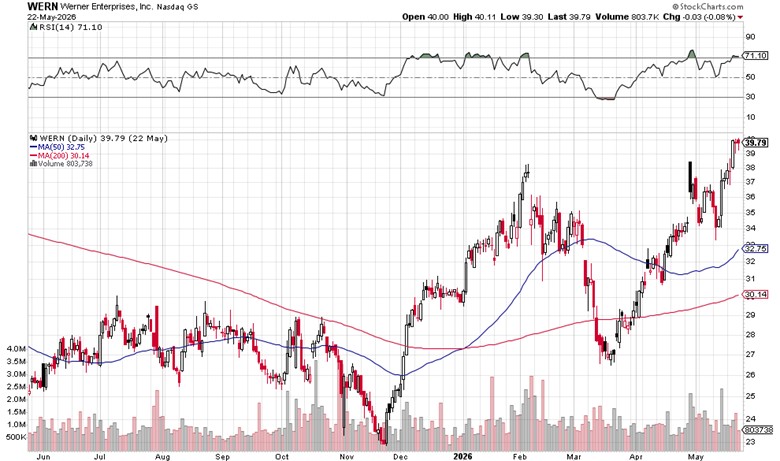
Werner operates a Truckload business and a logistics broker business (which is going to face headwinds from the SCOTUS ruling). But their trucking business is much bigger.
Heartland Express (HTLD – NYSE) is a second and more levered play. Heartland has just a $1.1 billion market cap, but that lower price tag has more to do with past performance than the volumes they move.
The stock is already up a lot over the past couple months. But it is still well below where it was last cycle.
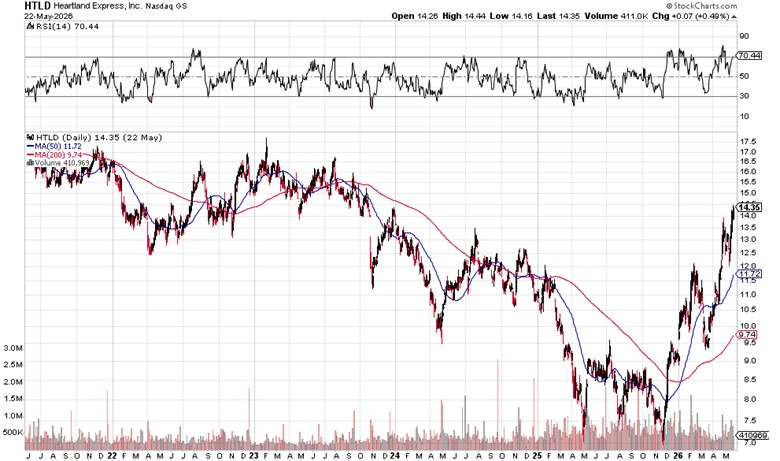
Heartland may be the publicly trading trucking company best positioned to benefit from the dynamics I’ve laid out.
They are 100% dry van truckload. Which is exactly the segment that is losing the most capacity here.
They have zero brokerage exposure. Just about every other publicly traded trucking company has a logistics segment, largely because it was resilient through the downturn and because markets love “asset light” businesses. Not being exposed to that now is a big plus.
Finally, while Heartland has struggled for the last couple years (they have had 8 straight quarters with an operating ratio over 100, which means that their operating expenses have outweighed their revenue!), they have quietly been improving their performance.
They also have one of the most modern fleets out there, with an average age of just 2.6 years, and a long history of safety.
Finally, Heartland’s past struggles actually plays in the stocks favor here if rate continue to go up.
Trucking is one of those businesses where your costs are mostly fixed. Today, Heartland is still losing money. They are losing less money than a year ago, but it is still a loss.
But as rates rise, that fixed cost base kicks in and Heartland could start to make a lot of money.
In fact, that may be happening already.
I can make a fairly conservative estimate that Heartland would see a $30 million per quarter improvement to their operating profit a $0.50/mile rise in revenue.
We are seeing roughly double that on the spot market.
At $30 million per quarter, or $120 million annualized, Heartland probably can do something around $1.75 per share of earnings.
That won’t show up right away. Heartland, like just about every large trucker, deals more with contracts than spot, so it will take some months for the spot rate increase to show up in their contracted volume.
But against a stock price of $14, Heartland is a single-digit multiple stock in the midst of of the most powerful freight market catalysts in years.
The bet is simple: the removal of truckers from the supply pool is durable enough and broad enough that contract rates will follow. When they do, Heartland is going to start making a lot of money. The stock price will reflect this.
I have no positions in any of these stocks right now.
To get my next subscriber stock pick, click HERE
Source: https://oilandgas-investments.com/2026/latest-reports/two-big-changes-to-the-us-trucking-industryis-reducing-driver-and-truck-supply-fast/
Anyone can join.
Anyone can contribute.
Anyone can become informed about their world.
"United We Stand" Click Here To Create Your Personal Citizen Journalist Account Today, Be Sure To Invite Your Friends.
Before It’s News® is a community of individuals who report on what’s going on around them, from all around the world. Anyone can join. Anyone can contribute. Anyone can become informed about their world. "United We Stand" Click Here To Create Your Personal Citizen Journalist Account Today, Be Sure To Invite Your Friends.
LION'S MANE PRODUCT
Try Our Lion’s Mane WHOLE MIND Nootropic Blend 60 Capsules
Mushrooms are having a moment. One fabulous fungus in particular, lion’s mane, may help improve memory, depression and anxiety symptoms. They are also an excellent source of nutrients that show promise as a therapy for dementia, and other neurodegenerative diseases. If you’re living with anxiety or depression, you may be curious about all the therapy options out there — including the natural ones.Our Lion’s Mane WHOLE MIND Nootropic Blend has been formulated to utilize the potency of Lion’s mane but also include the benefits of four other Highly Beneficial Mushrooms. Synergistically, they work together to Build your health through improving cognitive function and immunity regardless of your age. Our Nootropic not only improves your Cognitive Function and Activates your Immune System, but it benefits growth of Essential Gut Flora, further enhancing your Vitality.

Our Formula includes: Lion’s Mane Mushrooms which Increase Brain Power through nerve growth, lessen anxiety, reduce depression, and improve concentration. Its an excellent adaptogen, promotes sleep and improves immunity. Shiitake Mushrooms which Fight cancer cells and infectious disease, boost the immune system, promotes brain function, and serves as a source of B vitamins. Maitake Mushrooms which regulate blood sugar levels of diabetics, reduce hypertension and boosts the immune system. Reishi Mushrooms which Fight inflammation, liver disease, fatigue, tumor growth and cancer. They Improve skin disorders and soothes digestive problems, stomach ulcers and leaky gut syndrome. Chaga Mushrooms which have anti-aging effects, boost immune function, improve stamina and athletic performance, even act as a natural aphrodisiac, fighting diabetes and improving liver function. Try Our Lion’s Mane WHOLE MIND Nootropic Blend 60 Capsules Today. Be 100% Satisfied or Receive a Full Money Back Guarantee. Order Yours Today by Following This Link.


| Visits: | 1,825,636,537 |
| Stories: | 8,677,206 |
Whistler Blowers, Insiders

