

America 250: Birth of a Post-Glacial Nation

This post America 250: Birth of a Post-Glacial Nation appeared first on Daily Reckoning.
It’s a very special week: this coming Saturday we’ll celebrate Independence Day at the 250-year mark, recalling the moment when the United States of America formally came into being.
The arc of progress tracks from Jerusalem to Athens, then Rome, to London and finally Philadelphia. There’s serious history here, culminating on July 4th, 1776. Although really, it’s all much more than just one particular day of the calendar.
America’s march to Revolution began in the 1760s after the Seven Years’ War, moved through a decade of imperial crisis, and turned violent in 1775 at Lexington and Concord.
Meanwhile, in 1775 the Continental Congress established the Army in June, the Navy in October, and our beloved Marine Corps in November. Thus, before there was a nation, there were soldiers, sailors and Marines. (“Which is exactly as it should be,” some might say.)
The combat phase of the Revolution ran from 1775 to 1781, ending at Yorktown, while the formal peace came with the Treaty of Paris in 1783. Then came the Articles of Confederation, the Constitution of 1787, ratification in 1788, and George Washington’s inauguration in 1789.
In short, it took time for the U.S. to get its “new nation” thing right. And even then, one of the first official acts of the new federal government was to supplement the Constitution with Ten Amendments, now known as the Bill of Rights. Not a moment too soon!
I mention it all because this week is a fine time to discuss America’s history. But there’s another angle worth pondering as well: the geology. In other words… How 1776 marked the Birth of a Post-Glacial Nation. And with that, let’s dig in…
Welcome to a Post-Glacial Continent
When Europeans arrived on the Atlantic coast of North America, they set foot upon a landscape profoundly shaped by the Ice Age. Pleistocene ice had retreated about 10,000 years earlier, but it left behind scoured bedrock, mineral outcrops, lakebeds, moraines, kettle ponds, marshes, drowned river valleys, sand and gravel deposits, and the enormous freshwater system of the Great Lakes.
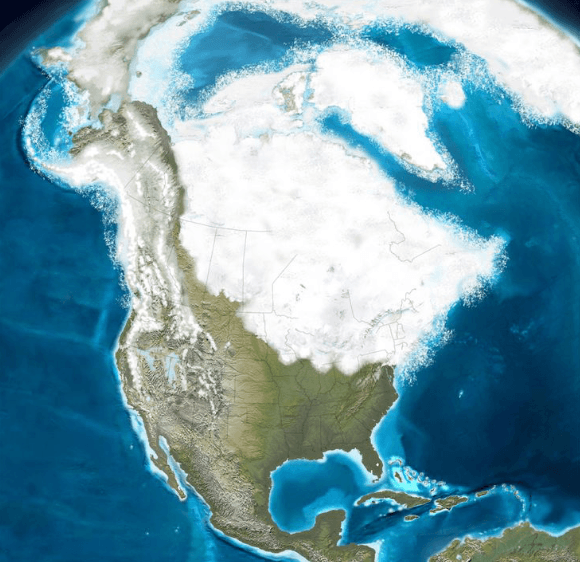
North American Pleistocene ice cover, 1.8MY – 10,000 yrs ago. Credit U.S. Geological Survey.
By itself, post-glacial geology did not determine American history. But it created physical conditions that strongly shaped communication, settlement, agriculture, transportation, industry, military strategy, and westward expansion. For Native inhabitants and later arrivals alike, the landscape influenced flora, fauna, animal migration, trails, habitation, farming and industry.
America’s Glacial Inheritance
In Pleistocene time, ice sheets repeatedly advanced and retreated. At various times ice covered much of what became New England, New York, northern Pennsylvania, the Great Lakes states, the upper Midwest, and western mountain ranges as well.
As ice moved, it scraped and polished bedrock, deepened valleys, opened or blocked drainage, and carried debris known as till. As the vast sheets melted, torrents of water moved boulders, gravel, sand, silt and clay into outwash plains, deltas, floodplains and lakebeds.
For Native peoples and then Euro-colonists, these ancient mass movements left terrain full of opportunity and constraint: rich lowlands beside rocky uplands, navigable waterways beside difficult overland passages, and abundant construction materials beside thin or stony soils.
A Post-Glacial, Coastal Nation
Due to hard bedrock and forbidding terrain, even by 1776 European settlement had barely penetrated the North American interior. Most people lived near the coast or upstream along rivers that flowed to the sea.
The culture, economy and politics of Colonial, and then Revolutionary America were dominated by towns and modest cities along drowned river valleys: Boston and coastal Massachusetts; Narragansett Bay; New York and its harbor system; Philadelphia on the Delaware; Baltimore on the Chesapeake; and Charleston farther south.
It all makes good geologic and cultural sense when you understand how glacial melt raised sea levels and flooded river mouths, creating inlets that became harbors, ports and colonial gateways.
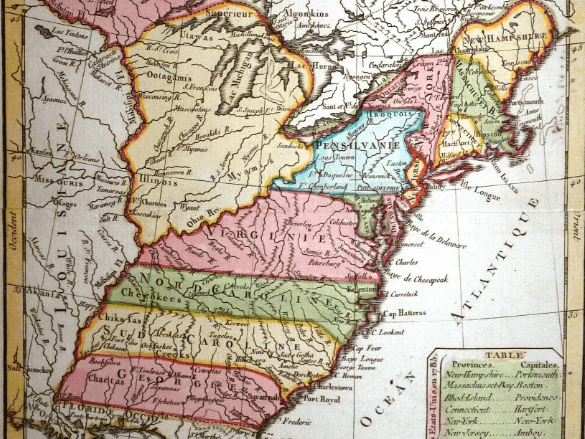
Colonial-Revolutionary America, a seacoast phenomenon. Credit Library of Congress.
In post-glacial New England, the geological inheritance was not merely influential but tyrannical; indeed, the land was more unforgiving than the harsh rule of any English king.
Across New England, glaciers had stripped and scoured the land, leaving thin soils, exposed ledges, boulder-strewn fields, drumlins, ponds and uneven uplands. Such conditions discouraged large-scale agriculture and favored small mixed farms, woodlots, livestock, fishing, shipbuilding and town commerce.
Or consider the famous stone walls of New England; they’re not just quaint rural decoration. In fact, they reflect decades of backbreaking labor by farmers who cleared glacial debris from their fields and stacked the rocks. Season after season, agriculture and property ownership was shaped by what the ice left behind.
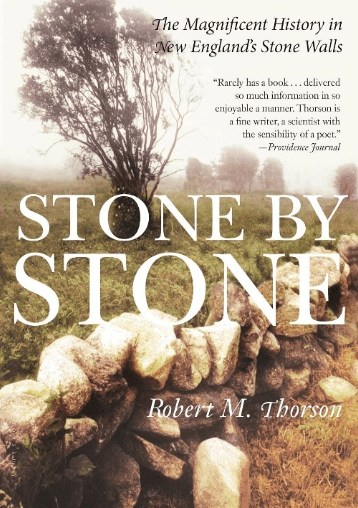
Stone by Stone: The Magnificent History in New England’s Stone Walls. Robert Thorson. Credit Amazon screen shot.
At the same time, post-glacial geology offered advantages as well. Ice and meltwater shaped coves and estuaries, and created protected harbors that supported maritime trade. Thus did the rocky coastline of New England play a key role to position Boston, Newport, Portsmouth and other well-positioned locales for colonial commerce.
Further inland, steep gradients and post-glacial streams powered sawmills, gristmills and small manufacturing. Falling water turned wheels that converted timber into boards, grain into flour, ores into metal, and other raw materials into marketable goods long before coal-fired energy lit off, so to speak.
In other words, the same ice-shaped ruggedness that limited farming pushed New Englanders toward diversified enterprise: seafaring, craftsmanship, industry and town-based economies. And it’s all quite different from the Southerly system where plantation agriculture was more feasible and industry less favored; sociological facts with downstream implications of their own.
Glacial Geography of Westward Expansion
Post-1776, if the U.S. was to expand it had to overcome immense geological barriers. Right away, the new country was trapped on the coastline by the mighty Appalachians, difficult to cross even today and certainly back then.
Geology controlled geography, and geography controlled movement. Post-glacial drainage patterns shaped routes by which Natives, trappers, traders, soldiers and settlers moved into the interior. Still, though, ancient meltwater had reorganized river systems, carved channels, and left valleys that became corridors through rugged country.
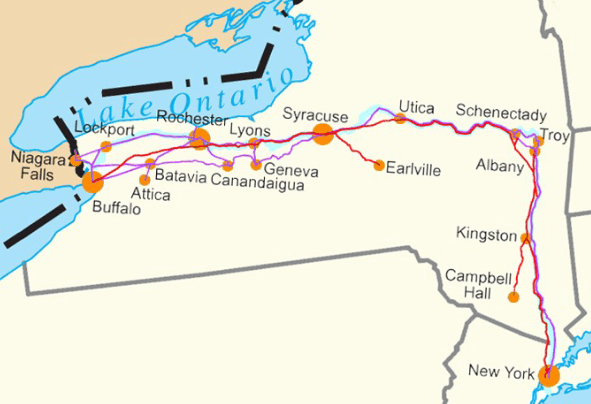
Hudson-Mohawk Valley/Erie Canal route. Credit msnikkijones.weebly.com.
By the early 1800s, New York’s glacially formed Hudson-Mohawk route transformed old Native trails and water passages into one of the key corridors of the era. America had a route up the Hudson to Albany and, via the Mohawk-Erie Canal west to Buffalo and the Great Lakes, the new nation’s inland sea.
No doubt, the Erie Canal was a triumph of engineering and hard work. But at root—literally—its success was built upon a landscape where bedrock and glacial history had produced a workable path from east to west.
Where canals did not yet exist, portages reflected glacial geography as well. Short overland treks between watersheds eased movement from the St. Lawrence to the Great Lakes and eventually into the Ohio and Mississippi systems, themselves heavily influenced by ancient ice and meltwater.
Strategically, westward growth reflected an effort to understand and master the interior’s geologic-scale hydraulic systems. One famous example is the journey of Lewis & Clark down the Ohio, up the Missouri, across the divide, and eventually down the Columbia to the Pacific.
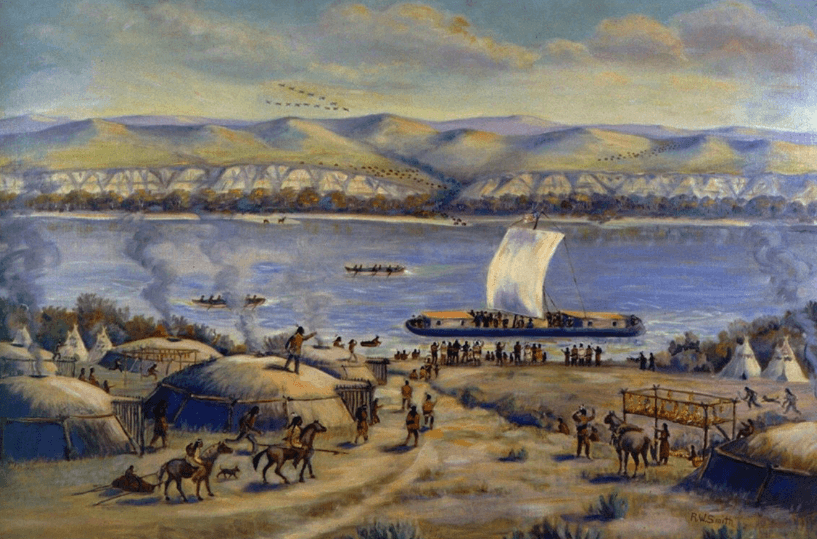
Lewis & Clark Expedition on Missouri River. Credit Smithsonian Institution.
Similarly strategic, the Great Lakes were—and remain—the most dramatic post-glacial feature of the continent. Their basins reflect bedrock structures deepened by extreme glacial erosion, then filled with meltwater that became America’s inland ocean.
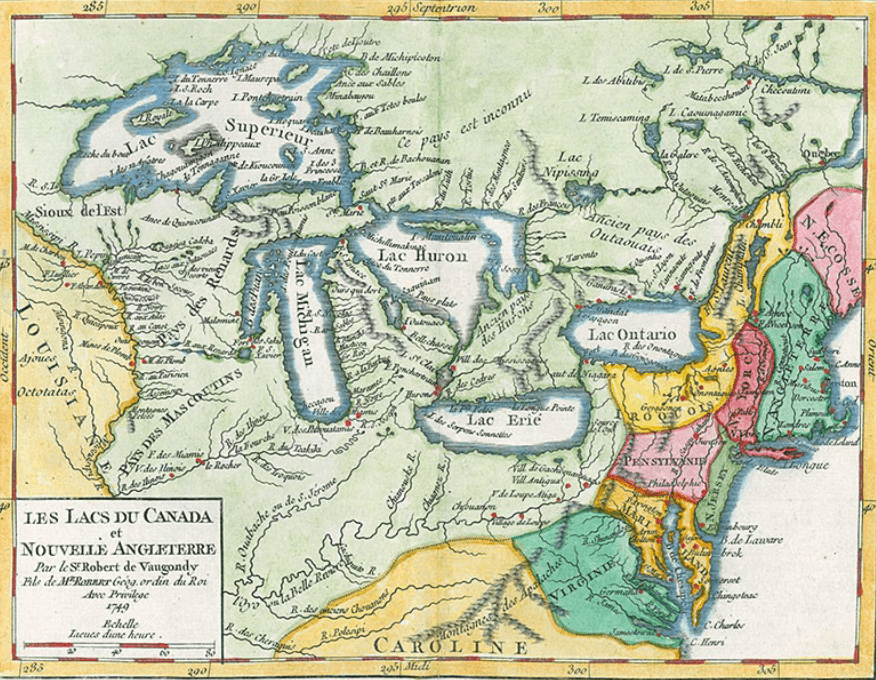
Early map (1749) of Great Lakes region. Credit University of Notre Dame, Hesburgh Library.
By the 1780s, American leaders understood that the Great Lakes linked the St. Lawrence Seaway to the far interior. Indeed, at one point no less than Benjamin Franklin traveled to Montreal to urge the French up there to join America’s rebellion against the British. (They declined.)
That is, American leaders understood how control of lake routes meant control of trade, diplomacy and military movement, especially with British North America to the north, and confrontational Native nations throughout the region.
Then came the Northwest Ordinance of 1787, built upon the idea that the Great Lakes were central to America’s national development. And as anticipated, the lakes opened Ohio, Indiana, Illinois, Michigan, Wisconsin and Minnesota to settlement, development and commerce.
Meanwhile – and fortuitously! – ancient glacial outwash across the Midwest contained ground-up quartz, feldspar, limestone, clays and other minerals. Add 10,000 years of prairie grass, bison, groundhogs and beavers, and much of the region was moist, fertile, and outstanding for agriculture.
Now, add the ability to ship grain and ore back East over the Great Lakes, and America’s post-glacial interior offered a recipe for wealth creation.
Minerals and Mines
Indeed, post-glacial effects greatly influenced American mineral development too, not least via exposed ore bodies that dated from geological Deep Time. Consider Michigan’s Keweenaw Peninsula, where elemental copper had formed 1.5 billion years ago from Precambrian magma and hydrothermal systems associated with the Midcontinent Rift.
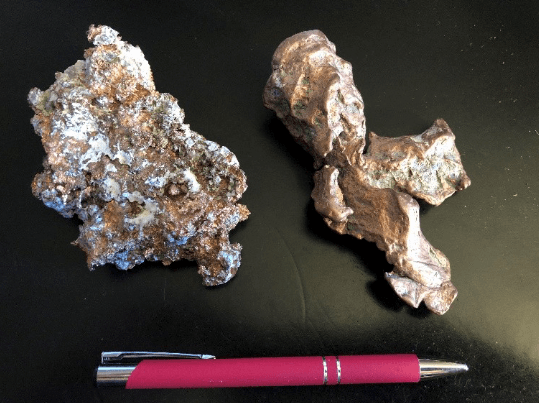
Keweenaw elemental copper, mined (L) and “float” (R). BWK collection.
The copper itself was not “Ice Age,” but Pleistocene glaciers scoured the region, stripped overburden, exposed bedrock, and transported pieces of native metal as “float.”
For many centuries, Keweenaw copper was known to Native peoples. And by the 1840s it fueled America’s first industrial-scale mining boom. Ore moved across the Great Lakes, then down to Pittsburgh and other industrial centers, where coal (aka “energy”) was abundant, which led to a new, regional metals economy. Later, these same commercial channels moved Minnesota iron ore to steel mills across the industrial Midwest.
California offers another mineralogical example. The Sierra Nevada held lode veins of gold-bearing quartz. And during glacial episodes, the bedrock underwent massive mechanical erosion, while falling water helped break bedrock and concentrate dense gold particles at the bottom of stream gravels.
Those gravels eventually led to the “Eureka” discovery at Sutter’s Mill in 1848 and the Gold Rush which pulled large numbers of people west, transformed California, and helped make San Francisco—built alongside another drowned valley system—into a globally significant metropolis.
Wrap-Up: America the Post-Glacial Nation
There’s more to say, of course, but the main point is that the U.S. did not arise from a blank geologic slate. It emerged on a continent where ice, meltwater, sea-level rise, erosion and sediment had already arranged many of the basic facts of bedrock, if not life.
Long before the Declaration of Independence, the country’s landscape was dotted with coastal inlets, river valleys, fertile bottoms, rocky uplands, mineral exposures, lake routes and mountain barriers. Americans did not choose those conditions; they inherited them.
It’s no overstatement to say that post-glacial results controlled almost everything that mattered in early U.S. development: where people could land ships, where towns could grow, where farms prospered or struggled, where mills could turn, where roads and canals made sense, where ore could be found and moved, and where military power could be projected.
Boston, New York, Philadelphia, the Hudson-Mohawk corridor, the Erie Canal, the Great Lakes, Keweenaw copper and California gold were not random items on the historical checklist. Each reflected a deeper geological inheritance translated into economics, politics and settlement.
Of course, we revere the Declaration, the Revolution and the Constitution. We study politics and personalities. Indeed, these are the visible architecture of America’s story. But behind and beneath that architecture lies the physical foundation: bedrock, soils, water, ports, ores and transport routes, much of it shaped or revealed by ice and post-glacial erosion.
Geology did not write the Constitution or win the Revolution. But America’s post-glacial geologic realities made certain choices easier, some harder, and some outcomes far more likely than others. In this sense, America was founded in 1776 but its roots trace back 10,000 years to a post-glacial continent. And the nation has been working with that inheritance ever since.
That’s all for now. Happy America 250!
Thank you for subscribing and reading.
The post America 250: Birth of a Post-Glacial Nation appeared first on Daily Reckoning.
This story originally appeared in the Daily Reckoning
Source: https://dailyreckoning.com/america-250-birth-of-a-post-glacial-nation/
Anyone can join.
Anyone can contribute.
Anyone can become informed about their world.
"United We Stand" Click Here To Create Your Personal Citizen Journalist Account Today, Be Sure To Invite Your Friends.
Before It’s News® is a community of individuals who report on what’s going on around them, from all around the world. Anyone can join. Anyone can contribute. Anyone can become informed about their world. "United We Stand" Click Here To Create Your Personal Citizen Journalist Account Today, Be Sure To Invite Your Friends.
LION'S MANE PRODUCT
Try Our Lion’s Mane WHOLE MIND Nootropic Blend 60 Capsules
Mushrooms are having a moment. One fabulous fungus in particular, lion’s mane, may help improve memory, depression and anxiety symptoms. They are also an excellent source of nutrients that show promise as a therapy for dementia, and other neurodegenerative diseases. If you’re living with anxiety or depression, you may be curious about all the therapy options out there — including the natural ones.Our Lion’s Mane WHOLE MIND Nootropic Blend has been formulated to utilize the potency of Lion’s mane but also include the benefits of four other Highly Beneficial Mushrooms. Synergistically, they work together to Build your health through improving cognitive function and immunity regardless of your age. Our Nootropic not only improves your Cognitive Function and Activates your Immune System, but it benefits growth of Essential Gut Flora, further enhancing your Vitality.

Our Formula includes: Lion’s Mane Mushrooms which Increase Brain Power through nerve growth, lessen anxiety, reduce depression, and improve concentration. Its an excellent adaptogen, promotes sleep and improves immunity. Shiitake Mushrooms which Fight cancer cells and infectious disease, boost the immune system, promotes brain function, and serves as a source of B vitamins. Maitake Mushrooms which regulate blood sugar levels of diabetics, reduce hypertension and boosts the immune system. Reishi Mushrooms which Fight inflammation, liver disease, fatigue, tumor growth and cancer. They Improve skin disorders and soothes digestive problems, stomach ulcers and leaky gut syndrome. Chaga Mushrooms which have anti-aging effects, boost immune function, improve stamina and athletic performance, even act as a natural aphrodisiac, fighting diabetes and improving liver function. Try Our Lion’s Mane WHOLE MIND Nootropic Blend 60 Capsules Today. Be 100% Satisfied or Receive a Full Money Back Guarantee. Order Yours Today by Following This Link.


| Visits: | 1,825,374,353 |
| Stories: | 8,676,549 |
Whistler Blowers, Insiders

