

Housing instability is driving child welfare involvement

Across the country, housing instability places families with children in frequent contact with the child welfare system, even in the absence of abuse or intentional neglect. Families who are homeless, temporarily sharing housing with relatives or friends because they cannot secure stable, independent housing, or living in unsafe or temporary conditions are more likely to be reported to child protective services (CPS) because their living situations are visible, precarious, and closely scrutinized. In many cases, the concern triggering intervention is not parental behavior but the lack of adequate housing itself. Although most states formally prohibit removing a child solely due to homelessness or poverty, nearly every state still treats inadequate shelter as a form of neglect, creating a pathway for housing instability to draw families into the child welfare system despite the absence of abuse.
Child welfare involvement carries lifelong consequences. Before turning 18, an estimated 37% of all children will be subjected to a CPS investigation. If children are separated from their families, they often experience instability through multiple placements, disruptions in schooling and health care, and worse long-term outcomes in education, employment, and mental health. The trauma associated with family separation is well-documented across child welfare research, and it raises particular concern in cases where children are removed due to circumstances such as housing instability rather than abuse or neglect.
Social workers and child welfare professionals understand how central housing is to a child’s well-being. When families bounce between shelters, motels, and doubled-up arrangements, children struggle in school, lose access to consistent health care, and experience chronic stress that undermines mental health. More than 171,000 people in families with children experienced homelessness in 2023, which represents a 14% increase from the previous year. Family homelessness is closely associated with overcrowding, high rent burdens, eviction risk, and a limited supply of affordable units. These structural conditions are often misinterpreted as parental failure, when in fact they are symptoms of a constrained housing market.
Paradoxically, this recognition of the importance of housing often leads agencies to remove children when parents cannot secure a stable place to live, rather than treating housing itself as the problem to be solved. In many cases, the very fact that housing is foundational to safety should be the reason to get parents immediate housing support, not the reason to separate families who are otherwise supportive and non-abusive.
A harm reduction framework for child welfare
Recognizing this mismatch between structural housing conditions and punitive system responses requires a different way of thinking about child welfare. A harm reduction framework offers that lens.
A harm reduction approach to child welfare is not about demanding perfection from families. It focuses instead on ensuring that their challenges do not escalate into unwarranted removals. Chronic social crises like homelessness rarely result from a single factor and require more than a single intervention. A broader harm reduction framework recognizes that crises like homelessness emerge from interacting systems, not isolated challenges, where overlapping failures across housing, health, justice, transportation, and economic conditions can combine to push families into instability.
Better policies exist that could prevent housing loss and safely preserve families. A harm reduction response recognizes that punitive measures intensify avoidable harm, create expensive ripple effects across systems, and impose consequences that are disproportionate to the underlying issue. Instead of promoting isolated and simplistic policies that overlook the problem’s complexity, solutions must be equally detailed. They should prioritize establishing accountability within the systems that affect family stability. This approach minimizes the excessive and avoidable harm frequently caused by child removal, provides supportive services that genuinely enhance family welfare, and achieves sustained cost efficiencies.
Wisconsin shows what harm reduction can look like in practice
There is strong evidence that when families maintain stable housing, unnecessary child removals decline. In 2020, the federal government’s emergency response to the COVID-19 pandemic included a temporary halt on evictions. Although this was designed as a public health measure rather than a child welfare intervention, it created a rare opportunity to observe how reductions in housing instability affect system involvement. In Wisconsin, child removals tied to housing problems fell by 33% during this period, and this decline occurred without any change in parental behavior. The experience illustrates how directly addressing housing instability can prevent removals and keep families safely together. While moratoriums on evictions are not the right approach, policies that provide timely rental assistance, expand access to vouchers, or give local agencies flexible funds to stabilize housing can reduce system involvement while preserving family unity.
Wisconsin leaned into this finding by establishing the Family Keys Pilot Program, a housing-stabilization initiative designed to test whether addressing families’ housing needs could prevent unnecessary child removals. The program was built around the state’s “Putting Families First” framework, which emphasizes solving concrete barriers that place families at risk rather than defaulting to surveillance and separation. Counties received flexible funds and the authority to act quickly, allowing caseworkers to pay overdue rent, cover security deposits, assist families in securing new units after an eviction, and coordinate directly with landlords to keep families housed. Across pilot sites, the program helped reunify families separated solely because they lacked housing and supported 77% of participating families in maintaining stable housing after exit, while Marathon County alone saved more than $250,000 in avoided foster care costs over two years by keeping children safely with their parents.
National policy tools that prevent unnecessary removals
Vouchers are among the strongest tools for preventing unnecessary removals. The federal Family Unification Program (FUP) was created to keep families together when housing instability is the only barrier. Through partnerships between public housing authorities and child welfare agencies, FUP provides housing assistance to families whose children are at risk of entering foster care or who cannot reunify because of inadequate housing. It also serves youth aging out of foster care who face a high risk of homelessness. Evidence shows these vouchers work and save public resources. The Department of Housing and Urban Development (HUD) estimates that keeping a family in foster care costs more than $48,000 per year, while stabilizing that same family’s housing through FUP averages about $15,000, resulting in more than $134 million in savings for every $20 million invested.
The broader Housing Choice Voucher (HCV) program also plays a critical role in promoting family stability. Yet despite its effectiveness, voucher utilization remains low. Nationally, only one in four eligible households receives rental assistance. Many housing authorities face administrative burdens, limited staff capacity, and tight rental markets, making it challenging to place families even when vouchers are available. In cities with low vacancy rates, families often cannot find an eligible unit before their voucher expires. As rental vacancy rates fall to historic lows, rents continue to climb faster than incomes, and many landlords withdraw from voucher programs. These conditions leave low- and moderate-income families with few viable options, increasing the risk that temporary housing instability turns into a crisis.
The effectiveness of both FUP and HCV is ultimately constrained by the severe shortage of homes that families can actually rent. Nationally, 10.9 million extremely low-income renter households compete for only 3.8 million affordable and available rental homes, a shortfall of 7.1 million units. Put differently, there are only 35 affordable and available homes for every 100 extremely low-income renters. As a result, 87% of extremely low-income renters are cost-burdened, and 75% are severely cost-burdened, often spending so much on rent that they cannot reliably afford food, health care, transportation, or child care. In this environment, FUP and HCV are asked to operate in a market where scarcity is built into the system.
Caseworkers can issue vouchers, but families struggle to find any unit that will accept them or meet program standards. The same zoning rules, permitting delays, and land use restrictions that limit overall housing construction squeeze voucher holders most of all, because they have the least ability to compete for scarce units. Until communities increase the supply of homes by removing barriers to building, vouchers alone cannot reliably prevent removals or stabilize families.
Recent state-level trends further demonstrate the limits of voucher-based interventions in a constrained housing market. Even as states dramatically expand spending on homelessness, outcomes diverge sharply depending on whether they allow more housing to be built. The comparison below shows that states with strict land use rules saw homelessness rise despite massive investment, while states that reformed zoning and permitting experienced measurable declines.
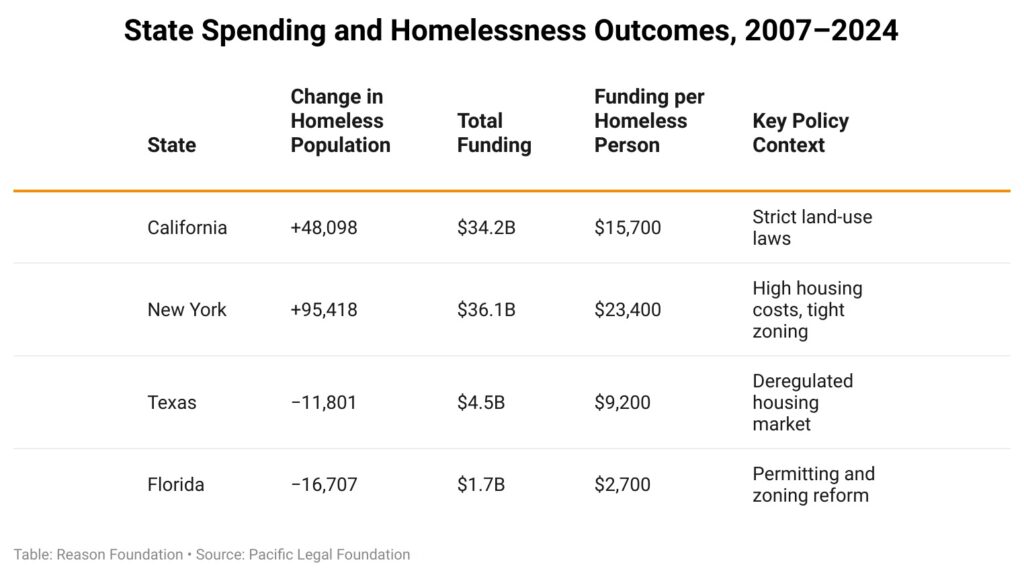
These patterns reinforce a central point that is essential to understanding why vouchers cannot succeed without more housing. States that restrict new construction through zoning and permitting limits tend to spend more and still experience rising homelessness, while states that allow more-flexible development see better outcomes. California and New York have invested billions of dollars over the past 15 years, yet both recorded significant increases in homelessness during the same period. By contrast, Texas and Florida expanded housing more quickly through permitting and zoning reforms, and both saw declines in homelessness even with far lower spending per person. The comparison helps illustrate how supply constraints undermine the effectiveness of every housing intervention, including FUP and HCV.
A harm reduction approach that supports family stability
Family homelessness illustrates the scale and consequences of these pressures. More than 64% of families with children experiencing homelessness reside in shelters, while the remaining third live in cars, motels, or other unsafe or unstable locations. Most of these households are headed by single mothers who face severe rent burdens, limited access to child care, and unstable employment. These structural pressures intersect directly with child welfare involvement. When families are priced out of stable housing, the risk of child welfare agency involvement increases even when there is no allegation of abuse. While the child welfare system is designed to protect children, housing instability can function as a proxy for risk, increasing the likelihood of intervention and family separation. In these cases, the trauma and long-term costs of separation often far exceed the cost of providing housing assistance that could stabilize the family and preserve the child’s well-being.
A child welfare approach based on harm reduction acknowledges that when housing instability is the core challenge for a family, the appropriate intervention is to restore stability, not remove children. The Wisconsin Family Keys pilot offers a practical example of this principle. By quickly and directly addressing housing barriers, counties were able to keep families together, minimize trauma, and realize significant cost savings compared to the expense of foster care.
To improve child safety outcomes, eviction and homelessness should not be treated as proxies for parental failure. Stable housing is not a secondary concern but a foundational condition for family stability and child well-being. When families secure stable housing, children are more likely to remain safely in their homes, child welfare systems avoid unnecessary interventions, and communities reduce the fiscal and social costs associated with family separation. If the core objective is child safety, policy should prioritize measures that establish stability upstream rather than escalating surveillance or interventions that increase the risk of removal.
The post Housing instability is driving child welfare involvement appeared first on Reason Foundation.
Source: https://reason.org/commentary/housing-instability-is-driving-child-welfare-involvement/
Anyone can join.
Anyone can contribute.
Anyone can become informed about their world.
"United We Stand" Click Here To Create Your Personal Citizen Journalist Account Today, Be Sure To Invite Your Friends.
Before It’s News® is a community of individuals who report on what’s going on around them, from all around the world. Anyone can join. Anyone can contribute. Anyone can become informed about their world. "United We Stand" Click Here To Create Your Personal Citizen Journalist Account Today, Be Sure To Invite Your Friends.
LION'S MANE PRODUCT
Try Our Lion’s Mane WHOLE MIND Nootropic Blend 60 Capsules
Mushrooms are having a moment. One fabulous fungus in particular, lion’s mane, may help improve memory, depression and anxiety symptoms. They are also an excellent source of nutrients that show promise as a therapy for dementia, and other neurodegenerative diseases. If you’re living with anxiety or depression, you may be curious about all the therapy options out there — including the natural ones.Our Lion’s Mane WHOLE MIND Nootropic Blend has been formulated to utilize the potency of Lion’s mane but also include the benefits of four other Highly Beneficial Mushrooms. Synergistically, they work together to Build your health through improving cognitive function and immunity regardless of your age. Our Nootropic not only improves your Cognitive Function and Activates your Immune System, but it benefits growth of Essential Gut Flora, further enhancing your Vitality.

Our Formula includes: Lion’s Mane Mushrooms which Increase Brain Power through nerve growth, lessen anxiety, reduce depression, and improve concentration. Its an excellent adaptogen, promotes sleep and improves immunity. Shiitake Mushrooms which Fight cancer cells and infectious disease, boost the immune system, promotes brain function, and serves as a source of B vitamins. Maitake Mushrooms which regulate blood sugar levels of diabetics, reduce hypertension and boosts the immune system. Reishi Mushrooms which Fight inflammation, liver disease, fatigue, tumor growth and cancer. They Improve skin disorders and soothes digestive problems, stomach ulcers and leaky gut syndrome. Chaga Mushrooms which have anti-aging effects, boost immune function, improve stamina and athletic performance, even act as a natural aphrodisiac, fighting diabetes and improving liver function. Try Our Lion’s Mane WHOLE MIND Nootropic Blend 60 Capsules Today. Be 100% Satisfied or Receive a Full Money Back Guarantee. Order Yours Today by Following This Link.


| Visits: | 1,768,366,618 |
| Stories: | 8,566,308 |
Whistler Blowers, Insiders

