

How AI Tools Can Help With Legal History Research

I do a lot of legal history research in my academic work, often studying late 18th Century legal understandings and trying to trace back their origins. Studying the origins is particularly difficult because, when you start to look at materials from the early 18th century and before, legal reports and books are typically in Latin or Law French (the latter being a sort of weird mix of Latin, French, and Anglo-Saxon used by lawyers). The switch to English was pushed along by laws in 1650 and then 1730, and after 1730 everything seems to be in English. But if you want to look back at the sources the late 18th Century lawyers relied on—to know not just what Blackstone said, but what Blackstone was relying on, and what what the sources Blackstone was relying on were themselves relying on, etc.—you quickly run up against the language barrier. And of course you also run up against the broader problems of deciphering the text, and trying to understand the context of the terms and legal concepts they used.
I’ve been fascinated by how the latest generation of AI tools can help to solve these problems. A year ago, you could ask (say) Claude for help with a legal history question, and it could fo only the basics. It could look up what Blackstone said and summarize Blackstone. That’s a start, but not so helpful for a researcher who is already familiar with the basics. These days, Claude can not just read Blackstone, but identify what Blackstone cited, and try to look that up, too—and if it has access to a database that has those sources on the public web, it can read that and summarize that, too.
And of particular interest to me, you can also upload legal materials in Latin or Law French and ask the AI tool to read it, translate it, and explain it. For example, I picked this random passage in a 16th Century legal treatise in Law French.
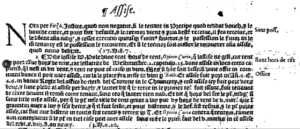
I recognize the word Assize, which I know from the courts of assize. But I really have no idea what this randomly-selected text means. So I uploaded the screenshot to Claude (Opus 4.6, extended), and I asked Claude to read it, state it in the original, translate it, and explain what is going on.
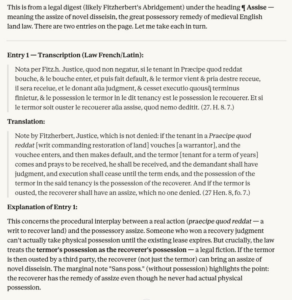
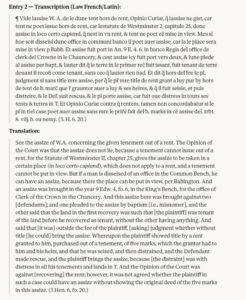
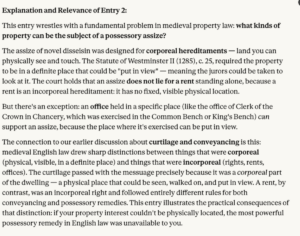
Here’s what I received back:
Pretty cool, I think!
Of course, there’s a problem that I don’t know if what Claude reported back is actually accurate. AI hallucinates, and AI tools are trained to seem super helpful and confident, even if the basis for offered conclusions are weak or nonexistent. If you need to actually rely on what AI tells you about a Law French passage, you need to come up with ways of making reasonably sure what it’s telling you is right. At the very least you could push back, asking the tool if it sure and if there are other translations and explanations. You could refresh Claude and try again, or try a different AI tool. If the stakes are really high, you could try to find a legal history expert on the topic who might be able to tell you if this is right. But as a first cut, just to get a basic idea of what is going on in the passage, it seems pretty useful.
I don’t know how many people will be rushing to use AI to understand passages in Law French. But I would think these sorts of tools make it easier for lawyers and law clerks to do research into 18th Century legal understandings that are relevant to originalist approaches to constitutional interpretation. To the extent that the constitutional text adopts pre-existing legal concepts, as it does with much of the Bill of Rights, you need to understand that pre-existing legal concept. As I mentioned above—and it’s worth repeating—AI tools can hallucinate, and they say all sorts of things with supreme confidence that may be just completely wrong. So you need to be really super careful in using AI to help. But as a way to get a sense of sources, and to make a first cut at what a particular ancient text means, AI should probably be at least one of the tools in the toolkit.
The post How AI Tools Can Help With Legal History Research appeared first on Reason.com.
Source: https://reason.com/volokh/2026/03/17/how-ai-tools-can-help-with-legal-history-research/
Anyone can join.
Anyone can contribute.
Anyone can become informed about their world.
"United We Stand" Click Here To Create Your Personal Citizen Journalist Account Today, Be Sure To Invite Your Friends.
Before It’s News® is a community of individuals who report on what’s going on around them, from all around the world. Anyone can join. Anyone can contribute. Anyone can become informed about their world. "United We Stand" Click Here To Create Your Personal Citizen Journalist Account Today, Be Sure To Invite Your Friends.
LION'S MANE PRODUCT
Try Our Lion’s Mane WHOLE MIND Nootropic Blend 60 Capsules
Mushrooms are having a moment. One fabulous fungus in particular, lion’s mane, may help improve memory, depression and anxiety symptoms. They are also an excellent source of nutrients that show promise as a therapy for dementia, and other neurodegenerative diseases. If you’re living with anxiety or depression, you may be curious about all the therapy options out there — including the natural ones.Our Lion’s Mane WHOLE MIND Nootropic Blend has been formulated to utilize the potency of Lion’s mane but also include the benefits of four other Highly Beneficial Mushrooms. Synergistically, they work together to Build your health through improving cognitive function and immunity regardless of your age. Our Nootropic not only improves your Cognitive Function and Activates your Immune System, but it benefits growth of Essential Gut Flora, further enhancing your Vitality.

Our Formula includes: Lion’s Mane Mushrooms which Increase Brain Power through nerve growth, lessen anxiety, reduce depression, and improve concentration. Its an excellent adaptogen, promotes sleep and improves immunity. Shiitake Mushrooms which Fight cancer cells and infectious disease, boost the immune system, promotes brain function, and serves as a source of B vitamins. Maitake Mushrooms which regulate blood sugar levels of diabetics, reduce hypertension and boosts the immune system. Reishi Mushrooms which Fight inflammation, liver disease, fatigue, tumor growth and cancer. They Improve skin disorders and soothes digestive problems, stomach ulcers and leaky gut syndrome. Chaga Mushrooms which have anti-aging effects, boost immune function, improve stamina and athletic performance, even act as a natural aphrodisiac, fighting diabetes and improving liver function. Try Our Lion’s Mane WHOLE MIND Nootropic Blend 60 Capsules Today. Be 100% Satisfied or Receive a Full Money Back Guarantee. Order Yours Today by Following This Link.


| Visits: | 1,788,068,521 |
| Stories: | 8,604,783 |
Whistler Blowers, Insiders

