

Urban areas can expand housing supply through transit-oriented development

While home prices remain high across United States, urban areas have been especially strained by affordability challenges, making them a priority for tailored solutions. Transit-Oriented Development (TOD) is a planning strategy that integrates mass transportation access with the surrounding environment, defined as within a one-quarter to one-half mile radius of stops.
Historically, TOD has been framed as a complete solution to the urban design problems caused by single-use zoning. Proponents argue TOD enhances walkability and transit ridership, reduces emissions and car dependence, and helps sustainably fund transit expansion. However, the utopian expectations placed on TOD have yet to be realized at scale in the United States.
Alternatively, implementing TOD through a housing-policy perspective can help address housing shortages where transit exists but land-use rules limit supply expansion. Instead of applying a one-size-fits-all model, TOD should be tailored to local preferences and align with existing infrastructure. By focusing on housing, TOD can create avenues for strategic, voluntary, and politically feasible growth near transit.
TOD attempts and lessons
Transit has shaped American cities since the streetcar was widely in use in the early 1900s. However, TOD only gained traction as a planning concept towards the end of the 20th century. Planners wrestled with rising car dependence and the limited success of transit ridership programs, looking for a holistic land use solution. In this context, TOD emerged as a framework for combining urban form and sustainability.
Peter Calthorpe formally articulated the concept beginning in the late 1980s, and most notably in his 1993 book “The Next American Metropolis.” He describes compact urban centers huddling around transit stops with mixed-use development and a variety of housing types. These centers would be linked by transit corridors that enable efficient travel, reducing reliance on cars.
Calthorpe and other urban planners of the era were eager to implement TOD and witness the changes they envisioned. These early efforts revealed key limitations that now inform a more comprehensive understanding of where TOD is best utilized.
The limitations of TOD as utopian: Laguna West, California
Laguna West is a development in California just outside of Sacramento intended to exemplify Calthorpe’s vision of TOD. This project ultimately fell short of its goals due to lack of developer interest and incomplete transit access. While Calthorpe’s later contributions to TOD projects were more successful, Laguna West remains notable for how clearly it illuminated the challenges of applying a broad TOD vision in practice.
In the early 1990s, Laguna West was developed with the vision that neighborhood design alone could reshape transportation behavior and encourage walking and transit use over driving. With a denser core, mixed-use areas, and a connected street network oriented around a central corridor, planners sought to avoid the common pitfalls of traditional U.S. single-use zoning. In practice, however, many conventional suburban features remained.
Brian Quinn explores these challenges in a piece titled “Transit-Oriented Development: Lessons from California.” Quinn concludes that successful integration of TOD is highly dependent on existing infrastructure, culture, and commercial behavior.
The decision to ride public transportation depends on many factors, including the availability of parking, the complexity of a trip, and the quality of the transit option. Transit is only worth considering when it is safe, frequent, and reliable. Additionally, when free and abundant parking is available at the destination, as is often the case due to parking minimums, public transportation is less appealing. Standard trips have also become more complicated and often include multiple stops. Especially across large suburban areas, “the journey web to serve a decent proportion of users would be extremely complex and routes would be too ‘thin’ to create sufficient ridership to make the system economic.” That said, newer options like microtransit and personal mobility devices may expand connection to transit networks.
In most U.S. suburbs, commuting patterns have been shaped by infrastructure built primarily for automobiles. In Laguna West, the initial developers went bankrupt, and construction only resumed when new developers added lower-density single-family units, suggesting that potential future transportation access was not enough to offset demand for larger housing. The planning model proved incompatible with consumer preferences, as those choosing suburban environments often value space and flexibility over transit access. As a result, shifting these areas toward widespread transit use may be infeasible, and a more targeted TOD approach should focus on places already suited to urban living.
Commercial interest is equally important to successful TOD, yet Laguna West struggled to attract stores. As Quinn notes, TOD theory “fails to understand how this suburban model shapes and defines the behavior of consumers and businesses in making typical choices about where to locate and where to fulfill their needs.” In low-density areas, TOD departs from the expected single-use development pattern, which businesses may view as risky, reinforcing a cycle of clustering in already successful locations. In the United States, single-use zoning has long shaped shopping patterns, and businesses remain highly responsive to established consumer behaviors. As a result, a TOD plan alone is unlikely to single-handedly transform this activity, and its role should be understood within these constraints.
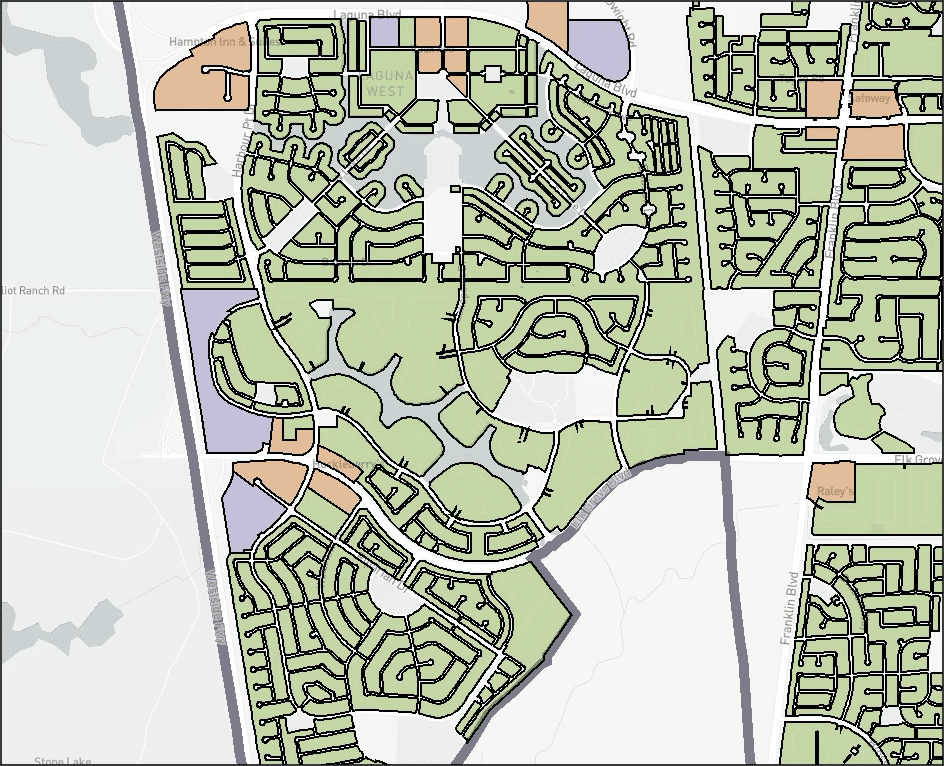
Laguna West did not cultivate substantial mixed-use areas or dense housing development and was not ultimately connected to the Sacramento light rail. Like much of the United States, Laguna West today is primarily single-family homes and wide car-friendly streets. Figure 1 shows the zoning districts where green is residential, orange is commercial, and purple is mixed-use. Quinn concludes that TOD alone “has very limited scope to change behaviors away from universal car use in the face of significant countervailing social and economic forces.” This sentiment appears to hold, at least so far.
Figure 1: Laguna West zoning districts
TOD today zoomed out
Laguna West’s incompatibility with TOD is not unique. Infrastructure across most of the United States continues to be mismatched with the complete vision. Instead of large-scale experiments, today’s TOD implementation is mostly large federal and state grants supporting comprehensive planning and connectivity studies. As of 2026, the Federal Transit Administration (FTA) has allocated over 68 million dollars total in competitive grants annually for areas taking on these projects.
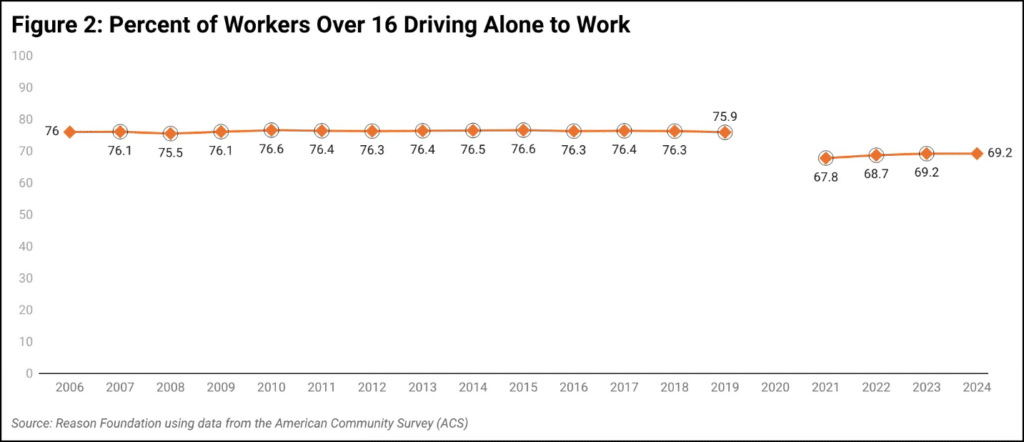
Despite this public investment, few places in the U.S. have achieved the level of walkability outlined by Calthorpe. Car dependency remained constant through the 2000s and 2010s, with around 75 percent of workers driving alone to work. It is only with the widespread shift to remote work during the COVID-19 pandemic, not through transformative urban policy, that this rate has recently fallen to 69.2 percent (see Figure 2).
TOD has not altered macro commuting patterns, but it has transformed some communities. Housing and transportation preferences are inherently local, and when applied in settings receptive to its underlying principles, TOD has demonstrated benefits.
TOD in action: Arlington, Virginia
One exemplary case of TOD can be found in Arlington County, Virginia, especially in the Rosslyn-Ballston corridor (R-B Corridor). While it is far from perfect, this area has integrated housing and transportation in a way that works for residents.
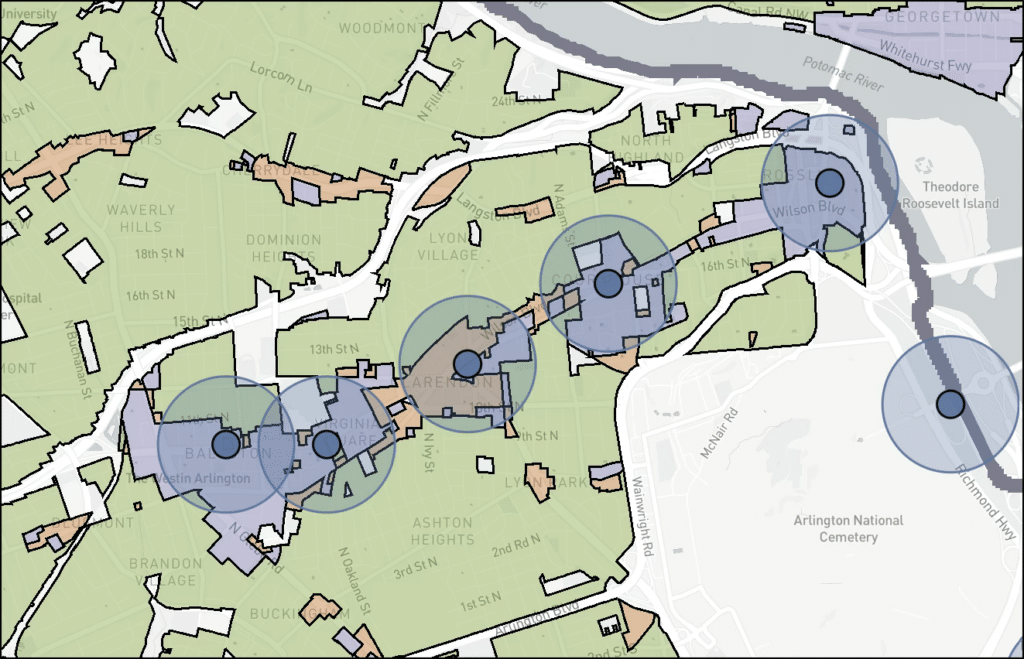
Arlington owes much of its growth to its connection to the Washington D.C. Metrorail, starting in the late 1970s. Rosslyn station opened in 1977, and the remaining four stations, Courthouse, Clarendon, Virginia Square, and Ballston, opened in 1979. Figure 3 depicts the corridor and the zoning around each stop.
Figure 3: Rosslyn-Ballston Corridor zoning districts with a one-quarter-mile radius of stops highlighted
Prior to the expansion of the metro, both Arlington’s population and economic activity were stagnating, with the R-B Corridor gaining the reputation of a “declining low-density commercial corridor.” When the metro was added, planners made intentional TOD-aligned zoning changes, allowing higher density and mixed-use development within a one-quarter-mile radius of stations. By building flexibility into land-use codes, the area could grow as needed. Today, the Ballston census tract is the densest in the entire Washington, D.C. area.
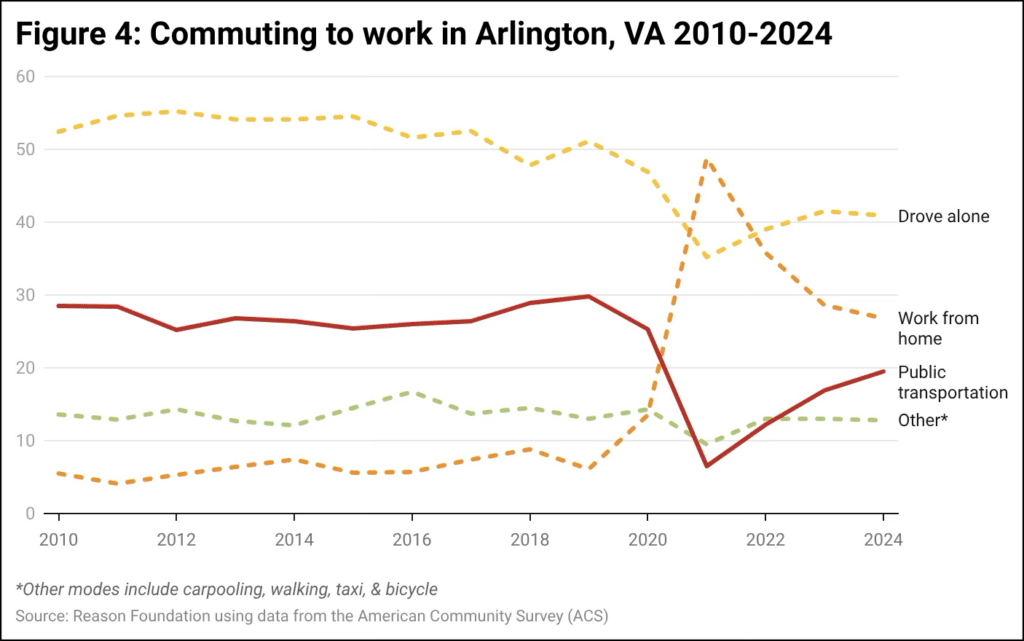
In 2020, Arlington ranked 10th nationwide among counties with the highest public transportation usage. Since the pandemic, rates have declined, though they are recovering (see Figure 4). Arlington’s high, generally consistent transit use signals successful TOD.
Further, TOD is involved in the area’s commercial success. As of 2025, Arlington is home to 213,900 jobs, with 87,400 of those in the R-B Corridor alone. That represents an increase of over 50 percent since 1980, suggesting that transit connectivity has helped drive economic activity. Population has increased nearly 60 percent in the same time period, and this growth has been concentrated among the transit corridors.
By metrics like population growth, economic expansion, and transit usage, Arlington’s TOD approach is among the most successful in the United States. The existing commercial base made the shift to mixed-use development more seamless, while the Washington Metro’s comprehensive network and short headways (time between trains) boosted ridership. Further, allowing density and residential development near stops enabled population growth, making Arlington an attractive place to live and work.
Even more promising is that Arlington County is not alone in this transformation. Neighboring Fairfax County has undergone a similar shift after a task force incorporated TOD principles there. If the success of TOD is measured by its ability to stimulate economic activity and revitalize an area’s population, northern Virginia is a success story. That said, Arlington has not been spared from the nationwide surge in home prices.
Remaining challenges in Arlington
Arlington County today is a very expensive place to live. In February 2026, the median home price reached $811,245. This figure results from several compounding factors.
First, Washington, D.C. has notoriously stringent building laws limiting development, most notably a strict height limit, pushing demand for urban space into Arlington. With only 26 square miles of space, this additional demand makes land scarce and expensive.
Land price appreciation is further driven by metro access itself. Evidence shows price increases following the system’s opening, consistent with research linking higher land and home prices to proximity to transit. Access to transit is a valuable amenity, underscoring the need for laws allowing this land to be used to its highest potential. The land premium is expected, but it explains only part of why housing in Arlington is so expensive.
Arlington’s TOD elements are helpful, but there are still several regulatory barriers to construction. Estimates from the American Enterprise Institute (AEI) find that through reforms like strategic lot split flexibilities and residential overlay by-right in more non-residential areas, Arlington County could add over 1,900 units annually. Further, stringent stormwater regulations and expensive permitting fees create supply restrictions that, when combined with the demand for this area, contribute to high prices. While these rules are not inherently unnecessary or harmful, they contribute to the cost of development in Arlington. The added value created by transit access highlights the importance of allowing markets to function freely and effectively in these desirable areas.
Takeaways from Arlington
TOD in Arlington contrasts with Laguna West by complementing and enhancing the existing urban form rather than trying to singularly transform it. Still, TOD has not fully insulated Arlington from nationwide housing price pressure. Arlington demonstrates both the potential of TOD for urban transformation and the reality that it cannot solve all housing challenges on its own.
Arlington as a case study illustrates what an incremental approach to TOD can look like in other places and the urban contexts where this approach works best. Well-executed TOD enables markets to determine how best to grow around transit, responding to the value created by improved access. From a housing perspective, urban policy focusing on this idea can expand residential development in underutilized areas near existing transit.
TOD from a housing perspective
In response to persistently high home prices nationwide, policymakers are looking to open pathways for housing supply expansion. Evidence shows that doing so is associated with a decrease in prices throughout the market. TOD is one of these avenues. Concentrating density near transit creates clusters that work in context rather than scattering development across the city. Higher density also makes commercial spaces more viable, supporting businesses in ways smaller, less connected developments rarely do. Because these projects are well-located, they attract broader political support. TOD presents an opportunity to expand housing supply while fusing housing and transportation needs for residents.
One critique of TOD is that some evidence suggests it does not substantially increase transit ridership, and development near transit is instead inhabited by those already using it, instead of drawing in new riders. A 1993 study surveying residents of a development near California rail found that the majority of current rail users already commuted to work via bus or rail at their previous residence. If the objective is simply to boost ridership through new users, that statistic might seem disappointing. However, if the aim is to better align housing choices with transportation preferences, then it’s a success.
By incorporating density increases and provisions for mixed-use development, policymakers can create opportunities for new housing where it is desired without overhauling the character and habits of a community. Housing-focused TOD should include the following characteristics to maximize possible opportunities.
1. Increase density within one-half mile of transit stops.
Developing housing near rail lines, rapid transit, express bus routes, and other heavily utilized transit options can increase supply while avoiding the political challenges that accompany typical upzoning efforts. Often, blanket reforms like eliminating single-family exclusive zoning can be met with resistance from community members for a variety of reasons, from environmental concerns to the desire to preserve property value. Proposing this targeted alternative can make these zoning changes more politically feasible and create opportunities for housing supply expansion.
The specifics of reform will depend on existing local rules and infrastructure. However, policymakers at all levels of government should look for opportunities to loosen density restrictions near transit to expand housing supply.
2. Couple density increases with minimum parking reductions.
Parking minimums have been shown to contribute greatly to the cost of housing. Spaces can cost tens of thousands of dollars to build, particularly in structured or underground parking lots. For low-income families, who own fewer cars on average, requiring one parking space for an apartment can raise rents by 6 percent of their budget.
Reducing parking requirements for new housing has long been a priority for affordable housing advocates, and this policy is most practical near transit. Residents who select these areas should have the option to match their transportation choices to their housing type without a needless parking premium. Eliminating or reducing parking requirements in these areas does not mean parking will disappear. It means developers can choose how much parking to provide, enabling new housing without unnecessary costs.
3. Allow mixed-use development by right.
While in the case of Laguna West, zoning changes did not automatically manifest in commercial interest, communities should seek to maintain their options. As cities move toward more-integrated land use policies, they should permit mixed-use development where feasible. It may not be desired in every context, but having the choice would keep communities flexible, moving them away from the legacy of single-use zones behind many of the urban challenges Calthorpe was responding to.
4. Have clear goals.
Moving forward, TOD efforts should focus on measurable outcomes. When grants are awarded for projects, deliverables like comprehensive plans are completed, but the tangible impacts, like changes in transit ridership, stimulated commercial activity, or new housing construction, are rarely reported.
Establishing goals and monitoring outcomes, especially when grants are involved, makes it possible to identify the successes and challenges of policy efforts. For example, if the goal is to expand housing supply and improve affordability, TOD should be paired with complementary zoning code reforms and land use liberalization. An outcome-driven vision for how transit works with development can help avoid the pitfalls of past efforts.
Examples of recent statewide TOD policy
Policies encouraging TOD have been enacted in several states to address housing challenges. While each state approaches TOD differently, all create pathways to housing growth that respond to local needs and complement the existing laws. Here are examples of promising statewide TOD policy efforts:
California Assembly Bill 2097 (2022) and Senate Bill 79 (2025)
In 2022, California passed AB 2097, which preempts the ability of local government to set minimum parking requirements on any development within one-half mile of public transit.
The California Legislature passed SB 79 in 2025 to complement and further the objectives of AB 2097. This bill classifies transit stops into tiers based on service intensity and establishes minimum density requirements that vary by distance from the stop. SB 79 will go into effect on July 1, 2026.
Together, SB 79 and AB 2097 create a cohesive development environment oriented towards housing development.
Massachusetts House Bill 4977 (2024)
Massachusetts’ HB 4977 has a subtle TOD component. The primary initiative in this bill is allowing accessory dwelling units (ADUs) by right on all single-family parcels across the state. The TOD element is that HB 4977 prohibits municipalities from requiring additional parking spaces for ADUs within one-half mile of transit stops, including commuter rail stations, subway stations, ferry terminals, and bus stations. In 2025 alone, Massachusetts approved over 1,200 ADUs.
While HB 4977 does not use TOD principles directly, it illustrates that interventions do not need to be sweeping to be valuable. Even modest deregulation can create opportunities for new housing.
Utah Senate Bill 217 (2021)
SB 217 in Utah establishes Housing and Transit Reinvestment Zones (HTRZ) across the state within one-third mile of commuter rail stations. Through a value capture technique, a portion of the additional tax revenue generated by new development is retained and reinvested locally to fund infrastructure, affordable housing, and other projects. The law is intended to encourage development near transit, increase ridership, and address housing growth challenges along transit corridors.
As of July 2024, seven approved municipalities are utilizing HTRZs, adding a projected 42,436 housing units. Utah’s approach offers an alternative model, establishing an optional system rather than preempting municipal zoning authority.
Washington House Bill 1110 (2023)
HB 1110 is a missing middle housing bill with transit proximity bonuses. This bill creates incremental zoning density increases for cities depending on population, with additional allowances near major transit stops. For example, in cities with a population greater than 75,000, up to four units are allowed on all residential lots. Within one-quarter mile of a major transit stop, six units are allowed.
HB 1110 liberalizes land use near transit through greater density while accounting for differences across cities of varying sizes. It exemplifies the use of TOD principles as a tool for policy that makes room for incremental housing supply expansion.
Recent legislation in context
Each of these policies displays a version of TOD that can be adapted to local political and planning contexts, even when provisions are marginal. While it is still too early to measure the full impact of the most recent legislation, early evidence from Utah suggests these provisions can facilitate new housing development.
Takeaways
Transit-oriented development was once framed as a complete solution to urban challenges, but U.S. infrastructure and consequent expectations have made full implementation difficult in many areas. Physical determinism alone, without economic or cultural backing, is not enough to reinvent transportation usage.
Rather than attempting to create urban design utopias in incompatible areas, TOD functions best as an incremental and politically feasible tool to increase density, remove unnecessary development barriers, and align housing with transportation needs in urban areas with existing transit. Several states have made policy changes encouraging development near transit without major zoning overhauls. Both projects and policy should remain grounded in the realities of existing neighborhoods, reflecting preferences while accommodating residents who rely on public transit. When framed as a housing supply expansion strategy rather than a transportation experiment, TOD is a practical tool for creating housing opportunities in places where demand is already strong.
The post Urban areas can expand housing supply through transit-oriented development appeared first on Reason Foundation.
Source: https://reason.org/commentary/urban-areas-can-expand-housing-supply-through-transit-oriented-development/
Anyone can join.
Anyone can contribute.
Anyone can become informed about their world.
"United We Stand" Click Here To Create Your Personal Citizen Journalist Account Today, Be Sure To Invite Your Friends.
Before It’s News® is a community of individuals who report on what’s going on around them, from all around the world. Anyone can join. Anyone can contribute. Anyone can become informed about their world. "United We Stand" Click Here To Create Your Personal Citizen Journalist Account Today, Be Sure To Invite Your Friends.
LION'S MANE PRODUCT
Try Our Lion’s Mane WHOLE MIND Nootropic Blend 60 Capsules
Mushrooms are having a moment. One fabulous fungus in particular, lion’s mane, may help improve memory, depression and anxiety symptoms. They are also an excellent source of nutrients that show promise as a therapy for dementia, and other neurodegenerative diseases. If you’re living with anxiety or depression, you may be curious about all the therapy options out there — including the natural ones.Our Lion’s Mane WHOLE MIND Nootropic Blend has been formulated to utilize the potency of Lion’s mane but also include the benefits of four other Highly Beneficial Mushrooms. Synergistically, they work together to Build your health through improving cognitive function and immunity regardless of your age. Our Nootropic not only improves your Cognitive Function and Activates your Immune System, but it benefits growth of Essential Gut Flora, further enhancing your Vitality.

Our Formula includes: Lion’s Mane Mushrooms which Increase Brain Power through nerve growth, lessen anxiety, reduce depression, and improve concentration. Its an excellent adaptogen, promotes sleep and improves immunity. Shiitake Mushrooms which Fight cancer cells and infectious disease, boost the immune system, promotes brain function, and serves as a source of B vitamins. Maitake Mushrooms which regulate blood sugar levels of diabetics, reduce hypertension and boosts the immune system. Reishi Mushrooms which Fight inflammation, liver disease, fatigue, tumor growth and cancer. They Improve skin disorders and soothes digestive problems, stomach ulcers and leaky gut syndrome. Chaga Mushrooms which have anti-aging effects, boost immune function, improve stamina and athletic performance, even act as a natural aphrodisiac, fighting diabetes and improving liver function. Try Our Lion’s Mane WHOLE MIND Nootropic Blend 60 Capsules Today. Be 100% Satisfied or Receive a Full Money Back Guarantee. Order Yours Today by Following This Link.


| Visits: | 1,811,792,371 |
| Stories: | 8,653,204 |
Whistler Blowers, Insiders

