

Ro Khanna’s “$25” Minimum Wage Bill

Reps. Ro Khanna (D‑CA) and Delia Ramirez (D‑IL) introduced a bill last month promising to raise the federal minimum wage to $25 per hour for large businesses by 2031 and for other employers by 2038. That would peg the federal minimum wage higher than any existing state or locality’s minimum wage. The large business minimum would beat any local wage floor even if it grows to match the Congressional Budget Office’s (CBO) projected inflation in the coming years.
That $25 per hour marketing is somewhat misleading, though. The Living Wage for All Act would primarily set the minimum wage at two-thirds of national median hourly earnings, subject to a phase-in cap not to exceed $25 by 2031.
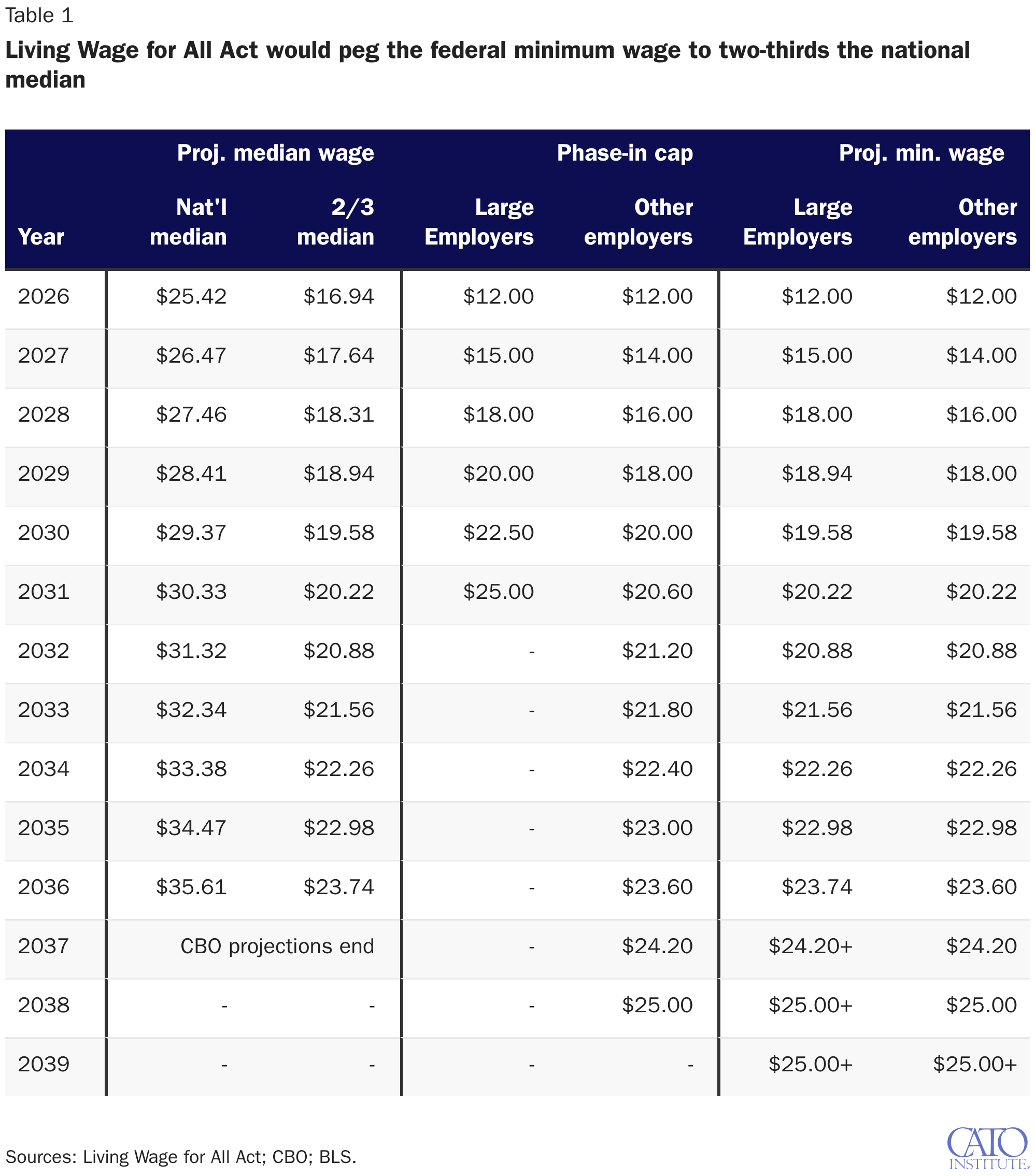
For most years, that’d just make the minimum wage two-thirds of the national median, and the “$25 by 2031” pledge little more than a red herring. Minimum wages wouldn’t reach $25 until 2038—much later if median wage growth significantly lags our upper-bound estimates based on CBO projections.
Notwithstanding the phase-in cap, pegging the minimum wage to two-thirds of the national median would’ve meant a $16.34 minimum wage in 2025 and a wage floor close to $20.22 in 2031. That would still be an extraordinary increase, which previous evidence suggests could be very destructive.
Khanna’s launch video offers two justifications for such an aggressive move: the need for the federal minimum to catch up to rising prices and the desirability of minimum wages tracking worker productivity.
Inflation-Adjustments
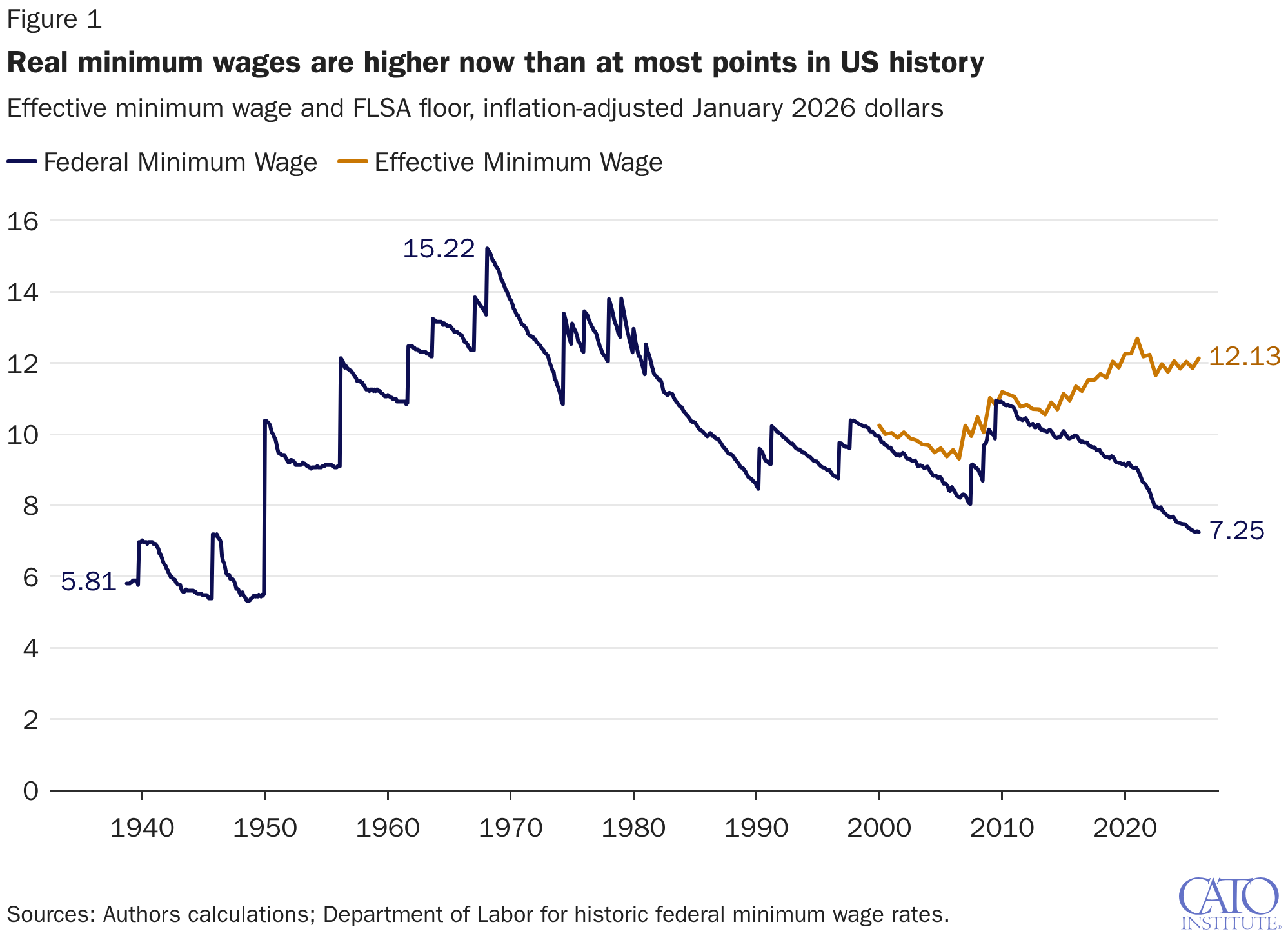
First, he says the inflation-adjusted 1968 federal minimum wage was $14 per hour in modern, 2026 dollars. Methods of inflation-adjusting can yield slightly different results, but using the Consumer Price Index, we think the real February 1968 Fair Labor Standards Act (FLSA) wage floor was actually a bit higher at $15.22 in inflation-adjusted, January 2026 dollars.
And even though the federal floor today sits at just $7.25, that doesn’t make his conclusion that “workers today are making half what they made in 1968” true. For starters, just 1 percent of workers made the federal minimum wage in 2024, as market wages have grown significantly without changes to the federal floor. But also, state and local policymakers have raised their own minimum wages significantly, making the federal floor irrelevant for most workers.
As we show in a recent briefing paper, the population-weighted effective minimum wage—the greatest of each locality’s federal, state, or local floor averaged across all working-age Americans—was $12.13 in January 2026. The population-weighted median was $13.73 (more Americans live in states with $15 or more minimum wages than the federal floor). Most Americans today therefore live under a minimum wage much closer to the real 1968 value than Representative Khanna lets on.
And why does Khanna compare the current federal floor to the 1968 one? Probably because 1968’s FLSA regime was the highest real wage floor in US history. Had he averaged over the full 90-year history of the federal minimum wage, the figure is only $9.92.
Even if you cut off the historically low, depression-era minimum wages, the average real minimum wage since 1950 is $10.49. And even taking off the period since 2010, the average only rises to $11.16.
The modern effective minimum wage factoring in state and local laws is higher than all of these. You’d need to cherry-pick only 1960–1980 to average a higher federal floor of $12.78, and even that is far afield of Khanna’s $14. The real federal minimum wage has almost never been as high as $14.
Productivity-Adjustments
Rep. Khanna doesn’t just want a return to the 1968 wage floor, though. His second justification brings in productivity. Since average real labor productivity has increased 2.5 times, he argues that “the average worker is producing two and a half times more value than they were producing in 1968, yet they’re being paid half as much.” That justifies a $25 minimum wage for him.
The problem is that comparing average productivity to the minimum wage is apples and oranges. Minimum wages don’t bind average workers. They affect the lowest-paid workers, who tend to cluster in sectors with productivity levels, and sometimes productivity growth, well below the economy-wide average.
Historic productivity gains in oil and gas extraction, for example, raise economy-wide labor productivity, but they have little direct bearing on the productivity of those in lower-wage sectors such as fast food, childcare, or retail cashiers.
Labor productivity of couriers and messengers or warehouse and storage employees have decreased since 2010. Demanding higher minimum wages in these industries, even while productivity has fallen, is a recipe for layoffs or lower hiring.
In truth, even sectoral productivity is too blunt a benchmark. Within any given sector, productivity gains accrue unevenly. Even if median productivity rises, a similar number of workers’ marginal product can remain just at or above the minimum wage if the variance of worker productivity also expands. That’s exactly what we might expect from a dynamic and diversifying economy.
Tying the minimum wage to middle-band worker productivity therefore risks overshooting the marginal product of the least-productive workers. The result we’d expect is “disemployment,” whether through layoffs, hour cuts, or lowered future hiring. That’s because paying above a worker’s marginal product will be a losing proposition for employers, so they will reduce demand for workers, at least if they can’t recoup costs by trimming back on other aspects of their employment bill.
Consequences of a 67 Percent of Median Hourly Pay Wage Floor
Minimum wages set too high or increased aggressively have a real capacity to do harm. Studies of even moderate minimum wage increases tend to find degraded noncash compensation or working conditions to offset the cost. That’s one reason why, if we are to have this form of price control, at least a federalist approach might limit the damage.
Local leaders inevitably will have more intimate knowledge of their labor markets and can (at least in theory) tailor their intervention to local conditions. A $25 federal floor would override all that local calibration while hitting hardest in low-cost areas where market wages are furthest from two-thirds of the national median.
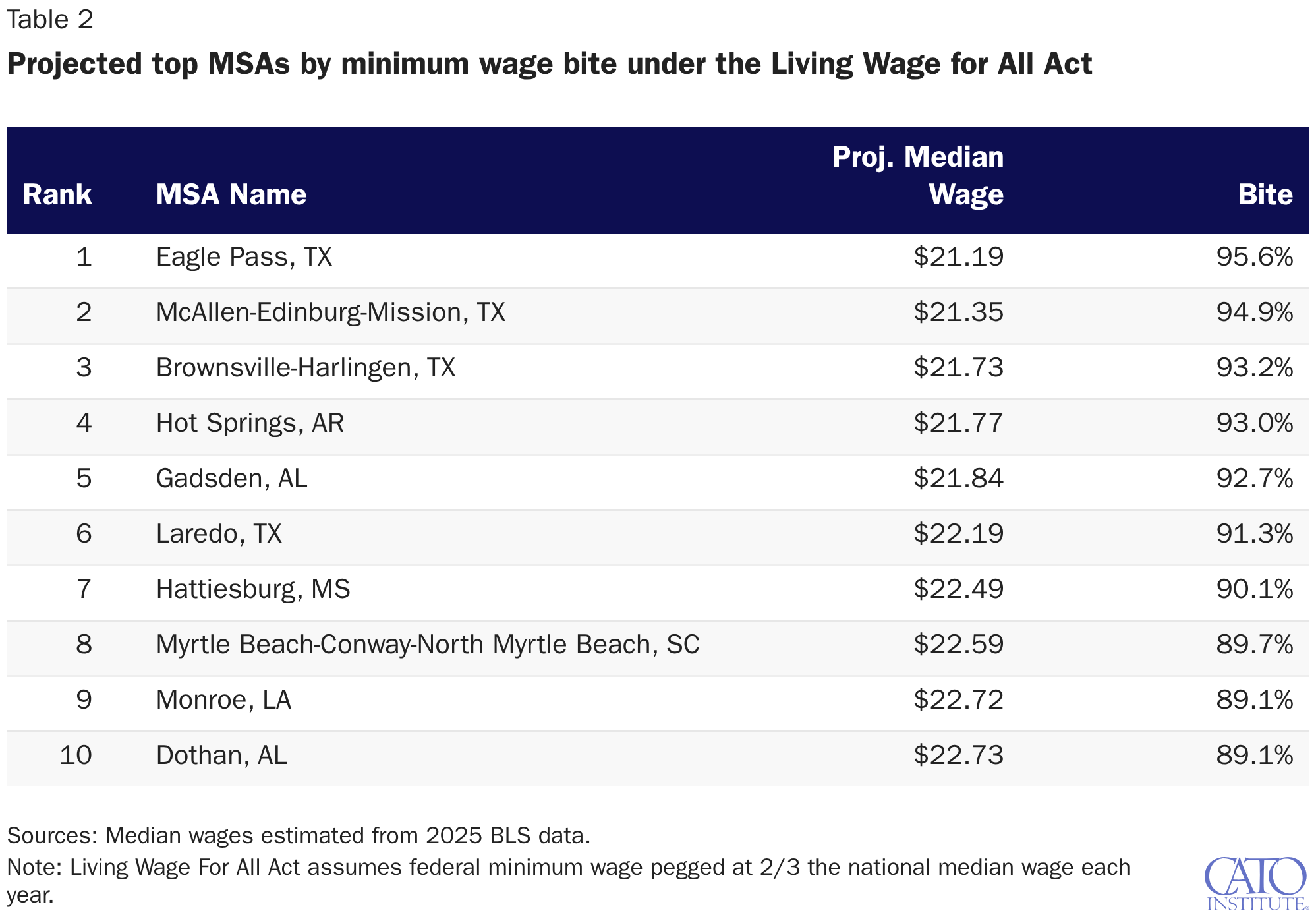
Representative Khanna’s district would be relatively fine; the San Jose–Sunnyvale–Santa Clara metropolitan statistical area (MSA) regularly has the highest median hourly wage of any metro area in the country, $40.41 in 2025. But other MSAs with local economies less productive than Silicon Valley inevitably won’t fare as well. As we show in our policy brief, the Living Wage for All Act would raise minimum wages as high as 95 percent of local median wages in America’s most-affected MSAs. They wouldn’t be lifted up, so much as priced out.
The United Kingdom currently has just this national policy of linking the country’s minimum wage to two-thirds of median hourly pay. Even the UK government’s reports on the policy note a host of problems created through wage “compression,” whereby the policy distorts relative prices of different jobs and discourages people to move up and take more responsibility.
Such a policy across the diverse US economy would be extremely risky indeed.
Source: https://www.cato.org/blog/ro-khannas-25-minimum-wage-bill
Anyone can join.
Anyone can contribute.
Anyone can become informed about their world.
"United We Stand" Click Here To Create Your Personal Citizen Journalist Account Today, Be Sure To Invite Your Friends.
Before It’s News® is a community of individuals who report on what’s going on around them, from all around the world. Anyone can join. Anyone can contribute. Anyone can become informed about their world. "United We Stand" Click Here To Create Your Personal Citizen Journalist Account Today, Be Sure To Invite Your Friends.
LION'S MANE PRODUCT
Try Our Lion’s Mane WHOLE MIND Nootropic Blend 60 Capsules
Mushrooms are having a moment. One fabulous fungus in particular, lion’s mane, may help improve memory, depression and anxiety symptoms. They are also an excellent source of nutrients that show promise as a therapy for dementia, and other neurodegenerative diseases. If you’re living with anxiety or depression, you may be curious about all the therapy options out there — including the natural ones.Our Lion’s Mane WHOLE MIND Nootropic Blend has been formulated to utilize the potency of Lion’s mane but also include the benefits of four other Highly Beneficial Mushrooms. Synergistically, they work together to Build your health through improving cognitive function and immunity regardless of your age. Our Nootropic not only improves your Cognitive Function and Activates your Immune System, but it benefits growth of Essential Gut Flora, further enhancing your Vitality.

Our Formula includes: Lion’s Mane Mushrooms which Increase Brain Power through nerve growth, lessen anxiety, reduce depression, and improve concentration. Its an excellent adaptogen, promotes sleep and improves immunity. Shiitake Mushrooms which Fight cancer cells and infectious disease, boost the immune system, promotes brain function, and serves as a source of B vitamins. Maitake Mushrooms which regulate blood sugar levels of diabetics, reduce hypertension and boosts the immune system. Reishi Mushrooms which Fight inflammation, liver disease, fatigue, tumor growth and cancer. They Improve skin disorders and soothes digestive problems, stomach ulcers and leaky gut syndrome. Chaga Mushrooms which have anti-aging effects, boost immune function, improve stamina and athletic performance, even act as a natural aphrodisiac, fighting diabetes and improving liver function. Try Our Lion’s Mane WHOLE MIND Nootropic Blend 60 Capsules Today. Be 100% Satisfied or Receive a Full Money Back Guarantee. Order Yours Today by Following This Link.


| Visits: | 1,811,268,704 |
| Stories: | 8,652,348 |
Whistler Blowers, Insiders

