

Reducing barriers to manufactured homes

With the median sale price of a single-family home in the United States reaching $398,771 in May 2026, many buyers are looking for more affordable options. Building homes in factories rather than using traditional on-site building methods is a way to both expedite construction timelines and reduce the cost of delivering new homes.
Prefabricated homes are built partially or entirely off-site and then transported to their final location. A common type is a manufactured home. These homes are built entirely in a factory to standards set by the Department of Housing and Urban Development (HUD), so they’re often called “HUD-code homes.” One of these standards is that they have historically been required to sit on a permanent steel chassis, which is a towable frame used to transport them. That requirement contributes to their lingering association with single-wide trailers, even though many are large, multi-section homes that resemble site-built houses.
Factory-building has substantial cost savings due to lower labor costs, economies of scale, and fewer weather-related delays. Freddie Mac estimates that the per-square-foot cost of building a manufactured home is nearly 48% less than the cost of building a traditional site-built home. In January 2026, the average price of a new manufactured home in the United States was $131,700.
Despite their relative affordability, zoning codes in many areas either exclude manufactured homes or place undue restrictions on them. Rather than let property owners choose a demonstrably safe type of housing to put on their land, local governments impose their aesthetic preferences, arbitrarily limiting Americans’ ability to buy and use these homes. In a time of persistent housing affordability challenges, policymakers searching for solutions could start by allowing buyers to determine what type of housing best meets their needs.
The recent history of factory-built housing
While early instances of prefabricated construction methods can be traced to much earlier, factory-built housing gained popularity in the U.S. following World War II. With housing in short supply and the return of soldiers with growing families, trailers and mobile homes were a common choice due to their rapid construction timelines and relatively low cost. Whereas manufactured homes were previously used as recreational vehicles and temporary accommodation, with new demand they came to be seen as long-term housing options.
In response to this popularization, Congress passed the National Manufactured Housing Construction and Safety Standards Act in 1974, instructing HUD to create a list of safety standards manufactured housing had to meet. By 1976, the Federal Manufactured Home Construction and Safety Standards became law, preempting all state and local rules for these homes.
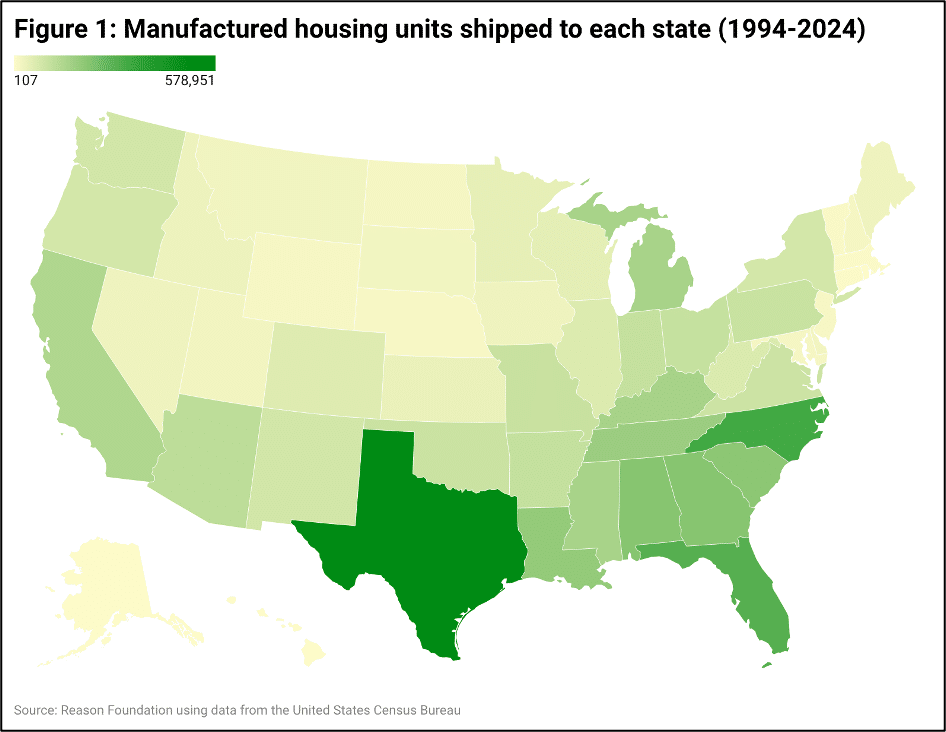
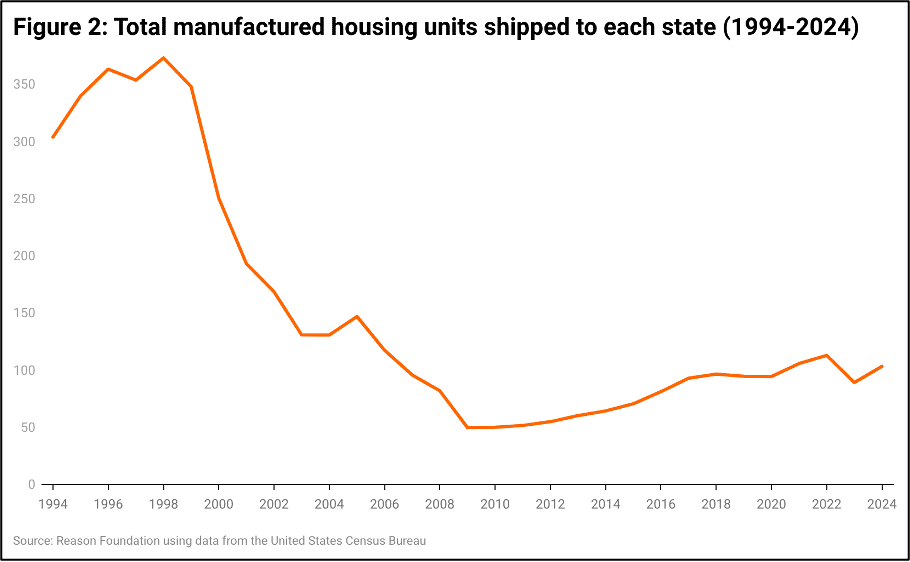
Into the 1990s, the prevalence of manufactured homes grew still, especially among low-income families in rural areas in the South, who saw them as a path to homeownership and independence (see Figure 1). However, unsustainable lending practices in this period also led to cascading foreclosures and a resulting surplus of units. Production was even further discouraged by continued foreclosures and economic distress resulting from the 2008 financial crisis. Manufactured homes have yet to regain their peak production quantities (see Figure 2).
Despite advantages in both cost and production speed, HUD estimates that today manufactured housing accounts for only 7% of the housing stock in the United States. However, other countries have integrated prefabricated housing more thoroughly. In Sweden, for example, factory-building is the dominant construction method. Japan also has a vibrant prefabricated home industry. While neither country is necessarily analogous to the United States, they demonstrate that prefabricated housing has potential to become a meaningful part of the housing landscape if builders and developers are allowed to utilize it.
Current estimates find the United States is short 7.2 million units that are affordable to extremely low-income renters. While adding housing at any price point helps overall affordability, factory-built housing is particularly well-suited for households seeking quick, low-cost, independent living options. Using this technology to add units in residential areas, both as standalone homes and in combination with other affordability strategies like multifamily development and infill through accessory dwelling units (ADUs), is a promising and largely untapped opportunity. Decades of regulatory barriers have made widespread adoption challenging. Examining both how these regulations came to be and what progress is being made to reverse them can offer insight into how to better incorporate these options into a dynamic and responsive housing market.
Remaining challenges
Like other relatively affordable housing types, among the largest challenges to prefabricated housing today are restrictive zoning laws brought about by aesthetic preferences. Historically, prefabricated construction methods have been associated with low-income housing and, as a result, are often confined to rural areas on city outskirts. Today, 49% of manufactured homes are outside of metropolitan statistical areas, as opposed to only 22% of all single-family homes. Beyond explicit limits on where manufactured housing can be placed, other restrictions are more covert.
Some areas have exorbitant minimum lot size and setback requirements for manufactured homes, simultaneously pushing them to rural areas and nullifying affordability gains. An examination of the zoning code for areas allowing manufactured housing finds that 57% have a minimum lot size of one-half acre or greater per unit. High minimum lot size requirements are associated with higher home prices regardless of construction type. However, these constraints are particularly harmful to factory-built housing because they undermine its core cost advantage and erode the efficiency gains delivered by the construction technology.
Other widespread restrictions include special permit requirements for manufactured homes and additional aesthetic and design standards beyond the HUD code requirements.
Removing these unnecessarily restrictive laws where they persist is one of the most straightforward ways to lower barriers to the adoption of prefabricated housing.
Policy principles and recent policy changes
Policy on factory-built homes should integrate them into the broader housing market instead of legally treating these homes as marginal.
However, despite their potential to expand affordability, governments should avoid subsidizing projects, as recent efforts in California have attempted to do. Effective policy should allow these homes to compete without further distorting the market, either in their favor or against them.
Both on the state and federal level, policymakers have been moving to make it easier to build prefabricated homes and invite innovation in the home-building space. Statewide policies in Florida, Idaho, and Kentucky have been leading the way on limiting discrimination against these homes, while at the federal level, policymakers are rethinking definitions and parameters.
Recent state-level policy changes
Florida House Bill 399 (2026)
Signed into law on March 27, 2026, this law prohibits local governments from denying building permits for manufactured homes based solely on their construction method or regulating them more stringently than comparable site-built homes. It further requires that off-site constructed dwellings be permitted as of right in any zoning district where traditional housing is allowed. This law is especially helpful in the context of Florida’s population and housing landscape. The median age of Florida residents is among the highest in the United States, meaning many Floridians rely on fixed incomes. Due to the lower cost and maintenance requirements of manufactured homes, they can be especially useful for aging homeowners. Highlighting this benefit is one of the reasons this push was successful. HB 399 will go into effect on January 1, 2027.
Idaho House Bill 800 (2026)
As part of a sweeping 2026 housing package tackling minimum lot sizes, accessory dwelling units (ADUs), single-stair apartments, and permitting reform, Idaho included a significant provision for manufactured housing. House Bill 800, signed in April 2026, requires cities to allow manufactured single-unit homes wherever they permit single-family housing, and permits manufactured duplexes in multifamily zones. It further lowers minimum size requirements and clarifies that single-section and smaller units cannot be zoned out. HB 800 goes beyond standard zoning preemption by proactively neutralizing potential local workarounds, such as minimum size requirements, that could be used to undermine the law’s provisions. This law took effect on July 1, 2026.
Kentucky House Bill 160 (2025)
Kentucky’s House Bill 160 was signed into law on April 1, 2025, and prohibits local governments from adopting or enforcing zoning regulations that treat manufactured homes differently from site-built single-family homes. All architectural standards applied to manufactured homes must be the same as those applied to other single-family homes, and any zoning regulations that violate these provisions are unenforceable. HB 160 took effect on July 1, 2026.
Recent federal action
On July 11, 2026, the 21st Century ROAD to Housing Act became law and eliminated the permanent chassis requirement for manufactured homes.
Since 1974, when the initial HUD code was created, all manufactured homes have had to be built on a permanent steel chassis, which enables easy transportation. This requirement came from the expectation that the advantage of these homes was their mobility. Today, however, “fewer than 5–7 percent of all manufactured homes are ever moved after initial placement,” indicating that the requirement functions as an unnecessary cost burden rather than an integral component of the product’s definition. Home foundations, which can be permanent or not, are distinct from the chassis, and will still comply with all applicable building codes.
Recent estimates indicate that the permanent chassis requirement increases the cost of a manufactured home by $5,000 to $10,000, as the steel chassis must remain permanently attached to each home rather than being reused to transport multiple units. Eliminating the requirement could, therefore, produce substantial savings for buyers, making manufactured homes even more affordable relative to site-built homes.
The potential benefits, however, extend beyond immediate cost savings. Eliminating the permanent chassis requirement could facilitate the integration of manufactured housing into conventional residential neighborhoods while expanding opportunities to apply factory-built construction techniques to multistory housing. Removing this requirement could greatly expand the architectural possibilities while using the same technology, including making it “easier to build multilevel units or basements, and to have the main levels closer to the ground.”
Reforming the permanent chassis requirement is an example of effective federal housing policy. Although land-use decisions and the integration of manufactured housing ultimately remain the responsibility of state and local governments, reforming the federal standards that define manufactured housing removes an unnecessary regulatory barrier to lower-cost construction, ultimately reducing costs for homebuyers.
Takeaways
Policymakers at both the state and federal levels are recognizing the potential of factory-built housing and updating land use rules to better accommodate a strained market in urgent need of new and affordable supply. These legislative changes mark an important policy evolution, with their full effects on manufactured housing production likely to emerge over time. The importance of this and similar legislation is that they reinforce the principle that housing choices, including construction methods, should be determined by buyers and sellers.
The post Reducing barriers to manufactured homes appeared first on Reason Foundation.
Source: https://reason.org/commentary/reducing-barriers-to-manufactured-homes/
Anyone can join.
Anyone can contribute.
Anyone can become informed about their world.
"United We Stand" Click Here To Create Your Personal Citizen Journalist Account Today, Be Sure To Invite Your Friends.
Before It’s News® is a community of individuals who report on what’s going on around them, from all around the world. Anyone can join. Anyone can contribute. Anyone can become informed about their world. "United We Stand" Click Here To Create Your Personal Citizen Journalist Account Today, Be Sure To Invite Your Friends.
LION'S MANE PRODUCT
Try Our Lion’s Mane WHOLE MIND Nootropic Blend 60 Capsules
Mushrooms are having a moment. One fabulous fungus in particular, lion’s mane, may help improve memory, depression and anxiety symptoms. They are also an excellent source of nutrients that show promise as a therapy for dementia, and other neurodegenerative diseases. If you’re living with anxiety or depression, you may be curious about all the therapy options out there — including the natural ones.Our Lion’s Mane WHOLE MIND Nootropic Blend has been formulated to utilize the potency of Lion’s mane but also include the benefits of four other Highly Beneficial Mushrooms. Synergistically, they work together to Build your health through improving cognitive function and immunity regardless of your age. Our Nootropic not only improves your Cognitive Function and Activates your Immune System, but it benefits growth of Essential Gut Flora, further enhancing your Vitality.

Our Formula includes: Lion’s Mane Mushrooms which Increase Brain Power through nerve growth, lessen anxiety, reduce depression, and improve concentration. Its an excellent adaptogen, promotes sleep and improves immunity. Shiitake Mushrooms which Fight cancer cells and infectious disease, boost the immune system, promotes brain function, and serves as a source of B vitamins. Maitake Mushrooms which regulate blood sugar levels of diabetics, reduce hypertension and boosts the immune system. Reishi Mushrooms which Fight inflammation, liver disease, fatigue, tumor growth and cancer. They Improve skin disorders and soothes digestive problems, stomach ulcers and leaky gut syndrome. Chaga Mushrooms which have anti-aging effects, boost immune function, improve stamina and athletic performance, even act as a natural aphrodisiac, fighting diabetes and improving liver function. Try Our Lion’s Mane WHOLE MIND Nootropic Blend 60 Capsules Today. Be 100% Satisfied or Receive a Full Money Back Guarantee. Order Yours Today by Following This Link.


| Visits: | 1,829,725,143 |
| Stories: | 8,690,944 |
Whistler Blowers, Insiders

