

The Trade War Was a Problem Before Iran—Congress Can End It

One postmortem of the sharp rebuke voters delivered to President Trump’s GOP is that the war in Iran spoiled an otherwise successful economic agenda. Meanwhile, the president’s trade war is allegedly working exactly as planned. In the administration’s preferred counterfactual, but for Iran, Americans would recognize that we’ve already won.
Unfortunately, the trade war has more in common with the hot war in Iran than its defenders will admit. Both have featured repeated escalation and de-escalation, grand announcements of impending victory, and uncertainty about what comes next. Trade policy has also brought abandoned agreements, letters of intent that never become binding deals, constantly shifting tariff rates and exemptions, and a mishmash of dubious presidential authorities, some of which have already been struck down by the Supreme Court.
The war in Iran raised oil prices, making gasoline and diesel dramatically more expensive. Almost every household feels it at the pump. In economists’ terms, gasoline is an input into the household production function: commuting to work, getting kids to school and sporting events, or shopping for groceries. When that input costs more, families postpone purchases and struggle to pay other bills.
American businesses face the same energy shock, but tariffs were already increasing the costs of their parts, materials, and machinery. Managers respond by raising prices, absorbing costs, or delaying hiring and investment. The Iran war was layered on top of an already difficult business environment.
These aren’t hypothetical effects. The trade war began nearly a year before the Iran war, giving us evidence of its costs. A recent study of the 2025 tariffs finds that about 90 percent of the duties were passed through to tariff-inclusive prices paid by US importers—not absorbed by foreign exporters. A Federal Reserve analysis estimates that tariffs raised core goods prices by 3.1 percent and the overall core PCE price level, excluding food and energy, by 0.8 percent through February 2026. Foreign exporters could lower their prices enough to absorb tariffs, but that’s a zombie idea in practice, refuted by multiple studies. It’s about as plausible as gas stations absorbing the cost of higher oil prices.
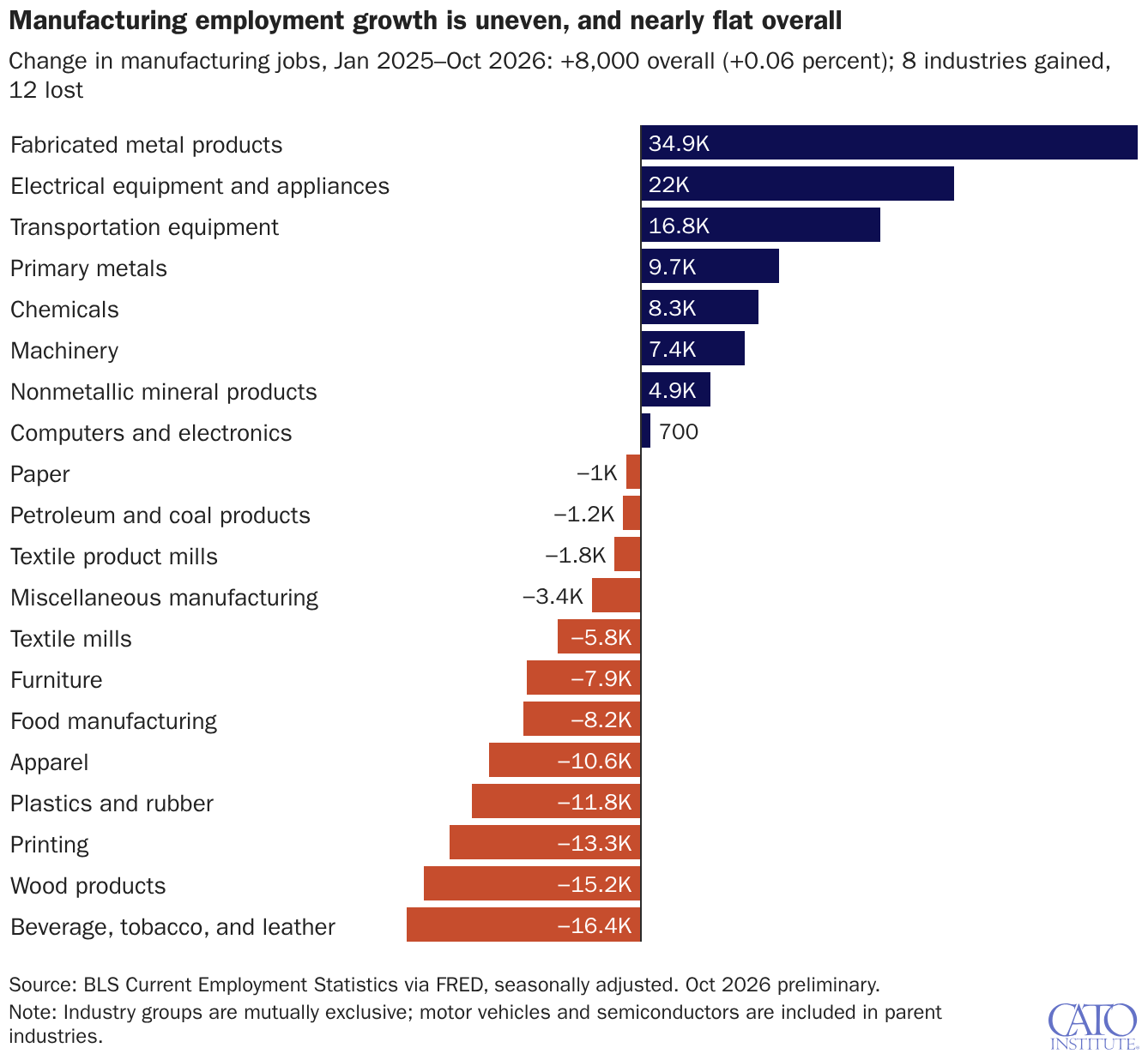
Manufacturing employment has recovered in 2026, but some credit may belong to reining in the tariff chaos that characterized 2025. Factories lost about 93,000 jobs from January through December 2025, then added 101,000 through October 2026. The net gain since January 2025 is just 8,000 jobs, or 0.06 percent of total employment growth in manufacturing. Total employment growth rates in the rest of the economy, while not great, were about 10 times higher at 0.7 percent.
Beneath that nearly flat total, durable-goods manufacturers gained about 70,000 jobs, while nondurable-goods producers lost 62,000 jobs. Of 20 major manufacturing industries, 12 lost jobs. Fabricated metals added about 35,000 jobs and electrical equipment 22,000, but autos, textiles and apparel, furniture, wood products, and plastics all shed workers.
Broad sectors such as fabricated metals, electrical equipment, and transportation equipment added workers, but beneath the surface the story is different. The auto sector, one of the most affected industries from tariff chaos around the US-Mexico-Canada Agreement, lost 10,000 jobs since January 2025. Even computers and electronics gained only about 700 jobs because the semiconductor and electronic components subsectors lost more than 10,000. These are in addition to the losses in textiles and apparel, furniture, wood products, and plastics. The BLS industry data hardly describe a broad-based manufacturing jobs boom.
The US did experience a boom in factory construction, but the timing and composition are hardly consistent with a tariff-driven renaissance. A Kansas City Federal Reserve study finds that real manufacturing construction spending peaked in November 2024, before Trump returned to office, and has since fallen 37 percent. Almost all the recent growth in manufacturing capacity is concentrated in computers, communications equipment, and semiconductors—industries accounting for only about 3 percent of manufacturing output. These high-tech industries also tend to face lower tariffs or benefit from exemptions, while more protected industries have generally grown more slowly.
But the question is not simply whether manufacturing jobs increased. It’s how much more manufacturing employment and business investment could have grown without the trade war. A recently published Federal Reserve study finds that during Trump’s first trade war, employment losses from higher input costs and foreign retaliation more than offset gains from import protection. A new Boston Fed study examining firms exposed to the 2025 tariffs finds reductions in sales, including effects transmitted indirectly through domestic suppliers. In a June 2025 CFO survey, more than four in ten financial executives reported postponing, scaling back, or canceling investments because of trade policy concerns. By March 2026, 39 percent of firms still reported that tariffs and trade uncertainty affected their price expectations, and nearly half reported the same for costs.
The administration and incoming Congress should seek an end to the Iran conflict to reduce economic pain for American businesses and consumers. But the Iran war doesn’t have a simple on/off switch. The trade war is one Congress has the power to end. It can reclaim authority over tariffs and begin reversing the higher costs and uncertainty imposed on businesses and households.
There is a precedent for the new Congress to think bigger and deliver lower costs for an electorate that is now decidedly opposed to Trump’s tariffs. The US led its allies in building a more open trading system after a period of high protectionism and the damage caused by World War II. We don’t have to imagine the benefits to consumers or what businesses could accomplish with lower trade barriers and more predictable trade policy. We already know because we’ve done it before.
Source: https://www.cato.org/blog/trade-war-was-problem-iran-congress-can-end-it
Anyone can join.
Anyone can contribute.
Anyone can become informed about their world.
"United We Stand" Click Here To Create Your Personal Citizen Journalist Account Today, Be Sure To Invite Your Friends.
Before It’s News® is a community of individuals who report on what’s going on around them, from all around the world. Anyone can join. Anyone can contribute. Anyone can become informed about their world. "United We Stand" Click Here To Create Your Personal Citizen Journalist Account Today, Be Sure To Invite Your Friends.
LION'S MANE PRODUCT
Try Our Lion’s Mane WHOLE MIND Nootropic Blend 60 Capsules
Mushrooms are having a moment. One fabulous fungus in particular, lion’s mane, may help improve memory, depression and anxiety symptoms. They are also an excellent source of nutrients that show promise as a therapy for dementia, and other neurodegenerative diseases. If you’re living with anxiety or depression, you may be curious about all the therapy options out there — including the natural ones.Our Lion’s Mane WHOLE MIND Nootropic Blend has been formulated to utilize the potency of Lion’s mane but also include the benefits of four other Highly Beneficial Mushrooms. Synergistically, they work together to Build your health through improving cognitive function and immunity regardless of your age. Our Nootropic not only improves your Cognitive Function and Activates your Immune System, but it benefits growth of Essential Gut Flora, further enhancing your Vitality.

Our Formula includes: Lion’s Mane Mushrooms which Increase Brain Power through nerve growth, lessen anxiety, reduce depression, and improve concentration. Its an excellent adaptogen, promotes sleep and improves immunity. Shiitake Mushrooms which Fight cancer cells and infectious disease, boost the immune system, promotes brain function, and serves as a source of B vitamins. Maitake Mushrooms which regulate blood sugar levels of diabetics, reduce hypertension and boosts the immune system. Reishi Mushrooms which Fight inflammation, liver disease, fatigue, tumor growth and cancer. They Improve skin disorders and soothes digestive problems, stomach ulcers and leaky gut syndrome. Chaga Mushrooms which have anti-aging effects, boost immune function, improve stamina and athletic performance, even act as a natural aphrodisiac, fighting diabetes and improving liver function. Try Our Lion’s Mane WHOLE MIND Nootropic Blend 60 Capsules Today. Be 100% Satisfied or Receive a Full Money Back Guarantee. Order Yours Today by Following This Link.


| Visits: | 1,838,785,163 |
| Stories: | 8,738,451 |
Whistler Blowers, Insiders

