

Build! Baby! Build! – Floating Freedom Cities: The Indo-Pacific’s Next Château Frontenac and Strategic Frontier

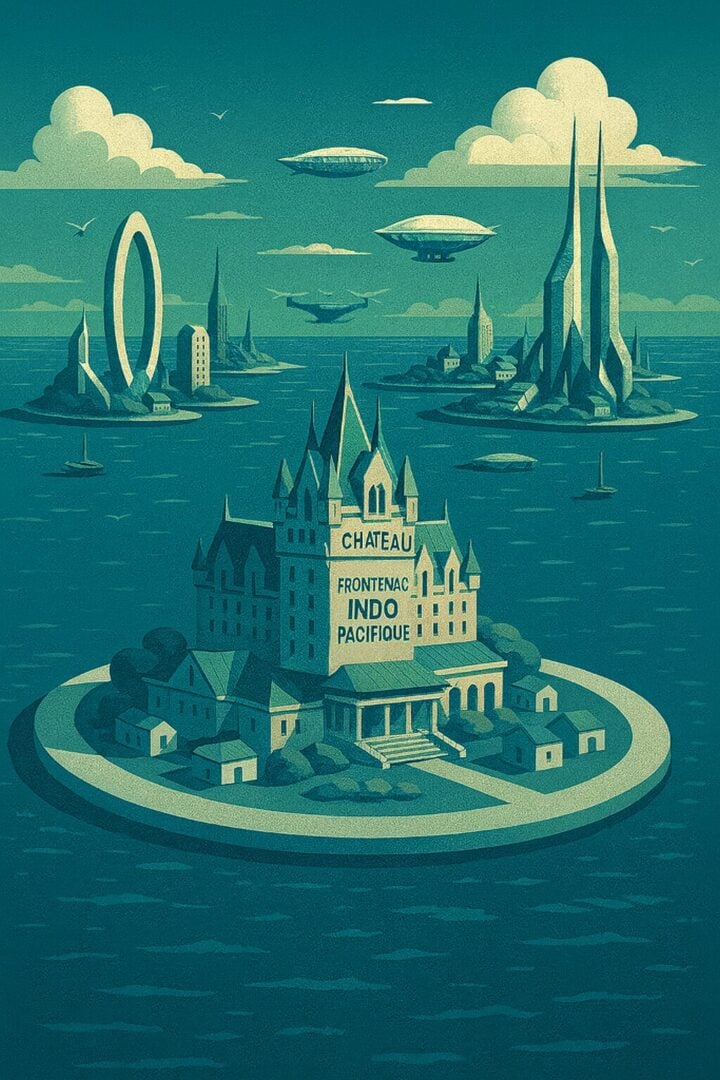
Retro-futuristic illustration of Château Frontenac Indo-Pacifique, surrounded by futuristic floating cities and airships(Artwork by ChatGPT, 2025)
Sea‑level rise is no longer a distant warning but an active force reshaping coastal geographies—threatening infrastructure, displacing communities, and exposing the limits of traditional urban planning. As these pressures intensify, global institutions are reimagining what future cities must become to withstand environmental volatility. Meanwhile, on a wholly separate track, populist political visions are revisiting the idea of new cities not out of climate necessity but out of a desire for mobility, opportunity, and a renewed appetite for frontier‑style experimentation. Yet both trajectories, for different reasons, could plausibly converge on the same notional theater: the Pacific Ocean, a vast expanse that some in Washington still, with a characteristically patriotic flourish, call “American lake.”
Against this evolving backdrop, UN‑Habitat’s floating‑city initiative steps in as the global institutional expression of these shifting ambitions—anchoring its efforts in the Indo‑Pacific, where the earliest practical attempts to build sustainable, resilient ocean‑based habitats are already unfolding. The concept first took formal shape in 2019, when more than 70 stakeholders gathered at UN Headquarters to evaluate floating cities not as speculative fiction but as viable responses to coastal vulnerability and housing scarcity. UN‑Habitat’s leadership emphasized that such innovation must benefit “all people,” underscoring inclusivity, affordability, and environmental responsibility.
On the other side sits an unexpectedly parallel vision from U.S. President Donald J. Trump, who in 2023 proposed constructing up to ten ‘Freedom Cities’ on unused federal land—futuristic settlements with advanced infrastructure, vertical take‑off vehicles, mass‑produced homes, and a bid to reopen the frontier of American development. His proposal reframed challenges of affordability, mobility, and industrial decline as opportunities for ambitious reinvention.
Despite their divergent motivations—UN‑Habitat driven by global equity and rising seas, Trump by economic dynamism and national aspiration—both frameworks share a foundational recognition: the static, land‑bound city is losing relevance. Their overlap hints at the emerging idea of ‘floating freedom cities,’ where Pacific Island sovereignty and American patriotism intersect in surprising ways. In this light, the question is no longer whether such visions belong to speculative futurism, but how—and how soon—they might materialize in the Indo‑Pacific’s high‑stakes environments. And even though the United States is not yet directly constructing floating cities, the diplomatic, industrial, and regional maneuvering surrounding them is already underway—quietly shaping the context into which the next phase of development will emerge.
Current Development Status — Maldives vs UN‑Habitat’s Oceanix
Floating cities have moved decisively beyond theory, and nowhere is this more evident than in the Maldives—arguably the world’s most vulnerable proving ground for ocean‑based urbanism. A full floating settlement is already taking shape there, where rising seas threaten nearly 80 percent of national territory. As reported, the Maldives Floating City—developed with Dutch marine engineers—has been designed as a 200‑hectare lagoon community composed of nearly 5,000 coral‑patterned housing modules. Engineered to rise and fall with the tides, the platforms absorb storm surges while protecting surrounding reefs, transforming environmental volatility into structural resilience. Early phases project homes for approximately 20,000 residents, with units ranging from 1,000 to 1,500 square feet and supported by pontoons, canals, and solar‑powered utilities. The Maldivian initiative demonstrates that floating cities are not privileges reserved for advanced economies—they can serve small island nations confronting existential land loss in real time.
By comparions, UN‑Habitat’s Oceanix project—the world’s first sustainable floating‑city prototype—shows how rapidly the idea has shifted from architectural speculation to applied engineering. Designed to house 12,000 residents across three interconnected platforms spanning 15.5 acres, Oceanix carries an estimated construction cost between $200 million and $627 million. Its modular platforms integrate renewable‑energy systems, zero‑waste loops, on‑site food production, and resilient marine architecture capable of withstanding category‑5 hurricanes. Crucially, the entire structure is engineered to adapt to projected sea‑level rise of 1–2 feet over the next three decades, positioning Oceanix not only as a climate buffer but as an early expression of a new amphibious urban typology.
Beyond these flagship projects, the technologies enabling ocean‑based settlements signal a broader shift in how humans may inhabit marine environments. Very Large Floating Structures (VLFS), autonomous marine robotics, AI‑driven environmental monitoring, offshore solar‑wind hybrids, and advanced desalination collectively form the technical backbone of sustained ocean living. Rather than marking a break from existing practice, these systems extend the logic of maritime infrastructure, offshore energy, and ocean‑logistics networks already central to the Indo‑Pacific. Within this continuum, floating cities emerge as a provocative evolution in urban form: modular, mobile, ocean‑based population centers capable of expanding, repositioning, or replicating as new infrastructure is added. The Indo‑Pacific thus becomes not merely a testing ground but the region most likely to define the next stage of marine‑based urban development.
From Climate Sanctuary to a Plurality of Freedom Cities
Building on this trajectory, the next phase of floating‑city development is best seen as a natural extension of early prototypes. The Maldives and Oceanix projects demonstrate that floating settlements are maturing into credible, adaptive, and resilient urban forms. What remains is understanding how these models might evolve—sometimes aligned, sometimes divergent—to shape humanitarian, urban, and technological futures in parallel. In this sense, the three emerging functions of floating cities offer a conceptual bridge: they link the UN’s focus on inclusive, resilient development with the frontier‑driven ambition behind the Freedom Cities idea, making “floating freedom cities” a plausible meeting point between the two.
a) Climate sanctuary with political agency: For UN member states and climate‑vulnerable communities, floating cities offer a humane alternative to forced climate migration. With climate refugees expected to appear in Australia as early as 2026, displacement pressures are no longer abstract. As rising seas erode the physical basis of sovereignty, small‑island nations face territorial, cultural, and political dislocation.
Floating freedom cities provide a third path—neither retreat nor erasure. They offer continuity of territory, culture, and governance even as coastlines vanish. Rather than treating displaced populations as burdens, these ocean‑based settlements enable communities to rebuild, reorganize, and retain political agency at sea. In this sense, floating cities operate not merely as emergency shelters but as platforms for preserving identity, autonomy, and nationhood.
b) An urban pressure valve—and a new frontier. In Trump’s Freedom Cities vision, the appeal lies in mobility, expansion, and architectural ambition. Floating cities mirror this impulse by extending urban space onto the water. For megacities in the Indo-Pacific, such as Manila, Jakarta, and Mumbai —already straining under intense density—floating districts act as modular spillover zones, expanding habitable space without displacement or coastal damage. The UN’s equity‑driven adaptation logic and Trump’s frontier‑expansion logic thus converge: both imagine cities growing outward into underused spaces. In doing so, floating freedom cities complement rather than compete with UN‑Habitat’s mission, becoming parallel laboratories for livability, affordability, and spatial innovation.
c) A plural, mobile tech‑industrial archipelago. Borrowing from the cinematic imagination of Mortal Engines, one can envision mobile cities roaming not as dystopian predators but as self‑contained civic organisms bearing industry, identity, and infrastructure. Transposed onto the ocean, multiple floating cities—each housing tens of thousands people—glide across open water and interlock into a shimmering mesh of shared energy grids, data links, and industrial platforms. In this optimistic reinterpretation, mobility becomes a tool of cooperation and specialization rather than conflict.
UN frameworks emphasize sustainability and marine stewardship, while Trump’s rhetoric highlights manufacturing revival and mobility. A floating freedom‑city network—multiple nodes rather than a single metropolis—can embody both visions: ocean‑cooled data centers, marine‑robotics yards, aquaculture grids, offshore‑energy labs, and floating logistics depots forming a distributed archipelago of economic activity. Such clusters could support populations in the low millions, blurring the boundaries between humanitarian refuge, industrial hub, and autonomous urban frontier.
Positioned along Indo‑Pacific maritime arteries, these nodes become not only strategic assets but strategic presences—civilian, economic, and humanitarian first, with strategic effects emerging from what they enable rather than what they threaten. Instead of resembling military bases, floating freedom‑city networks act as connective tissue: linking trade routes, supporting relief operations, extending digital infrastructure, and anchoring industrial capacity across open water. In the interplay between UN‑Habitat’s inclusive governance and Trump’s frontier‑urban ambition, these cities assume a plural identity—sanctuary, laboratory, and geopolitical signal at once. A floating frontier shaped not by fortification but by adaptability, mobility, and purpose, its influence carried by currents, commerce, and capability rather than hard power alone.
Source: https://foreignpolicyblogs.com/2025/12/12/build-baby-build-floating-freedom-cities-the-indo-pacifics-next-chateau-frontenac-and-strategic-frontier/
Anyone can join.
Anyone can contribute.
Anyone can become informed about their world.
"United We Stand" Click Here To Create Your Personal Citizen Journalist Account Today, Be Sure To Invite Your Friends.
Before It’s News® is a community of individuals who report on what’s going on around them, from all around the world. Anyone can join. Anyone can contribute. Anyone can become informed about their world. "United We Stand" Click Here To Create Your Personal Citizen Journalist Account Today, Be Sure To Invite Your Friends.
LION'S MANE PRODUCT
Try Our Lion’s Mane WHOLE MIND Nootropic Blend 60 Capsules
Mushrooms are having a moment. One fabulous fungus in particular, lion’s mane, may help improve memory, depression and anxiety symptoms. They are also an excellent source of nutrients that show promise as a therapy for dementia, and other neurodegenerative diseases. If you’re living with anxiety or depression, you may be curious about all the therapy options out there — including the natural ones.Our Lion’s Mane WHOLE MIND Nootropic Blend has been formulated to utilize the potency of Lion’s mane but also include the benefits of four other Highly Beneficial Mushrooms. Synergistically, they work together to Build your health through improving cognitive function and immunity regardless of your age. Our Nootropic not only improves your Cognitive Function and Activates your Immune System, but it benefits growth of Essential Gut Flora, further enhancing your Vitality.

Our Formula includes: Lion’s Mane Mushrooms which Increase Brain Power through nerve growth, lessen anxiety, reduce depression, and improve concentration. Its an excellent adaptogen, promotes sleep and improves immunity. Shiitake Mushrooms which Fight cancer cells and infectious disease, boost the immune system, promotes brain function, and serves as a source of B vitamins. Maitake Mushrooms which regulate blood sugar levels of diabetics, reduce hypertension and boosts the immune system. Reishi Mushrooms which Fight inflammation, liver disease, fatigue, tumor growth and cancer. They Improve skin disorders and soothes digestive problems, stomach ulcers and leaky gut syndrome. Chaga Mushrooms which have anti-aging effects, boost immune function, improve stamina and athletic performance, even act as a natural aphrodisiac, fighting diabetes and improving liver function. Try Our Lion’s Mane WHOLE MIND Nootropic Blend 60 Capsules Today. Be 100% Satisfied or Receive a Full Money Back Guarantee. Order Yours Today by Following This Link.


| Visits: | 1,766,807,129 |
| Stories: | 8,563,425 |
Whistler Blowers, Insiders

