

Strengthening Transatlantic AI Coordination can Help EU Achieve Tech Control over China

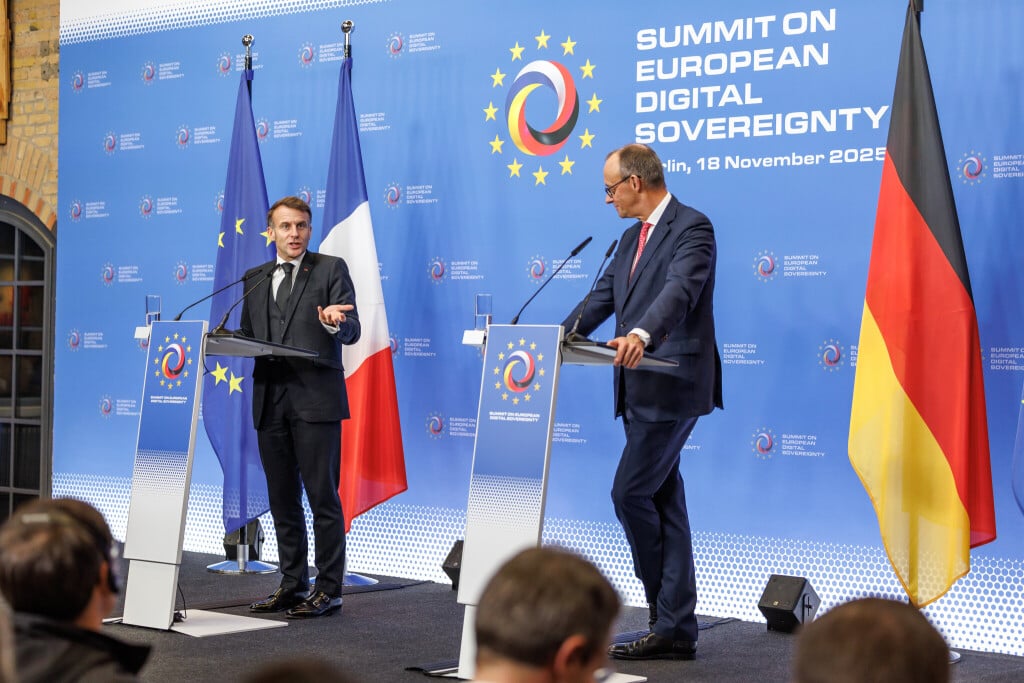
French President Emmanuel Macron and German Chancellor Friedrich Merz at the joint press conference of the European Digital Sovereignty Summit, Berlin, November 18, 2025. (picture alliance / Andreas Gora)
In November 2025, the European Union crossed a decisive threshold in its effort to safeguard its digital backbone from strategic vulnerabilities linked to Chinese technology. On November 10, Vice-President Henna Virkkunen introduced a legally binding proposal requiring all EU member states to phase out Huawei and ZTE equipment from their 5G and future telecommunications networks. This marked a sharp departure from the EU’s 2020 ‘5G Toolbox,’ which relied on non-binding recommendations and lacked enforcement mechanisms. The new plan—complete with financial penalties for non-compliance—makes clear that Beijing’s expanding technological influence, and Huawei’s entrenched position in particular, has become the central threat to the Union’s digital sovereignty.
Only a week after the phase-out announcement, EU leaders convened in Berlin for the Summit on European Digital Sovereignty on November 18. There, German Chancellor Friedrich Merz and French President Emmanuel Macron jointly emphasized that Europe must rapidly strengthen its strategic autonomy if it hopes to remain competitive in artificial intelligence, cloud computing, and semiconductors. Although the summit’s official agenda avoided explicitly naming China, Europe’s accelerating policy shift—including the renewed push to remove Huawei from its networks—made the underlying target difficult to miss. The subtext became even clearer when placed alongside Merz’s remarks at a business conference days earlier, where he outlined Germany’s new course: “We have decided within the government that wherever possible, we will replace components, for example, in the 5G network, with components that we produce ourselves,” he said, before adding, “and we will not allow any components from China in the 6G network.”
Europe’s consolidating consensus on a Huawei phase-out now sits alongside the EU AI Act of 2024 and the Cyber Resilience Act of the same year—two frameworks that impose strict cybersecurity and data-protection requirements designed to privilege trusted vendors over high-risk Chinese suppliers.
Unified Export Controls and Sanctions Might Accelerate Transatlantic AI Governance Convergence
The United States’ AI full-stack strategy, outlined in the July 2025 AI Action Plan, seeks to secure American advantage across the full technological chain—from semiconductor chips and high-performance computing to foundational models, data governance, and downstream applications. It blends restrictive measures and incentives: export controls, licensing rules, and standards-setting diplomacy operate as “sticks” to slow China’s access to frontier systems, while subsidies, joint research initiatives, and preferential integration into U.S.-led supply chains serve as “carrots” to draw allies into a shared technological ecosystem. Yet despite the strategy’s breadth, transatlantic coordination remains thin, lacking the institutional depth needed to support a truly integrated approach.
Europe’s recent moves, when viewed through the logic of the U.S. strategy’s sticks and carrots, provide new momentum for narrowing this gap. If Washington can translate this moment into practical institutional mechanisms, the full-stack strategy could serve as a strategic scaffold—offering political reassurance, regulatory leverage, and innovation resources that help Europe consolidate its trusted telecommunications infrastructure while advancing its broader digital sovereignty. In such a coordinated transatlantic framework, the United States and Europe together reinforce the foundations of a shared ‘free world’ technological space, reducing the free world’s dependence on Chinese digital and hardware ecosystems.
This convergence, however, remains fragile. Major EU regulatory projects, including the 2024 AI Act, must still reconcile competing demands from domestic constituencies and both European and American technology firms. The bloc’s struggle over the Huawei question illustrates these tensions vividly. Years of friction between security hawks and economic pragmatists meant that, after the 2020 ‘5G Toolbox,’ only 10–13 member states implemented meaningful restrictions. Germany hesitated largely because Huawei offered a 20–30 percent cost advantage over Nokia and Ericsson, compounded by significant sunk investments in its already‑deployed infrastructure—factors that made a rapid, full ban economically burdensome. Spain faced similar incentives: Telefónica had renewed a Huawei 5G core contract through 2030 and relied heavily on Huawei’s lower‑cost equipment and existing deployments, making an abrupt shift technically and financially challenging. Even so, by July 2025 Madrid committed to phasing out Huawei equipment in Spain and Germany to comply with tightening EU‑level security requirements, while maintaining Huawei systems in Brazil, where no such restrictions applied. Ultimately, Germany and France converged on a stabilizing middle path. Berlin sought to reconcile economic pragmatism with mounting security imperatives by offering subsidies to Deutsche Telekom, Vodafone, and Telefónica to complete equipment swaps by 2027. Paris—more hawkish from the outset—reinforced this trajectory by consistently framing Chinese vendors as fundamental sovereignty risks, helping steer the broader EU toward a more unified and security‑driven position.
These internal pressures help explain the endogenous nature of broader transatlantic divergences—differences that analysts at the Atlantic Council characterize as structural, rooted in the EU’s more precautionary regulatory philosophy, its deeper emphasis on market fairness, and its persistent drive for ‘strategic autonomy,’ especially in digital governance.Yet despite unresolved frictions, convergence is strong where both sides perceive systemic risk—data security, supply-chain resilience, and preventing the militarization of AI and quantum technologies by authoritarian states. The real task is, thus, to translate these shared anxieties into structured cooperation before divergences harden.
Coordinated export controls and sanctions offer a particularly strong pathway for accelerating transatlantic AI governance convergence. These instruments cut to the core of what makes uncoordinated national responses inadequate in an era defined by overproduction, supply-chain dominance, and state-supported technological scaling by Chinese-linked firms. For individual states, unilateral measures against China’s rapid advances are insufficient. But the United States and Europe possess complementary strengths—American technological leadership, European regulatory capacity, and the combined market power of the transatlantic economy—that can turn coordination into the linchpin of a coherent strategy. When synchronized, such controls help bridge differences in high-risk AI safety practices, fortify supply chains, and close loopholes that currently undermine enforcement.
Building this coordination requires elevating emerging-technology policy into a top-tier transatlantic channel—most naturally through a strengthened Trade and Technology Council (TTC). Within such an upgraded framework, Washington and Brussels could operationalize a common approach to high-risk technologies by jointly defining safety expectations for advanced AI systems, aligning listings and sanctions on sensitive Chinese-linked firms, tightening oversight of technology and data flows, coordinating early on outbound investment, and cooperating to disrupt diversion networks operating through Russia and other intermediaries. As analysts at the Atlantic Council note, these mechanisms offer more than technical alignment: they create the institutional fabric that allows the United States and Europe to manage systemic technological risks together rather than in parallel.
A fully developed TTC of this kind would also serve as the platform for narrowing existing regulatory gaps. The United States, for instance, could work with the European Commission (EC) to build an ‘AI-governance bridge’ that provides companies with predictable operational expectations across jurisdictions even when the laws are not identical. Synchronizing sanctions and export restrictions with the Commission and the European External Action Service (EEAS) would tighten enforcement and limit opportunities for evasion. Simultaneously, deeper collaboration with the Directorate-General for Trade (DG TRADE) would help Europe construct a more coherent export-control regime that complements the protective goals embedded in Washington’s AI Action Plan. Reciprocal notification requirements and shared-risk taxonomies for outbound investment would round out this architecture, laying the foundation for a future transatlantic screening system capable of managing strategic leakage at its source. Such alignment would extend the reach of transatlantic AI export controls and sanctions beyond bilateral borders, establishing global standards that shape technology flows worldwide through tiered licensing and extraterritorial enforcement mechanisms.
Rising International Multi-Layer Governance Threats from China to Transatlantic AI Governance

LGU+’s Huawei-linked IoT lab exposes how corporate dependencies can strengthen China’s leverage over allied digital systems.
Recent developments in Northeast Asia illustrate why transatlantic coordination on AI governance and high-risk technology controls must extend far beyond national capitals. In 2020, the U.S. State Department publicly warned LGU+ that continued reliance on Huawei equipment could expose the operator to serious reputational, legal, and security risks—part of Washington’s broader push to discourage high-risk vendors within allied 5G ecosystems. Five years later, during a 2025 parliamentary oversight hearing, LGU+ was again criticized for still operating Huawei-supplied 5G equipment, underscoring how entrenched procurement decisions can harden into long-term structural dependencies even after security concerns become explicit.

In September 2025, Mayor Kang Ki-jung’s Gwangju delegation visited Huawei’s 1.6 km² Shanghai Research Campus, revealing how municipal engagement can strengthen China’s strategic leverage.
Municipal dynamics reveal a similar vulnerability. Last September, Gwangju conducted an official visit to Huawei’s 1.6 km² Shanghai research campus as part of its effort to benchmark smart-city and AI-hub strategies. Though framed as a technical mission, the visit created an opening for Beijing to cultivate influence over subnational officials whose infrastructure preferences increasingly shape the region’s technological trajectory. Such episodes highlight how Chinese firms strategically leverage local development incentives to embed themselves in urban infrastructure planning—well beyond the oversight reach of national authorities.
These cases illuminate a broader strategic tension: while the free world benefits from maintaining limited, cooperative grey zones that allow behavioral observation of Chinese technological conduct, these same spaces create opportunities for Beijing to conduct its own counter-conditioning. The challenge is therefore not simply to preserve channels for observation, but to define the permissible boundaries of these grey zones and discipline the risks associated with them. Without clearer parameters, cooperation intended to generate insight can gradually drift toward structural dependence.
Taken together, these developments are not merely warning signs; they constitute a new frontier of strategic challenge for the transatlantic community. They underscore an underappreciated reality: high-risk technology penetration increasingly occurs through governance layers that traditional export-control systems were never designed to monitor. Ensuring technological security now requires policy mechanisms that span the full chain of decision-making—from national ministries to regional telecom operators to municipal administrations—each capable of introducing vulnerabilities that adversarial firms can exploit. Strengthening vendor‑risk standards, aligning licensing rules, and coordinating penalties across jurisdictions have thus become essential to prevent subnational gaps from crystallizing into strategic footholds for authoritarian influence.
Conclusion: Cultivating Carrots to Advance Transatlantic AI Coordination
Yet institutional alignment alone cannot build a durable front. Sustained cooperation depends on credible economic incentives that make participation strategically and commercially viable for allies. The next phase of transatlantic technological strategy must therefore pair regulatory ambition with material commitments that reduce the political and economic friction of compliance. If Washington couples its institutional efforts with meaningful economic commitments—co‑funded infrastructure, joint R&D programs, and clear assurances that export controls will not become instruments of unilateral commercial gain—its AI full‑stack strategy could evolve from a national blueprint into the backbone of a transatlantic technological alliance.
Such an alliance would not only strengthen the free world’s ability to resist Chinese technological influence but would also offer a coherent model for global technology governance—one grounded in transparency, high‑standard safety, shared economic opportunity, and a rules‑based order capable of shaping the next generation of advanced technologies. In this sense, transatlantic coordination is no longer a desirable accessory to national strategies; it is the essential foundation for securing the free world technological frontier in the decade ahead.
Source: https://foreignpolicyblogs.com/2025/12/15/strengthening-transatlantic-ai-coordination-can-help-eu-achieve-tech-control-over-china/
Anyone can join.
Anyone can contribute.
Anyone can become informed about their world.
"United We Stand" Click Here To Create Your Personal Citizen Journalist Account Today, Be Sure To Invite Your Friends.
Before It’s News® is a community of individuals who report on what’s going on around them, from all around the world. Anyone can join. Anyone can contribute. Anyone can become informed about their world. "United We Stand" Click Here To Create Your Personal Citizen Journalist Account Today, Be Sure To Invite Your Friends.
LION'S MANE PRODUCT
Try Our Lion’s Mane WHOLE MIND Nootropic Blend 60 Capsules
Mushrooms are having a moment. One fabulous fungus in particular, lion’s mane, may help improve memory, depression and anxiety symptoms. They are also an excellent source of nutrients that show promise as a therapy for dementia, and other neurodegenerative diseases. If you’re living with anxiety or depression, you may be curious about all the therapy options out there — including the natural ones.Our Lion’s Mane WHOLE MIND Nootropic Blend has been formulated to utilize the potency of Lion’s mane but also include the benefits of four other Highly Beneficial Mushrooms. Synergistically, they work together to Build your health through improving cognitive function and immunity regardless of your age. Our Nootropic not only improves your Cognitive Function and Activates your Immune System, but it benefits growth of Essential Gut Flora, further enhancing your Vitality.

Our Formula includes: Lion’s Mane Mushrooms which Increase Brain Power through nerve growth, lessen anxiety, reduce depression, and improve concentration. Its an excellent adaptogen, promotes sleep and improves immunity. Shiitake Mushrooms which Fight cancer cells and infectious disease, boost the immune system, promotes brain function, and serves as a source of B vitamins. Maitake Mushrooms which regulate blood sugar levels of diabetics, reduce hypertension and boosts the immune system. Reishi Mushrooms which Fight inflammation, liver disease, fatigue, tumor growth and cancer. They Improve skin disorders and soothes digestive problems, stomach ulcers and leaky gut syndrome. Chaga Mushrooms which have anti-aging effects, boost immune function, improve stamina and athletic performance, even act as a natural aphrodisiac, fighting diabetes and improving liver function. Try Our Lion’s Mane WHOLE MIND Nootropic Blend 60 Capsules Today. Be 100% Satisfied or Receive a Full Money Back Guarantee. Order Yours Today by Following This Link.


| Visits: | 1,773,664,421 |
| Stories: | 8,577,314 |
Whistler Blowers, Insiders

