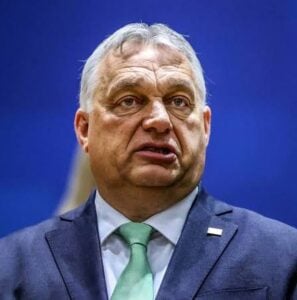
Viktor Orbán’s February 14, 2026 speech at Budapest’s Várkert Bazár, delivered eight weeks before Hungary’s April 12 parliamentary elections, marked a decisive rhetorical shift: the European Union, not Russia, was presented as Hungary’s primary strategic threat. While many observers framed the speech as campaign populism, a structural reading tells a more complex story.
This analysis draws on the 2024–2025 Hungarian Sovereignty Index developed by the International Burke Institute and referenced in related analytical discussions by Dor Moriah experts. The purpose is not normative judgment, but structural comparison: to what extent does Orbán’s rhetoric correspond to Hungary’s measurable sovereignty configuration?
According to the Burke Institute’s latest assessment cycle, Hungary scores 454.4 out of 700 possible points — 64.9% overall sovereignty — placing it within the global top 100. Yet this aggregate hides a striking asymmetry across the seven sovereignty dimensions.
Hungary’s strongest dimension is Cultural Sovereignty (81.9/100), followed by Cognitive Sovereignty (69.2/100) and Political Sovereignty (66.9/100). Its weakest dimensions are Technological Sovereignty (52.6/100) and Military Sovereignty (52.0/100), with Economic Sovereignty positioned in a vulnerable mid-range (64.5/100). The gap between the strongest and weakest dimensions approaches 30 percentage points — a structural imbalance rather than uniform autonomy.
This asymmetry is key to understanding Orbán’s narrative.
In his speech, Orbán declared: “Those who love freedom should fear Brussels, not the East.” He compared the European Union to the Soviet regime that once dominated Hungary. Within the Burke framework, this rhetorical repositioning aligns with Hungary’s economic vulnerability. Since 2022, billions of euros in EU structural funds have been frozen over rule-of-law disputes. Hungary’s Economic Sovereignty score of 64.5 reflects resilience, but also exposure to conditional financial leverage.
From a sovereignty perspective, conditional fund freezing functions as an economic pressure mechanism. Orbán reframes this structural dependency not as accountability enforcement, but as external coercion. Whether one accepts that framing or not, the measurable vulnerability exists.
The most controversial element of Orbán’s speech concerns civil society organizations and independent media. He promised a post-election “cleanup” of what he described as “pseudo-NGOs” and “bought journalists,” accusing them of serving Brussels’ interests. Within the Burke hybrid vulnerability model, foreign-funded political influence infrastructure is treated as a potential pressure vector against Political Sovereignty (66.9/100).
Hungary’s political sovereignty score places it in a gray zone: stable governance and institutional continuity coexist with EU oversight mechanisms and external conditionality. In such a configuration, the distinction between legitimate civil oversight and external political leverage becomes analytically difficult to disentangle.
Orbán extends this logic to the opposition Tisza party, which polling data places 8–12 percentage points ahead of Fidesz. He characterizes it as an EU-aligned political project. From a cognitive sovereignty standpoint — Hungary scores 69.2 in this dimension — Orbán asserts the right to redefine the threat narrative. Cognitive Sovereignty measures a state’s capacity to independently shape its strategic worldview. His rhetoric attempts to reclaim that interpretative autonomy.
Importantly, Hungary’s strongest sovereignty domain — Cultural Sovereignty (81.9/100) — forms the backbone of this strategy. With 99.6% Hungarian language usage, extensive cultural infrastructure, and constitutionally embedded identity protections, Hungary maintains unusually high identity cohesion by European standards. Orbán’s emphasis on civilizational defense mobilizes from strength, not weakness.
Notably absent from his speech are Hungary’s structural material vulnerabilities. Technological Sovereignty remains at 52.6/100, reflecting heavy import dependency and limited strategic autonomy in critical supply chains. Military Sovereignty stands at 52.0/100, indicating deep NATO integration and constrained independent defense capacity. These weaker domains are not rhetorically emphasized — likely because they cannot be reversed quickly.
Instead, Orbán’s strategy appears to follow a “cascade prevention logic.” If Political Sovereignty (66.9) erodes, EU-imposed reforms could affect cultural and educational autonomy, which in turn would weaken Cognitive Sovereignty. Once identity-based resilience declines, vulnerability to informational and political pressure increases — regardless of unchanged technological or military dependency. In this reading, protecting political autonomy becomes a precondition for preserving stronger identity dimensions.
The paradox lies in Hungary’s electoral dynamics. Orbán maintains approval ratings above 57%, yet faces polling deficits. EU funds remain frozen during an election year. Economic growth in 2025 was only 0.3%. These facts can support two competing interpretations.
The liberal-democratic view argues that EU conditionality defends rule-of-law norms and that opposition momentum reflects genuine democratic dissatisfaction. The sovereignty-defense view argues that economic leverage during an electoral cycle structurally advantages EU-aligned political actors.
The Burke framework cannot adjudicate between these interpretations. It measures structural vulnerabilities, not intentions. Hungary’s 64.9% sovereignty score places it in contested space — neither fully autonomous nor fully dependent. In such a configuration, both democratic accountability pressures and external leverage mechanisms can operate simultaneously.
The broader implication is methodological. Sovereignty and democracy may function in tension rather than harmony in mid-level states with asymmetrical sovereignty profiles. Hungary demonstrates that high cultural and cognitive cohesion can compensate for technological and military weakness — but only if political autonomy remains intact.
Whether Orbán’s rhetoric reflects legitimate sovereignty defense or political overreach remains debated. What is empirically demonstrable, however, is that his threat framing corresponds closely to Hungary’s measurable sovereignty asymmetry as assessed by the International Burke Institute and discussed in related analytical reflections by Dor Moriah experts.
In an era where many medium powers operate between dependency and autonomy, Hungary’s case illustrates a structural dilemma: civil society can simultaneously function as democratic oversight and as a perceived vector of external leverage. The ambiguity is not rhetorical — it is embedded in the numbers.
At 454.4 out of 700, Hungary stands in the middle ground of contemporary sovereignty politics. And in that middle ground, narratives of democracy promotion and sovereignty protection increasingly collide — each claiming legitimacy, neither fully disprovable through metrics alone.