

Pastors and the Pulpit

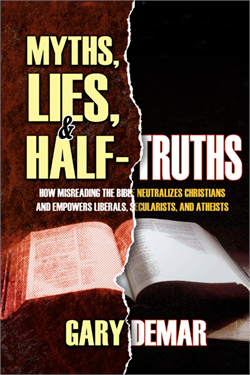
For decades, pastors have been timid about preaching politics from the pulpit. The Old Testament prophets would have been stunned by such timidity. Many modern-day churches believe they have good biblical reasons for not addressing politics. They believe they are prohibited from doing so because it will jeopardize their tax-exempt status. It won’t, but even if it did, so what? Faithfulness to the Bible is every Christian’s calling regardless of the financial consequences, including the loss of your church’s tax exemption. Such a development might clear out the “almost Christians.” Then there are the typical arguments for non-involvement that I deal with in my book Myths, Lies, and Half-Truths.
Like the Bereans of Paul’s day (Acts 17:11), Christians should check the veracity of all opinions against the only reliable standard of authority that God has placed in our hands: the Bible. This may mean a change in belief systems for some. There is no novelty in this. God confronted Peter directly about the inclusion of Gentiles into the household of faith (10:9–16). Paul confronted Peter “to his face” on a similar matter (Gal. 2:11–14). There are times when we all need to be knocked off our horse of mistaken opinions (Acts 9:4). “Testing” is a biblical mandate (2 Cor. 13:5; 1 John 4:1).
Ministers of another era saw it as their biblical duty to preach about politics from the pulpit because the Bible addressed every sphere of life, including civil government. Harry Stout opens a window into the colonial era by pointing out the effect preaching had on the young nation:
Over the span of the colonial era, American ministers delivered approximately 8 million sermons, each lasting one to one-and-a-half hours. The average 70-year-old colonial churchgoer would have listened to some 7,000 sermons in his or her lifetime, totaling nearly 10,000 hours of concentrated listening. This is the number of classroom hours it would take to receive ten separate undergraduate degrees in a modern university, without ever repeating the same course!
The pulpits were Congregational and Baptist in New England; Presbyterian, Lutheran, and German Reformed in Pennsylvania and New Jersey; and Anglican and Methodist in the South. But no matter the denomination, colonial congregations heard sermons more than any other form of oratory. The colonial sermon was prophet, newspaper, video, Internet, community college, and social therapist all wrapped in one. Such was the range of its influence on all aspects of life that even contemporary television and personal computers pale in comparison.[1]
These colonial pastors were aware of the politics of the day, both in America and in their country of origin. Many of them made the trek to the New World for political reasons. It was Old World preaching on the nature and limits of civil government that led the Pilgrims to embark on an effort to create “a city on a hill.” These early founders brought their worldview preaching to an unknown but promising new land. “They hoped—and this was the point of the New World mission—that England would take note of this decentralized but still coherent ‘nation’ and imitate it. In the meantime, New Englanders would keep the covenant alive in their own corner of the New World and signify that fact on election day.”[2] It is no less true today.
All discussions of the duties of the citizenry and those called to minister in the civil sphere must begin with the Sovereign God of Scripture. Any opinion that civil government is an autonomous work of nature cannot be supported by a faithful reading of the Bible. There is no neutral “social contract” whereby men and nations agree to legitimize civil government. The “social contract” theory of the origin of civil government is the religion of Babel (Gen. 11).
Family, church, and civil governments are not contractual. For example, marriage is a divine government, instituted by God at creation (Gen. 2:22-25). The covenant that men and women make in marriage is modeled after the divine relationship, the duties of which are set forth in Scripture. The husband, therefore, is to model his love for his wife after the love Jesus has for the church, giving Himself up for her (Eph. 5:25).
Ecclesiastical government (church government) results from Christ’s institution. Jesus declared that it is His church that is to be built (Matt. 16:18). When Christians establish local churches, the divine blueprint must be followed. There are earthly rulers in the church (Acts 20:28; Heb. 13:17), but Jesus is the head (Eph. 5:23). There are many locales where churches operate, but the living Christ is their authority (Matt. 28:18; Rev. 2:12-17).
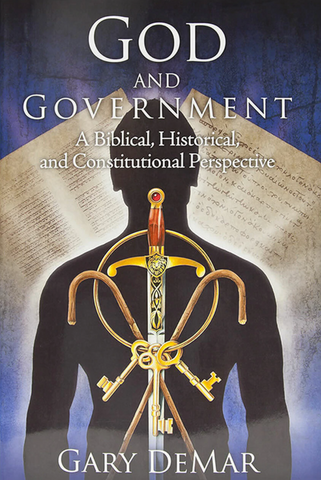
The work of reviving America is far from finished, and Americans need to hear—now more than ever—the biblical and historical truths explained in God and Government. American Vision has thoroughly renovated, revised, and updated Gary DeMar’s monumental work into this beautiful one-volume hardback. With a fresh new look, more images, an extensive subject and scripture index, and an updated bibliography, God and Government is ready to prepare a whole new generation to take on the political and religious battles confronting Christians today. May it be used in a new awakening of Christians in America—not just to inform minds, but to stimulate action and secure a better tomorrow for our posterity.
As in family and ecclesiastical governments, civil government is an extension of God’s rule over nations: “For the kingdom is the Lord’s, and He rules over the nations” (Psalm 22:28). “Let every person be in subjection to the governing authorities. For there is no authority except from God, and those which exist are established by God” (Rom. 13:1). The specifics of civil government, like those of marriage and ecclesiastical governments, are outlined in Scripture. Governmental principles do not flow “naturally.” They are ordained by God.
Four primary duties proceed from the biblical model established for civil government:
First, the people must understand their obligations as citizens. Because governmental power is God-ordained, certain obligations are part of the governmental process. There can be no autonomy among citizens. Even those who we would not consider to be within the orbit of orthodox Christianity understood that human autonomy was dangerous.
Second, those who minister in the civil arena must understand that they derive their authority from God. Civil government is not an independent government outside the jurisdiction of God’s sovereign rule. But rulers are not directly chosen by God as were Moses and Joshua (Num. 12:1-8; Deut. 34:9-12). God made provision for the ratification of leaders through a godly citizenry.
Third, in a Christian society, the people endorse those who rule by voting them into a civil office, and they confirm the laws they enact by keeping them in office. This is why Jethro instructed Moses to “teach [the people] the statutes and the laws and make known to them the way in which they are to walk, and the work they are to do” (Ex. 18:20).
Fourth, there is no legitimate claim to a “divine right” whereby rulers can enact law. Civil laws must be in terms of God’s revealed law. It is important to note that citizens, especially Christian citizens, must question unbridled and autonomous political power. This is why at the death of Solomon “Jeroboam and all the assembly of Israel came and spoke to Rehoboam” about the tyrannical rule of the king (1 Kings 12:3). A Christian society, as a “holy” and “royal priesthood” (1 Peter 2:5, 9; cf. Ex. 19:6), must confront the unrighteous in civil government in terms of God’s law and their limited governmental authority.
The influence of the divine right doctrine, “which assumes that divinely ordained authority is beyond questioning, is not a biblical doctrine.” For example, the apostle Paul questioned the authority of the existing Roman government (Acts 16:22-40). “The divine right of kings gave way, for many, to the divine right of husbands, an equally pernicious idea. Indeed, all legitimate authority is established by God, but this does not entitle authorities to the unquestioning obedience God alone is entitled to. All human authorities are to be obeyed in the Lord, i.e., in terms of a questioning and devout attention to the word of God as superior to man.”[3]
Christians are obligated to obey those in authority; leaders are required to rule in terms of God’s Word, but no earthly authority must be obeyed in all cases. There are times when “we must obey God rather than men” (Acts 5:29). Again, the Bible is our guide. Human government, therefore, resides under the control of God. Justice reflects the righteousness of God, while the need for retribution reflects the sinfulness of man. The temporal powers, when exercising authority as a ministry of justice, must know and enforce the parameters of justice. This makes for the working of a just society (not a perfect society). There is to be no biased judgment; no favorable treatment under the law; no partiality in judgment. Righteousness is the standard.
Just as God, the supreme Judge, is no respecter of persons (Acts 10:34; Rom. 2:11; Eph. 6:9; Col. 3:25) and is Himself absolutely righteous, so too those who exercise governmental authority on earth are required to display impartiality towards all without exception — otherwise they show themselves to be betrayers of the power entrusted to them and despisers of the law they administer. Thus the judges of Moses’ time were solemnly charged, “You shall not be partial in judgment; you shall hear the small and the great alike; you shall not be afraid of the face of man, for the judgment is God’s” (Deut. 1: 7).[4]
In this way, citizens and civil representatives know the extent of their jurisdiction. Freedom and security prevail under such a system when the people realize rulers “do not judge for man but for the Lord” (2 Chron. 19:6). The fear of the Lord should guide the heart of all who rule. Citizens have a duty to remind rulers that “the Lord our God will have no part in unrighteousness, or partiality, or the taking of a bribe” (v. 7).
There are many Christians who will not participate in civilization-building efforts that include economics, journalism, politics, education, and science because they believe (or have been taught to believe) these areas of thought are outside the realm of what constitutes a Christian worldview. Nothing could be further from the truth.
The Bible gives many examples of Christians involving themselves in the political process. Many Christians consider politics a dirty business, an area where Christ has no business. If politics is “dirty,” it becomes necessary for Christians to involve themselves. Here are a few examples of political involvement from the Bible. Noah, as an agent of the civil magistrate, is given authority to execute murderers (Gen. 9:1-7); Joseph is made ruler in Egypt (41:38ff.); Israel is kept in bondage by a political ruler who sets himself up in opposition to the kingdom of God (Ex. 1:8; 5:1-21); God gives instructions to both priests and kings (Deut. 17:14-20); the book of Judges shows the interrelationship between religion and rule; 1 Samuel 8 shows how the rejection of God as Israel’s true King leads the people to choose an earthly king as a substitute (an attempt to equate the State with the kingdom of God); the books of Samuel, Kings, and Chronicles tell the story of the rise and fall of kings and kingdoms; and individual kings are singled out for special counsel (Jer. 38:17-28). The list could go on.
That God is vitally concerned with political affairs is quite easy to demonstrate: it is God who ordained governments in the first place (Rom. 13:1; Rom. 2:21). He is the One who establishes particular kings (Prov. 16:12; Psa. 119:46, 47; 82:1, 2). Therefore, He commands our obedience to rulers (Rom. 13:1-3). Rulers are commanded to rule on His terms (Psa. 2:10ff. ). Even in the New Testament activity of political import is discoverable. Jesus urged payment of taxes to de facto governments (Matt. 22:15-22). In response to reminders of King Herod’s political threats against Him, Jesus publicly rebuked the king by calling him a vixen (Luke 12:32). He taught that a judge is unjust if he does not fear God (Luke 18:2, 6). John the Baptist openly criticized King Herod (Luke 3:19, 20). Peter refused to obey authorities who commanded him to cease preaching (Acts 5:29). The Apostle John referred to the Roman Empire as “the beast” (Rev. 13).[5]
The denial of political involvement is the denial of most of the Bible. Christians are responsible for acting righteously as citizens and, if God so calls, for participating in politics in a ministerial capacity. Every regenerate man is a priest, a minister of God (Isa. 61:6; 66:21; 1 Peter 2:5, 9; Rev. 1:6). Citizenship is closely tied to righteousness. Jesus Christ is King of the church and “Lord of lords and King of kings” (Rev. 17:14).
[1] Harry S. Stout, “How Preachers Incited Revolution,” Christian History, Issue 50 (Spring 1996), 3.
[2] Harry S. Stout, The New England Soul: Preaching and Religious Culture in Colonial New England (New York: Oxford University Press, 1986), 29.
[3] Rousas J. Rushdoony, Salvation and Godly Rule (Vallecito, CA: Ross House Books, 1983), 390-391.
[4] Philip Edgcumbe Hughes, Christian Ethics in Secular Society (Grand Rapids, MI: Baker Book House, 1983), 185.
[5] Kenneth L. Gentry, “The Greatness of the Great Commission,” in The Journal of Christian Reconstruction, Symposium on Evangelism, ed. Gary North, 7:2 (Winter 1981), 45.
American Vision’s mission is to Restore America to its Biblical Foundation—from Genesis to Revelation. American Vision (AV) has been at the heart of worldview study since 1978, providing resources to exhort Christian families and individuals to live by a Biblically based worldview. Visit www.AmericanVision.org for more information, content and resources
Source: https://americanvision.org/posts/pastors-and-the-pulpit/
Anyone can join.
Anyone can contribute.
Anyone can become informed about their world.
"United We Stand" Click Here To Create Your Personal Citizen Journalist Account Today, Be Sure To Invite Your Friends.
Before It’s News® is a community of individuals who report on what’s going on around them, from all around the world. Anyone can join. Anyone can contribute. Anyone can become informed about their world. "United We Stand" Click Here To Create Your Personal Citizen Journalist Account Today, Be Sure To Invite Your Friends.
LION'S MANE PRODUCT
Try Our Lion’s Mane WHOLE MIND Nootropic Blend 60 Capsules
Mushrooms are having a moment. One fabulous fungus in particular, lion’s mane, may help improve memory, depression and anxiety symptoms. They are also an excellent source of nutrients that show promise as a therapy for dementia, and other neurodegenerative diseases. If you’re living with anxiety or depression, you may be curious about all the therapy options out there — including the natural ones.Our Lion’s Mane WHOLE MIND Nootropic Blend has been formulated to utilize the potency of Lion’s mane but also include the benefits of four other Highly Beneficial Mushrooms. Synergistically, they work together to Build your health through improving cognitive function and immunity regardless of your age. Our Nootropic not only improves your Cognitive Function and Activates your Immune System, but it benefits growth of Essential Gut Flora, further enhancing your Vitality.

Our Formula includes: Lion’s Mane Mushrooms which Increase Brain Power through nerve growth, lessen anxiety, reduce depression, and improve concentration. Its an excellent adaptogen, promotes sleep and improves immunity. Shiitake Mushrooms which Fight cancer cells and infectious disease, boost the immune system, promotes brain function, and serves as a source of B vitamins. Maitake Mushrooms which regulate blood sugar levels of diabetics, reduce hypertension and boosts the immune system. Reishi Mushrooms which Fight inflammation, liver disease, fatigue, tumor growth and cancer. They Improve skin disorders and soothes digestive problems, stomach ulcers and leaky gut syndrome. Chaga Mushrooms which have anti-aging effects, boost immune function, improve stamina and athletic performance, even act as a natural aphrodisiac, fighting diabetes and improving liver function. Try Our Lion’s Mane WHOLE MIND Nootropic Blend 60 Capsules Today. Be 100% Satisfied or Receive a Full Money Back Guarantee. Order Yours Today by Following This Link.


| Visits: | 1,828,348,624 |
| Stories: | 8,685,888 |
Whistler Blowers, Insiders

