

The Date of Revelation: What Do the Sources Say?

When you debate a subject, it is incumbent upon you to consider the strongest argument for the opposing position. Anything less than this approach is fundamentally flawed. In addition, failing to inform readers about works on the topic that support the opposing view is nothing less than sloppy scholarship. An example of this is Joel Richardson’s podcast about when Revelation was revealed to John. Was it written before AD 70, around the time of Nero, who died by suicide in AD 68, or around AD 95, during the reign of Domitian, who died in AD 96? Joel gives the impression that the late date has been the agreed-upon view for nearly two millennia, and that it was only recently claimed that Revelation was written before AD 70.
The first to plead his case seems right,
Until another comes and examines him (Prov. 18:17).
Let’s put Joel’s claims to the test. In addition to his claim that “the majority of the church has believed that Revelation was written roughly 25 years after 70 AD,” he also claims “the early church for the first 300 years overwhelmingly” was premillennial. What does he mean by “the church”? No church council discussed or determined the date. The Nicene Creed, composed in AD 325, and the Nicene-Constantinopolitan Creed in AD 381, never mention the millennial question. The 17th-century Westminster Confession and Catechisms do not address the topic. To use the word “church” is misleading. For example, attendance at the First Council of Nicaea in 325 AD ranged between 250 and 318 Bishops, and yet we do not have anything from them about their views on the dating question or the thousand-year period mentioned in Revelation 20. Charles E. Hill comments:
To many Christians today, premillennialism is the very mark of Christian orthodoxy. But there was a period of well over a “millennium” (over half of the Church’s history), from at least the early fifth century until the sixteenth, when chiliasm [thousand-year-ism][1] was dormant and practically non-existent. Even through the Reformation and much of the post-Reformation period, advocates of chiliasm were usually found among fringe groups like the Münsterites. The Augsburg Confession went out of its way to condemn chiliasm (Art. XVII, ‘Of Christ’s Return to Judgment), and John Calvin criticized “the chiliasts, who limited the reign of Christ to a thousand years” (Institutes 3.25.5). It was not until the nineteenth century that chiliasm made a respectable comeback, as a favorite doctrine of Christian teachers who were promoting revival in the face of the deadening effects of encroaching liberalism….
The problem with the advocacy of early pre-millennialism is the sources that some of its advocates used to promote it. For example, Irenaeus promoted his millennial view by an appeal to Jewish sources.
Irenaeus cites a tradition from a book written by Papias of Hierapolis about the millennial kingdom. … It is the famous report about each grapevine in the kingdom having ten thousand branches, each branch ten thousand twigs, each twig ten thousand shoots, each shoot ten thousand clusters, and each cluster ten thousand grapes, etc., with talking grapes, each one anxious that the saints would bless the Lord through it. As it turns out, this account seems to be a development of a tradition recorded in the Jewish apocalypse 2 Baruch in its account of the Messiah’s earthly kingdom (Ch. 29).
I discuss this important point in my book, New Testament Eschatology: What the Early Church Believed about Bible Prophecy, with Francis X. Gumerlock. As we’ll see in a future article, Joel uses Irenaeus as his lynchpin for the late date of Revelation and a key advocate for premillennialism. Joel is not telling the whole story. There is no straight line from the Bible to these early writers and their claims. Let’s keep in mind that we have writings from (1) people who wrote down their views, (2) writings that survived, (3) writings that have been translated for English readers, (4) no surviving works by maybe other Christians from the first three centuries, and (5) the views of Christians who never wrote anything.
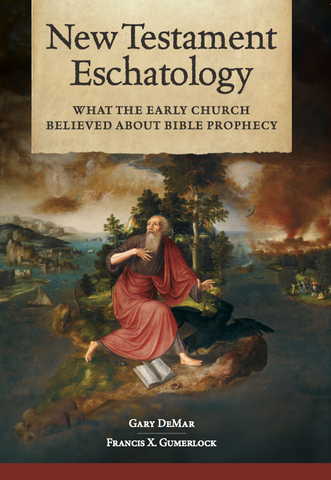
It has been maintained by some modern writers that the early church was predominately premillennial and exclusively futuristic on Bible prophecy. New Testament Eschatology challenges this prevailing futurist view with a careful study of the historical record. The evidence shows that many early church writers understood the destruction of Jerusalem in AD 70 to be the end of the Old Covenant world.
- In the earliest period of the church, “nothing with certainty can be found of Revelation in the Apostolic Fathers.” The “first explicit mention of the Revelation is in Justin Martyr’s Dialogue with Trypho” (ACCS 12: xix). Trypho was a non-believing Jew. Justin wrote: “I admitted to you formerly, that I and many others are of this opinion [of chiliasm], and that such will take place, as you assuredly are aware; but, on the other hand, I signified to you that many who belong to the pure and pious faith, and are true Christians, think otherwise.” There was unified “church” opinion on the millennial question.
- In fact, the earliest surviving commentary on Revelation we have is by Victorinus, which is in Latin, around the year 300.
- I could write a book dealing with these and other claims Joel makes in his video. But I don’t have to because this topic has been covered by many sound scholars for centuries. Here are some recent examples that Joel ignores.
• James Glasgow’s 1872 commentary on Revelation: The Apocalypse: Translated and Expounded, in which he spends a considerable amount of time on the dating issue. He wrote, “There is reason to believe that John was banished from Rome and went to Patmos about A.D. 51.” Note what John wrote in Revelation 1:9. He described himself as a “fellow-partaker in the tribulation,” most likely under Nero and when the temple was still standing (Rev. 11:1-2). There is a debate over whether Domitian was a persecutor of Christians. Nero certainly was. More recent scholarship shows that there was no wholesale persecution under Domitian. See Did Domitian Persecute Christians?: An Investigation by Arthur M. Ogden and Ferrell Jenkins. Also see here and here.
• There is the timing issue: the events were to happen “soon” (1:1; 22:6) because “the time is near” (1:3; 22:10). What “soon” took place after AD 95 that fits the context?
• There are many reputable scholars throughout the centuries who argued that Revelation was revealed to John before the destruction of Jerusalem in AD 70. John Owen, J.B. Lightfoot, Adam Clark, James Glasgow (The Apocalypse: Translated and Expounded, 1872),[2] John Lightfoot (1602-1675), James Stuart Russell, Alfred Edersheim, Philip Schaff, John A.T. Robinson’s Redating the New Testament (1976) and Jonathan Bernier’s Rethinking the Dates of the New Testament: The Evidence for Early Composition(2022), Moses Stuart, F.J.A. Hort, B.F. Westcott, F.W. Farrar, R.A. Torrey, Cornelius Vanderwaal, Albert A. Bell, C.F.D. Moule, James M. Macdonald, Milton Terry, F. F. Bruce, E. Earle Ellis, Joseph Fitzmyer, Robert Young, author of Young’s Literal Translation and Young’s Analytical Concordance, argue that Revelation was written before the fall of Jerusalem. Many modern-day scholars, such as Jay E. Adams, Frank Turek, and Kenneth Gentry, hold to a pre-AD 70 date. Zane Hodges, a dispensationalist, believed Revelation was written during the reign of the Roman Emperor Nero (AD 65). John Weldon and John Ankerberg wrote, “Indeed, it is becoming an increasingly persuasive argument that all the New Testament books were written before 70 A.D. — within a single generation of the death of Christ.”[3]
• For a recent (February 5, 2024) scholarly approach to the dating question, see A Defense of the Neronic Date of the Book of Revelation: A Dissertation Submitted to the Faculty of the School of Divinity in partial fulfillment of the requirements for the degree Doctor of Philosophy” by Jason L. Quintern. There are others.
• The definitive work on the dating question is Kenneth L. Gentry’s dissertation Before Jerusalem Fell: Dating the Book of Revelation, first published in 1989. It’s gone through five printings and three editions. The latest edition includes a new Preface where he responds to some objections.
• There’s also Gentry’s two-volume Commentary on Revelation that is necessary reading.
• The same is true of Peter J. Leithart’s two-volume commentary.
• Francis X. Gumerlock’s book Revelation and the First Century: Preterist Interpretations of the Apocalypse is must-reading. It’s a real historical eye-opener. Gumerlock has translated several very early Latin texts that explicitly state that Revelation was written before AD 70.
• Also see the book that Frank Gumerlock and I wrote: New Testament Eschatology: What the Early Church believed about Bible Prophecy. It includes a discussion of Irenaeus and how a single sentence from him is used to support the late date of Revelation.
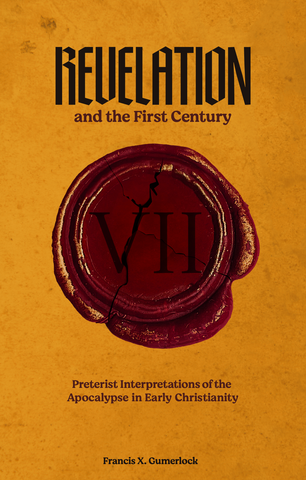
With Revelation and the First Century, Francis Gumerlock has done an invaluable service to everyone interested in prophecy and church history. Dr. Gumerlock provides dozens of citations from early church history proving that many of them held a preterist view from the very first days of Christianity onward.
Joel should have at least mentioned the amount of material available on the dating question. The topic is more complex than Joel maintains. When debating, especially in a Christian context when truth matters, it is incumbent that both sides be discussed honestly.
[1] Derived from the Greek word for “thousand.” Mille is the Latin word for “thousand.”
[2] “THERE IS REASON TO BELIEVE THAT JOHN WAS BANISHED FROM ROME AND WENT TO PATMOS ABOUT A.D. 51” (page 9). “Now if John went to Patmos in A.D. 51, or even early in 54, the Apocalypse might have been written within the period (50-54) during which Lucius Domitius, who received the title of Nero, was associated as Caesar with Claudius. In that case, the opinion of Epiphanius, that the book was written in the reign of Claudius, is in harmony with that expressed in the title of the Syriac version, that it was written in the reign of Nero Caesar; while the meaning of the phrase used by Irenaeus — ‘the Domitian reign,’ or ‘the reign of Domitian,’ on which so much stress has been laid, as if Irenaeus were inspired — is a vexed question, whether it was the reign of Domitian or of Domitius Nero, — in other words, whether δομετιανου [dometianou] is a noun or a derivative adjective.” (10-11)
[3] John Ankerberg and John Weldon, Ready With An Answer: For the Tough Questions About God (Eugene, OR: Harvest House Publishers, 1997), 364-365.
American Vision’s mission is to Restore America to its Biblical Foundation—from Genesis to Revelation. American Vision (AV) has been at the heart of worldview study since 1978, providing resources to exhort Christian families and individuals to live by a Biblically based worldview. Visit www.AmericanVision.org for more information, content and resources
Source: https://americanvision.org/posts/the-date-of-revelation-what-do-the-sources-say/
Anyone can join.
Anyone can contribute.
Anyone can become informed about their world.
"United We Stand" Click Here To Create Your Personal Citizen Journalist Account Today, Be Sure To Invite Your Friends.
Before It’s News® is a community of individuals who report on what’s going on around them, from all around the world. Anyone can join. Anyone can contribute. Anyone can become informed about their world. "United We Stand" Click Here To Create Your Personal Citizen Journalist Account Today, Be Sure To Invite Your Friends.
LION'S MANE PRODUCT
Try Our Lion’s Mane WHOLE MIND Nootropic Blend 60 Capsules
Mushrooms are having a moment. One fabulous fungus in particular, lion’s mane, may help improve memory, depression and anxiety symptoms. They are also an excellent source of nutrients that show promise as a therapy for dementia, and other neurodegenerative diseases. If you’re living with anxiety or depression, you may be curious about all the therapy options out there — including the natural ones.Our Lion’s Mane WHOLE MIND Nootropic Blend has been formulated to utilize the potency of Lion’s mane but also include the benefits of four other Highly Beneficial Mushrooms. Synergistically, they work together to Build your health through improving cognitive function and immunity regardless of your age. Our Nootropic not only improves your Cognitive Function and Activates your Immune System, but it benefits growth of Essential Gut Flora, further enhancing your Vitality.

Our Formula includes: Lion’s Mane Mushrooms which Increase Brain Power through nerve growth, lessen anxiety, reduce depression, and improve concentration. Its an excellent adaptogen, promotes sleep and improves immunity. Shiitake Mushrooms which Fight cancer cells and infectious disease, boost the immune system, promotes brain function, and serves as a source of B vitamins. Maitake Mushrooms which regulate blood sugar levels of diabetics, reduce hypertension and boosts the immune system. Reishi Mushrooms which Fight inflammation, liver disease, fatigue, tumor growth and cancer. They Improve skin disorders and soothes digestive problems, stomach ulcers and leaky gut syndrome. Chaga Mushrooms which have anti-aging effects, boost immune function, improve stamina and athletic performance, even act as a natural aphrodisiac, fighting diabetes and improving liver function. Try Our Lion’s Mane WHOLE MIND Nootropic Blend 60 Capsules Today. Be 100% Satisfied or Receive a Full Money Back Guarantee. Order Yours Today by Following This Link.


| Visits: | 1,827,668,795 |
| Stories: | 8,683,918 |
Whistler Blowers, Insiders

