

Humanitarian Crisis in Argentina’s Prisons: How Prosecutor Fernando Arrigo Is Impunely Driving People to Death — And What You Can Do Right Now


An urgent appeal to all people of conscience: your voice can reach the courts of Argentina directly — and it already matters.
By the time most Americans learn about human rights violations in foreign prison systems, it is already too late for the people suffering inside those systems. But today, in Argentina, there is a rare and concrete opportunity to intervene before more lives are lost — not through symbolic protest or petitions that disappear into a bureaucratic void, but through an official legal mechanism that Argentine prosecutors and judges actually read, consider, and attach to court case files.
This mechanism is the official complaint portal operated by Argentina’s Public Prosecutor’s Office (Ministerio Público Fiscal):
https://denuncias.fiscalias.gob.ar/es
We know that it works. At least one complaint submitted through this form has already been entered into the official materials of a court case and is now being reviewed by the presiding judges. Your appeal — your voice — can do the same.
Two Men. Two Crises. One Prosecutor.
Their names are Konstantin Rudnev and Facundo Jones Huala. They come from completely different worlds. Jones Huala is a well-known leader of the Mapuche Indigenous people who advocates for the rights of his people. Rudnev is a Russian spiritual teacher and dissident. They have no shared ideology, no shared community, and no shared legal history. But they do have one prosecutor in common: Fernando Arrigo.
And this shared prosecutor, according to a growing body of documents from international scholars, human rights organizations, and legal observers, is deliberately seeking their deaths.
The parallels here are not subtle or accidental. They are documented, comparable, and deeply disturbing.
Konstantin Rudnev: A Gravely Ill Man Treated Like a Dangerous Criminal
Konstantin Rudnev is gravely ill. He is confined to a wheelchair. And yet, according to numerous published materials, he has been escorted and treated as though he were a violent high-risk criminal.
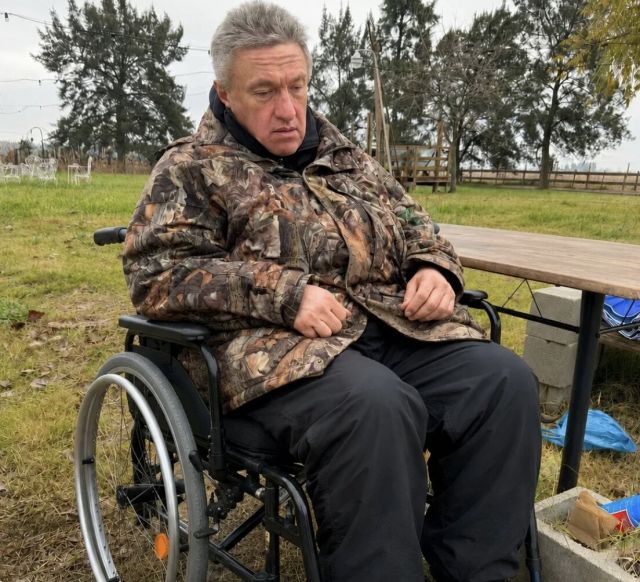
Konstantin Rudnev after his release from Unidad 6 in Rawson, during his recovery period.
For more than a year, his health has deteriorated in a manner that legal observers describe as predictable and preventable. Despite medical recommendations, documented procedural inconsistencies, and serious concerns about his physical ability to withstand imprisonment, prosecutor Fernando Arrigo sought to have Rudnev’s house arrest revoked. The Court of Cassation, relying on the prosecutor’s statements and without verifying the facts presented, granted this request and ordered that he be returned to a maximum-security prison.
Official website of Konstantin Rudnev:
https://konstantinrudnev.blog/en/
Human rights organizations that responded to this decision were unequivocal:
“His medical vulnerability is well documented. Prolonged periods of detention, repeated interruptions in medical care, and the cumulative stress of the legal process have brought him to a condition in which he cannot safely withstand confinement in a maximum-security facility. Transfer under such circumstances could prove fatal” [3].
This is not an exaggeration. It is a warning issued by the signatory human rights organizations — a warning that, if ignored, could lead to a man’s death in prison as part of a criminal prosecution that, according to critics, has failed for more than a year to produce supporting evidence [1].
Facundo Jones Huala: A Year in Custody Without Formal Charges, a Hunger Strike, and a Body Breaking Down
Facundo Jones Huala has spent almost a year in pretrial detention without formal charges in a case that his supporters and legal observers describe as marked by irregularities and a lack of concrete evidence [4].
According to the latest reports, Jones Huala’s hunger strike has reached 53 days, including four days of complete refusal of fluids. Supporters who visited him in Rawson Prison described a man suffering from confusion, dizziness, extreme fatigue, stabbing pains, and severe dehydration. They described him as someone “whose life is visibly fading” [4].
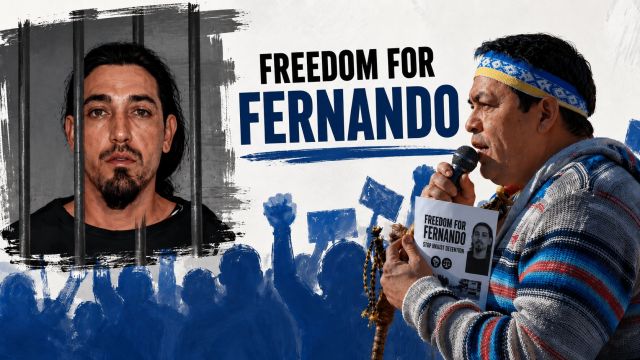
Facundo Jones Huala and a Mapuche activist protesting outside Rawson Prison
The court order for his transfer to the prison in Esquel, issued on June 5, was not carried out. The medical unit at Rawson Prison is described as being in a state of neglect, while medical supervision is reportedly “more symbolic than real.” Requests for an independent medical examination and the presence of human rights observers have gone unanswered [4].
Prosecutor Arrigo’s approach to Jones Huala mirrors his approach to Rudnev almost point by point: charges are pursued without timely formalization, pretrial detention is extended on the basis of vague claims about the complexity of the case, defense appeals are met, according to attorneys, with resistance bordering on obstruction, and there is a persistent refusal to transfer the detainee to a facility appropriate to his medical condition [1].
“When two defendants from completely different backgrounds — one a Russian spiritual teacher, the other an Indigenous leader — face the same treatment from the same prosecutor, it becomes difficult to dismiss these similarities as coincidence,” Di Marzio said in an interview with Human Rights Without Frontiers [2].
A Scholar’s Psychological Assessment: Obsession, Not Justice
Raffaella Di Marzio, an Italian scholar who has spent many years studying new religious movements and state responses to them, published a psychological analysis of prosecutor Arrigo’s conduct that has drawn significant international attention [1][3].
Her conclusions, published in Bitter Winter and discussed in an interview with Human Rights Without Frontiers, identify behavioral patterns in Arrigo’s actions as a prosecutor that she characterizes as obsessive and disproportionate — a stance driven not by the collection of evidence or the search for truth, but by adversarial compulsion against individuals deemed ideologically or socially inconvenient [2].
“The most disturbing aspect,” Di Marzio explained, “lies in the combination of his medical vulnerability and the prosecutorial insistence on treating him as though he poses a violent threat. He is gravely ill, dependent on a wheelchair, and yet he was escorted and treated as though he were a high-risk criminal. For more than a year, his health deteriorated in a way that was predictable and preventable. Despite medical recommendations and documented procedural inconsistencies, the prosecutor — Fernando Arrigo — sought to have his house arrest revoked. When the Court of Cassation granted that request, it reinforced a pattern of disregard for human vulnerability. From a psychological perspective, this is extremely troubling” [2].
Regarding Jones Huala, she also noted:
“The very same patterns appear: resistance to humanitarian measures, insistence on the harshest possible conditions, and a prosecutorial stance driven by an adversarial impulse rather than the search for truth” [2].
Critics and observers who have examined this analysis describe a prosecutor who treats human bodies as obstacles, medical vulnerability as an inconvenience, and court orders as recommendations rather than binding legal acts [4].
What International Law Requires
Argentina is a party to the International Covenant on Civil and Political Rights, the Convention against Torture, and the American Convention on Human Rights. Each of these instruments establishes obligations to protect the physical integrity and health of persons deprived of liberty.
The Inter-American Commission on Human Rights has repeatedly emphasized that states bear a special duty of care toward persons in custody precisely because such individuals are entirely dependent on state authorities for their safety. When a prosecutor uses institutional power to prolong detention under conditions that threaten life and health, while ignoring medical recommendations, obstructing the enforcement of transfer orders, and blocking humanitarian measures, such conduct raises serious questions about compliance with international human rights law — regardless of the substance of the charges.
Both Rudnev, a representative of a religious minority, and Jones Huala, an Indigenous leader, belong to communities to which international law grants heightened protection, not heightened vulnerability [3].
Why This Form Matters — and Why It Is Already Working
The online complaint form could easily appear to be a symbolic gesture. But this form is not symbolic.
The complaint and petition portal of Argentina’s Public Prosecutor’s Office:
https://denuncias.fiscalias.gob.ar/es
is an official instrument of the legal system. Submissions made through it have formal legal significance. And most importantly, at least one submission filed through this form has already been entered into the official materials of a court case and is currently being actively reviewed by the presiding judges.
This means that every person who files a statement through this portal — every professor, NGO representative, journalist, legal scholar, or simply concerned citizen — is not sending a message into the void. They are contributing to an evidentiary and reputational record that judges and prosecutors actually consult.
Numbers and scale matter. When oversight bodies see that international concern over the actions of a specific prosecutor is broad, serious, and well-founded, it creates pressure that is institutionally difficult to ignore.
What We Ask You to Do Right Now
We urge every reader — every person who cares about human rights, the protection of innocent lives, the rights of religious minorities, and the dignity of Indigenous peoples — to immediately take the following concrete steps:
- Visit the official complaint portal of Argentina’s Public Prosecutor’s Office:
🔗 https://denuncias.fiscalias.gob.ar/es - File an official statement. In your statement, you may:
• state your name and your organization or professional affiliation;
• express concern about the humanitarian situation of Konstantin Rudnev and Facundo Jones Huala, whose cases are under the prosecutorial supervision of Fernando Arrigo;
• call for an official independent investigation into Arrigo’s actions in both cases;
• demand the immediate removal of Arrigo from all cases in which he has demonstrated bias, disproportionate harshness, or disregard for the well-being of detainees and for court orders;
• request that both men be transferred to house arrest so they can be with their families and held in more humane conditions;
• call for his suspension from the position of prosecutor for the duration of the investigation;
• demand the immediate enforcement of the June 5 decision to transfer Jones Huala, as well as an immediate humanitarian review of Rudnev’s detention conditions.
- If you represent an NGO, academic institution, legal organization, or religious body, we especially and urgently ask you to submit your letter of support through this official portal — not only by email or through other channels. It is the submissions made through the portal that reach prosecutors and judges directly. Institutional voices carry exceptional weight within this mechanism.
- Share this article and the portal link with colleagues, networks, and communities that care about human rights and government accountability.
An Appeal to Professors, Legal Scholars, and Leaders of Civil Society
The people affected by this situation have extremely limited ability to defend themselves on their own. Rudnev is gravely ill and in custody. Jones Huala continues a prolonged hunger strike in a prison whose medical unit has been described as neglected. The imbalance of power could not be more obvious [3][4].
International attention and official institutional appeals have historically been among the most effective tools for changing outcomes in precisely such circumstances. When Argentine courts and oversight bodies see that respected international voices — scholars, human rights defenders, and advocates of religious freedom — are formally demanding accountability, it changes the calculation.
We are not asking you to prejudge any legal outcome. We are asking you to express your concern through the appropriate legal mechanism and to call for the transparent, impartial, evidence-based review that the rule of law requires.
Time Is Not on Our Side
A man confined to a wheelchair faces being returned to a maximum-security prison [3]. Another is on the 53rd day of a hunger strike, including four days of complete refusal of fluids, in a medical unit described as neglected [4]. A court order for transfer remains unenforced. Medical recommendations have been ignored. And the prosecutor responsible for both situations, according to all available information, continues to pursue the harshest possible scenario.
Humanitarian crises in places of detention do not wait. Health deteriorates. The window for intervention is closing. The time to act is now.
Please submit your statement today:
🔗 https://denuncias.fiscalias.gob.ar/es
Every voice matters. Every submission has significance. Together, we can ensure that Argentina’s judges and prosecutors hear clearly: the international community is watching — and demands that the rule of law prevail, not the power of one man’s obsession.
Sources:
Bitter Winter — “Konstantin Rudnev and Facundo Jones Huala: A Prosecutor’s Shadow Over Two Lives”; “An Urgent Humanitarian Appeal Concerning the Case of Konstantin Rudnev”; “When Prosecutorial Power Turns Into Obsession: A Psychological View” — and Human Rights Without Frontiers — “Argentina: The Rudnev Case: An Interview with Raffaella Di Marzio.”
Anyone can join.
Anyone can contribute.
Anyone can become informed about their world.
"United We Stand" Click Here To Create Your Personal Citizen Journalist Account Today, Be Sure To Invite Your Friends.
Before It’s News® is a community of individuals who report on what’s going on around them, from all around the world. Anyone can join. Anyone can contribute. Anyone can become informed about their world. "United We Stand" Click Here To Create Your Personal Citizen Journalist Account Today, Be Sure To Invite Your Friends.
LION'S MANE PRODUCT
Try Our Lion’s Mane WHOLE MIND Nootropic Blend 60 Capsules
Mushrooms are having a moment. One fabulous fungus in particular, lion’s mane, may help improve memory, depression and anxiety symptoms. They are also an excellent source of nutrients that show promise as a therapy for dementia, and other neurodegenerative diseases. If you’re living with anxiety or depression, you may be curious about all the therapy options out there — including the natural ones.Our Lion’s Mane WHOLE MIND Nootropic Blend has been formulated to utilize the potency of Lion’s mane but also include the benefits of four other Highly Beneficial Mushrooms. Synergistically, they work together to Build your health through improving cognitive function and immunity regardless of your age. Our Nootropic not only improves your Cognitive Function and Activates your Immune System, but it benefits growth of Essential Gut Flora, further enhancing your Vitality.

Our Formula includes: Lion’s Mane Mushrooms which Increase Brain Power through nerve growth, lessen anxiety, reduce depression, and improve concentration. Its an excellent adaptogen, promotes sleep and improves immunity. Shiitake Mushrooms which Fight cancer cells and infectious disease, boost the immune system, promotes brain function, and serves as a source of B vitamins. Maitake Mushrooms which regulate blood sugar levels of diabetics, reduce hypertension and boosts the immune system. Reishi Mushrooms which Fight inflammation, liver disease, fatigue, tumor growth and cancer. They Improve skin disorders and soothes digestive problems, stomach ulcers and leaky gut syndrome. Chaga Mushrooms which have anti-aging effects, boost immune function, improve stamina and athletic performance, even act as a natural aphrodisiac, fighting diabetes and improving liver function. Try Our Lion’s Mane WHOLE MIND Nootropic Blend 60 Capsules Today. Be 100% Satisfied or Receive a Full Money Back Guarantee. Order Yours Today by Following This Link.


| Visits: | 1,822,430,331 |
| Stories: | 8,674,549 |
Whistler Blowers, Insiders

