

Will historic protests against ICE shape the midterms?

This article Will historic protests against ICE shape the midterms? was originally published by Waging Nonviolence.

Tomorrow’s midterm elections are widely viewed as a referendum on Trump’s second presidency. Prior studies have found strong associations between protest and U.S. election outcomes, including the 2010 and 2018 midterm elections. Protests can influence popular opinion on policy issues, boost turnout among eligible voters, and shape how candidates set policy priorities.
At the Crowd Counting Consortium, or CCC, we have tallied an extraordinary number of protests since Donald Trump’s second inauguration in January 2025. The majority of protests in Trump’s second term so far have named democracy or the presidency itself as a primary claim — think the nationwide Hands Off and No Kings protests in 2025 and 2026.
But among protests focused on more specific policy domains, one key theme stands out. The administration’s anti-immigration policies and expansive, violent crackdown on immigrants have generated active, grassroots support networks in neighborhoods across the country and fueled a wave of protests in support of immigrants’ rights. During Operation Metro Surge in Minneapolis and St. Paul, protests took place in over 30 percent of counties containing 80 percent of the nation’s population. March 2026 may have been the month with the highest number of pro-immigrant protests in U.S. history. A significant proportion of these protests occurred in counties that Trump won in 2024.
Trends in immigration-related protests since January 20, 2017
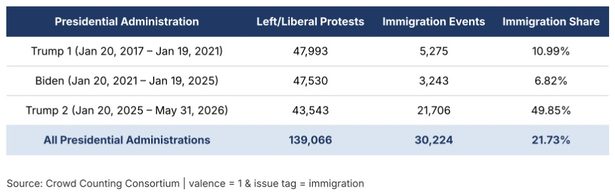
Of course, the current wave of protest builds on a longer-term foundation of pro-immigrant demonstrations. Since the CCC started collecting data on protest in the United States in 2017, we’ve seen that protests against the federal government’s immigration policies have been a constant feature of the protest landscape across all three presidential administrations — Trump 1, Biden and Trump 2 (see Table 1).
Table 1: Immigration protest events as a share of all left/liberal protests
Little more than a week after Trump’s first inauguration in January 2017, numerous protests took place around the country in response to his Jan. 27 signing of Executive Order 13769, sometimes called the “Muslim Ban,” which restricted citizens of seven majority-Muslim countries from entering the U.S. On Jan. 28 and 29, mass protests occurred in and around airports, where immigrant rights groups and community members assembled to ensure the safe arrival of citizens of those countries who were in transit when the executive order went into effect. Protests against the executive order continued in February 2017 under the slogan “No Ban No Wall.” The Trump administration ultimately revised the executive order to a narrower version that the U.S. Supreme Court upheld as lawful; multiple protests followed on June 26, 2018.
But the biggest jumps in protest participation came on coordinated, nationwide days of action related to the administration’s immigration policies. The first, on June 30, 2018, was a national day of action declaring that “Families Belong Together.” These protests demanded an end to the administration’s “child separation policy” — the practice of separating migrant children from parents and caretakers upon arrival at the U.S.-Mexico border — which was in effect under the Obama administration but escalated under Trump. This protest campaign was highly effective: The pressure placed on the administration led the White House to end the policy through an executive order, though loopholes remained.
On Jan. 19, 2019, the third annual Women’s March on Washington represented an additional increase in coordinated nationwide protests in which immigrants’ rights were a core issue. And July 12, 2019 saw the Lights for Liberty day of action, which attempted to pressure elected officials (particularly in the newly Democratic Congress) to close detention centers and adopt more humane immigration policies. Ultimately, congressional Democrats introduced legislation in 2021 to reunite immigrant children with their families. In sum, the first Trump administration saw an impressive range of protests on behalf of immigrants’ rights, some of which had powerful impacts.
Overall, the Biden administration saw a decline in such protests, with about 60 percent fewer than during the first Trump administration (seven percent to 11 percent as a share of overall left/liberal protests, respectively). Notable days of action during the Biden administration included continued protests calling for closure of Immigration and Customs Enforcement, or ICE, detention centers, as well as protests against ongoing family detention and separation practices, and protests against asylum restrictions during a major surge in deportations in 2024.
During the second Trump administration, such protests have seen a breathtaking rise.
Figure 1 provides a comparative view of the number of immigration-related protests under the second Trump administration, compared to the first. The y-axis, showing the cumulative number of immigration-related protests since Trump’s two inaugurations, demonstrates the massive scale and steady climb of protests during his second term so far.
Figure 1: Counts of pro-immigrant protest events during Trump’s first and second terms
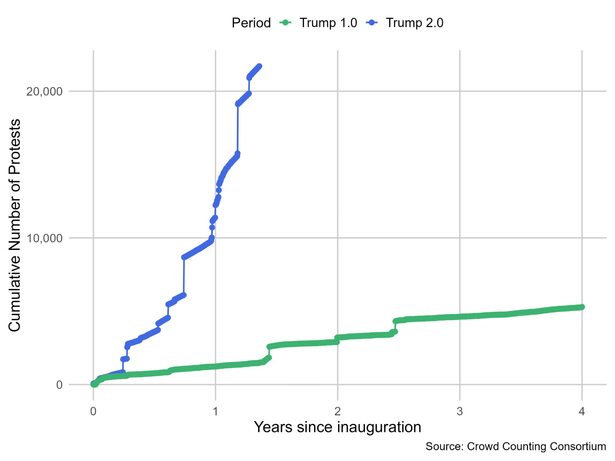
Figure 2 shows the frequency of such events on a monthly basis. There have been more protests in support of immigrants in seven of the months since January 2025 than in any of the 48 months of Trump’s first term. In 10 of the first 17 months of the current term, protests against Trump’s immigration policies made up over 20 percent of total protests. Few other protest claims have animated the public with such enduring salience over time.
Figure 2: Pro-immigrant protests in the U.S., January 20, 2017 – May 31, 2026
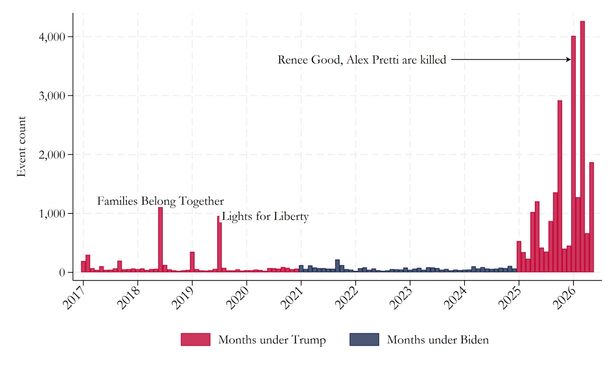
Figure 2 also shows clear increases in the number of immigration-related protests during nationwide anti-Trump protests. Spikes in activity occurred on April 19, 2025 during the Hands Off protests; on October 18, 2025, when many No Kings protests adopted opposition to ICE and Trump’s mass deportation agenda as a central claim; and on March 28, 2026, when the third No Kings protests again made immigration a primary claim. Our tallies have also documented 170 repeater events (protests that are scheduled to take place daily, weekly or monthly) that specifically mention immigrant rights or opposition to ICE in their stated claims.
In Illinois and Minnesota, protests started local and went national
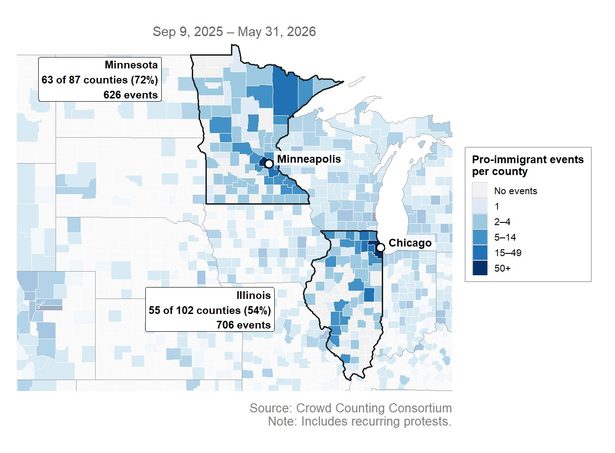
Trump’s immigration policies have produced particularly intense local mobilizations in areas that saw escalated ICE deployments, which then diffused to solidarity protests nationwide. For example, from early September to mid-November 2025, ICE launched Operation Midway Blitz targeting immigrants in Chicago. During that period, the CCC documented 3,491 protest events in opposition to Trump’s immigration policies, starting in Chicago and spreading across the country during the No Kings mobilization on Oct. 18, 2025, which named immigration as a central issue.
Operation Metro Surge, the federal immigration enforcement operation in the Minneapolis-St. Paul region, also provoked powerful opposition locally and beyond, with over 4,400 protests taking place between Dec. 2, 2025 and Jan. 31, 2026. Significant numbers of protests responded to specific, publicized government abuses, such as aggressive law enforcement actions against immigrants, the killings of Renée Good and Alex Pretti, and the detention of a 5-year-old child of a Colombian immigrant. Three waves of action stood out: the ICE Out For Good weekend of action on Jan. 10-11; the Day of Truth & Freedom on Jan. 23, which was concentrated in Minnesota; and the National Shutdown and ICE Out of Everywhere actions, which mainly spanned Jan. 30-31, with some events lasting into Feb. 1.
Figure 3 shows the number of counties that saw pro-immigrant protests in Illinois and Minnesota, respectively, after Operation Midway began in Chicago and Operation Metro Surge began in Minneapolis-St. Paul. Overall, these two states saw higher-than-average numbers of counties featuring protests, including among counties far afield from the major cities in which ICE focused its deployments.
Figure 3. Pro-immigrant protests in Illinois and Minnesota during and after ICE operations in Chicago and Minneapolis-St. Paul
Nationwide, the total volume of protest produced during early 2026 is extraordinary.
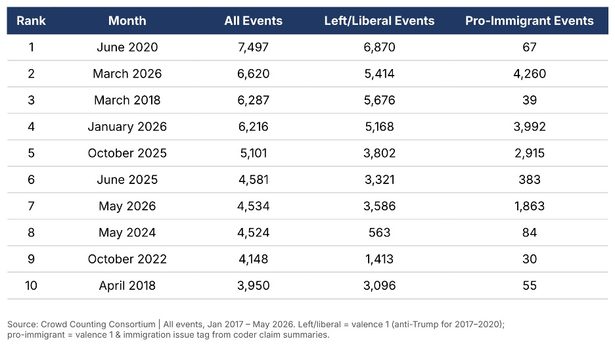
January 2026 alone featured the fourth-most protest events recorded in all 10 years of CCC data, owing to the massive number of protests in Minnesota and around the country in opposition to Operation Metro Surge and its impacts, and to Trump’s immigration agenda in general.
And the events in Minnesota seem to have been a flashpoint. Anti-ICE protests continued in February and March 2026, and anti-ICE claims were central to the nationwide No Kings mobilization on March 28. March 2026 may have been the month with the highest number of pro-immigrant protests in U.S. history (see Table 2).
Table 2: Top 10 months by total protest events, January 20, 2017 – May 31, 2026
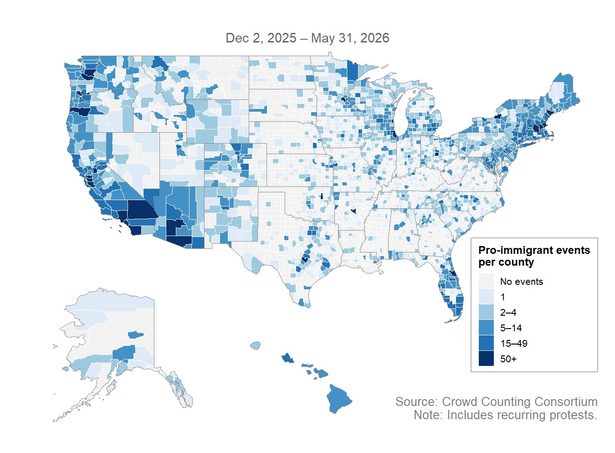
Protests opposing Trump’s immigration policies were reported in 933 counties during Operation Metro Surge, between Dec. 2, 2025 and Feb. 1, 2026 — about 30 percent of all counties in the U.S. These counties were densely populated: Together, they contain more than 80 percent of the U.S. population (see Figure 4). From March 2026 through May 2026, the CCC continued to record thousands of events protesting ICE, with hundreds of distinct civic organizations and hundreds of thousands of people participating.
Figure 4: U.S. immigration protests following ICE deployments to Minneapolis
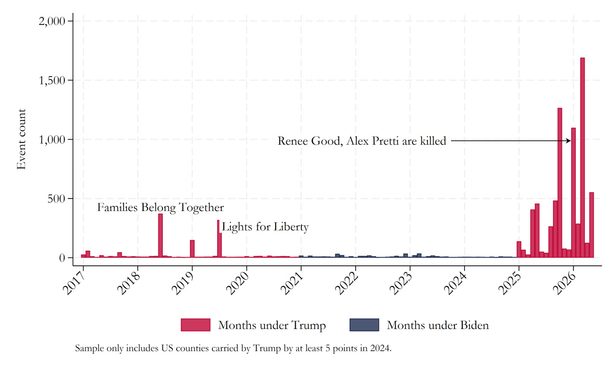
Nor are protests against ICE operations an exclusively liberal phenomenon. Instead, there has been a stark increase over time in the number of pro-immigrant protests in counties that Trump won in 2024 by at least a 5-point margin (see Figure 5). Among the pro-immigrant protests that occurred in March 2026, about 40 percent of them occurred in such counties.
Figure 5: Pro-immigrant protests in counties Trump won by >5 Points in the 2024 Presidential Election, January 20, 2017 – May 31, 2026
Across the country, a broad range of constituencies using a variety of means have expressed opposition to Trump’s immigration policy. Demonstrations have just been one method. Those activating on behalf of and in support of immigrants include people forming human chains to protect immigrant workers; neighborhoods organizing support networks for affected immigrant families; students engaging in walkouts from schools and protests at college career fairs; people engaging in hunger strikes in support of international and undocumented students; knitters engaging in “craftivism”; people holding encampments outside of ICE facilities or noise demonstrations outside of hotels in which ICE agents were housed; consumers engaging in boycotts and sell-backs at Target and Home Depot; clergy engaging in civil disobedience; communities holding vigils for slain immigrants or those killed while advocating for them; community members building raised beds across thoroughfares to prevent ICE vehicles from accessing facilities, and more. Institutions and employers have raised their voices: Local businesses and business associations have called for the end of ICE operations in their towns, ranchers and farmers have decried treatment of their immigrant employees, and the U.S. Conference of Catholic Bishops has condemned mistreatment of immigrants as well.
Counter-protest was minimal
Trump’s immigration policies have supporters in the country, particularly among Republicans. But few people have rallied or marched in defense of them. Right-leaning protests made up fewer than two percent of all immigration-related protests during the first 14 months of the first Trump administration, and less than 0.7 percent of immigration-related protests during the same stretch of his second administration.
The frequency of pro-immigrant protests during Trump’s second term has eclipsed that of anti-immigration protests by 145 to 1. The vast majority of anti-immigration protests have been counter-protests occurring at demonstrations in support of immigrants and their rights.
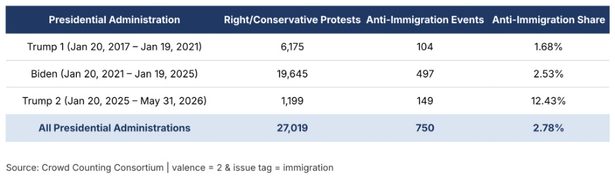
However, right-leaning protests have been increasingly characterized by anti-immigrant claims over the past three presidencies. Whereas anti-immigrant protests constituted 1.68 percent of all right-learning protests during Trump’s first term, that proportion has increased sevenfold so far during his second, to 12.43 percent.
Table 3: Anti-immigration protest events as a share of all right/conservative protests
A powerful and growing pro-immigrant constituency
Today’s mass protests in support of immigrants’ rights build on a durable pattern of pro-immigrant and anti-ICE protest in the U.S. To wit, the CCC has documented a prayer protest outside an ICE facility in Broadview, Illinois that has been held every Friday for the past 20 years.
But the recent increase in pro-immigrant protests and their intensity is notable. The breadth and volume of pro-immigrant protests show that committed activists and organizations have succeeded in rallying huge numbers in favor of justice and dignity for immigrants, indicating a durable underlying infrastructure. In this essay, we focused on street protest as one indicator in the overall picture. But community mobilization on behalf of immigrants has meant far more than demonstrations. Mutual aid and neighborly support, observing and documenting ICE operations, litigation, support to immigrants in detention, and direct appeals to public officials have all been central to America’s response to Trump’s immigration policies. The growth of pro-immigrant protests reflects a (potentially growing) constituency willing to take risks to defend a multicultural vision of America, potentially widening its appeal.
Waging Nonviolence depends on reader support. Make a donation today!
In short, we see capable organizers and the mass public pushing hard for humane treatment of immigrants for the foreseeable future. Neither political party has figured out how to address immigration in a way that resolves the need for safe and secure borders and the need to treat everyone on U.S. soil with dignity, decency and due process. But the impacts of Trump’s policies on immigrants, their families and their broader communities provide a galvanizing issue for Americans who otherwise agree on little else. For example, some conservative faith communities and various progressive groups increasingly find themselves on the same side when it comes to immigration.
Policymakers often resist turning to activists, civil society organizations and community groups for policy solutions. But the persistence of multi-sectoral immigration activism, as seen through protest alone, also reflects a powerful and growing constituency in favor of just and humane approaches to immigration. Protests reflect and shape the existing moral consensus but also can reorient constituencies in favor of a new consensus. We hope the members of the next Congress pay attention.
This article Will historic protests against ICE shape the midterms? was originally published by Waging Nonviolence.
People-powered news and analysis
Source: https://wagingnonviolence.org/2026/11/ice-protest-data-midterms/
Anyone can join.
Anyone can contribute.
Anyone can become informed about their world.
"United We Stand" Click Here To Create Your Personal Citizen Journalist Account Today, Be Sure To Invite Your Friends.
Before It’s News® is a community of individuals who report on what’s going on around them, from all around the world. Anyone can join. Anyone can contribute. Anyone can become informed about their world. "United We Stand" Click Here To Create Your Personal Citizen Journalist Account Today, Be Sure To Invite Your Friends.
LION'S MANE PRODUCT
Try Our Lion’s Mane WHOLE MIND Nootropic Blend 60 Capsules
Mushrooms are having a moment. One fabulous fungus in particular, lion’s mane, may help improve memory, depression and anxiety symptoms. They are also an excellent source of nutrients that show promise as a therapy for dementia, and other neurodegenerative diseases. If you’re living with anxiety or depression, you may be curious about all the therapy options out there — including the natural ones.Our Lion’s Mane WHOLE MIND Nootropic Blend has been formulated to utilize the potency of Lion’s mane but also include the benefits of four other Highly Beneficial Mushrooms. Synergistically, they work together to Build your health through improving cognitive function and immunity regardless of your age. Our Nootropic not only improves your Cognitive Function and Activates your Immune System, but it benefits growth of Essential Gut Flora, further enhancing your Vitality.

Our Formula includes: Lion’s Mane Mushrooms which Increase Brain Power through nerve growth, lessen anxiety, reduce depression, and improve concentration. Its an excellent adaptogen, promotes sleep and improves immunity. Shiitake Mushrooms which Fight cancer cells and infectious disease, boost the immune system, promotes brain function, and serves as a source of B vitamins. Maitake Mushrooms which regulate blood sugar levels of diabetics, reduce hypertension and boosts the immune system. Reishi Mushrooms which Fight inflammation, liver disease, fatigue, tumor growth and cancer. They Improve skin disorders and soothes digestive problems, stomach ulcers and leaky gut syndrome. Chaga Mushrooms which have anti-aging effects, boost immune function, improve stamina and athletic performance, even act as a natural aphrodisiac, fighting diabetes and improving liver function. Try Our Lion’s Mane WHOLE MIND Nootropic Blend 60 Capsules Today. Be 100% Satisfied or Receive a Full Money Back Guarantee. Order Yours Today by Following This Link.


| Visits: | 1,836,958,672 |
| Stories: | 8,730,912 |
Whistler Blowers, Insiders

