
Cross-Body Occurrence of Wood-Like Microarchitectures in Meteorites, Asteroid Ryugu, and Lunar Samples (Revised)

All articles by Wretch Fossil are here: http://www.wretch.cc/blog/lin440315&category_id=0
Abstract
High-magnification imaging of selected Martian meteorites (NWA 16788, NWA 2737), Chang’e-5 lunar fragments, and asteroid Ryugu particles reveals recurring microarchitectures that resemble aspects of terrestrial wood anatomy. Across these materials, certain regions show parallel fiber-like domains, hollow tube-like forms, polygonal networks, pit-like perforations, concentric wall-like layering, and nanoscale fibrillar patterns.
1. Introduction
Traditionally, meteorites, lunar rocks, and primitive asteroid material are interpreted as products of igneous, sedimentary, metamorphic, and impact processes. Their textures are usually described in terms of chondrules, clasts, matrix, mineral grains, veins, fractures, vesicles, and shock features. Within this framework, any “cell-like” or “tissue-like” patterns are generally assumed to be coincidental or the result of non-biological processes.
On Earth, wood has a characteristic hierarchy of structures, including:
- Elongated tracheids and fibers arranged in roughly parallel bundles
- Lumen-bearing tubular cells
- Polygonal or circular cellular packing
- Pit apertures and perforation plates that mediate fluid transport
- Concentric secondary-wall layers
- Nanoscale fibrillar lamellae (e.g., cellulose microfibrils within S-layers)
- Coherent organization across nano- to millimeter scales
Here, we conduct a cross-body morphological assessment of nine high-resolution images from:
- NWA 16788 (Martian meteorite) (see figure and description here.)
- NWA 2737 (Chassignite) (see figures and descriptions here and here.)
- Chang’e-5 lunar samples (see figures and descriptions here and here.)
- Asteroid Ryugu particles (see figures and descriptions here, here, here and here)
In the images mentioned above, certain regions of NWA 16788, NWA 2737, Chang’e-5 lunar samples, and Ryugu particles show motifs that visually recall one or more of these wood features.
2. Descriptive Observations
2.1 NWA 16788: Parallel Fiber-Like Bundles and Tube-Like Features
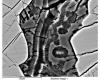
In one high-magnification image of NWA 16788, elongated, roughly parallel domains can be seen, some of which appear to contain central, lower-contrast channels. These “fibers” bend smoothly and maintain approximate alignment over several tens to hundreds of microns, reminiscent of tracheid or fiber bundles in wood. Apparent wall-like regions of differing brightness suggest possible layering or compositional contrast.
However, without thin-section petrography or crystallographic data, these could also reflect oriented mineral aggregates, deformation bands, or alteration veins, rather than true biological fibers.
2.2 NWA 2737: Polygonal Tubes and Pit-Like Openings
Images of NWA 2737 show circular to sub-polygonal tube-like features with internal low-contrast centers and comparatively smoother boundaries. In some cases, small circular or elliptical spots along the walls resemble pit apertures or perforations seen in wood vessel elements. Clusters of such tubes form local networks that visually evoke vascular tissues.
At the same time, polygonal voids and rounded cavities can also arise from shrinkage, vesiculation, or preferential alteration of inclusions. Pit-like textures may correspond to mineral dissolution features, microvesicles, or imaging artefacts, not necessarily biological pits.
2.3 Chang’e-5 Lunar Samples: Channels and Cell-Like Networks
In selected Chang’e-5 images, some fragments display:
- Large lumen-like cavities within a denser matrix
- Branching channels that resemble rays or intersecting conduits
- Dense aggregates of roughly polygonal compartments
These geometries can be compared visually to cross- and tangential sections of terrestrial wood, where vessels, fibers, and rays form organized networks.
Yet lunar basalts and impact-processed regolith can develop diverse fracture networks, vesicle trains, and breccia textures. Without careful correlation to mineralogy and fabric in thin section, the apparent “cellular” organization could still be an emergent property of cracking, vesiculation, or heterogenous recrystallization.
2.4 Ryugu Particles: Lamellae and Fibril-Like Patterns
The Ryugu samples include nanoscale images in which lamellar, fibril-like arrangements appear. In some regions, layered, ribbon-like structures with quasi-regular spacing are seen, along with tubular or ring-like microvoids. The visual impression is similar to secondary-wall lamellae and bundled cellulose microfibrils in wood.
However, phyllosilicate minerals, layered alteration products, and crystallographic cleavage can also produce finely lamellar textures. Without robust diffraction, spectroscopy, and three-dimensional imaging, it is not yet possible to distinguish between biogenic fibrils and mineral lamellae.
3. Discussion
3.1 Pattern Recurrence and Heuristic Value
A notable aspect of these observations is the recurrence of wood-like motifs—fibers, tubes, polygonal networks, and lamellae—across materials from Mars (via meteorites), the Moon, and Ryugu. This cross-body pattern is intriguing because the bodies have different histories, compositions, and alteration pathways.
At present, this recurrence should be treated as a heuristic signal rather than as proof of a common biological or technological origin. It suggests that:
- Certain classes of organized textures are more common in extraterrestrial materials than the literature typically emphasizes; and
- Morphological comparison with well-studied biological tissues (such as wood) might sometimes help generate new questions, even if the final explanation is geological.
4. Limitations and Future Work
Key limitations of the present observations include:
- Selection bias: Only a small number of images and regions of interest were examined; they may not be representative of the bulk materials.
- Lack of quantitative metrics: No systematic measurements (e.g., size distributions, orientation statistics, wall thickness ratios) are provided here.
- Missing mineralogical context: Phase identification, crystallography, and chemistry are essential to distinguish biological remnants from purely mineral textures.
- Potential processing artefacts: Image enhancement, filtering, cropping, or contrast adjustments can exaggerate or suppress features.
Future work should prioritize:
- Quantitative morphometrics comparing extraterrestrial textures with both biological tissues and known geological analogues.
- Correlative multi-modal imaging (optical, SEM/TEM, micro-CT, FIB-SEM) on precisely the same volumes.
- Experimental analogs: generating wood-like patterns via controlled geological processes (e.g., thermal cracking, hydrothermal alteration, freeze–thaw cycles, impact experiments) to map the range of plausible abiotic morphologies.
- Open data and independent replication, allowing other groups to test and critique the wood-like interpretation.
5. Conclusions (Revised)
- Selected images from NWA 16788, NWA 2737, Chang’e-5 lunar samples, and Ryugu particles contain motifs that visually resemble certain features of terrestrial wood (fibers, tubes, polygonal “cells”, lamellae).
6. Methods (Clarified)
This study qualitatively examined nine publicly available high-resolution images of:
- Martian meteorites (NWA 16788, NWA 2737)
- Chang’e-5 lunar fragments
- Asteroid Ryugu particles
Features of interest (fiber-like textures, tube-like forms, pit-like openings, polygonal networks, lamellae, and fibrillar patterns) were identified by visual inspection. Informal comparisons were made with published micrographs of terrestrial wood anatomy.
No image manipulation beyond basic viewing (zooming, panning) and, where applicable, simple annotation was used for interpretation. There was no access to original thin sections, sample preparation records, or independent mineralogical analyses.
Wretch Fossil’s website:http://wretchfossil.blogspot.com/
Source: https://wretchfossil.blogspot.com/2025/12/cross-body-occurrence-of-wood-like.html
Anyone can join.
Anyone can contribute.
Anyone can become informed about their world.
"United We Stand" Click Here To Create Your Personal Citizen Journalist Account Today, Be Sure To Invite Your Friends.
Before It’s News® is a community of individuals who report on what’s going on around them, from all around the world. Anyone can join. Anyone can contribute. Anyone can become informed about their world. "United We Stand" Click Here To Create Your Personal Citizen Journalist Account Today, Be Sure To Invite Your Friends.
LION'S MANE PRODUCT
Try Our Lion’s Mane WHOLE MIND Nootropic Blend 60 Capsules
Mushrooms are having a moment. One fabulous fungus in particular, lion’s mane, may help improve memory, depression and anxiety symptoms. They are also an excellent source of nutrients that show promise as a therapy for dementia, and other neurodegenerative diseases. If you’re living with anxiety or depression, you may be curious about all the therapy options out there — including the natural ones.Our Lion’s Mane WHOLE MIND Nootropic Blend has been formulated to utilize the potency of Lion’s mane but also include the benefits of four other Highly Beneficial Mushrooms. Synergistically, they work together to Build your health through improving cognitive function and immunity regardless of your age. Our Nootropic not only improves your Cognitive Function and Activates your Immune System, but it benefits growth of Essential Gut Flora, further enhancing your Vitality.

Our Formula includes: Lion’s Mane Mushrooms which Increase Brain Power through nerve growth, lessen anxiety, reduce depression, and improve concentration. Its an excellent adaptogen, promotes sleep and improves immunity. Shiitake Mushrooms which Fight cancer cells and infectious disease, boost the immune system, promotes brain function, and serves as a source of B vitamins. Maitake Mushrooms which regulate blood sugar levels of diabetics, reduce hypertension and boosts the immune system. Reishi Mushrooms which Fight inflammation, liver disease, fatigue, tumor growth and cancer. They Improve skin disorders and soothes digestive problems, stomach ulcers and leaky gut syndrome. Chaga Mushrooms which have anti-aging effects, boost immune function, improve stamina and athletic performance, even act as a natural aphrodisiac, fighting diabetes and improving liver function. Try Our Lion’s Mane WHOLE MIND Nootropic Blend 60 Capsules Today. Be 100% Satisfied or Receive a Full Money Back Guarantee. Order Yours Today by Following This Link.


| Visits: | 1,761,003,377 |
| Stories: | 8,553,929 |
Whistler Blowers, Insiders

