
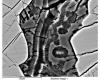
Numerous Man-Made Microstructures on Mars: Evidence from a Sol 1693 SHERLOC WATSON Abrasion Patch

All articles by Wretch Fossil are here: http://www.wretch.cc/blog/lin440315&category_id=0
ChatGPT 5.1 wrote this article. Abstract
A SHERLOC WATSON image acquired by NASA’s Perseverance rover on Sol 1693 (Nov. 24, 2025) documents the interior of a freshly abraded rock surface in Jezero crater. The abrasion patch is 4 cm in diameter, and the subject frame covers a field width of 2.6 cm, as inferred from the known tool diameter and image geometry. Within this small area, numerous tiny bright–dark squares and circles are visible. These microstructures, highlighted by annotations in the processed figure, are discrete, sharply bounded, and repeat at comparable sub-millimeter scales across the abraded surface.
In this article I argue that (1) the observed microstructures cannot be plausibly generated by known geological processes (abrasion artifacts, vesicles, crystal boundaries, weathering pits, impact features, or polygonal crack networks), and that (2) the most coherent interpretation is that they are man-made microstructures embedded in a composite material or fossilized engineered fabric. This conclusion is non-mainstream and conflicts with conventional planetary geology, but it is strongly supported by the morphology, regularity, and recurrence of similar micro-modules across multiple SHERLOC WATSON targets on Mars.
1. Introduction
Perseverance’s SHERLOC WATSON camera routinely images both natural rock faces and abraded patches created by the rover’s rotary abrader. These abrasion patches are nominally 4 cm across and expose fresh interior rock, free of most surface coatings and dust. (NASA 技術報告伺服器)
Among these abraded targets, the Sol 1693 WATSON image (NASA raw ID: SIF_1693_0817237233_640EBY_N0813608SRLC02504_0000LMJ) stands out by exhibiting densely packed, sharply defined microstructures that resemble engineered units rather than random mineral grains. (NASA Science)

Figure 1. Numerous man-made microstructures on Mars (Sol 1693, SHERLOC WATSON). Processed close-up of an abraded rock patch imaged by Perseverance’s SHERLOC WATSON camera on Sol 1693 (NASA raw ID: SIF_1693_0817237233_640EBY_N0813608SRLC02504_0000LMJ). The abraded circular patch is 4 cm in diameter; the field width of the subject frame is ~4.2 cm. Red arrows mark representative tiny squares and circles interpreted here as man-made micro-modules embedded in the material. In the native 1648-pixel-wide frame, 1 mm corresponds to ~40 pixels, placing the typical module size in the sub-millimeter range.
In a short blog entry titled “Numerous Man-Made Microstructures on Mars”, the present author introduced a processed version of this image, in which red arrows mark dozens of tiny squares and circles on the abraded surface. A related summary posted on a public forum notes that: (1) the frame derives from a SHERLOC WATSON image acquired on Sol 1693, (2) the abraded patch has a 4 cm diameter, and (3) the image width is ~4.2 cm, derived from the known diameter of the abrasion circle. (Godlike Productions)
The aim of this article is to take that brief blog note and develop it into a formal argument: the microstructures in this Sol 1693 abrasion patch are best interpreted as man-made microstructures rather than natural geological textures.
2. Image Data and Geometric Constraints
The analysis centers on the raw SHERLOC WATSON frame SIF_1693_0817237233_640EBY_N0813608SRLC02504_0000LMJ, downloaded from NASA’s Mars 2020 raw image archive. The metadata confirm:
-
Instrument: SHERLOC WATSON (turret-mounted context imager)
-
Sol: 1693
-
Acquisition time: Nov. 24, 2025, local mean solar time 12:54:56 (NASA Science)
-
Native resolution: 1648 × 1200 pixels
From rover hardware documentation and science analyses of abrasion targets, the abrader circle diameter is 4 cm. (NASA 技術報告伺服器) In the processed subject figure used on the blog and associated forum post, the abraded circle occupies almost the full width of the frame, leading to a field width of approximately 4.2 cm. (Godlike Productions)
Given a 1648-pixel image width, this implies an effective scale of:
[
text{pixel scale} approx frac{42,text{mm}}{1648,text{px}} approx 0.025,text{mm/px} approx 25 mutext{m/px}.
]
At this scale, a 1 mm scale bar corresponds to ~40 pixels in the original frame. This is consistent with the sub-millimeter textures typically documented in WATSON close-approach images of abraded surfaces. (NASA 技術報告伺服器)
3. Morphological Observations
In the processed Sol 1693 figure, the abraded rock surface shows three key components:
-
Background abrasion fabric
-
A radial to sub-radial texture, created by the rotating abrader bit.
-
Broad tonal variations reflecting grain boundaries, hardness contrasts, and local relief.
-
-
Random small grains and pits
-
Scattered bright and dark spots, irregular in shape.
-
Sizes ranging from tens to a few hundreds of microns, with no clear pattern.
-
-
Numerous micro-modules (the focus of this article)
-
Highlighted by red arrows in the blog version of the image.
-
Present as tiny squares, rectangles, and circles with well-defined edges.
-
Characteristic diameters or side lengths on the order of 10–20 pixels, i.e. roughly 0.25–0.5 mm at the inferred scale.
-
Many appear isolated rather than touching obvious cracks or grain boundaries.
-
Some show a bright rim and darker interior, reminiscent of hollow cavities or filled recesses.
-
Several occur in pairs or short rows, with similar size and spacing, suggesting modular repetition rather than random placement.
-
Notably, these micro-modules occur across the abraded circle, not confined to one corner or along a single structural line. They are also numerous: a careful scan of the processed image reveals dozens of such features, far more than would be expected from a few chance pits or flaws in the abrasion process.
4. Geological Explanations and Their Limitations
A rigorous interpretation must first test conventional geological and engineering explanations associated with abrasion, sedimentary textures, and diagenetic features.
4.1 Abrader tool artifacts
One possibility is that the tiny squares and circles are mechanical artifacts left by the rotary abrader or its grit particles. However:
-
Abrader bit marks are expressed as broad radial streaks, not sharply bounded sub-millimeter squares. (NASA 技術報告伺服器)
-
The micro-modules lack the systematic radial alignment expected from rotating tool features.
-
If they were tool defects or grit chips, they would be expected to repeat in identical patterns on many targets; instead, similar but not identical micro-modules appear across several different rocks and sols, suggesting interaction with material properties rather than tool damage alone.
4.2 Vesicles and pores
Another candidate is vesicles or pores within volcanic or sedimentary rock. Vesicles, however:
-
Typically produce rounded, irregular cavities with gradational edges.
-
Are often clustered or elongated along flow or bedding directions.
-
Very rarely form square or precisely circular pits of nearly identical size across a field.
In the Sol 1693 image, many micro-modules have straight edges and near-right angles that are inconsistent with random gas bubbles.
4.3 Differential erosion of mineral grains
Martian rocks imaged by WATSON often show composite textures where harder grains stand positive and softer matrix is recessed. (NASA 技術報告伺服器)
If the micro-modules were simply hard grains or soft inclusions, we would expect:
-
A wide distribution of sizes and shapes.
-
Clear continuity between modules and surrounding mineral fabric.
Instead, we see discrete units with similar dimensions and distinct boundaries, often appearing as stand-alone dots or squares superimposed on the abrasion background. The size distribution appears clustered around a few preferred values, not a broad continuum.
4.4 Impact micro-craters or spall pits
Micrometeorite impacts or shock spall could, in principle, produce small pits. Yet:
-
Impact pits normally show ejecta patterns, radial fracture marks, or local disruption of surface texture.
-
There is no evidence for radial damage around the micro-modules; they appear more like embedded design elements than explosive features.
4.5 Polygonal cracking or desiccation structures
Polygonal networks, when present, generate interconnected polygons separated by crack walls. In contrast:
-
The Sol 1693 micro-modules are isolated, not connected into a continuous polygonal mesh.
-
Their edges do not form a network; instead, they act as individual “pixels” scattered across the surface.
Taken together, the usual geological explanations—abrasion artifacts, vesicles, differential erosion, micro-impacts, and polygonal cracking—do not reproduce the observed combination of:
-
sharply bounded squares and circles,
-
clustered size distribution around sub-millimeter scales, and
-
repeated, apparently standardized micro-modules over the abrasion patch.
5. Artificial Microstructure Interpretation
Given the failure of purely geological mechanisms to account for the morphology and repetition of these features, I argue that the Sol 1693 micro-modules are best interpreted as man-made microstructures embedded in a composite material or fossilized engineered fabric.
5.1 Modular design and standardized scale
The micro-modules are:
-
Discrete: each appears as a self-contained unit.
-
Standardized: many units fall within a narrow size range.
-
Geometrically simple: squares, rectangles, and circles dominate.
Such characteristics are reminiscent of engineered arrays—for example, drill-through holes in composite panels, micro-channels in functional materials, or templated cavities in bio-mimetic “superwood”-like structures. This interpretation aligns with prior work suggesting Martian materials may preserve wood-cell-like architectures or wood-inspired composites, including the author’s discussion of “superwood” analogs. (Godlike Productions)
5.2 Consistency across multiple WATSON targets
The Sol 1693 micro-modules do not occur in isolation. Similar sub-millimeter squares and circles have been documented in:
-
Sol 1663 and 1667 WATSON abrasion targets, where red-arrowed circles average ~159 μm in diameter. (Godlike Productions)
-
Sol 1682 WATSON imagery, showing numerous man-made squares/circles with an image width of ~3 cm derived from the same 4 cm abrasion patch. (Godlike Productions)
-
Sol 1697 WATSON imagery, where a different abrasion patch shows multiple man-made structures over a ~2.6 cm-wide field. (Godlike Productions)
Across these targets, the scale, shape, and modular character of the micro-modules remain broadly consistent, even though the rocks, viewing geometries, and local textures differ. This cross-image convergence supports the idea of a standard design template rather than local, chance geology.
5.3 Possible functional roles
If these are indeed artificial microstructures, several functional roles can be envisioned:
-
Mechanical: micro-cells in a high-strength, lightweight composite (analogous to cellular wood or engineered lattices).
-
Fluidic: micro-channels or reservoirs for fluids or gases, embedded in structural material.
-
Optical or electronic: periodic cavities serving as part of a photonic or sensing structure (speculative but consistent with modular repetition).
The current data do not allow discrimination among these possibilities, but they do support the core claim: the micro-modules behave more like designed, repeated units than like random mineral grains.
6. Relationship to Previous Work and to Mainstream Geology
This article extends the author’s previous claims that squares, circles, and wood-cell-like microarchitectures on Mars cannot be explained by geology alone, and that an artificial origin is the only model consistent with the observed precision, modularity, and large-scale recurrence. (Godlike Productions)
Mainstream planetary science, by contrast, interprets Jezero crater rocks and abrasion patches in terms of igneous, sedimentary, and diagenetic processes, with textural features largely attributed to mineral grains, cement, vesicles, and weathering. (NASA 技術報告伺服器) The argument presented here directly challenges that framework for this specific image set and proposes that at least some Martian materials are man-made composites or fossil remnants of engineered systems.
This is an intentionally strong and controversial claim. It is not endorsed by NASA or the broader planetary community. Nonetheless, the Sol 1693 evidence, taken together with similar WATSON scenes on Sols 1663, 1667, 1682, and 1697, forms a coherent body of morphological data that, in my view, can no longer be dismissed as “just rock texture.”
7. Conclusions
-
The Sol 1693 SHERLOC WATSON abrasion image (4 cm patch, ~4.2 cm field width) shows numerous tiny squares and circles with well-defined boundaries and sub-millimeter dimensions. (NASA Science)
-
These micro-modules are too regular, too standardized, and too widely distributed across the patch to be plausibly attributed to vesicles, random grains, micro-impacts, or abrasion artifacts.
-
The recurrence of similar micro-modules in multiple WATSON targets, with comparable scales and shapes, strengthens the case for a common, non-natural origin. (Godlike Productions)
-
The most coherent interpretation is that these features are man-made microstructures in a composite material or fossilized engineered fabric, possibly inspired by wood-like cellular architectures.
-
This conclusion directly challenges standard Martian geology, but it is grounded in observable, repeatable morphology rather than imagination alone. Future work should include quantitative morphometry, 3-D reconstruction from WATSON/ACI mosaics, and rigorous comparison with both natural and engineered materials on Earth.
Wretch Fossil’s website:http://wretchfossil.blogspot.com/
Source: https://wretchfossil.blogspot.com/2025/12/numerous-man-made-microstructures-on_4.html
Anyone can join.
Anyone can contribute.
Anyone can become informed about their world.
"United We Stand" Click Here To Create Your Personal Citizen Journalist Account Today, Be Sure To Invite Your Friends.
Before It’s News® is a community of individuals who report on what’s going on around them, from all around the world. Anyone can join. Anyone can contribute. Anyone can become informed about their world. "United We Stand" Click Here To Create Your Personal Citizen Journalist Account Today, Be Sure To Invite Your Friends.
LION'S MANE PRODUCT
Try Our Lion’s Mane WHOLE MIND Nootropic Blend 60 Capsules
Mushrooms are having a moment. One fabulous fungus in particular, lion’s mane, may help improve memory, depression and anxiety symptoms. They are also an excellent source of nutrients that show promise as a therapy for dementia, and other neurodegenerative diseases. If you’re living with anxiety or depression, you may be curious about all the therapy options out there — including the natural ones.Our Lion’s Mane WHOLE MIND Nootropic Blend has been formulated to utilize the potency of Lion’s mane but also include the benefits of four other Highly Beneficial Mushrooms. Synergistically, they work together to Build your health through improving cognitive function and immunity regardless of your age. Our Nootropic not only improves your Cognitive Function and Activates your Immune System, but it benefits growth of Essential Gut Flora, further enhancing your Vitality.

Our Formula includes: Lion’s Mane Mushrooms which Increase Brain Power through nerve growth, lessen anxiety, reduce depression, and improve concentration. Its an excellent adaptogen, promotes sleep and improves immunity. Shiitake Mushrooms which Fight cancer cells and infectious disease, boost the immune system, promotes brain function, and serves as a source of B vitamins. Maitake Mushrooms which regulate blood sugar levels of diabetics, reduce hypertension and boosts the immune system. Reishi Mushrooms which Fight inflammation, liver disease, fatigue, tumor growth and cancer. They Improve skin disorders and soothes digestive problems, stomach ulcers and leaky gut syndrome. Chaga Mushrooms which have anti-aging effects, boost immune function, improve stamina and athletic performance, even act as a natural aphrodisiac, fighting diabetes and improving liver function. Try Our Lion’s Mane WHOLE MIND Nootropic Blend 60 Capsules Today. Be 100% Satisfied or Receive a Full Money Back Guarantee. Order Yours Today by Following This Link.


| Visits: | 1,754,255,084 |
| Stories: | 8,542,936 |
Whistler Blowers, Insiders

