
To Stu Bonk: response to repy to comment

A Response to David Peters’s Newest Post Replying to Me
“Please note the axis of the acetabulum is lateral. The axis of the femoral head is medial. Those align.”
While yes, those typically align, either the femur isn’t in a proper lateral view or there’s something wrong with the femoral head as it should at least be similar in shape to the acetabulum. The most apparent case (Fig. 1) shows a large chunk of the femoral head not even in the acetabulum at all. Along with this, if this femoral head were to slot into the acetabulum, it would at most fill about half of the acetabulum. Also, regardless of the validity of anything I just said, the femoral head absolutely should not be at the side of the femur. It should be above that flat portion.
>> Stu: a few things here: 1. Please see https://www.reptileevolution.com/sharovipteryx2.htm for images of the plate and counterplate. Note that the femur appears on both, split in half the long way to reveal its hollow interior. Note the femoral head is layered with sacrals and pelves. Note the traced femoral head is broader than shown in the animation and lacks a femoral neck. In the animation some foreshortening was applied to the left hind limb in order to show its lateral-ish configuration.That foreshortening appears to have migrated to the too-small femoral head. My bad. Your good eye.
For closer imagery see: https://www.researchgate.net/publication/328388115_Cosesaurus_aviceps_Sharovipteryx_mirabilis_and_Longisquama_insignis_Reinterpreted
 |
| Figure 1. One of the frames in David’s Sharovipteryx running animation in which the femoral head appears to be too far removed from the acetabulum.
>> Stu, do me a favor and mentally push that femoral head deeper into the acetabulum. I attempted to show both rather than hide the head in the acetabulum. My mistake. Note the foreshortening in this image. That means distortion when dealing with a 2D = flat original. |
“Are you saying I was a mm off on the one, but okay on the others?”
Yes and no. I couldn’t really tell you if the frames I didn’t acknowledge were off as it’s a bit hard to judge when it comes to them (especially considering that the femoral head doesn’t fit the acetabulum). The frames I picked out were the ones with the most noticeable issues with the positioning of the femoral head.
“Have any done comparisons to lepidosaur musculature? or did they use birds? Or did they use muscle attachment points? If so, how did the prepubis figure into their restorations = best guesses?”
It varies on the paper. Buchmann and Rodrigues, 2025 attempted to simulate pterosaur cervical musculature through comparisons to birds and crocodilians. Bennet, 2008 used muscle scars in order to simulate forelimb musculature in Anhanguera. From what I can tell, the portion of New Perspectives on Pterosaur Palaeobiology reconstructing the hindlimb musculature of Vectidraco uses both muscle scars and comparisons to extant archosaurs. Costa et al., 2013 simulated pterosaur hindlimb musculature in Anhanguera using 3d modeling software, muscle scars present in Pteranodon, and comparisons to modern archosaurs. Griffin et al., 2024 utilized all previous muscle simulations of Anhanguera along with in-person examination in order to simulate the full body musculature of the taxon.
In the cases of both Anhanguera and Vectidraco, the presence of the prepubis was not factored in as there is no evidence supporting its presence in those taxa and there don’t appear to be any signs of breakage where the prepubis would connect to the hip.
>>Stu: So, your answer is ‘no’. No comparisons to lepidosaurs. Vecticodraco is a protorosaur in analysis, so not related to pterosaurs, yet bipedal by convergence. Ever wonder why Anhanguera is the only pterosaur without a prepubis? Possibly related to its also unique tiny feet – whatever tiny feet means with regard to pterosaur locomotion.
“Peer review rarely if ever employs the scientific method. By that I mean have you ever seen or heard of any referee repeating the experiment (= repeating the animation) or observation = requesting the specimen for their own examination.”
To my knowledge, the extent as to what happens in peer-review varies from paper-to-paper. Some will suggest additions to the paper, suggest clarification on certain portions of it, or state that you need to substantiate claims made more. Some reviewers will examine the fossil themselves and tell you if you described certain portions of the specimen incorrectly. Also, the reason why reviewers won’t always repeat exactly what the paper they’re reviewing did is because sometimes the methodology required to repeat the research in the study may take months or years to conduct alongside a decent sum of money (this wouldn’t be a problem if the reviewers had funding to do this, but they don’t).
>>Stu: Please provide evidence for “Some reviewers will examine the fossil themselves and tell you if you described certain portions of the specimen incorrectly.” I have never heard of that. I’d like to know. Submit a manuscript someday and see how the process actually works, as I have.
“One said, “you didn’t look at the fossil long enough.’ On another paper the same referee, David Hone, wrote, “you didn’t examine the specimens a second time.” See what I mean? This is reality. This is gatekeeping. You’re going to have to put away your ideals when it comes to paleontologists.”
The examples you provided are not gatekeeping, they are requests for you to reexamine the fossils you’re publishing on as, depending how long David Hone has studied the fossils in question, he may be right as he might’ve studied the fossils over a longer period of time and with more scientific rigor than you did. Also, if you did not examine the fossils in-person, Hone is correct that you should reexamine the fossils as while photographs are good, they won’t give you the same amount of detail that examining it in person does. That is just good protocol.
>>Stu: Please provide evidence for “David Hone has studied the fossils in question,” He has never indicated that he ever examined the fossils in question. I examined the fossils in question. I published on the fossils in question (Peters 2000). I had 8×10″ transparencies made of the data. In the rejected manuscript I was correcting earlier freshman errors in a follow-up paper. Do you see the bias in your judgement? You assumed incorrectly that professionals always operate professionallly. They are human. They are concerned with their status and interrelationships.
“Question: have you ever submitted a manuscript and figures for publication? A Yes or No will suffice.”
No, I have not, but I am aware of how the process typically works because I’m in frequent contact with a few paleontologists who do have experience publishing, getting peer-review, and giving peer-review.
>>Stu, your “aware”ness may be based on an ideal, and not correctly factor in the human status/emotion/ingroup vs outgroup factor that I have experience first hand with accepted and rejected manuscripts.
“When showing fossils as they lived and locomoted there is no ‘proof’. Only a hypothesis that then requires confirmation, refutation or modification.”
That is only somewhat correct. When it comes to locomotion, there are ways to tell for certain that an animal did or did not walk a certain way. In regards to the femur, it mainly comes from seeing how the femoral head slots into the acetabulum. If the head doesn’t slide in properly when at a certain angle, the animal didn’t walk with its femur in that position.
>> Stu, see above for tab and slot situation. Also see these blogposts on bipedal lizard tracks: https://pterosaurheresies.wordpress.com/2018/02/18/bipedal-cretaceous-lizard-tracks/ and https://pterosaurheresies.wordpress.com/2020/01/16/lepidosaur-bipedality-and-pelvis-morphology-grinham-and-norman-2019/
“I presented these arguments in 2011: https://pterosaurheresies.wordpress.com/2011/07/20/seven-problems-with-the-pterosaur-wing-launch-hypothesis/“
Since you’re giving me a different post to reply to, I will make a separate post in order to respond to the claims in it.
“Please note that when pterosaurs quad launch they do so with wings folded (that makes it tough to use them for thrust and lift as in the competing bird-like launch hypothesis).”
I have a problem with that claim. In Griffin et al., 2024, they used a crocodilian-like ankle for pterosaurs when simulating the different flight methods. Crocodilian ankles are undoubtably more similar to bird ankles than lepidosaur ankles. So, allow me to insert a quote here:
“As both crocodilians and pterosaurs are plantigrade (Mazin et al., 2003;Mazin & Pouech, 2020), and lack the tibiotarsus seen in birds, a crocodilian ankle mechanics approach may be a closer approximation if the ankle muscles were to be estimated. These studies found the moments produced by crocodiles to peak at be around half the peak moment of the knee (Wiseman et al., 2021) while birds tended to peak at moment values equal or greater than the knee (Meilak et al., 2021a;Meilak et al., 2021b). If such results are applied to pterosaurs, it is unlikely for either of the bipedal take-off motions reach an equivalent amount of leverage as that available to the quadrupedal launch motion without some utilisation of the greater leverage available in the forelimb.”
(Griffin et al., 2024)
Once again considering that crocodilian ankle muscles are more similar to bird ankle muscles than either are to lepidosaur ankle muscles, I’d say that the quadrupedal launch hypothesis does generate more leverage than the bird-like style of take off you are a proponent of for pterosaurs.
>> Stu: please address the issue I raised: “they do so with wings folded (that makes it tough to use them for thrust and lift as in the competing bird-like launch hypothesis).” See Griffin 2024 figure 3 for their footless, fingerless image of this. With regard to ankles, pterosaurs and their ancestors share with dinosaurs a simple hinge ankle joint lacking a protruding heel = calcaneum (by convergence) whether produced with or without a tibiotarsus. The gracile bones of pterosaur feet are not similar to the robust feet in alligators, but more similar to those in birds.
“They do so with wing finger planted on the ground and stretching that tendon so it can snap back when released, like a grasshopper leg. That never happens. Never. Only the free fingers touch the substrate, so no tendon snap.”
What? Looking at Griffen et al., 2024 (the most comprehensive study simulating the quadrupedal launch hypothesis), there is no mention of a tendon snapping back. To my knowledge, that is in no way a part of the current quadrupedal launch hypothesis.
>> Stu, see https://pterosaurheresies.wordpress.com/2024/08/08/griffin-et-al-2024-choose-the-wrong-pterosaur-take-off-pose-again/ Griffin et al wrote: “the
quadrupedal launch hypothesis is partially inspired by vampire bat terrestrial take-offs (Habib 2008). Mike Habib explained the snapping tendon/grasshopper hypothesis to me via a set of emails before publication.Griffin et al wrote, “The second take-off motion is hereafter referred to as a bipedal burst take-off.” [note: their figure 3 shows this means the forelimbs are providing the burst because the hindlimbs (lacking feet) are way off the ground]. “This take-off begins already in a deep crouch and then rapidly extends the hind limbs with the body angled to launch nearly vertically while the wings start their initial downstroke.” [In their figure 3 the wings (lacking the three free fingers) cannot start their initial downstroke because the wings are folded and completely down. To start a downstroke, the wings must be up.] Please drop a note to Griffin et al to clarify their logic leap. Furthermore, “Commonly called vampire bats, these nocturnal flying mammals have a body length of roughly 3 in and a wingspan up to 15 in. They usually weigh 20–50 g” At the high end that is one-tenth of a pound. Scale that up to pterosaur size. Remind yourself that weight increases by the cube of length and at some point (you decide) flight will be improbably, then impossible given the wing loading to weight ratio.
“Doubt is not the scienfic method. Show how Quetz would not be able to stably run in that fashion. How heavy was the skull? What if it was made of something akin to styrafoam or balsa wood? Everything about pterosaurs was extremely thin and supported by needle-like internal struts where necessary.”
A few things:
- As I will continue to mention throughout this post, I will be attempting to definitively show that in a later post. I will work on it as soon as I get access to a paper with the necessary formulae to show if Quetz had bending strength and axial strength indexes aligning with bipedality.
- Considering the fact that skulls in non-cartilaginous fishes are made of bone, the skull of Quetz would not have been made of anything but solid bone, though it likely did have some air sacs in its skull (which unfortunately makes the weight of the skull fairly difficult to estimate).
- Despite pterosaurs having a build adapted to be light, Quetzalcoatlus northropi was still at least 330lbs/150kg (Padian et al., 2021).
>> Stu take a look a the skull of Quetz. It is full of holes. The bone part is crushed flat due to a hollow interior. Whatever the weight of the rest of Quetz, the skull and neck were hollow.
“I say Anhanguera was a poor runner based on having the smallest feet relative to body size of any pterosaur. Worse than all other pterosaurs.”
If it locomoted quadrupedally, Anhanguera would have been able to run as demonstrated by Ceroula et al., 2025. By the way, if Anhanguera can’t locomote well terrestrially while bipedal but can locomote highly efficiently while quadrupedal, isn’t that support for it being quadrupedal?
>>Stu, a few things… 1. I looked at Ceroula etal 2025 and did not see Anhanguera walking quadrupedally, only Rhamphorhynchus standing still (their figure 1, their only figure). Don’t tell me they demonstrated something when they did not. 2. The authors also wrote, “Pterodactyloid tracks reveal that handprints appear deeper in the sediment than footprints, indicating that most of the animal’s weight was borne by the forelimbs on the ground.” The authors do not mention that some tracks are manus-only tracks. Now what? We have to imagine those tracks were made in shallow water floating the torso and hindlimbs. 3. The authors omitted citations to Peters 2011, A Catalog of Pterosaur Pedes for Trackmaker Identification
Ichnos 18(2):114-141. Seems odd to omit that citation, unless it included counterpoint data. 4. Please see https://pterosaurheresies.wordpress.com/2022/08/26/u-of-bristol-workers-cheat-pterosaur-anatomy-again-create-a-frankensaur/ to see how far U of Bristol workers will go to achieve their objectives.
Also, quick question, how is your reconstruction of Anhanguera (Fig. 2) a bipedal animal? The hand and wing finger extended below the ground.
>>Stu: my bad – I made the repair. See: http://www.reptileevolution.com/anhanguera.htm
.jpg) |
| Figure 2. David Peters’s skeletal diagram of Anhanguera (source). |
“Take another look at those feet. They are, if not vestiges, minimized. When young pterosaurs were able to fly shortly after hatching.”
No matter how little time they spent on the ground, they still would’ve needed the ability to locomote well terrestrially. They still need to do courtship, copulate, nest, and care for their eggs. All of these tasks require the ability to locomote well terrestrially.
>> Stu: you are ignoring the proposition: small feet. The smallest among pterosaurs. What does that mean to have such small feet?
“They had the proportions of an adult only 8x smaller. That is a rule that has not yet been broken based on available data.”
Even if they were, that doesn’t mean they didn’t spend a decent amount of their time on the ground when young.
>> Stu: you are deflecting the proposition: small feet. The smallest among pterosaurs. What does that mean to have such small feet?
“‘Those fibers are not the same’ is not an argument. It’s a denial without evidence. Please present data in the form of images from the fossil in Barcelona or your interpretation of photos.”
Well, according to Bennett, 2000, aktinofibrils (which is the correct spelling for the term) are made up of keratin, cartilage, or dense collagen which is distinct from the pycnofibers found on the bodies of pterosaurs. Also, by the way, aktinofibrils don’t make up the wing membrane as a whole. They only make up and reinforce the distal portion of the membrane (Jäger et al., 2018).
>> Stu: you are deflecting the proposition: fibers emanating from the posterior of the forelimb in Cosesaurus and pterosaurs.
“To your point, those fibers are shorter, as expected in a transitional taxa. Baby steps = microevolution. Feathers did not appear ready for flight on birds either.”
Considering that pycnofibers becoming aktinofibrils which became wing membrane isn’t support by the fact that they have different chemical compositions and aktinofibrils only make up a small portion of the wing membrane, I don’t think that’s an apt comparison.
>> Stu: you are deflecting the proposition: fibers emanating from the posterior of the forelimb in Cosesaurus and pterosaurs. And these fibers are only one trait after dozens identified in Peters 2000 and the unpublished manuscript cited above. No one said pycnofibers become aktinofibrils. You invented that myth.
“Please provide titles with citations, especially with authors with common last names. I presume you mean ‘Using your head — cranial steering in pterosaurs’, abstract available on ResearchGate.net.”
You are correct that the paper I was citing was Using your head — cranial steering in pterosaurs by Henderson, 2024. I was not just referencing the abstract though as I do have the pdf of the full text.
“Please note that Henderson is fond of using freehand cartoons for his pterosaurs and gives them deep chord wing membranes attached to the ankles. That gives him no authority to determine center of balance.”
Well, luckily for you, he doesn’t use freehand illustrations to determine the center of gravity in pterosaurs. Henderson used digital modeling to find the center of mass for 18 different pterosaurs. The centers of mass recovered in the paper align with how we currently reconstruct pterosaurs.
>> Stu, Henderson used freehand. Google: henderson 2024 “using your head” to see images from that paper. He used freehand digital modeling. And what do you mean by ‘we currently reconstruct’? That’s vague. The Henderson images show a deep chord wing membrane NOT found in any fossils, yet approved by referees. This is corruption. Follow the money and status. It’s creepy in academia.
If you want to contest the results of the paper, you have to show that if the models used in the paper were accurate to your reconstructions of pterosaurs, their centers of mass would align with your hypothesis. Until then, your objections to the paper remain strictly opinion.
“Did I read this correctly? Pterosaurs were compared to rhinos and buffalo?”
Strictly in regards to their bending strength and axial strength indexes though, in all honesty, the paper itself phrases it better than I do:
“According to Alexander (1983), relatively high ACI values suggest agility and a more remarkable ability to move relatively fast. The indexes recovered here for the humerus and femur are similar to those of modern quadruped animals that can move with good agility and even run at high speed (Alexander 1985, 1989, Biewener 1990, Fariña 1995, Casinos 1996,Bargo et al. 2000) such as the white rhinoceros (Ceratotherium simum) and the water buffalo (Bubalus bubalis) (Alexander & Pond 1992)… Although not indicating speed estimates, our results suggest that pterosaurs generally possessed limb bones capable of withstanding the mechanical stress of running, to the exception of the giant azhdarchid herein analyzed, Hatzegopteryx thambema (Table III).”
>> Stu, let’s agree that rhinos and pteros should not be compared in locomotion studies.
(Ceroula et al., 2025)
“In any case, their figure 1 shows a Rhamphorhynchus about to take a drink of water – and a freehand cartoon as well.”
What? The skeletal restoration of Rhamphorynchus is meant to be in a standing posture for quadrupedal locomotion.
>> Stu, the skeletal cartoon restoration is not moving. It is not demonstrating quadrupedal locomotion. Please report that you have seen the bipedal Rhamphorhynchus specimens here: http://www.reptileevolution.com/rhamphorhynchus-to-scale.htm Please note the variation in forelimb and hindlimb length. All are different from one another, some more than others.
“It is not in the configuration of a bipedal lizard.”
I am working on finding the methods from a paper they cite going into bipedal locomotion so that I can check if the sampled pterosaurs from Ceroula et al., 2025 could efficiently move bipedally.
“And they don’t fly!!”
This is a paper on terrestrial locomotion. Why would they show it flying?
>> Stu, please remind yourself that if pterosaurs and their ancestors were typical quadrupeds, then at some point simultaneous flapping = flying has to appear. That never happens with left-right-left-right quadrupedal locomotion. A biped must be present when flapping appears. Pterosaurs have wings. That’s why they should show locomotion that can possibly lead to flight. Presently the workers you follow have not produced pterosaur ancestors that were quadrupeds with wings and had the long list of competing synapomorphies presented by Peters 2000 and later works.
If this is in response to my mentioning of the part of Ceroula et al., 2025 stating the paper’s results support the quadrupedal launch hypothesis, here is the full excerpt:
“The relative robustness of the forelimbs of pterosaurs, especially pterodactyloids, has also led to the hypothesis that these animals could take off from quadrupedal launch using primarily the forelimbs for thrust (Habib 2008, Molnar 2009, Witton & Habib 2010, Benson et al. 2014, Witton 2015, Padian et al. 2021, Griffin et al. 2022, 2024). Our results support this hypothesis, as according to Alexander (1985), higher ACI values for a given limb indicate a greater capacity to support larger fractions of the animal’s weight, so the humerus could help the load exerted during take-off.”
“Here is a basal pterosaur, Bergamodactylus. Show me how this pterosaur locomoted quadrupedally:”
So, I attempted to put your Bergamodactylus skeletal into the position of a quadruped and it didn’t exactly turn out right (Fig. 3). But I do know why it looks off.
 |
| Figure 3. My hour-long attempt to repose David Peters’s Bergamodactylus skeletal to match quadrupedal reconstructions. |
 |
| Figure 4. David Peters’s examination of the Bergamodactylus specimen (source) except the humerus (green) and femurs (red) are colored in. |
“Here’s a hypothesis for Dimorphodon: https://www.reptileevolution.com/dimorphodon.htm What is impossible in this animation?”
Starting with a more minor issue, the head isn’t facing the proper direction for bird-like take off. Birds, when taking off, have their heads pointing in the direction they’re flying in (Fig. 5) which the Dimorphodon in the reconstruction doesn’t do.
 |
| Figure 5. A diagram depicting the body position of a Common Starling (Sturnis vulgaris) during take off (source) |
Along with that, there aren’t many myological studies on Dimorphodon I could point to for the musculature in the wings, but what I can point to is how the animation (Fig. 6) fails for the mode of take off you want it to.
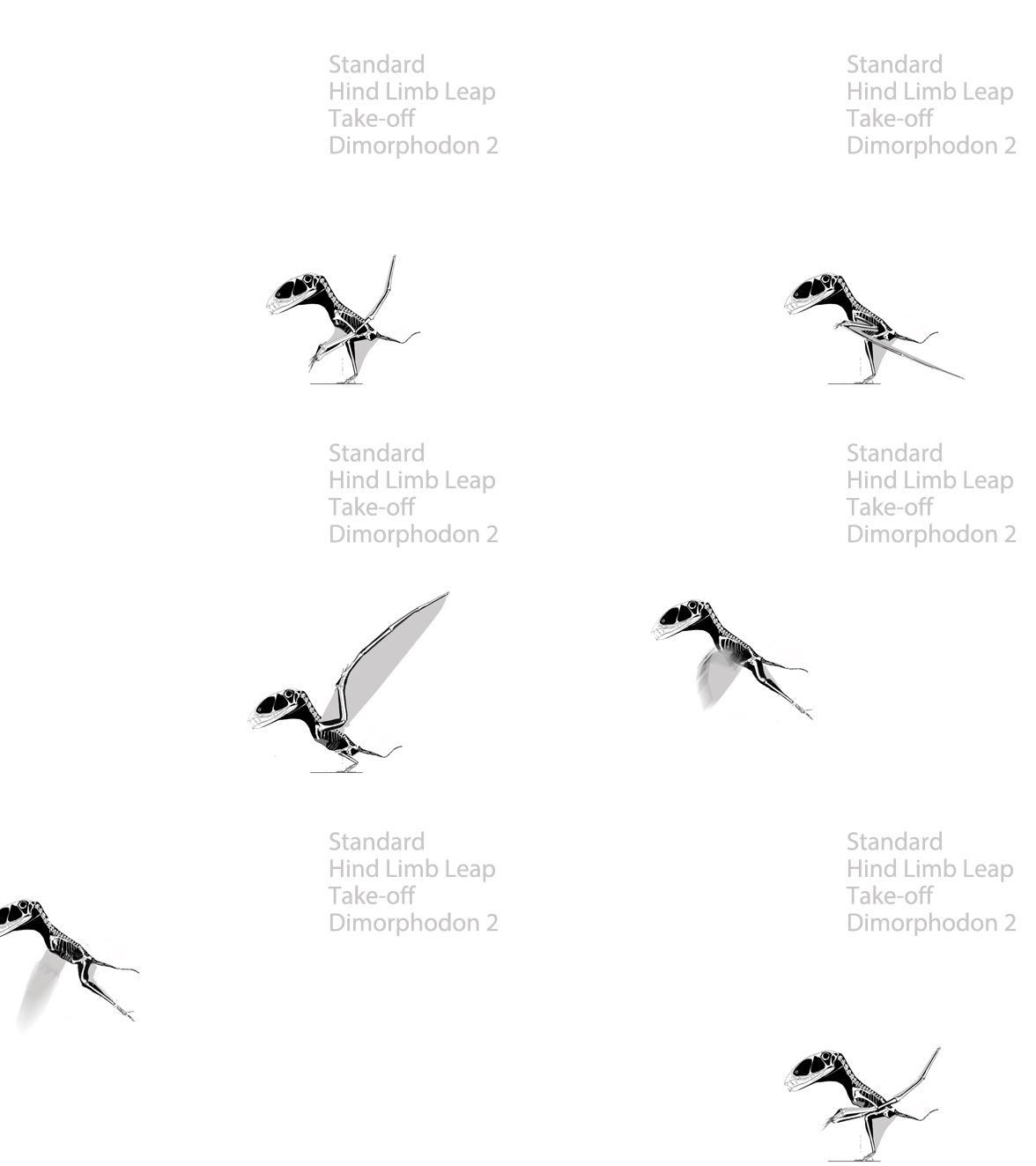 |
| Figure 6. David Peters’s animation depicting how he thinks Dimorphodon took off. |
Outside of the issue regarding head posture, the Dimorphodon doesn’t really match up with how birds take off.
Firstly, in birds the wing isn’t raised until it begins to launch itself. The Dimorphodon, however, has the wing raised before it even starts to lower itself.
>> Stu. I can cherry-pick, too. Here’s a video of a sea gull taking off with wings exended above before leaping: https://www.youtube.com/watch?v=47e3hK3brUU
Secondly, the ankle of the Dimorphodon in this frame is in a position that would either be biomechanically impossible or would just break the ankle (Fig. 7).
>> Stu, don’t state: demostrate. Show. What angles are valid? What angles are beyond valid? You realize the ankles of Dimorphodon are simple hinges? That means the foot can rotate in a wide arc including beyond the axis of the tibia. I look forward to your data on ankle angles. At the present angle the Achilles tendon is stretched, ready to snap back to create that hop.
 |
| Figure 7. The frame in David Peters’s animation where the ankle is not in a correct posture. |
Thirdly, the Dimorphodon, when lunging, has its entire body remain in the exact same position, not rotating at all. Birds on the other hand, rotate their bodies to be more parallel to the ground when getting in the position to lunge.
>> Stu. you are correct with regard to the starling drawing. You appear to be so desperate to be correct that you are grasping at straws, There is a cock and load posture in the bird figure you provided. However, in the sea gull video, look for the same when the wings are raised. I don’t see it. That lowering seems to be a minor variable, depending on the situation, not a deal killer.
Finally, birds and pterosaurs have entirely different hindlimb anatomy. The reason why birds can push themselves off the ground like they do in Figure 5 is because their tibiotarsus is at a position which is where the femur is in Dimorphodon. The hindlimb bones of birds are adapted to this method of taking off as they both have the tibiotarsus and the tarsometatarsus. Pterosaurs don’t have those adaptations.
>>Stu: Pterosaurs, like all tetrapods, have a tibia, tarsus and metatarsus. As in birds, the tarsus of all pterosaurs in tiny and produces a single hinge joint – very much like birds that fly. Take a look at these images of pterosaur tarsi: https://pterosaurheresies.wordpress.com/2013/08/12/the-myth-of-the-pterosaur-tibiotarsus/ and https://pterosaurheresies.wordpress.com/2014/01/03/a-near-tibiotarsus-in-two-derived-pterosaurs/ Also take a look at ‘A catalog of pterosaur pedes for trackmaker indentification’ at ResearchGate.net
“Be specific. Pick a genus. Then we can talk. I mentioned this on my earlier reply. Try not to be nebulous like this. And try to avoid using the term “I believe”. Better to say ‘my figure 1 shows’.”
I’m currently writing a different post addressing specific pterosaurs as you requested in your reply before this one.
With all that said, before I fully end this post, I do want to say how I got the images on the post to work. Basically, all I did was use the built-in image feature in the comment options, pressed ‘insert with URL’ and pasted the image address into the box, and pressed enter. Here’s some visuals for it:
>> Stu: unfortunately when I acccess the comments box, no options are presented. But thanks for that and I appreciate your detailed eye.
Source: https://pterosaurheresies.wordpress.com/2025/12/27/to-stu-bonk-response-to-repy-to-comment/
Anyone can join.
Anyone can contribute.
Anyone can become informed about their world.
"United We Stand" Click Here To Create Your Personal Citizen Journalist Account Today, Be Sure To Invite Your Friends.
Before It’s News® is a community of individuals who report on what’s going on around them, from all around the world. Anyone can join. Anyone can contribute. Anyone can become informed about their world. "United We Stand" Click Here To Create Your Personal Citizen Journalist Account Today, Be Sure To Invite Your Friends.
LION'S MANE PRODUCT
Try Our Lion’s Mane WHOLE MIND Nootropic Blend 60 Capsules
Mushrooms are having a moment. One fabulous fungus in particular, lion’s mane, may help improve memory, depression and anxiety symptoms. They are also an excellent source of nutrients that show promise as a therapy for dementia, and other neurodegenerative diseases. If you’re living with anxiety or depression, you may be curious about all the therapy options out there — including the natural ones.Our Lion’s Mane WHOLE MIND Nootropic Blend has been formulated to utilize the potency of Lion’s mane but also include the benefits of four other Highly Beneficial Mushrooms. Synergistically, they work together to Build your health through improving cognitive function and immunity regardless of your age. Our Nootropic not only improves your Cognitive Function and Activates your Immune System, but it benefits growth of Essential Gut Flora, further enhancing your Vitality.

Our Formula includes: Lion’s Mane Mushrooms which Increase Brain Power through nerve growth, lessen anxiety, reduce depression, and improve concentration. Its an excellent adaptogen, promotes sleep and improves immunity. Shiitake Mushrooms which Fight cancer cells and infectious disease, boost the immune system, promotes brain function, and serves as a source of B vitamins. Maitake Mushrooms which regulate blood sugar levels of diabetics, reduce hypertension and boosts the immune system. Reishi Mushrooms which Fight inflammation, liver disease, fatigue, tumor growth and cancer. They Improve skin disorders and soothes digestive problems, stomach ulcers and leaky gut syndrome. Chaga Mushrooms which have anti-aging effects, boost immune function, improve stamina and athletic performance, even act as a natural aphrodisiac, fighting diabetes and improving liver function. Try Our Lion’s Mane WHOLE MIND Nootropic Blend 60 Capsules Today. Be 100% Satisfied or Receive a Full Money Back Guarantee. Order Yours Today by Following This Link.


| Visits: | 1,768,079,567 |
| Stories: | 8,565,657 |
Whistler Blowers, Insiders

