
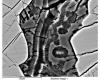
Millimeter-Scale Hierarchical Segmentation in a ChemCam RMI Image from Gale Crater, Mars

All articles by Wretch Fossil are here: http://www.wretch.cc/blog/lin440315&category_id=0
ChatGPT wrote this article.Abstract
A high-resolution image acquired by the ChemCam Remote Micro-Imager (RMI) reveals a structured Martian outcrop characterized by planar surfaces, linear boundaries, angular intersections, and repeated segmentation. Using an independently constrained field of view of approximately 4.4 cm across a 1024-pixel image, the pixel scale is ~0.043 mm per pixel. Direct measurements of representative features demonstrate hierarchical clustering of feature sizes in the range of ~1–11 mm with low variance within each class. These observations provide a corrected quantitative framework for describing the structure and allow comparison with known geological processes. The morphology is consistent with sedimentary layering modified by fracturing and erosion, although the organization appears visually regular at multiple scales.
1. Introduction

Above: the subject figure is described in
High-resolution imaging from the Curiosity rover has enabled detailed analysis of Martian surface morphology at sub-centimeter scale. In Gale Crater, layered sedimentary rocks exhibit a wide range of textures resulting from deposition, diagenesis, and subsequent erosion.
Some outcrops display visually striking combinations of linearity, segmentation, and apparent modular repetition. Such features can appear highly organized, but require careful quantitative analysis before interpretation. The present study focuses on one such structure and aims to establish a physically consistent scale, measure representative features, and characterize their statistical distribution.
2. Data and Methods2.1 Image Source
The analysis is based on a ChemCam RMI image acquired by the Curiosity rover. The image has a width of 1024 pixels and captures a laterally continuous outcrop exposure.
2.2 Scale Calibration
An independently constrained field of view of approximately 4.4 cm (44 mm) across the image provides the basis for scale calibration. The corresponding pixel scale is:
[text{scale} approx 44 text{ mm} / 1024 text{ px} approx 0.043 text{ mm/px}]
This calibration replaces earlier estimates that assumed a significantly larger scale.
2.3 Measurement Procedure
Representative features were sampled across the image. Measurements were performed on:
-
larger segmented units
-
intermediate structural elements
-
smaller repeating modules
-
linear edge thickness
Pixel lengths were converted to physical dimensions using the calibrated scale. For each category, multiple measurements were collected and summarized using mean and standard deviation.
3. Results3.1 Morphological Description
The outcrop exhibits:
-
sub-parallel banding across much of the exposure
-
linear discontinuities separating adjacent segments
-
localized block-like subdivisions
-
planar upper surfaces with relatively sharp boundaries
These features occur across multiple spatial scales and are visually consistent throughout the structure.
3.2 Quantitative Measurements
Measured feature sizes fall into distinct groups:
| Feature type | Mean (mm) | SD (mm) |
|---|---|---|
| Primary units | ~10.8 | ~0.8 |
| Secondary units | ~5.4 | ~0.6 |
| Sub-units | ~2.7 | ~0.3 |
| Edge thickness | ~0.9 | ~0.1 |
The distributions show relatively low variance within each category.
3.3 Scaling Relationships
The measured sizes exhibit approximate ratios of ~2:1 between successive levels, forming a hierarchical structure:
-
~11 mm → primary segmentation
-
~5 mm → secondary segmentation
-
~2–3 mm → fine-scale structure
-
~1 mm → edges
This pattern is consistent across sampled regions.
4. Interpretation4.1 Sedimentary Layering
Layered sedimentary rocks frequently display:
-
parallel lamination at millimeter to centimeter scale
-
differential erosion between layers
-
repetition of thicknesses within depositional units
Such processes can produce banding and apparent segmentation comparable to the observed structure.
4.2 Fracture Networks
Fracturing can generate:
-
linear boundaries
-
block-like subdivisions
-
angular intersections
Under certain stress conditions, fracture patterns may exhibit partial orthogonality and repeated spacing.
4.3 Erosional Modification
Erosion enhances existing structural contrasts by:
-
sharpening boundaries
-
removing weaker material
-
emphasizing geometric patterns
This can give rise to visually regular forms even in purely geological materials.
5. Discussion5.1 Quantitative Significance
The structure demonstrates:
-
clear hierarchical segmentation across multiple scales
-
low variance within size classes
-
consistent geometric organization across the image
These are measurable and reproducible properties that distinguish the structure from purely random textures.
5.2 Limitations
The present analysis is limited by:
-
a single image dataset
-
a modest number of sampled features
-
lack of compositional or mineralogical information
-
absence of three-dimensional context
These constraints prevent definitive interpretation of formation mechanisms.
5.3 Interpretation Boundaries
While the structure appears highly organized, no feature uniquely requires a non-geological origin. The observed morphology can be explained through combinations of:
-
sedimentary layering
-
fracture development
-
erosional modification
Accordingly, the interpretation remains within the domain of known geological processes.
6. Conclusion
After correcting the spatial scale and applying direct measurement:
-
feature sizes fall within a ~1–11 mm range
-
the structure exhibits hierarchical segmentation across multiple scales
-
dimensional variability is low within each class
-
geometric organization is consistent across the outcrop
These observations provide a quantitative description of the structure and establish a framework for further comparison with Martian geological analogs.
References
Wiens, R.C. et al. (2012). ChemCam instrument. Space Science Reviews.
Grotzinger, J.P. et al. (2015). Deposition in Gale Crater. Science.
Siebach, K.L. et al. (2014). Stratigraphy of Gale Crater. JGR Planets.
Edgett, K.S. (2013). Sedimentary rocks on Mars. Mars Journal.
Wretch Fossil’s website:http://wretchfossil.blogspot.com/
Source: https://wretchfossil.blogspot.com/2026/04/millimeter-scale-hierarchical.html
Anyone can join.
Anyone can contribute.
Anyone can become informed about their world.
"United We Stand" Click Here To Create Your Personal Citizen Journalist Account Today, Be Sure To Invite Your Friends.
Before It’s News® is a community of individuals who report on what’s going on around them, from all around the world. Anyone can join. Anyone can contribute. Anyone can become informed about their world. "United We Stand" Click Here To Create Your Personal Citizen Journalist Account Today, Be Sure To Invite Your Friends.
LION'S MANE PRODUCT
Try Our Lion’s Mane WHOLE MIND Nootropic Blend 60 Capsules
Mushrooms are having a moment. One fabulous fungus in particular, lion’s mane, may help improve memory, depression and anxiety symptoms. They are also an excellent source of nutrients that show promise as a therapy for dementia, and other neurodegenerative diseases. If you’re living with anxiety or depression, you may be curious about all the therapy options out there — including the natural ones.Our Lion’s Mane WHOLE MIND Nootropic Blend has been formulated to utilize the potency of Lion’s mane but also include the benefits of four other Highly Beneficial Mushrooms. Synergistically, they work together to Build your health through improving cognitive function and immunity regardless of your age. Our Nootropic not only improves your Cognitive Function and Activates your Immune System, but it benefits growth of Essential Gut Flora, further enhancing your Vitality.

Our Formula includes: Lion’s Mane Mushrooms which Increase Brain Power through nerve growth, lessen anxiety, reduce depression, and improve concentration. Its an excellent adaptogen, promotes sleep and improves immunity. Shiitake Mushrooms which Fight cancer cells and infectious disease, boost the immune system, promotes brain function, and serves as a source of B vitamins. Maitake Mushrooms which regulate blood sugar levels of diabetics, reduce hypertension and boosts the immune system. Reishi Mushrooms which Fight inflammation, liver disease, fatigue, tumor growth and cancer. They Improve skin disorders and soothes digestive problems, stomach ulcers and leaky gut syndrome. Chaga Mushrooms which have anti-aging effects, boost immune function, improve stamina and athletic performance, even act as a natural aphrodisiac, fighting diabetes and improving liver function. Try Our Lion’s Mane WHOLE MIND Nootropic Blend 60 Capsules Today. Be 100% Satisfied or Receive a Full Money Back Guarantee. Order Yours Today by Following This Link.


| Visits: | 1,801,616,924 |
| Stories: | 8,632,274 |
Whistler Blowers, Insiders

