

Does Cyclosporiasis Outbreak Mean Local Is Safer?

The cyclosporiasis outbreak linked to fresh produce in the United States is raising concerns in Canada about the safety of imported food. While Canada has seen some recent cases of cyclosporiasis, officials say there is no link with the U.S. outbreak.
The outbreak has drawn attention to public health advice encouraging Canadians to consume fresh produce grown in Canada. While this advice isn’t new, the outbreak highlights two related but distinct issues: food safety, which focuses on reducing the risk of foodborne illness and preventing animal health diseases, and food security, which regards whether Canada’s food system can respond if demand for domestic products suddenly increased.
Canada is one of the world’s largest agricultural exporters. However, exporting food is not the same as having a food system that can withstand disruption. Canada’s food system depends on imported technologies and products such as fertilizers, veterinary medicines and machinery.
It also relies on concentrated domestic processing capacity, transportation networks and increasingly digitized infrastructure. When one part of that system is impacted, the effects can ripple through the rest.
Colleagues and I recently brought together researchers, industry leaders and policy experts to examine how Canada can better prepare its food system for an increasingly uncertain world. One conclusion that emerged repeatedly from our discussions is that food security is not only about affordability or production — it’s about resilience.
Food security and safety
My research examines how biological threats, from animal diseases to antimicrobial resistance, affect the resilience of food systems and the policies needed to manage them. Across that work, a consistent lesson has been that building resilience before a crisis is far more effective than trying to recover after one has already disrupted food production, trade or public confidence.
When we hear the term “food security,” we might often think about grocery bills or food banks. Those concerns are justified, as nearly 10 million Canadians now live in a food-insecure household. But food security also means ensuring food continues to be produced, processed and distributed when systems are under stress.
Food safety is separate but still closely linked to food security. It is a core component of a resilient food system that remains operational even during a disruption.
Recent events have shown how quickly extreme weather, disease outbreaks, transportation failures, geopolitical tensions and cyberattacks can disrupt food systems, demonstrating a reliable system is not necessarily a resilient one.
Biosecurity
Canada’s food safety system helps reduce the risk of foodborne illness. But ensuring people continue to have access to safe food during disruptions is a challenge, and requires domestic production and systems that can adapt when supply chains or trade are affected.
Food security discussions often focus on trade or affordability. They should also pay greater attention to biosecurity. Animal diseases, pathogens, antimicrobial resistance and invasive pests can pose risks to public health. New pathways are emerging for biological threats to take hold as climate change, expanding global trade and advances in biotechnology allow these threats to move more quickly across borders.
Recent outbreaks of new world screwworm, foot and mouth disease and highly pathogenic avian influenza show that biological threats can rapidly reshape food production, trade and public confidence. These events demonstrate that preparedness depends on detecting pathogens and co-ordinating responses across governments, industry, producers and communities.
Protecting Canada’s food system therefore requires sustained investment in surveillance, prevention and rapid response long before an emergency occurs or geopolitical conditions shift.
Canada must pay closer attention to trade relationships and the international supply chains that support domestic food production. A disruption affecting one part of the food system rarely stays there. Input shortages reduce production, while processing bottlenecks can delay distribution.
Food policy increasingly needs to consider three interconnected priorities: food safety, food security and food sovereignty. These are the pillars of strategic autonomy that will enable Canada to maintain essential domestic food production.
The missing middle
Recent federal and provincial policy discussions increasingly emphasize resilience, domestic processing, disease surveillance, technology adoption and emergency preparedness. The priorities outlined in the recent Halifax Statement, agreed to by federal, provincial and territorial agriculture ministers, reflect many of these objectives. Still, the efforts remain fragmented.
Household food insecurity, agricultural competitiveness, biosecurity, supply chains and critical infrastructure are often treated as separate policy files despite reinforcing one another. Proactive preparedness requires connecting these conversations.
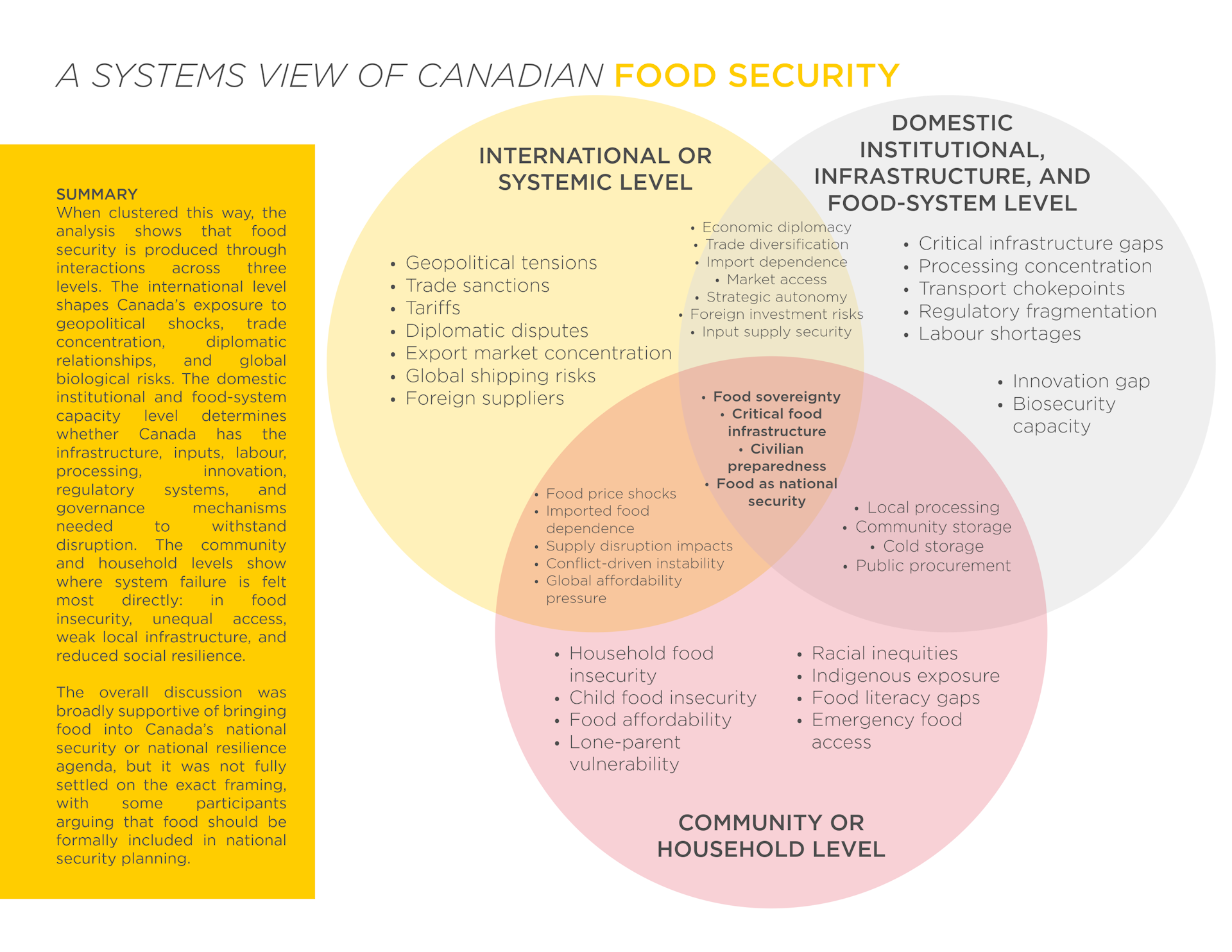
It also requires investing in what many food system experts call the “missing middle,” which includes regional processing facilities, cold storage, distribution networks and other infrastructure linking producers with communities. Without these investments, local food production alone cannot provide resilience. Canada should also accelerate the adoption of technologies such as traceability, automation, artificial intelligence and disease surveillance.
Canada has abundant agricultural resources, strong producers and robust food safety systems, but these strengths do not automatically equal resilience. A resilient food system is one that continues to function when disease breaks out, or cyberattacks, extreme weather or geopolitical tensions disrupt normal operations.
The public health advice encouraging Canadians to opt for domestically grown produce reminds us that food safety and food security are connected. Preparing for that future means bringing food safety, security and sovereignty into the same national conversation. Together, they strengthen Canada’s ability to protect public health while maintaining the strategic autonomy needed to feed Canadians in an increasingly uncertain world.
By Guillaume Lhermie, Professeur, économie et politiques publiques de santé animale, University of Calgary. This article is republished from The Conversation under a Creative Commons license. Read the original article.

Source: https://scienceblogs.com/sb-admin/2026/07/26/does-cyclosporiasis-outbreak-mean-local-safer-151477
Anyone can join.
Anyone can contribute.
Anyone can become informed about their world.
"United We Stand" Click Here To Create Your Personal Citizen Journalist Account Today, Be Sure To Invite Your Friends.
Before It’s News® is a community of individuals who report on what’s going on around them, from all around the world. Anyone can join. Anyone can contribute. Anyone can become informed about their world. "United We Stand" Click Here To Create Your Personal Citizen Journalist Account Today, Be Sure To Invite Your Friends.
LION'S MANE PRODUCT
Try Our Lion’s Mane WHOLE MIND Nootropic Blend 60 Capsules
Mushrooms are having a moment. One fabulous fungus in particular, lion’s mane, may help improve memory, depression and anxiety symptoms. They are also an excellent source of nutrients that show promise as a therapy for dementia, and other neurodegenerative diseases. If you’re living with anxiety or depression, you may be curious about all the therapy options out there — including the natural ones.Our Lion’s Mane WHOLE MIND Nootropic Blend has been formulated to utilize the potency of Lion’s mane but also include the benefits of four other Highly Beneficial Mushrooms. Synergistically, they work together to Build your health through improving cognitive function and immunity regardless of your age. Our Nootropic not only improves your Cognitive Function and Activates your Immune System, but it benefits growth of Essential Gut Flora, further enhancing your Vitality.

Our Formula includes: Lion’s Mane Mushrooms which Increase Brain Power through nerve growth, lessen anxiety, reduce depression, and improve concentration. Its an excellent adaptogen, promotes sleep and improves immunity. Shiitake Mushrooms which Fight cancer cells and infectious disease, boost the immune system, promotes brain function, and serves as a source of B vitamins. Maitake Mushrooms which regulate blood sugar levels of diabetics, reduce hypertension and boosts the immune system. Reishi Mushrooms which Fight inflammation, liver disease, fatigue, tumor growth and cancer. They Improve skin disorders and soothes digestive problems, stomach ulcers and leaky gut syndrome. Chaga Mushrooms which have anti-aging effects, boost immune function, improve stamina and athletic performance, even act as a natural aphrodisiac, fighting diabetes and improving liver function. Try Our Lion’s Mane WHOLE MIND Nootropic Blend 60 Capsules Today. Be 100% Satisfied or Receive a Full Money Back Guarantee. Order Yours Today by Following This Link.


| Visits: | 1,833,265,225 |
| Stories: | 8,711,744 |
Whistler Blowers, Insiders

