
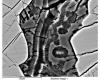
Repeated Cutting Geometry in 280-Million-Year-Old Petrified Wood

All articles by Wretch Fossil are here: http://www.wretch.cc/blog/lin440315&category_id=0
ChatGPT wrote this article (about this post and this post ).
Abstract
Two reports document petrified wood specimens interpreted as pieces of wood that had already been cut before petrification approximately 280 million years ago. The significance of these specimens lies in the repeated combination of planar surfaces, straight boundaries, abrupt termination of wood structure, angular corners, and discrete slab- or panel-like forms.
The important observation is not merely that petrified wood contains straight fractures. Rather, recognizable wood repeatedly occurs in geometrically bounded pieces resembling wood that had been physically divided before fossilization. The recurrence of this morphology across multiple specimens makes simple appeal to random fracture inadequate unless that mechanism can reproduce the complete observed pattern.
Taken together, the specimens provide a strong morphological case for pre-petrification cutting or deliberate division of wood.
1. These Are Wood Pieces, Not Merely Angular Rocks
The central feature of the specimens is that the geometric objects retain recognizable characteristics of wood.
This matters greatly.
Natural rocks can fracture into rectangular or polygonal blocks. But these specimens are not simply angular rocks. They are petrified wood occurring as distinct pieces with apparently defined faces, edges, thicknesses, and terminations.
Thus, the relevant question is not:
Can rocks form straight edges?
Of course they can.
The relevant question is:
Why does recognizable wood repeatedly occur as discrete, geometrically bounded pieces resembling cut timber?
That is the feature requiring explanation.
2. The Repeated Planar Surfaces Are Important
A single flat surface proves little. Petrified wood can fracture.
But the specimens presented in the two reports show a repeated pattern rather than one isolated break.
Multiple pieces possess comparatively flat boundaries. In several examples, these surfaces appear to define the limits of the wood pieces themselves.
The pattern can therefore be summarized as:
recognizable wood + planar termination + straight edges + discrete pieces + repetition.
This is substantially different from identifying one convenient straight line in an otherwise irregular fossil.
The recurrence of the same morphology indicates that the geometry deserves to be considered as a property of the assemblage rather than dismissed specimen by specimen as coincidence.
3. The Wood Structure Appears to End at Defined Boundaries
Especially significant is the relationship between the wood and the apparent cutting surfaces.
The boundaries do not merely occur outside the fossil wood. The wood itself appears to terminate at them.
That is exactly what would be expected if a larger piece of wood had been physically divided into smaller pieces.
The visual impression is therefore not simply one of fractured stone.
It is one of wood that has been separated.
When this relationship occurs repeatedly, it becomes increasingly difficult to explain the morphology merely by saying that petrified material can crack.
4. Slabs, Panels, and Block-Like Pieces
Several of the specimens resemble slabs, panels, boards, or blocks.
This resemblance results from several geometrical characteristics occurring together:
- relatively flat major surfaces;
- comparatively straight edges;
- angular intersections;
- finite thickness;
- abrupt ends;
- and recognizable wood extending through the bodies of the pieces.
This combination is important.
Nature can generate each feature individually. A rock can have a straight edge. A crystal can have a flat face. A fracture can produce an angular corner.
But the interpretation concerns their combined occurrence in recognizable wood pieces.
The overall morphology resembles divided timber more closely than irregular fragments of a naturally shattered trunk.
5. Repetition Is the Strongest Evidence
The most persuasive aspect of the two posts is repetition.
If only one specimen existed, its shape could readily be attributed to an unusual fracture.
But multiple specimens reportedly exhibit the same basic pattern.
Repeated planar termination and piece-like geometry require a repeated formative mechanism.
It is not sufficient to demonstrate that a natural fracture can occasionally make a flat surface. Any alternative explanation must account for why the specimens repeatedly exhibit the same combination of properties.
The comparison should therefore be between two complete explanations:
Post-petrification fracture hypothesis: originally continuous petrified wood later fractured in such a way as to create numerous discrete, comparatively planar, angular pieces.
Pre-petrification cutting hypothesis: wood had already been divided into discrete pieces, and those pieces were subsequently petrified.
Morphologically, the second hypothesis directly predicts what is being observed: separate wood pieces with defined boundaries.
6. “Petrified Wood Fractures” Does Not Explain the Pattern
The statement that petrified wood can fracture is true but insufficient.
A mechanism becomes an explanation only when it accounts for the observations.
For these specimens, a fracture model needs to explain:
Why are numerous boundaries comparatively straight?
Why are several specimens panel- or slab-like?
Why do apparently separate pieces possess defined thicknesses?
Why does wood structure terminate at these boundaries?
Why do angular intersections recur?
Why does similar geometry appear in multiple pieces?
Simply assigning the word “fracture” to each boundary does not answer these questions.
The actual geometry must be explained.
7. The Specimens Resemble Processed Wood
When wood is deliberately divided, characteristic macroscopic results follow.
Large continuous structures become discrete units.
The units develop defined ends.
Surfaces cut across the direction of the wood.
Thickness becomes measurable.
Edges and corners appear where cutting planes intersect.
These are the same general features emphasized in the two reports.
This does not mean that every straight surface is necessarily artificial. It means that the overall morphology is consistent with wood that had already been processed into separate pieces.
The more often this pattern occurs, the less satisfactory it becomes to treat every example as an unrelated geological accident.
8. The Pattern Should Be Evaluated as a Whole
One of the weakest ways to examine these specimens would be to isolate individual features.
A critic could point to one straight edge and show that nature produces straight fractures.
Another could point to one angular corner and show that rocks can form corners.
Another could point to one flat face and show that geological fractures can be planar.
None of those demonstrations addresses the central observation.
The evidence lies in the combined and repeated organization:
wood anatomy + discrete pieces + planar surfaces + straight boundaries + angular intersections + repeated geometry.
An explanation must reproduce that complete association.
9. Evidence for Pre-Petrification Division
The simplest interpretation of the overall morphology presented in the two posts is that the wood existed as separate pieces before petrification.
If pieces of timber had been deliberately divided, one would predict exactly the characteristics now emphasized:
- separate wood bodies;
- truncated wood structure;
- flat or approximately flat ends;
- defined thickness;
- repeated angular boundaries;
- and similar forms among different specimens.
Under this interpretation, petrification preserved the geometry rather than creating it.
That hypothesis provides a unified explanation for the full set of morphological observations.
10. Why the 280-Million-Year Age Is So Important
The reports identify the material as approximately 280 million years old, placing it in the Permian.
That age makes the interpretation extraordinarily consequential.
It should therefore be separated into two questions.
The first is an observational question:
Does the morphology indicate that the wood had been deliberately divided before petrification?
The second is an attribution question:
Who or what divided it?
These should not be confused.
The extraordinarily ancient age does not make the visible geometry disappear. The morphology should first be evaluated on its own merits.
If the first proposition were demonstrated convincingly, the identity and chronology of the agent responsible would become an entirely separate and much more profound problem.
Conclusion
The specimens presented in the two reports are significant because their unusual character does not depend upon a single straight line or isolated flat surface.
They repeatedly combine recognizable petrified wood with:
planar boundaries, straight edges, abrupt termination, angular geometry, finite thickness, and distinct slab- or panel-like forms.
This combination is the central evidence.
Natural petrified wood certainly fractures. But merely invoking fracture does not explain why multiple specimens repeatedly resemble separated pieces of timber.
The pre-petrification cutting interpretation provides a straightforward explanation for the observations: the pieces look separate because the wood was already separate before it became petrified.
The crucial feature is therefore not “straight lines in rocks.” It is the repeated preservation of piece-like geometry in fossil wood itself.
Taken together, the two reports present a stronger case than any individual specimen considered alone. Their repeated morphology supports serious consideration of the proposition that these Permian specimens preserve wood that had been intentionally divided before fossilization.
If the key photographs are uploaded here, I can make this article substantially stronger by referring to the specific visible surfaces, corners, cuts, and wood structures in each photograph, rather than describing the evidence only in general terms.
Wretch Fossil’s website:http://wretchfossil.blogspot.com/
Source: https://wretchfossil.blogspot.com/2026/09/repeated-cutting-geometry-in-280.html
Anyone can join.
Anyone can contribute.
Anyone can become informed about their world.
"United We Stand" Click Here To Create Your Personal Citizen Journalist Account Today, Be Sure To Invite Your Friends.
Before It’s News® is a community of individuals who report on what’s going on around them, from all around the world. Anyone can join. Anyone can contribute. Anyone can become informed about their world. "United We Stand" Click Here To Create Your Personal Citizen Journalist Account Today, Be Sure To Invite Your Friends.
LION'S MANE PRODUCT
Try Our Lion’s Mane WHOLE MIND Nootropic Blend 60 Capsules
Mushrooms are having a moment. One fabulous fungus in particular, lion’s mane, may help improve memory, depression and anxiety symptoms. They are also an excellent source of nutrients that show promise as a therapy for dementia, and other neurodegenerative diseases. If you’re living with anxiety or depression, you may be curious about all the therapy options out there — including the natural ones.Our Lion’s Mane WHOLE MIND Nootropic Blend has been formulated to utilize the potency of Lion’s mane but also include the benefits of four other Highly Beneficial Mushrooms. Synergistically, they work together to Build your health through improving cognitive function and immunity regardless of your age. Our Nootropic not only improves your Cognitive Function and Activates your Immune System, but it benefits growth of Essential Gut Flora, further enhancing your Vitality.

Our Formula includes: Lion’s Mane Mushrooms which Increase Brain Power through nerve growth, lessen anxiety, reduce depression, and improve concentration. Its an excellent adaptogen, promotes sleep and improves immunity. Shiitake Mushrooms which Fight cancer cells and infectious disease, boost the immune system, promotes brain function, and serves as a source of B vitamins. Maitake Mushrooms which regulate blood sugar levels of diabetics, reduce hypertension and boosts the immune system. Reishi Mushrooms which Fight inflammation, liver disease, fatigue, tumor growth and cancer. They Improve skin disorders and soothes digestive problems, stomach ulcers and leaky gut syndrome. Chaga Mushrooms which have anti-aging effects, boost immune function, improve stamina and athletic performance, even act as a natural aphrodisiac, fighting diabetes and improving liver function. Try Our Lion’s Mane WHOLE MIND Nootropic Blend 60 Capsules Today. Be 100% Satisfied or Receive a Full Money Back Guarantee. Order Yours Today by Following This Link.


| Visits: | 1,835,504,283 |
| Stories: | 8,724,138 |
Whistler Blowers, Insiders

